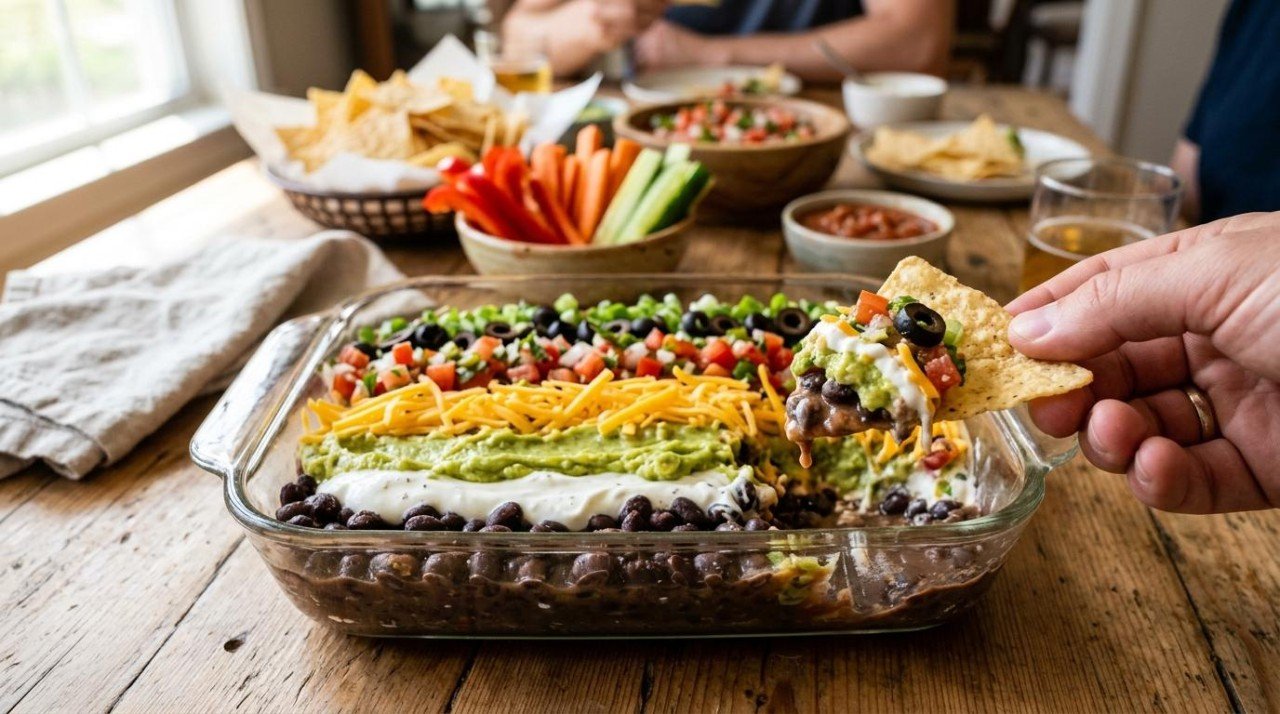
Seven-layer dip is one of the few foods that is genuinely better at a party than it is anywhere else. It arrives in a glass dish so you can see the stripes, it sits on the table for three hours, and it disappears. Nobody has ever taken it home.
It is younger than it feels. The recipe that made it famous ran in Family Circle on February 3, 1981 as "Tex-Mex Dip" - no layers in the name at all - contributed by Jo Anne Vachule, then food editor at the Fort Worth Star-Telegram. The food-history newsletter Snack Stack has traced versions back further, to a five-layer dip in a California newspaper in 1978, but the early 1980s is when it became the thing you bring.
We scored a standard version against production nutrition data using Eat Well Planner's Nutrition Score. It came out at 46 out of 100. Then we rebuilt it one layer at a time and scored every change. The finished version scores 76 - thirty points higher, still seven layers, still the same dish on the table.
The original: what is in it and how it scores
Here is the version we scored, built for eight people the way most recipes have it: a 16-ounce can of traditional refried beans, 16 ounces of sour cream mixed with a 1-ounce packet of taco seasoning, guacamole from two large avocados, 8 ounces of shredded cheddar, two diced tomatoes, a small can of sliced black olives, three scallions, and 12 ounces of tortilla chips to eat it with.
Per serving that is about 565 calories, 15.3 g protein, 7.8 g fiber, 36 g total fat, 14.1 g saturated fat, and 1,010 mg sodium. The score flags two cautions: saturated fat at 60% of a day's worth (very high) and sodium at 44% (high). Its named weaknesses are high saturated fat, low vitamin D, and low omega-3.
What is already good is worth saying out loud, because most "healthy dip" articles skip it. At 7.8 g per serving, the original already clears the bar for an excellent source of fiber - 26% of a day's worth. Put that next to the fact that average US intake runs about 16.2 g a day against recommendations of 19 to 38 g, with roughly 5% of people hitting the target, and a scoop of party dip is doing better than most dinners. It is also an excellent source of phosphorus (52% DV), calcium (34%), biotin (34%), iron (32%), vitamin A (27%), vitamin K (27%), and riboflavin (27%). Beans and avocados do a lot of quiet work in this recipe.
The interesting part is where the problems actually sit, because it is not where the internet says. The usual accusation against seven-layer dip is the lard in the refried beans. We checked the labels: Rosarita's traditional beans do still list lard, but at 1 g of saturated fat per half-cup serving, and Old El Paso has moved to soybean oil at 0 g. The lard is a rounding error. What the bean layer really brings is sodium: 440 to 470 mg per half cup, or roughly 1,800 mg in a 16-ounce can.
The saturated fat is coming almost entirely from the two dairy layers - a pint of sour cream and half a pound of cheese. And the sodium has four separate sources stacked on top of each other: the beans, the cheese, the chips, and a taco seasoning packet carrying 280 mg of sodium per 2-teaspoon serving, the entire packet of which gets stirred into the sour cream. The American Heart Association puts the daily ceiling at 2,300 mg. One scoop of dip is close to half of it.
The upgrades, in order of what they are worth
Each swap below was applied on top of the one before it and rescored, so the deltas are cumulative and in this exact order. If you only make one change, make the first one.
1. Sour cream to plain Greek yogurt
- Swap: 16 oz sour cream → 16 oz plain Greek yogurt
- Score impact: +7 points (46 → 53)
- What it changes: Saturated fat 14.1 g → 8.4 g per serving (60% DV to 36%, dropping out of the very high band); protein 15.3 g → 19.4 g; 73 calories off each serving
- What it costs you: A sharper tang than sour cream. In a dip carrying cumin, lime, and chili, almost nobody notices
This is the cheapest thirty seconds in the whole recipe. Greek yogurt is thicker than sour cream, which is actually an advantage here - the layer holds its edge instead of sliding, and it gives the guacamole above it something solid to sit on. There is no heat anywhere in this recipe, so the usual worry about yogurt splitting does not apply. If you want the full comparison, we have guides to sour cream substitutes and Greek yogurt substitutes.
Hold on to this number, because we come back to it: seven points, applied first.
2. Half the chips become a plate of vegetables
- Swap: 12 oz tortilla chips → 6 oz chips plus a large red bell pepper, half an English cucumber, and two carrots, cut into scoops and sticks
- Score impact: +4 points (53 → 57)
- What it changes: 87 calories off each serving; vitamin C from 12% DV to 43% (an excellent source); plant variety from 5.25 different plants to 8.25
- What it costs you: Nothing on the plate itself - the dip is untouched. You just have to actually cut the vegetables
The eighth layer nobody counts is the chips, and it is a real layer: 12 ounces of them is more weight than the cheese and olives put together. Halving them and putting out a board of bell pepper strips, cucumber rounds, and carrot sticks alongside is the only change on this list that does not touch the recipe at all.
It also buys plant variety, which matters on its own. The American Gut Project found that the number of different plant types someone ate tracked with their gut microbiome better than any diet label did, with people eating more than 30 a week differing measurably from those eating ten or fewer. Three extra vegetables on a party table is a genuinely easy way to move that number, and it is exactly what Plant Points tracks in the app.
3. Canned refried beans to a mashed black bean layer
- Swap: One 16 oz can traditional refried beans → two 15 oz cans no-salt-added black beans, drained and mashed with lime, olive oil, and spices
- Score impact: +5 points (57 → 62)
- What it changes: Fiber 7.3 g → 10.3 g per serving; folate to 36% DV; sodium 940 mg → 860 mg; protein 18.3 g → 20.6 g
- What it costs you: Five minutes with a fork, and a chunkier, less uniformly smooth base layer
Mash about three quarters of the beans and leave the rest whole - you want a spreadable layer with some texture, not a puree. A tablespoon of olive oil replaces what the lard was doing for mouthfeel, and lime juice plus the spice blend does what the salt was doing for flavor. Rinse the beans properly even if you can find no-salt-added cans: North Dakota State University Extension cites research finding that draining alone cuts a can's sodium by 36%, and draining plus rinsing cuts it by 41%.
Watch the calories on this one: they went up, from 405 to 483 per serving, because the bean layer got bigger. The score still rose five points. It is measuring nutrient density against what a portion costs you, not counting calories - which is why a pot of beans can add calories and still improve a dish. Beans earn it: Harvard's review of the evidence links eating legumes four or more times a week with a 22% lower risk of heart disease.
4. Eight ounces of cheese to four ounces of sharp cheddar
- Swap: 8 oz shredded mild cheddar → 4 oz sharp cheddar, grated from a block
- Score impact: +7 points (62 → 69)
- What it changes: Saturated fat 8.3 g → 5.6 g per serving (36% DV to 24%); sodium 860 mg → 770 mg; 58 calories off each serving
- What it costs you: A thinner cheese layer. Sharp cheddar tastes like more cheese than mild does, which covers most of the gap
This is the swap that proves order matters. Tested on its own against the untouched original, halving the cheese was worth exactly one point. Applied here, after the sour cream and the beans had already come down, it is worth seven. When a caution flag is buried deep in the very high band, small improvements have nowhere to go; once the number is close to the threshold, the same change moves the needle.
Use the sharpest cheddar you like and grate it yourself. Sharpness is concentration of flavor, and it is the whole reason four ounces reads as a cheese layer instead of a dusting. Our cheddar substitutes guide covers what else works if you want to go a different direction.
5. The taco packet to a homemade spice blend
- Swap: 1 oz taco seasoning packet → 1 tbsp chili powder, 1 tbsp cumin, 2 tsp smoked paprika, 2 tsp dried oregano, 1 tsp garlic powder, 1 tsp onion powder, 1/2 tsp salt
- Score impact: +4 points (69 → 73)
- What it changes: Sodium 770 mg → 680 mg per serving; added sugar to zero; plant variety 8.25 → 9.5
- What it costs you: Two minutes and six jars. The flavor is better, not worse - smoked paprika does something a packet cannot
A seasoning packet is mostly cornstarch, maltodextrin, and salt, with the actual spices further down the list. Mixing your own means you decide how much salt goes in, and half a teaspoon across a dish that serves eight is plenty when there is lime, garlic, and cumin doing the work. Split the blend: about two thirds into the beans, the rest whisked into the yogurt layer.
Sodium is only half the equation, too. Harvard's nutrition team points out that Americans average about 3,300 mg of sodium against only 2,900 mg of potassium, and that the people with the worst sodium-to-potassium ratio had double the risk of dying of a heart attack. Avocados, beans, and tomatoes are all potassium; this makeover improves both sides of that ratio at once.
6. A bigger guacamole layer and real pico
- Swap: Two avocados and two diced tomatoes → three large avocados, plus a proper pico de gallo of tomato, red onion, cilantro, jalapeno, and lime
- Score impact: +3 points (73 → 76)
- What it changes: Fiber 10.7 g → 12.4 g per serving (42% DV); vitamin C 40% → 50% DV; potassium 22% → 26%; plant variety 9.5 → 11.75
- What it costs you: The price of a third avocado, and about four minutes of dicing
Guacamole was the layer we most wanted to make bigger, because avocado fat is the kind the score rewards, and because it is the layer people fight over anyway. Turning the plain diced tomato into an actual pico de gallo is close to free - onion, cilantro, and jalapeno weigh almost nothing and each one counts as another plant.
One technique note: salt the diced tomatoes, let them sit five minutes, and drain them before they go on. Watery pico is the single most common reason a layered dip turns into soup by hour two. And because the guacamole sits buried under the cheese, it barely browns - the layers are protecting it from the air, which is the whole reason this dish holds on a table for three hours.
Take the Guesswork Out of Eating Well
Eat Well Planner helps you organize your favorite recipes, plan balanced meals, and automatically generate shopping lists — all in one place. Whether you're tracking macros, managing dietary restrictions, or just trying to stop asking "what's for dinner?", we've got you covered.
Our AI-powered tools can adapt any recipe to your dietary needs, help you discover new meals you'll love, and even log your nutrition effortlessly. It's meal planning made simple.
Start Organizing Your Meals — FreeWhat we kept, on purpose
Real cheddar, real avocado, real chips, and the olives. All four had a version of themselves that scored higher, and we took none of them.
Dropping the black olives entirely scores 79, three points up, mostly on sodium. But olives are layer six of seven. A six-layer dip is a different dish, and one small can spread over eight people is not what is wrong here.
Dropping the cheese entirely scores 88 - a twelve-point jump, the largest single move available anywhere on this page, and the moment the last saturated fat caution disappears. We are not doing it, and we would not recommend it. That is where the makeover stops: the point past which you have built a nice bean and avocado salad and told people it was seven-layer dip.
The line runs in the other direction too. Going back up to 6 ounces of cheese instead of 4 drops the score to 72 and puts saturated fat back at the top of the weakness list. Four ounces is where the cheese layer and the score stop arguing.
The healthier version: 76 out of 100
Serves 8. About 25 minutes, no cooking. Use a glass dish so the layers show - an 8x8-inch dish or a deep 9-inch pie plate.
- 2 cans (15 oz each) no-salt-added black beans, drained and rinsed (about 3 cups)
- 1 tablespoon olive oil
- 1 tablespoon chili powder
- 1 tablespoon ground cumin
- 2 teaspoons smoked paprika
- 2 teaspoons dried oregano
- 1 teaspoon garlic powder
- 1 teaspoon onion powder
- 1/2 teaspoon fine salt, divided
- 3 tablespoons lime juice (about 2 limes), divided
- 2 cups (16 oz) plain Greek yogurt
- 3 large ripe avocados (about 1 lb of flesh)
- 3 medium roma tomatoes, diced small (about 8 oz)
- 1/3 cup finely diced red onion
- 1/3 cup packed fresh cilantro, chopped
- 1 small jalapeno, seeded and minced
- 4 oz sharp cheddar, grated from a block (about 1 cup)
- 1 can (2.25 oz) sliced black olives, drained
- 4 scallions, thinly sliced
- 6 oz sturdy tortilla chips
- 1 large red bell pepper, cut into strips
- 1/2 English cucumber, cut into thick rounds
- 2 medium carrots, cut into sticks
- Stir the chili powder, cumin, smoked paprika, oregano, garlic powder, and onion powder together in a small bowl. This is your seasoning blend.
- Make the pico first so it can drain: combine the tomatoes, red onion, cilantro, jalapeno, 1 tablespoon of the lime juice, and 1/4 teaspoon of the salt in a bowl. Set it aside and stir once or twice while you work.
- Tip the beans into a bowl with the olive oil, 1 tablespoon of the lime juice, the remaining 1/4 teaspoon salt, and about two thirds of the seasoning blend. Mash with a fork or potato masher until roughly three quarters of the beans have broken down and the mixture is spreadable but still has some whole beans in it.
- Spread the beans into the bottom of the dish in an even layer, pushing them right to the edges.
- Whisk the Greek yogurt with the remaining seasoning blend and spread it over the beans, all the way to the sides so it seals the layer underneath.
- Mash the avocados with the last 1 tablespoon of lime juice, leaving it chunky, and spread it over the yogurt.
- Scatter the grated cheddar evenly over the guacamole. This layer is what keeps the avocado from browning, so cover it completely.
- Drain off any liquid the pico has released and spoon it over the cheese. Finish with the olives and scallions.
- Serve straight away, or cover and refrigerate up to 8 hours. Put the chips out with the bell pepper, cucumber, and carrots alongside.
Per serving, original versus improved:
- Nutrition Score: 46 → 76
- Calories: 565 → 461
- Saturated fat: 14.1 g (60% DV, very high) → 6.1 g (26% DV)
- Sodium: 1,010 mg (44% DV) → 680 mg (30% DV)
- Fiber: 7.8 g (26% DV) → 12.4 g (42% DV)
- Protein: 15.3 g → 18.4 g
- Vitamin C: 13% DV → 50% DV
- Folate: 14% DV → 41% DV
- Potassium: 19% DV → 26% DV
- Different plants: 5.25 → 11.75
The improved version lands as an excellent source of vitamin C, iron, vitamin K, fiber, folate, phosphorus, vitamin E, vitamin B6, riboflavin, magnesium, potassium, and protein. Two cautions remain, both down a tier: saturated fat at 26% of a day's worth and sodium at 30%. Half a pound of cheese and a pint of dairy have become 4 ounces and 2 cups of yogurt, but this is still a party dip, and we are not going to pretend otherwise.
Swaps we tested and skipped
No chips at all, only vegetables (69, seven points down). The obvious next step after halving the chips is deleting them, and it makes the score worse. Stripping out the last 6 ounces takes fiber from 42% DV to 39%, phosphorus from 48% to 42%, magnesium from 26% to 22%, and vitamin E from 34% to 31% - corn chips are made of corn, and they were carrying real minerals. Half the chips is the sweet spot, and it is also the version people will actually eat.
Nonfat Greek yogurt (74, two points down). The intuitive "healthier" move scored slightly lower than regular plain Greek yogurt and makes a thinner, sourer layer. The fat in normal Greek yogurt was never the problem in this recipe.
Toasted pepitas on top (77, one point up). They add crunch and one more plant, but a point is a point. Add them if you like them, not because the numbers demand it.
Reduced-fat cheddar (80, four points up). This one is real, and we are declining it rather than rejecting it. Four points is genuine, but reduced-fat cheddar is milder and drier, and the reason 4 ounces still reads as a cheese layer is the sharpness. If you would rather have the four points, take them - it is a straight trade of flavor for score.
Putting the sour cream back at the end (58, eighteen points down). This is the most useful test on the page. The yogurt swap was worth 7 points as the first change. Reversed as the last change, it costs 18 - it single-handedly puts saturated fat back into the very high band and drags the finished dip below where two swaps had already gotten it. The same swap is worth wildly different amounts depending on what else is going on around it, which is why guessing at improvements does not work and measuring them does.
Make it fit other diets
For a vegan version, the yogurt layer is the only real obstacle: a thick unsweetened plain coconut or cashew yogurt holds the layer, and a cashew-lime crema works even better. Swap the cheddar for a firm plant-based cheddar or skip it in favor of a heavier guacamole layer. For gluten-free, you are almost there already - genuine corn tortilla chips are naturally gluten-free, but check the bag for a certification if cross-contact matters, and the homemade spice blend removes the one place a packet could hide wheat starch.
Rather than rebuild it yourself, Eat Well Planner's Recipe Variations will rewrite the whole recipe for a diet in one step, and the AI recipe chat will talk through a specific substitution with the full ingredient list in front of it.
Do this to any recipe you love
None of this was guesswork. Every number on this page came out of the app: the original went in as an ingredient list, the Nutrition Score came back at 46, and each swap was applied and rescored in turn - which is how we found out that the cheese cut was worth one point in one position and seven in another, and that deleting the chips made things worse.
That is what Make It Healthier does inside Eat Well Planner. Import a recipe from any website, an Instagram reel, or a YouTube video, and the app scores it and proposes concrete swaps, with a calculator verifying the actual nutritional gain before a suggestion is ever shown to you. The Recipe Playground is where you argue with it - change one ingredient, watch the score move, decide whether the trade is worth it. Keep the full half-pound of cheese if that is your line, and find the points somewhere else.
If this is the kind of thing you enjoy, we did the same thing to a loaded nacho platter and found that the chips were not the problem there either.