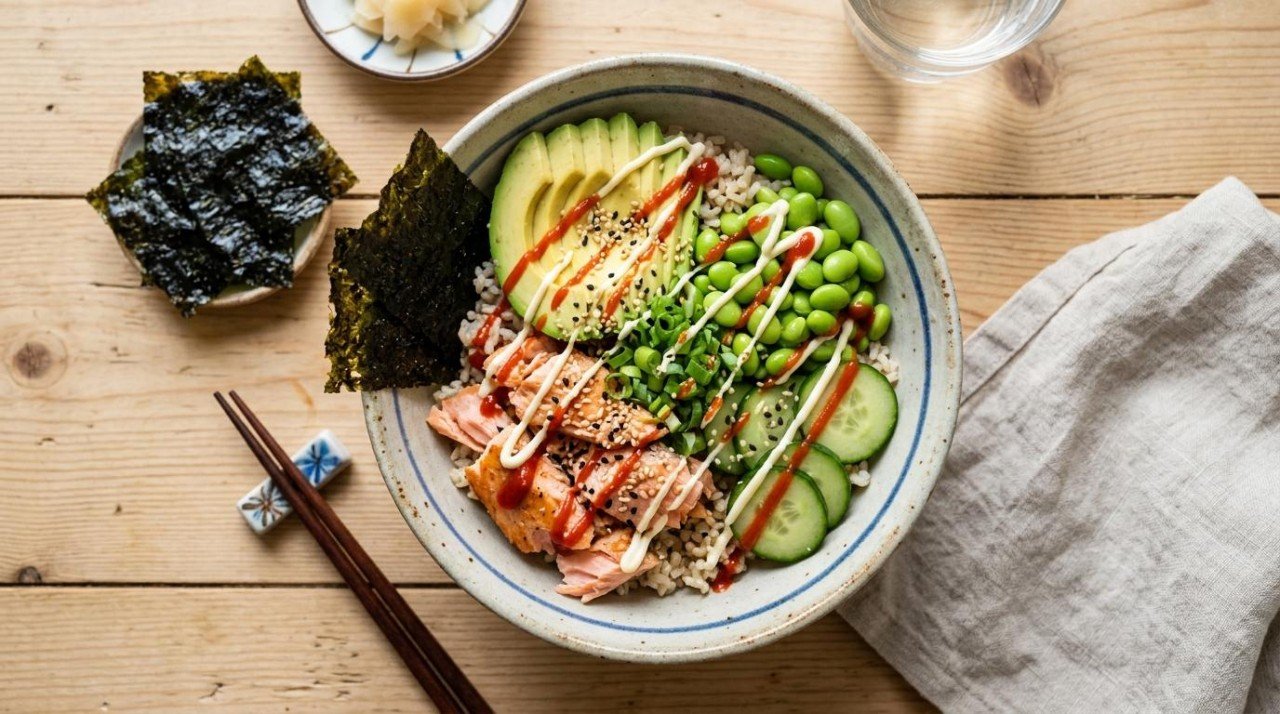
On September 21, 2021, Emily Mariko posted a TikTok captioned "Best lunch of the week!" She flaked a leftover salmon filet into a bowl, piled cold rice on top, nestled an ice cube into the middle, covered it with parchment, and microwaved it. Then soy sauce, Kewpie mayo, sriracha, avocado, kimchi, and roasted seaweed to scoop it all up with. It hit nearly 50 million views by that Friday, and Instacart reported that orders containing both salmon and dried seaweed doubled within the week.
It deserved every view. The ice cube trick is genuinely clever — it melts slowly, turns to steam under the parchment, and revives day-old rice instead of nuking it into pellets. And unlike most viral food, this one is built on real ingredients. So when we ran a representative version through Eat Well Planner's Nutrition Score, we half expected it to come back high.
It came back 51 out of 100. Not bad, not good — and the reason why is more interesting than either. This is a bowl with one world-class ingredient and a lot of empty space around it. We rebuilt it to 93 out of 100 without touching the salmon, the ice cube, the Kewpie mayo, or the sriracha. Every swap below carries the real, verified score change it earned.
The original: what's in it and how it scores
Here is the version we scored — the stripped-down core that spread across the internet as the 10-minute leftover lunch, for one bowl:
- 4 oz (113 g) cooked salmon, leftover and flaked
- 1 cup (158 g) cooked white rice, cold from the fridge
- 1 tablespoon soy sauce
- 1 tablespoon Kewpie mayonnaise
- 1 teaspoon sriracha
- 1 package (about 5 g) roasted seaweed snacks
- 1 ice cube
One honest note before the numbers: Emily's own bowl also had sliced avocado and kimchi on the side. Most of the copycat recipes list both as optional, and plenty of people make it exactly as above. We scored that stripped-down core on purpose, because it isolates what each topping is actually worth — and as you will see, her avocado was doing real work. (The Kewpie is scored as standard mayonnaise, which is the closest match in the ingredient database; the two are very close on calories and fat.)
Nutrition Score: 51/100. Now the diagnosis, because understanding why it lands there is what lets you read your own recipes.
Start with what is genuinely excellent, because it is a lot. The salmon makes this bowl an outstanding source of omega-3 EPA and DHA — 726% of the daily value in one lunch. It is also excellent for vitamin B12 (164%), vitamin D (83%), niacin, and vitamin B6, with 30 g of protein. The American Heart Association recommends two servings of fatty fish a week, and this single bowl covers one of them handily. Nobody should talk you out of eating this.
The problem is everything the salmon is sitting on:
- Sodium is very high — about 1,610 mg per bowl, or 70% of the daily limit, almost all of it from one tablespoon of soy sauce. The AHA caps sodium at 2,300 mg a day, with an ideal closer to 1,500 mg, and notes that cutting back by 1,000 mg a day improves blood pressure for most people. Lunch should not spend 70% of that budget.
- Fiber is almost nonexistent — 1.2 g. Adults need 25 to 35 g a day and most Americans get about 15. A cup of white rice contributes essentially none of it.
- One plant. The whole bowl counts as a single plant type. That is what tanks the gut health dimension, which scored 30 out of 100 — by far the weakest part of the whole picture.
So the plan is not to fix the salmon. The salmon is the best thing here. The plan is to fix the bowl underneath it: bring the sodium down, and give the fish some company.
The upgrades
Five changes, in the order we applied them. The first one is the one to make if you only make one.
1. Make it an actual bowl: edamame, cucumber, scallions
- Swap: Add 1/2 cup shelled edamame, 1/2 cup sliced cucumber, and 2 sliced scallions
- Score impact: +14 points (51 → 65)
- What it changes: Fiber from 1.2 g to 5.4 g, protein from 30 g to 39 g, plants from 1 to 4
- What it costs you: About 60 seconds and nothing at all in flavor — cucumber and scallion are what this bowl was already missing texturally
This is the biggest single lever and the easiest one. Frozen shelled edamame goes straight into the hot rice and warms through on its own; cucumber and scallion get sliced while the microwave runs. Edamame brings plant protein and fiber, cucumber brings crunch and water, scallions bring the sharp allium bite that soy-and-mayo bowls always want. Fiber more than quadruples, and fiber is what keeps hunger and blood sugar in check and feeds the beneficial gut bacteria that a one-plant bowl starves. The largest study of its kind found that people eating more than 30 different plant types a week had noticeably more diverse gut microbiomes than those eating 10 or fewer — so a bowl going from 1 plant to 4 is a real dent in the weekly target.
2. Brown rice instead of white
- Swap: 1 cup cooked white rice → a generous 3/4 cup (158 g) cooked brown rice
- Score impact: +6 points (65 → 71)
- What it changes: Adds fiber, magnesium, and B vitamins that milling removes
- What it costs you: A chewier, nuttier base — and it needs about 30 extra seconds in the microwave
Refining grain strips away more than half of the B vitamins, 90% of the vitamin E, and virtually all the fiber, and Harvard's researchers found that swapping white rice for brown was associated with a 36% lower diabetes risk. On its own, applied to the untouched original, this swap is worth only about 2 points — the bowl had bigger problems. Applied here, once the edamame and cucumber have lifted the base, it is worth 6.
The honest texture note: brown rice does not go as soft and sticky under the ice cube trick as white does. It stays chewier and the grains stay separate. In a bowl you are mixing with soy sauce and mayo anyway, that reads as texture rather than a downgrade — but it is a different mouthfeel, and if that is a dealbreaker, our guide to white rice substitutes covers short-grain brown, mixed grains, and the half-and-half approach that eases people in.
3. Half the soy sauce, and make it low-sodium
- Swap: 1 tablespoon regular soy sauce → 2 teaspoons reduced-sodium soy sauce
- Score impact: +16 points (71 → 87)
- What it changes: Sodium from 1,230 mg to 660 mg — from "very high" to comfortably in range
- What it costs you: A slightly less salty first bite. The rice vinegar in step 5 buys most of it back
This is the swap with the strangest arithmetic in the post. Applied to the untouched original, cutting the soy sauce is worth about 2 points. Applied here, at this exact point in the build, it is worth 16. Nothing about the soy sauce changed — what changed is that sodium was no longer competing with three other problems for the score's attention. Once the fiber and the plants were handled, sodium was the only thing left holding the bowl down, and removing it unlocked everything at once. That is the most useful thing this post can teach you about reading a Nutrition Score: a swap's value depends on what else is wrong.
If you want full-strength soy sauce for the flavor, that is a defensible choice — just use half as much and lean harder on the vinegar, sesame, and sriracha. Our soy sauce substitutes guide covers coconut aminos and the other lower-sodium options.
4. Put Emily's avocado back
- Swap: Add 1/2 a medium avocado, sliced
- Score impact: +6 points (87 → 93)
- What it changes: Fiber from 6.2 g to 10.8 g, plus potassium and monounsaturated fat
- What it costs you: Roughly 110 calories, and it is worth every one
Credit where it is due: this was in the original bowl. Emily served hers with sliced avocado, and the copycat recipes that filed it under "optional" were quietly throwing away 6 points. A medium avocado carries about 10 g of fiber and 22 g of fat, roughly two-thirds of it monounsaturated, the same heart-friendly fat that makes olive oil olive oil. Half of one delivers more potassium than a banana.
It also does something the numbers do not capture: creamy avocado against hot rice, crisp cucumber, and salty nori is most of why this bowl is satisfying. This is the rare upgrade where the healthier version tastes better than the one you were making.
5. The finishers that cost zero points (and are worth doing anyway)
- Swap: Add 1 teaspoon rice vinegar and 1 teaspoon toasted sesame seeds
- Score impact: 0 points (93 → 93)
- What it changes: Nothing the score measures — but plants go from 6 to 7, and the bowl tastes properly seasoned again
- What it costs you: Nothing
We are including a swap that moved the score by exactly zero, because pretending otherwise would be dishonest and because it is still the right thing to do. At 93 the bowl is near the ceiling of what the score can reward, so small additions stop registering. But acid is how you replace salt without anyone noticing it left: a teaspoon of rice vinegar brings back the brightness the reduced soy sauce took away, and toasted sesame seeds add the nutty top note sushi rice normally gets. They add a plant point too, which counts toward the weekly 30 even when it does not count toward the score.
Take the Guesswork Out of Eating Well
Eat Well Planner helps you organize your favorite recipes, plan balanced meals, and automatically generate shopping lists — all in one place. Whether you're tracking macros, managing dietary restrictions, or just trying to stop asking "what's for dinner?", we've got you covered.
Our AI-powered tools can adapt any recipe to your dietary needs, help you discover new meals you'll love, and even log your nutrition effortlessly. It's meal planning made simple.
Start Organizing Your Meals — FreeWhat we kept (on purpose)
A makeover that guts the dish is a failed makeover, so several things did not move. We kept the full tablespoon of Kewpie mayo, which we will defend below. We kept the sriracha, the roasted seaweed snacks you scoop with, and the whole 4 oz of salmon — it is the reason to eat this. And we kept the ice cube and parchment trick exactly as it is, because it is the actual invention here and it works just as well on brown rice.
We stopped at 93. As you will see, we found changes that score higher. They stopped being this bowl.
The healthier version: full recipe
Nutrition Score: 93/100. Makes 1 bowl. Total time, if the salmon and rice are already cooked: about 7 minutes.
- 4 oz (113 g) cooked salmon, leftover and cold
- Generous 3/4 cup (158 g) cooked brown rice, cold from the fridge
- 1 ice cube
- 2 teaspoons reduced-sodium soy sauce
- 1 teaspoon rice vinegar
- 1/2 cup (75 g) shelled edamame, cooked or thawed from frozen
- 1/2 cup (60 g) sliced cucumber
- 2 scallions (about 15 g), thinly sliced
- 1/2 medium avocado (about 68 g), sliced
- 1 tablespoon Kewpie mayonnaise
- 1 teaspoon sriracha
- 1 teaspoon (3 g) toasted sesame seeds
- 1 package (about 5 g) roasted seaweed snacks
- Flake the cold salmon into a microwave-safe bowl with a fork, discarding any skin. Pile the cold brown rice on top and nestle the ice cube into the middle of the rice.
- Cover the bowl with a sheet of parchment paper and microwave for about 2 minutes, until the rice is steaming hot all the way through. Brown rice is denser than white, so it needs a little longer than the original does.
- Lift off the parchment, remove whatever is left of the ice cube, and pour off any water pooled in the bottom. Add the soy sauce and rice vinegar and mix everything together, mashing the salmon into the rice.
- Stir in the edamame. The residual heat from the rice is enough to warm them through in under a minute.
- Top with the cucumber, scallions, and sliced avocado. Drizzle over the Kewpie mayo and sriracha and scatter the sesame seeds across the top.
- Eat with the seaweed snacks, scooping a bite of everything into each sheet.
Per bowl, here is the before and after:
- Nutrition Score: 51 → 93
- Gut health dimension: 30 → 90
- Sodium: about 1,610 mg → about 670 mg (from 70% of the daily limit down to 29%)
- Fiber: 1.2 g → 11.1 g (now an excellent source, at 38% of the daily value)
- Protein: 30.5 g → 40.4 g
- Calories: about 540 → about 752
- Saturated fat: 4.6 g → 7.0 g
- Plants in the bowl: 1 → 7 different plants
Two numbers moved the "wrong" way, and both have the same cause: this makeover adds food rather than taking it away. Half an avocado and a half cup of edamame are where the extra 210 calories and most of the extra saturated fat came from — and about two-thirds of avocado fat is monounsaturated, not saturated. In exchange you get 10 more grams of protein and nearly ten times the fiber, which is precisely the trade that makes a lunch hold you until dinner. The finished bowl is now an excellent source of omega-3s, B12, folate, niacin, vitamin K, vitamin B6, iron, magnesium, potassium, protein, and fiber.
Swaps we tested and skipped
Three changes scored well and did not make the cut. The reasons matter as much as the swaps that did.
- Greek yogurt instead of Kewpie mayo (scored 95). Two points higher, 78 fewer calories, 1.6 g less saturated fat. We still said no. Kewpie is made with egg yolks only rather than whole eggs, and carries MSG for umami, which is why it is richer and more savory than anything yogurt approximates — and it is a signature of the bowl, not a garnish. (For what it is worth, MSG's reputation was never deserved.) If you want the calorie cut more than the richness, the swap is in the mayonnaise substitutes guide.
- Cauliflower rice instead of brown rice (scored 95). Higher score, fewer calories — and it re-flagged both sodium and saturated fat, because stripping out the rice concentrates everything else relative to the calories. More to the point, the ice cube trick exists to revive leftover rice. Take the rice out and you have a salmon salad with a good story attached.
- Adding kimchi (scored 92). This one surprised us. Kimchi adds an eighth plant and live fermented cultures, but 1/4 cup pushes sodium from 670 mg back to 920 mg and re-triggers the high-sodium flag, costing a point. That is a scoring artifact more than a verdict — kimchi is a genuinely good thing to eat. So here is the fix we found: drop the soy sauce entirely and let kimchi and its brine be the salty element. That version scores 94, with 8 plants and only 560 mg of sodium. If you love kimchi here, that is the way to have it.
A note on the leftover rice
The whole premise of this bowl is day-old rice, so it is worth 20 seconds on doing that safely. Uncooked rice carries Bacillus cereus spores that survive cooking, and if cooked rice sits out at room temperature they multiply and produce a toxin that reheating does not reliably destroy. The rule is simple: get cooked rice into the fridge in a shallow container within two hours, reheat it once, and make sure it is steaming hot all the way through. The ice cube trick helps here, since the steam gets the middle of the bowl properly hot rather than leaving a cold core. We wrote about how long leftovers actually last separately.
Make it fit other diets
Gluten-free: use tamari or coconut aminos in place of soy sauce and check your seaweed snacks, since the rest of the bowl is naturally gluten-free. No salmon on hand: canned or leftover tuna, mackerel, or sardines all work with the same method and keep the omega-3s — the salmon substitutes guide ranks them. Vegan: swap the salmon for crispy marinated tofu and the Kewpie for a vegan Japanese-style mayo; you lose the EPA and DHA, so the edamame and avocado carry more of the load. In Eat Well Planner you do not have to work any of this out by hand — ask the AI recipe chat to "make this vegan" or "make this gluten-free" and it rewrites the whole recipe with the swaps already built in.
Do this to any recipe you love
None of this was guesswork. Every score and every point in this post came from Eat Well Planner's Make It Healthier tool, which proposes swaps like these and runs a calculator to verify the real nutritional gain before it shows you a suggestion — so you never chase a change that does not actually help. We tested each one in the Recipe Playground, watching the score move edit by edit, which is exactly how we caught that the soy sauce swap is worth 2 points at the start of the build and 16 points four steps in.
You can do this to the food you actually cook. See something blow up on TikTok or Instagram? Paste the video straight into the app, let it pull out the ingredients, and score it before you cook it. Then let Make It Healthier show you where the easy points are hiding. And if you are working from leftover salmon in the first place, you are already halfway to the cook once, eat three times habit that makes weeknights survivable.
Keep the bowl Emily gave us. Just give the salmon some company.