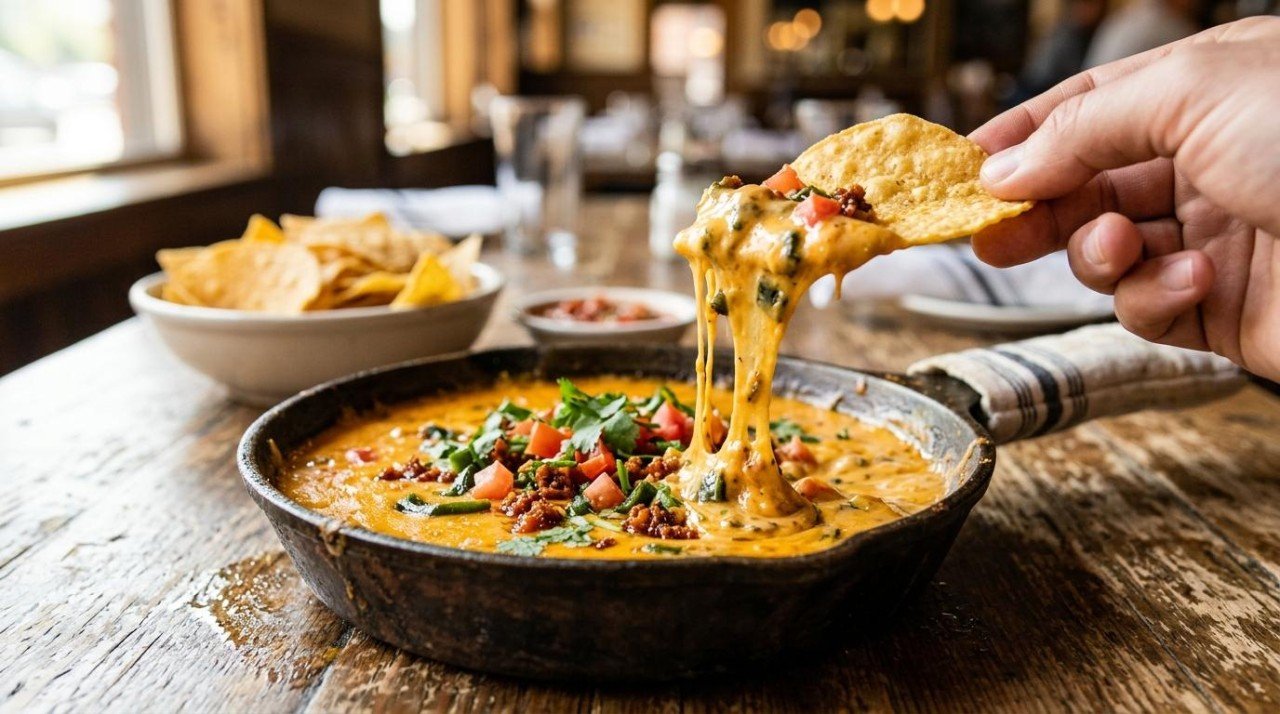
There is a specific sound that means a party has started: a crockpot lid coming off a pot of queso. Nobody stands near the vegetable tray. Everybody stands near the queso.
The standard American party version — melted processed cheese, a can of tomatoes and green chilies, usually some crumbled chorizo — is a 20th-century Tex-Mex creation descended from queso flameado, and it is genuinely great. It is also, when you run it through our Nutrition Score, a 33 out of 100. A single scoop carries almost half a day's sodium.
So we rebuilt it. Not into a cauliflower puree with nutritional yeast — into actual queso, with actual melted cheddar, that still gets scraped out of the pot. The finished version scores 56. That is 23 points, and every one of them is accounted for below, including the swap that made the score go down.
The original: what's in it and how it scores
Here is the version we scored, sized as a party batch for eight:
- 16 oz processed American cheese product, cubed
- 1/2 cup evaporated milk
- One 10 oz can diced tomatoes with green chilies, undrained
- 8 oz pork chorizo, browned
Everything melts together in a slow cooker. It takes about ten minutes of actual work, which is a large part of why it is the default.
Nutrition Score: 33/100. Per serving (one eighth of the batch, roughly a generous half cup): 284 calories, 14.3 g protein, 8.9 g carbohydrate, 0.4 g fiber, 21.4 g fat of which 10.5 g is saturated (45% of the Daily Value, flagged high), and 1,110 mg sodium (48% DV, flagged high). Plant points: 1.
What actually drags it down, in order:
- Sodium, by a mile. Half a day's sodium in one scoop of one appetizer — and almost nobody eats one scoop. The FDA puts the Daily Value at less than 2,300 mg and notes that Americans average about 3,400 mg, with over 70% of it coming from packaged and prepared foods rather than the salt shaker. This dip is a textbook example.
- Saturated fat at 45% DV. The Dietary Guidelines cap saturated fat at under 10% of daily calories, and the American Heart Association goes to 7%. An appetizer is not supposed to spend that budget.
- Effectively no fiber, and one plant. The canned tomatoes are the only plant food in the pot, and 0.4 g of fiber per serving is a rounding error.
- 0.5 g of trans fat per serving — and over 90% of it comes from the cheese product, not the chorizo, which is worth remembering when you get to the swaps.
And here is what is genuinely fine, because manufacturing problems is not the point: the protein is real — 14.3 g per serving, which is more than most dips manage — and it is an excellent source of calcium (83% DV) and riboflavin. There is no added sugar problem worth talking about. The dish is not junk. It is dairy with a sodium problem and no plants.
The upgrades
Six changes, applied in order, each scored on top of the last. They are presented in build order rather than impact order, because the first one is structural: it has to happen before any of the others can pay off, and on its own it actually costs points. We will be blunt about that when we get there.
1. Processed cheese product to real sharp cheddar, emulsified properly
- Swap: 16 oz processed cheese + 1/2 cup evaporated milk → 12 oz sharp cheddar + 1 cup evaporated milk + 1 tbsp cornstarch
- Score impact: -3 points (33 → 30)
- What it changes: Sodium drops from 1,110 mg to 670 mg per serving; trans fat goes from 0.5 g to almost nothing; saturated fat rises from 10.5 g to 12.1 g
- What it costs you: Three points, temporarily, and about five minutes of technique
This is the swap the whole post is built on, and it is the one that looks like a failure. Real cheddar has roughly half the sodium of a processed cheese product by weight, but around 50% more saturated fat — so trading one for the other at similar weight buys a huge sodium win and hands back a saturated fat loss. The score, which weighs both, comes out slightly behind. Everything after this is what turns that trade into a gain.
It is worth doing anyway, because of what it unlocks. Processed cheese melts smoothly for a specific legal reason: under the FDA standard of identity, pasteurized process cheese spread may contain emulsifying salts up to 3% of its weight — sodium citrate, sodium phosphate and their relatives — and must be at least 51% actual cheese. Those salts are the melt. Real cheddar has none of them, so its calcium-bound casein network collapses when heated and the fat leaks out as grease.
You can reproduce the melt without buying a chemistry set. Toss the grated cheddar with a tablespoon of cornstarch, and melt it into evaporated milk rather than regular milk: evaporated milk has most of its water removed, so its concentrated casein micelles do emulsifying work that plain milk cannot, and the starch holds the water in suspension. Modernist Cuisine is honest that starch and milk proteins are weaker emulsifiers than sodium citrate, and that is true — this sauce needs low heat and cannot be boiled. In exchange, you get cheese that tastes like cheese. Our evaporated milk guide and cornstarch guide cover what you can use instead of each if you are out.
2. The can of tomatoes and chilies to real roasted chilies and tomatoes
- Swap: One 10 oz can of tomatoes with green chilies → 2 roasted poblanos, 2 roma tomatoes, half a white onion, 1 jalapeño, 3 cloves garlic, 1 tsp cumin
- Score impact: +11 points (30 → 41)
- What it changes: Sodium 670 → 530 mg, plant points 1 → 4.5, vitamin C to 47% DV
- What it costs you: Fifteen minutes with the broiler. Flavor-wise it costs nothing — it is a straight upgrade
This is the biggest single move in the post. Canned tomatoes with green chilies are mostly salt and mild heat. Two poblanos blistered under the broiler until the skins blacken, then steamed in a covered bowl and peeled, bring smoke and a deep vegetal sweetness that a can cannot. Fresh romas bring acidity and body. The onion, garlic and cumin do what they do in every good Tex-Mex pot.
Nutritionally this is where the dish stops being a bowl of dairy. Plant points go from 1 to 4.5, which matters if you are working toward 30 different plants a week, and vitamin C lands at 47% of the Daily Value per serving, up from essentially zero.
3. Blend in a can of white beans
- Swap: Add one 15 oz can of cannellini beans, drained, blended smooth with the evaporated milk
- Score impact: +8 points (41 → 49)
- What it changes: Fiber 1.0 → 3.2 g per serving, protein 17.0 → 19.3 g, adds folate, magnesium and potassium
- What it costs you: Genuinely nothing if you blend them completely smooth. Leave them chunky and everyone will notice
This is the trick that sounds worst and works best. Blended cannellini beans are creamy, faintly sweet, and functionally invisible under cheddar, chorizo and roasted poblano. What they add is body — the thick, clingy texture that processed cheese gets from emulsifying salts, beans get from starch and protein.
Fiber is the headline. Going from 1.0 g to 3.2 g a serving is not a heroic number in absolute terms, but it is a tripling, and it is arriving in a dip. Harvard's Nutrition Source notes that people eating legumes four or more times a week had a 22% lower risk of heart disease than those eating them less often. Beans in the queso is a low-effort way to add one of those occasions.
Blend them with the evaporated milk before anything goes in the pot. A stick blender in a tall cup takes about twenty seconds and gets you smoother than a food processor will.
4. Drop the cheese from 12 oz to 8 oz
- Swap: 12 oz sharp cheddar → 8 oz sharp cheddar
- Score impact: +3 points (49 → 52)
- What it changes: Saturated fat 12.1 → 9.4 g per serving, calories 358 → 300
- What it costs you: Nothing you will notice, but only because steps 2 and 3 came first
This swap is only available because of the two before it. The beans and the roasted vegetables took over the job of making the dip thick, which means the cheese no longer has to be the structure — it only has to be the flavor. And sharp cheddar goes further per ounce than a mild processed cheese does, because aging concentrates the flavor compounds. Eight ounces of sharp cheddar tastes cheesier than sixteen ounces of the orange block.
If you want to push this further, buy the sharpest cheddar you can find rather than more of it. Our cheddar cheese guide covers which cheeses melt well enough to stand in here — Monterey Jack melts beautifully but tastes milder, so you end up needing more of it.
5. Halve the chorizo
- Swap: 8 oz pork chorizo → 4 oz
- Score impact: +3 points (52 → 55)
- What it changes: Sodium 490 → 380 mg per serving, saturated fat 9.4 → 8.2 g, calories 300 → 258. The sodium caution flag clears entirely here
- What it costs you: Less than you would think, if you brown it hard and stir most of it in rather than piling it on top
Chorizo is a seasoning, not a protein source, and it behaves like one. Four ounces browned until the edges are crisp, with its rendered fat used to cook the onion and garlic, puts chorizo flavor through the entire pot. Eight ounces mostly puts more chorizo in individual bites.
This is where the sodium story finishes. The original was flagged high at 1,110 mg per serving. Here it lands at 380 mg with no caution flag at all — roughly a third of where it started, in a dip that still has cured pork in it.
6. Evaporated milk to evaporated skim milk
- Swap: 1 cup evaporated milk → 1 cup evaporated skim milk
- Score impact: +1 point (55 → 56)
- What it changes: Saturated fat 8.2 → 6.8 g per serving (35% DV down to 29%)
- What it costs you: Nothing. It may even help the emulsion
One point is a small score move and we are not going to pretend otherwise. It is on the list because the underlying change is not small: it takes 1.4 g of saturated fat per serving out of the pot for free. The emulsifying power of evaporated milk comes from its concentrated milk proteins, not its fat, so the skim version does the same job — and with less fat in the liquid, there is marginally less fat for the sauce to hold in suspension.
Take the Guesswork Out of Eating Well
Eat Well Planner helps you organize your favorite recipes, plan balanced meals, and automatically generate shopping lists — all in one place. Whether you're tracking macros, managing dietary restrictions, or just trying to stop asking "what's for dinner?", we've got you covered.
Our AI-powered tools can adapt any recipe to your dietary needs, help you discover new meals you'll love, and even log your nutrition effortlessly. It's meal planning made simple.
Start Organizing Your Meals — FreeWhat we kept (on purpose)
We stopped at 56, and we stopped deliberately. Two things stayed in the pot that the score would rather we removed, and we know exactly what they cost:
- The 4 oz of chorizo costs 2 points. Taking it out entirely scores 58. It stays because without it this is a cheese-and-bean dip, not queso, and the smoky paprika-and-cumin note is most of what people mean when they say a queso tastes good.
- The 8 oz of cheddar costs 1 point. Dropping to 6 oz scores 57. One point is not a good enough reason to make a cheese dip less cheesy.
The saturated fat flag is still there at 29% of the Daily Value, and it is not going away without removing the cheese. That is the honest ceiling for this dish: queso is cheese, and cheese is saturated fat. What changed is the company it keeps — the sodium flag is gone, there is real fiber, and there are five and a half plants in something that used to have one.
We also skipped adding any salt. The chorizo and the cheddar bring plenty, and the lime juice at the end does the job people usually reach for salt to do. If you want the tangy dairy note that a lot of queso recipes get from a spoonful of sour cream, the sour cream guide has lighter stand-ins — but the lime handles it.
The healthier version: full recipe
Nutrition Score: 56/100. Serves 8 as an appetizer.
Ingredients
- 2 medium poblano peppers (about 7 oz total)
- 4 oz pork chorizo, casings removed
- 1/2 small white onion, finely diced (about 3 oz)
- 1 jalapeño, seeded and minced (about 1 oz)
- 3 cloves garlic, minced
- 1 tsp ground cumin
- 2 roma tomatoes, diced (about 7 oz total)
- One 15 oz can cannellini beans, drained and rinsed (about 9 oz drained)
- 1 cup evaporated skim milk
- 8 oz sharp cheddar, grated (about 2 cups, packed)
- 1 tbsp cornstarch
- 1 tbsp lime juice
- A small handful of cilantro, chopped (about 1/3 cup loosely packed)
Instructions
- Broil the poblanos on a sheet pan, turning occasionally, until the skins are blistered and blackened in patches, 8 to 12 minutes. Put them in a bowl, cover it, and let them steam for 10 minutes. Peel off the loose skin, pull out the stems and seeds, and chop.
- Meanwhile, brown the chorizo in a heavy saucepan over medium heat, breaking it up, until the edges are crisp, about 6 minutes. Lift it out with a slotted spoon, leaving the fat behind.
- Cook the onion and jalapeño in the chorizo fat until soft, about 5 minutes. Add the garlic and cumin and cook for 1 minute more, then add the tomatoes and cook until they slump and most of their liquid has evaporated, about 5 minutes.
- Blend the drained beans with the evaporated skim milk until completely smooth — a stick blender in a tall cup takes about 20 seconds. Any texture left here will be noticeable in the finished dip.
- Toss the grated cheddar with the cornstarch until every shred is dusted.
- Pour the bean puree into the saucepan with the vegetables and warm it over low heat until it steams. Do not let it boil.
- Take the pan off the heat and add the cheddar a handful at a time, stirring until each addition has melted before adding the next. Return it to low heat only if it stops melting, and never above a bare steam.
- Stir in the roasted poblanos, most of the chorizo, and the lime juice. Taste before adding any salt — it very likely does not need it.
- Scatter the remaining chorizo and the cilantro over the top and serve warm. If it thickens as it sits, loosen it with a splash of evaporated milk over low heat.
Per serving, original vs. improved:
- Nutrition Score: 33 → 56
- Calories: 284 → 242
- Sodium: 1,110 mg (48% DV, flagged high) → 380 mg (no flag)
- Saturated fat: 10.5 g (45% DV, flagged high) → 6.8 g (29% DV, still flagged)
- Fiber: 0.4 g → 3.2 g
- Protein: 14.3 g → 14.2 g (unchanged)
- Trans fat: 0.5 g → trace
- Plant points: 1 → 5.75
The protein line is the one worth staring at. Same protein, 42 fewer calories, a third of the sodium, eight times the fiber — the improved version is not a smaller portion of the same thing, it is a different composition at the same size.
It now qualifies as an excellent source of vitamin C (48% DV), calcium (33%) and vitamin B6 (20%), and a good source of fiber, folate, zinc, iron and potassium.
Swaps we tested and skipped
- Cauliflower instead of white beans. The internet's favorite creamy-vegetable trick scored 52 in the finished build — five points worse than the beans, with fiber falling from 3.2 g to 1.6 g per serving. Cauliflower is mostly water; beans bring fiber, protein and starch. Beans win on both the numbers and the texture.
- Just use half the processed cheese. The intuitive fix. Halving the block in the original recipe and changing nothing else scores 35 — two points. Sodium is still 740 mg a serving and both caution flags remain. Less of a processed cheese dip is still a processed cheese dip.
- Just skip the chorizo. On the original recipe, removing the chorizo entirely scores 34. One point, and you gave up the best-tasting thing in the pot. The meat was never the problem here — the cheese product was.
- Greek yogurt in place of some of the dairy. Rejected on technique before it was worth scoring: yogurt's proteins curdle at cheese-sauce temperatures, and this emulsion is already the fragile kind. If you want the tang, add lime.
Make it fit other diets
- Vegetarian: Drop the chorizo and add 1 tsp smoked paprika plus an extra 1/2 tsp cumin to the onions. That version scores 58 — the vegetarian one is the higher-scoring dip.
- Gluten-free: It already is. Check the chorizo label, and serve with corn tortilla chips.
- Bulletproof melt: If a cheese sauce has ever broken on you, 1 tsp of sodium citrate in place of the cornstarch makes this one essentially unbreakable. It does put some sodium back, so it is a trade rather than a freebie.
For anything more involved — dairy-free, lower fat, scaled for twenty people — Eat Well Planner's Recipe Variations will rewrite this whole recipe with the substitutions worked in, in one step, rather than leaving you to guess at ratios.
Do this to your own recipes
Nothing here required a nutrition degree. It required knowing the original's real score, knowing which numbers were dragging it down, and testing swaps one at a time instead of guessing — which is exactly what Eat Well Planner does. Import a recipe from any URL, video or photo, and it comes back with a Nutrition Score and the reasons behind it. Run Make It Healthier and the app proposes swaps like these, with a calculator verifying the actual nutritional gain before a suggestion is ever shown to you. The Recipe Playground is where you test your own ideas and watch the score move per edit — it is where the six deltas in this post came from, including the one that went the wrong way.
The family queso recipe is not going anywhere. It just has room to be better than it currently is, and now you know exactly which changes are worth making and what each one is worth.