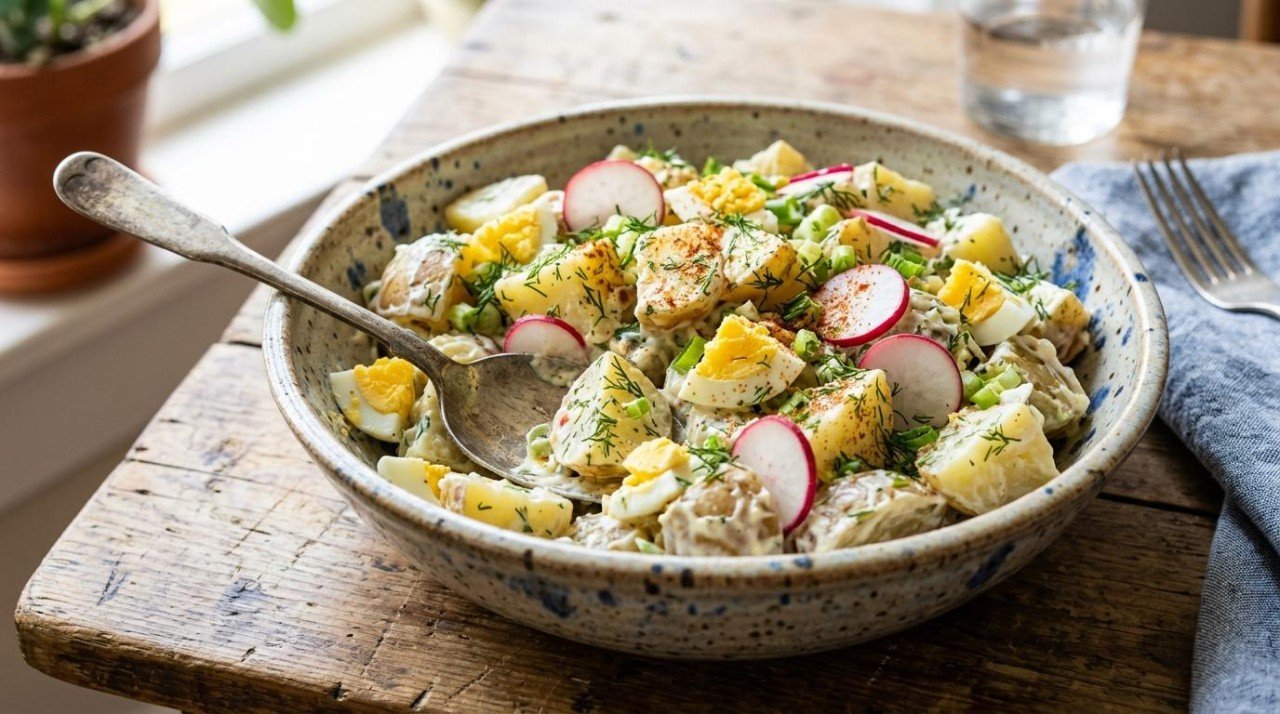
Potato salad is the dish that shows up whether or not anyone was assigned to bring it. It sits in the middle of the cookout table in a bowl too big for the fridge, it gets better on day two, and everybody has an opinion about whose family makes it right. It is also the dish people apologize for while eating it.
So we ran a standard creamy potato salad through our Nutrition Score, expecting the worst. It came back at 46 out of 100. That is not the disaster its reputation suggests, and the reason it scores where it does turned out to have very little to do with the thing everyone blames.
We rebuilt it to 76. The mayonnaise is still in there. It is still creamy, still cold, still the same dish you would recognize with your eyes shut. Here is every swap, exactly what each one was worth, the one that scored nothing and stayed anyway, and the two versions that scored higher than ours that we turned down on purpose.
The classic: what is in it and how it scores
The version we scored is the deli-and-family-reunion standard, built to serve eight as a side:
- 3 lb russet potatoes, peeled and boiled
- 1 1/2 cups mayonnaise
- 1 tablespoon yellow mustard
- 4 hard-boiled eggs, chopped
- 1 cup diced celery and 1/2 a yellow onion
- 1/4 cup sweet pickle relish
- 1 1/2 teaspoons salt, black pepper, a dusting of paprika
Per serving that comes to about 473 calories, 7.5 g of protein, 34 g of fat, 5.6 g of saturated fat, roughly 830 mg of sodium, and 2.9 g of fiber. The score flags two things: sodium at 36% of a day's limit and saturated fat at 24%, both marked high.
Now the part worth saying before we change anything, because it is genuinely surprising. The score's three listed strengths for this recipe are omega-3 ALA, vitamin K, and vitamin B6 — and the first two are coming from the mayonnaise. Most American mayonnaise is mostly soybean oil, and Harvard lists soybean oil and salad dressings made with it among the real dietary sources of vitamin K. The mayo is not a nutritional void. It is doing something.
The potatoes are pulling their weight too. One serving carries about 810 mg of potassium, and higher potassium intake helps relax blood vessels and excrete sodium, which matters a lot in a dish this salty. There is also a quiet bonus in the fact that potato salad is served cold: when cooked potatoes are chilled, some of their starch retrogrades into resistant starch, which your gut bacteria ferment rather than your small intestine digesting. A study of Yukon Gold, Dark Red Norland, and Russet Burbank potatoes found that chilled potatoes had more resistant starch than either hot or reheated ones, and that the variety made no difference. We have written more about resistant starch in day-old rice and potatoes if you want the mechanism.
So what actually drags it to 46? Not one villain. Three quieter things: the sheer volume of mayonnaise relative to everything else, a salt load that runs high before you count the relish and the mayo, and the fact that a bowl this size contains almost no plant variety — 3.5 different plants, most of that potato.
The upgrades: five swaps, 30 points
Each swap below is scored on top of the one before it, in the order we actually made them. That is build order, not impact order, and the reason matters: swap four is the biggest single mover on the board, but it only works that well because swap three came first. If you are only making one change today, make the first one.
1. Half the mayonnaise becomes Greek yogurt
- Swap: 1 1/2 cups mayonnaise → 3/4 cup mayonnaise plus 3/4 cup plain whole-milk Greek yogurt
- Score impact: +9 points (46 to 55)
- What it changes: 127 calories off per serving, saturated fat from 5.6 g to 3.4 g, protein from 7.5 g to 9.6 g
- What it costs you: A tang you will notice on the first bite and stop noticing by the third
Half, not all. This is the whole argument of the post in one line. Half the mayo keeps the fat that carries flavor across three pounds of potato and keeps the vitamin K and ALA that the score was already crediting, while the yogurt buys back protein and calcium. Calcium goes from about 50 mg a serving to 70 mg on this swap alone, and reaches 100 mg by the end of the build.
Two things make it work in practice. Use full-fat Greek yogurt, not zero percent — Greek yogurt is strained to remove whey, which is what makes it thick enough to stand in for mayonnaise at all, and the fat-free versions go thin and sharp in a dressing. And let the potatoes cool to room temperature before the dressing goes on. Yogurt on hot potatoes breaks and weeps, and you end up with a watery bowl and a story about how yogurt does not work in potato salad. It works fine. It just does not like heat. (Our mayonnaise substitutes guide and Greek yogurt substitutes guide cover the ratios for other dishes.)
2. Give it something to crunch on
- Swap: Add 1 cup sliced radishes, 5 sliced scallions, 1/4 cup chopped dill, and 1/4 cup parsley, and take the celery from 1 cup to 1 1/2
- Score impact: +7 points (55 to 62)
- What it changes: Plant variety from 3.5 to 6 different plants, fiber from 2.9 g to 3.5 g
- What it costs you: Ten minutes of slicing. Nothing at the table.
Radishes are the underused ingredient here. They are crisp, faintly peppery, hold their snap in a dressed salad for days in a way cucumber cannot, and they turn a soft dish into one with texture. Dill and potato is one of those pairings that feels obvious the moment you taste it.
The plant count going from 3.5 to 6 is worth more than it sounds. The largest microbiome study to date found people eating more than 30 different plants a week had measurably more diverse gut bacteria than people eating 10 or fewer, and herbs count. A side dish that quietly adds five plants to your week is doing real work.
Note what this swap did not do: fiber moved only 0.6 g. If you came here expecting a fiber transformation, this is the honest limit of the dish. Potato salad is potatoes. The win here is plant variety and texture, not fiber.
3. Sweet relish out, dill pickle and Dijon in
- Swap: 1/4 cup sweet pickle relish → 1/2 cup chopped dill pickle; yellow mustard → Dijon; add 1 tablespoon apple cider vinegar
- Score impact: +0 points (62 to 62)
- What it changes: Added sugar from 2.3 g to essentially zero, one more plant
- What it costs you: The faint sweetness some people consider non-negotiable
The score gave us nothing for this one. We kept it anyway, and it is the most important swap in the post.
Here is why. Salt, fat, and acid are the three levers that make food taste like something, and when you are about to pull one of them down hard, you push another one up first. Dijon, dill pickle brine, and cider vinegar are all acid. Load them in now, and the salt cut in the next section stops tasting like a subtraction. Skip this step and the next step tastes like diet food. (We wrote about how those four levers work together, and the cider vinegar guide lists what else does this job.)
This is also a good illustration of what a nutrition score is and is not. It measures nutrients. It cannot measure whether a dish is still worth eating. That part is your job, and it is why we test swaps in a kitchen and not only in a spreadsheet.
4. Cut the added salt almost in half
- Swap: 1 1/2 teaspoons salt → 3/4 teaspoon
- Score impact: +12 points (62 to 74)
- What it changes: Sodium from about 720 mg a serving to 480 mg
- What it costs you: Nothing, at this point in the build. Everything, if you do it first.
The biggest number in the post, and it is a teaspoon of nothing. We tested this same cut on the untouched original and it was worth only +6. The identical change was worth twice as much here, because by this point in the build the sodium load had already come down with the mayonnaise and the salad had enough acid that the score could register the drop instead of the recipe drowning it out. Order matters more than people expect.
The context is worth having. The AHA puts the ceiling at 2,300 mg of sodium a day with an ideal of 1,500 mg, notes that Americans average over 3,100 mg, and points out that for most people cutting back by 1,000 mg a day improves blood pressure. Two servings of the original potato salad is most of a day's allowance for a side dish. And because the potatoes bring 950 mg of potassium a serving in the finished version, the ratio is moving in the right direction on both ends — the thing we get into in potassium, the other half of the salt equation.
One technique note that makes this survivable: salt the potatoes in the cooking water and taste the dressing before it goes on, not after. Potatoes absorb salt while they boil, and salt distributed through the potato reads as seasoned in a way the same amount stirred into cold dressing does not.
5. Two more eggs
- Swap: 4 hard-boiled eggs → 6
- Score impact: +2 points (74 to 76)
- What it changes: Protein from 9.9 g to 11.4 g a serving, more choline and B12
- What it costs you: Two eggs
Small, cheap, and entirely in keeping with the dish — plenty of families already make it this way. It is the only swap here that adds calories, about 19 a serving, and the score went up anyway. We also tested the reverse and it is the clearest result on the page: pull the eggs out entirely and the salad drops to 67. The eggs are worth nine points. They stay.
Take the Guesswork Out of Eating Well
Eat Well Planner helps you organize your favorite recipes, plan balanced meals, and automatically generate shopping lists — all in one place. Whether you're tracking macros, managing dietary restrictions, or just trying to stop asking "what's for dinner?", we've got you covered.
Our AI-powered tools can adapt any recipe to your dietary needs, help you discover new meals you'll love, and even log your nutrition effortlessly. It's meal planning made simple.
Start Organizing Your Meals — FreeWhat we kept on purpose, and where we stopped
The mayonnaise stayed, at half. So did the eggs, the paprika on top, and the fact that this is a cold, creamy, mayo-dressed potato salad rather than something else wearing its name.
We also left the potatoes alone. No cauliflower, no swapping in half a bag of beans, no shrinking the portion. One thing we would change that the score cannot see: leave the skins on. The nutrition database treats potato as flesh-and-skin, so peeling is invisible to the score, but the underlying difference is real and small — a medium potato carries 2 g of fiber with the skin and 1 g without, plus about 150 mg more potassium and 4.5 mg more vitamin C. It is free, it saves you fifteen minutes of peeling, and thin red or Yukon Gold skins disappear into the salad. We scored russets because that is what the classic uses; if you prefer distinct chunks over a creamier texture, a waxy potato holds its edges better.
Where we stopped: the salt. The score keeps rewarding you all the way down — take out the remaining 3/4 teaspoon entirely and it climbs to 81. We are not going to tell you to eat unsalted potato salad. Five points is not worth a bowl nobody finishes, and a makeover that ends up in the trash improves nothing.
The healthier potato salad: 76/100
Serves 8. About 20 minutes of work, plus chilling time.
- 3 lb russet potatoes, scrubbed, skins on, cut into 1-inch chunks
- 3/4 teaspoon salt, plus more for the cooking water
- 6 large eggs, hard-boiled and chopped
- 3/4 cup mayonnaise
- 3/4 cup (180 g) plain whole-milk Greek yogurt
- 1 tablespoon Dijon mustard
- 1 tablespoon apple cider vinegar
- 1 1/2 cups diced celery (about 3 stalks)
- 1 cup sliced radishes (about 8)
- 5 scallions, thinly sliced
- 1/2 small yellow onion, finely diced
- 1/2 cup chopped dill pickle
- 1/4 cup chopped fresh dill
- 1/4 cup chopped fresh parsley
- 1/2 teaspoon black pepper
- 1 teaspoon paprika, for the top
- Put the potato chunks in a large pot, cover with cold water by an inch, and salt the water generously. Bring to a boil and simmer 10 to 15 minutes, until a knife slides in with no resistance but the chunks still hold together.
- Drain and leave them in the colander for 5 minutes to steam dry. Spread them on a sheet pan and let them cool to room temperature. Do not skip this. Warm potatoes will break the yogurt dressing.
- While they cool, whisk the mayonnaise, Greek yogurt, Dijon, cider vinegar, 3/4 teaspoon salt, and black pepper together in a large bowl. Taste it now and adjust the vinegar and pepper, not the salt.
- Add the celery, radishes, scallions, onion, dill pickle, dill, and parsley to the dressing and stir to coat.
- Fold in the cooled potatoes and the chopped eggs with a rubber spatula, lifting from the bottom rather than stirring, so the potatoes stay in pieces.
- Cover and chill at least 2 hours, ideally overnight. Dust with paprika before serving. If it looks tight coming out of the fridge, loosen it with a splash of cider vinegar rather than more mayonnaise.
Per serving, original versus improved:
- Nutrition Score: 46 → 76
- Calories: 473 → 363
- Protein: 7.5 g → 11.4 g
- Total fat: 34.1 g → 20.1 g
- Saturated fat: 5.6 g → 3.8 g (no longer flagged; the AHA's guidance is about 13 g a day on 2,000 calories)
- Sodium: about 830 mg → 500 mg
- Potassium: about 810 mg → 950 mg
- Fiber: 2.9 g → 3.5 g
- Added sugar: 2.4 g → essentially zero
- Different plants: 3.5 → 7
The finished version comes out an excellent source of vitamin K, vitamin B6, potassium, iron, phosphorus, choline, riboflavin, B12, and vitamin C, and a good source of protein, fiber, folate, magnesium, and calcium. Sodium is the only caution left on it, down from 36% of a day's limit to 22%.
Swaps we tested and skipped
Two of these scored higher than the version we published. We turned them down anyway, and the reasons are the honest part of this whole exercise.
- All Greek yogurt, no mayonnaise — scored 81. Five points better, 129 fewer calories, 13.3 g of protein. And it is not potato salad. Without any mayo the dressing goes tart and thin, it reads as a yogurt dish with potatoes in it, and it is the version that gets brought home from the cookout still in the bowl. Five points is not worth that.
- Olive oil and vinegar instead of mayonnaise — scored 85. The highest number we generated, nine points above ours. It is also a completely different dish — German or French style, no creaminess at all. It is genuinely delicious and we would happily eat it, but somebody searching for a healthier creamy potato salad has not been given what they asked for. Worth its own recipe, not a swap in this one.
- Dropping the eggs — scored 67. Nine points down. Tested because plenty of lightened-up recipes leave them out. The score says do not.
- Removing the last of the salt — scored 81. Covered above. Real points, unrealistic food.
Make it fit other diets
For dairy-free, put the mayonnaise back to the full 1 1/2 cups and skip the yogurt — you lose most of the first swap, but the other four still stand, so keep the vegetables, the acid, and the salt cut. A thick unsweetened coconut or cashew yogurt also works in the yogurt's place. For egg-free or vegan, vegan mayo plus a can of drained, rinsed chickpeas in place of the eggs keeps the protein and the texture, and a pinch of black salt gets you the egg note.
In Eat Well Planner you can skip the guesswork: ask the AI recipe chat for a dairy-free version of this exact recipe, or use Recipe Variations to have the whole thing rewritten with the swaps already worked in, then score the result to see what the change cost you.
Do this to any recipe you love
Nothing about this process is specific to potato salad. Import a recipe from a website, a photo, or an Instagram reel, and Eat Well Planner scores it against the same yardstick we used here. Make It Healthier then proposes swaps like these — and a calculator verifies the actual nutritional gain before a suggestion is ever shown to you, which is exactly how we found out that the pickle swap was worth zero and the eggs were worth nine.
If you want to argue with our choices, that is what the Recipe Playground is for. Put the full 1 1/2 cups of mayonnaise back and watch what it costs. Push the salt down to nothing and see the number we walked away from. Every edit shows you its own delta, live, so you can find your personal stopping point instead of taking ours.
Keep the dish. Change the numbers. Bring the bowl back empty.