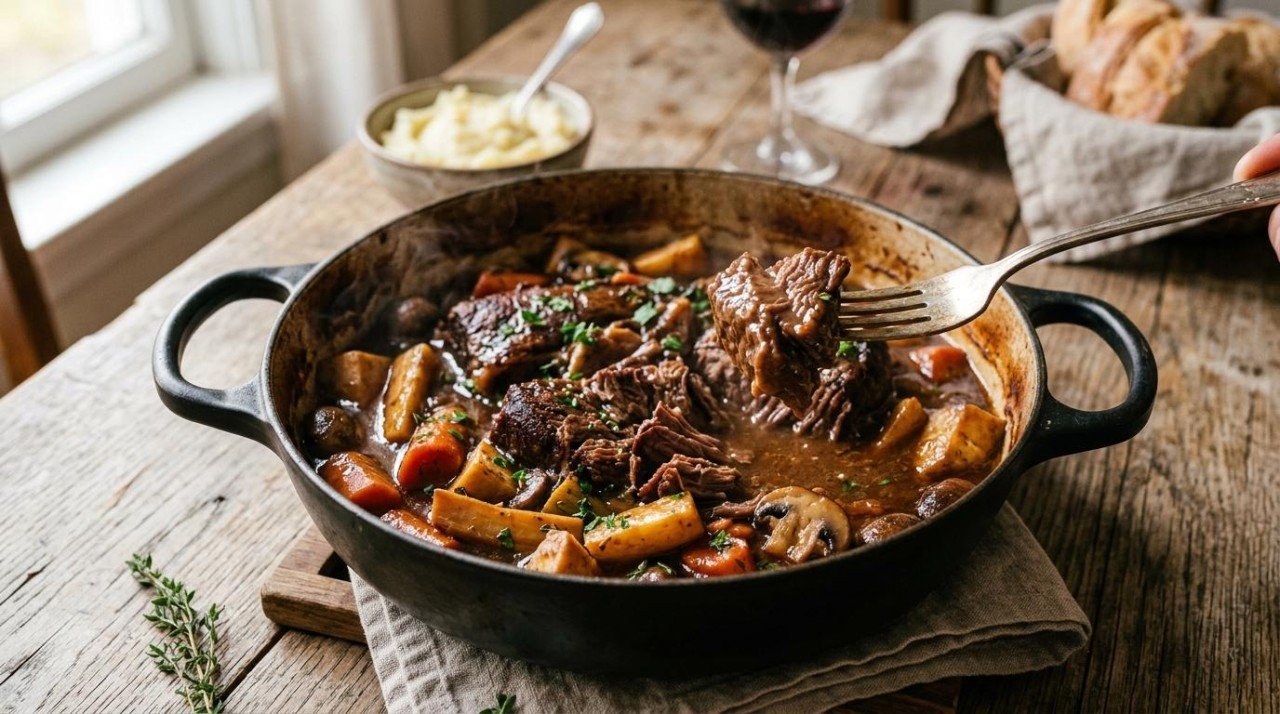
Pot roast is the dish that taught a lot of us that cheap meat and time beat expensive meat and hurry. A chuck roast, a couple of pounds of root vegetables, a lid, and most of an afternoon. You do almost nothing and the oven turns a tough, cheap cut into something you can pull apart with a spoon. It is the least fussy special-occasion dinner in the American repertoire.
We ran the standard version through our Nutrition Score and got 40 out of 100. The interesting part is why. Everyone assumes the villain is the onion soup packet, and the packet is genuinely expensive — but it is not the biggest number in this dish. Not close.
Then we rebuilt it and got 96. Same chuck roast, same potatoes and carrots, same lid, same oven. Here is every swap, what each one was actually worth, and the one place where the fix costs you a night of patience instead of an ingredient.
The original: what is in it and how it scores
We scored the version that shows up in most family recipe boxes, built to serve six:
- 3 lb boneless chuck roast, seared in 2 tablespoons of vegetable oil
- 1 packet (1 oz) of dry onion soup mix
- 2 cups of beef broth
- 1 1/2 lb of russet potatoes and 1 lb of carrots
- 1 large yellow onion
- 3 tablespoons of flour, whisked into the drippings at the end for gravy
- 1/2 teaspoon of salt and 1 teaspoon of black pepper
Per serving: 736 calories, 46.9 g protein, 36.2 g carbohydrate, 4.6 g fiber, 45.5 g total fat, 15.2 g saturated fat, and 1,030 mg of sodium. Three and a half plant points.
Start with what is already fine, because there is a lot of it. This is real food. There is one processed ingredient in the entire pot, and everything else is meat, vegetables, and water. The protein number is enormous — 47 g a serving, 58% of a day's worth. The micronutrient sheet is genuinely excellent: 117% of a day's zinc, 104% of vitamin B6, 86% of niacin, 80% of iron, 70% of vitamin A from the carrots, and 44% of potassium. Very few dinners deliver that. Nobody should feel bad about pot roast.
What drags the score to 40:
- Saturated fat: 15.2 g per serving, 65% of a day's worth. Flagged very high — the single worst number in the dish. The Dietary Guidelines put the ceiling at less than 10% of daily calories, and the American Heart Association at 7%. One serving of this uses most of it.
- Total fat: 45.5 g, and 736 calories. A chuck roast carries a fat cap and thick seams of fat between the muscles. All of it renders into the pot, and in the classic method all of it goes back onto the plate — because the gravy is thickened directly in the drippings.
- Sodium: 1,030 mg, 45% of a day's worth. Flagged high. The pouch of onion soup mix alone carries about 2,250 mg, and the salted broth adds several hundred more.
- 4.6 g of fiber and 3.5 plant points. Three plants in a pot big enough to feed six. Americans already average about 15 g of fiber a day against a 25 to 35 g target, and a dinner this size should be doing more of that work.
The dimension breakdown says the same thing in a different voice: energy and recovery score 65 and weight management 55, but gut health lands at 35, heart health 33, and brain health 33.
The upgrades: three swaps, 56 points
Each swap is scored on top of the one before it, in the order we made them, so the deltas add up. If you only make one change, make the first one. It is worth more than the packet and the vegetables combined, and it does not change a single thing about how the roast tastes.
1. Trim the roast, then chill the pot and lift the fat off
- Swap: Braise the roast and thicken the gravy in the drippings → trim the roast hard before it goes in, then refrigerate the whole pot overnight, lift off the solid cap of fat, and reheat
- Score impact: +21 points (40 to 61)
- What it changes: Calories from 736 to 472 per serving; total fat from 45.5 g to 17.0 g; saturated fat from 15.2 g to 5.3 g, which takes it from 65% of a day's worth down to 22% and clears the very-high flag
- What it costs you: A night in the refrigerator, about half a pound of trimmings, and a disc of solid fat you throw away. Nothing on the plate — genuinely nothing.
This is the swap that makes the whole post, and it works because of a distinction most recipes never make: the thing that makes chuck tender is collagen, not fat. Collagen is connective tissue, and when it is heated long enough in moisture it denatures and turns into gelatin — which is what gives braised chuck that sticky, spoon-tender, lip-coating quality. Gelatin stays in the meat and the sauce. The fat cap and the seam fat do not. They melt, float, and end up in the gravy, where they contribute mouthfeel and almost nothing else.
So do two things. Trim the external fat and the big interior seams before searing — you want the muscle, not the cap. Then cook the roast a day ahead, let it cool, and refrigerate the whole pot overnight in its liquid. Canada Beef's own pot roast guide gives the same instruction for make-ahead roasts: refrigerate it overnight in the braising sauce, then skim any fat from the sauce before reheating. In the morning there is a pale, solid disc sitting on top of the jellied liquid. Lift it off with a spoon and throw it away. The roast is also better on day two, which is the rare case where the healthier method and the tastier method are the same method.
What we scored here is the lean meat that actually reaches the plate after trimming and skimming — from a 3 lb roast, that is roughly 2 1/2 lb of meat plus a jellied, defatted braising liquid. To see it from the other direction: put the untrimmed, unskimmed roast back into the otherwise-finished dish and the score falls from 96 all the way to 56. That one habit is worth 40 points.
2. Throw the packet away and build the base yourself
- Swap: 1 packet of onion soup mix + 2 cups of salted beef broth → 2 large onions, 4 cloves of garlic, 2 tablespoons of tomato paste, 1 cup of red wine, 2 cups of unsalted beef broth, 1 tablespoon of Worcestershire, thyme, and 2 bay leaves
- Score impact: +22 points (61 to 83)
- What it changes: Sodium from 1,080 mg to 460 mg per serving — a 57% cut, and the high-sodium flag drops a full tier; plant points from 3.5 to 5
- What it costs you: Five minutes of chopping. The flavor goes up, not down.
The packet is doing three jobs: dehydrated onion, salt, and savory depth. You can do all three with actual food. Two sliced onions cooked down in the sear fond give you more onion than the pouch ever did. Tomato paste, browned for a minute before the liquid goes in, brings the savory depth. And the salt — well, you are the one adding it now, which is the entire point. Most sodium in the American diet arrives this way: about 75% comes from commercially prepared foods rather than the salt shaker, against a 2,300 mg daily limit that a single pouch nearly fills.
Measured from the other end, the pouch is expensive but not catastrophic: stir one into the otherwise-finished dish and the score falls from 96 to 84, with sodium jumping from 490 mg to 870 mg a serving. Twelve points. Hold that number against the 40 points the unskimmed fat was worth and you have the whole argument of this post.
The broth choice matters more than people expect. Swap the unsalted beef broth back for ordinary salted broth in the finished dish and the score drops from 96 to 87 — nine points for one carton. Worth knowing before you reach for the one on sale, and the same logic our chicken broth substitutes guide works through. If you want to dig into the individual pieces, we also have guides for onion, tomato paste, red wine, and Worcestershire sauce.
One honest note on the wine: it is in there for flavor, not for the score. Take the cup of red wine out entirely and the score goes up by a point, to 97. If you do not cook with alcohol, you lose nothing measurable. Replace it with an extra half cup of broth and a tablespoon of red wine vinegar.
3. Make it more than potatoes and carrots
- Swap: 1 1/2 lb of potatoes → 12 oz of potatoes plus 8 oz of parsnips, 8 oz of celery root, and 8 oz of cremini mushrooms (the carrots stay exactly as they are)
- Score impact: +13 points (83 to 96)
- What it changes: Fiber from 5.1 g to 7.7 g per serving, which crosses into an excellent source at 26% DV; plant points from 5 to 8; potassium to 54% of a day's worth, vitamin K to 38%, vitamin C to 24%, folate to 20%
- What it costs you: Peeling a celery root, which is an ugly job. Nothing on the plate — parsnip and celery root taste like they were always supposed to be in there.
This is not the swap where we take your potatoes away. Half of them stay, and the carrots are untouched. What changes is that the pot stops being three plants and starts being six. Parsnip goes sweet and silky in a braise, celery root tastes like the concentrated essence of the celery you would have put in the mirepoix anyway, and cremini mushrooms bring glutamate — the same amino acid behind the savory taste in meat and simmering soups, which is exactly why umami-heavy ingredients let you get away with less salt.
The mix matters more than the addition. Leave everything else the same but make all the root vegetables potatoes again, and the score falls from 96 to 86. Meanwhile, dropping the potatoes entirely only gets you to 95 — one point. Potatoes were never the problem. Monoculture was.
If you track plant points, this version delivers 8 of the 30 different plants a week that the gut-health research points to, from one dinner.
Take the Guesswork Out of Eating Well
Eat Well Planner helps you organize your favorite recipes, plan balanced meals, and automatically generate shopping lists — all in one place. Whether you're tracking macros, managing dietary restrictions, or just trying to stop asking "what's for dinner?", we've got you covered.
Our AI-powered tools can adapt any recipe to your dietary needs, help you discover new meals you'll love, and even log your nutrition effortlessly. It's meal planning made simple.
Start Organizing Your Meals — FreeWhat we kept on purpose
All 3 lb of chuck. We did not shrink the portion, we did not switch to a leaner cut, and we did not stretch the meat with anything. Chuck is the correct cut for this dish precisely because it is full of connective tissue; a lean round roast has very little collagen to convert, so it comes out of a four-hour braise dry and stringy instead of tender. Leaner is not better here — trimmed and skimmed is better here.
The 2 tablespoons of neutral oil for searing, which surprised us. Swapping it for olive oil actually costs 3 points (96 to 93), because the neutral oil supplies most of this dish's omega-3 ALA and the score flags its absence. Three points on a searing oil is inside the noise — use what you like — but we were not going to quietly change the number in our own favor.
The flour gravy. Three tablespoons of all-purpose flour for six servings costs nothing worth measuring, and a cornstarch slurry scores identically at 96.
And here is where we stopped: at 1/2 teaspoon of added salt. Take it to a full teaspoon and the score drops to 91. Take it to 1 1/2 teaspoons and it drops to 83. Salt is the cheapest lever in this dish in both directions, and the defatted braising liquid is concentrated enough that it does not need much.
Even at 96, this dish is still flagged for saturated fat (23% DV) and sodium (21% DV). That is what an 8 oz serving of beef looks like, and we are not going to pretend otherwise. It is a Sunday dinner, and it is a very good one.
The healthier version: full recipe
Nutrition Score: 96 out of 100. Serves 6. Start it the day before — that part is not optional.
Ingredients:
- 3 lb boneless chuck roast, trimmed of external fat and large interior seams
- 2 tablespoons vegetable oil or another neutral high-heat oil
- 2 large yellow onions (about 10 oz), sliced thick
- 4 cloves garlic, smashed
- 2 tablespoons tomato paste
- 1 cup dry red wine
- 2 cups unsalted beef broth
- 1 tablespoon Worcestershire sauce
- 1 teaspoon dried thyme
- 2 bay leaves
- 1/2 teaspoon fine salt
- 1 teaspoon black pepper
- 12 oz russet potatoes, cut into 2-inch chunks
- 1 lb carrots, cut into 2-inch lengths
- 8 oz parsnips, peeled and cut into 2-inch lengths
- 8 oz celery root, peeled and cut into 1-inch chunks
- 8 oz cremini mushrooms, halved
- 3 tablespoons all-purpose flour
Instructions:
- Trim the roast. Take off the fat cap and any thick seams of fat running between the muscles, then pat it dry and season it with the salt and pepper. Heat the oven to 300 degrees F.
- Heat the oil in a Dutch oven over medium-high heat and sear the roast hard on all sides, 8 to 10 minutes total. Move it to a plate.
- Add the onions to the pot and cook for 6 to 8 minutes, scraping up the browned bits, until they soften and pick up color. Add the garlic and tomato paste and cook for 1 minute more, until the paste darkens.
- Pour in the wine and let it bubble for 2 minutes. Add the broth, Worcestershire, thyme, and bay leaves, then return the roast and any juices. The liquid should come about halfway up the meat.
- Cover and braise in the oven for 3 to 3 1/2 hours, until a fork slides in and twists with no resistance.
- Let the pot cool on the counter for an hour, then refrigerate it, covered, overnight.
- The next day, lift the solid white cap of fat off the surface and discard it. Set the pot over medium heat until the liquid loosens.
- Add the potatoes, carrots, parsnips, celery root, and mushrooms. Cover and simmer for 40 to 45 minutes, until everything is tender. Fish out the bay leaves.
- Whisk the flour into 1/3 cup of cold water until smooth, stir it into the simmering liquid, and cook for 3 to 4 minutes until the sauce coats a spoon. Taste and adjust the pepper.
- Pull the roast apart into large pieces and serve it in shallow bowls with the vegetables and plenty of the sauce.
Per serving, original versus improved:
- Nutrition Score: 40 → 96
- Calories: 736 → 519
- Saturated fat: 15.2 g → 5.4 g
- Total fat: 45.5 g → 17.4 g
- Sodium: 1,030 mg → 490 mg
- Fiber: 4.6 g → 7.7 g
- Protein: 46.9 g → 46.5 g
- Plant points: 3.5 → 8
Gut health moves from 35 to 99, heart health from 33 to 94, and brain health from 33 to 94. The improved version is an excellent source of twenty different nutrients, including fiber, vitamin K, and vitamin C, which the original only reached good levels of, and folate, which it did not register at all.
Swaps we tested and skipped
- Barley served alongside: 92, down 4 points. This one hurt, because it was our own idea and the fiber math looked unbeatable — a cup of dry pearl barley takes the dish from 7.7 g to 13.0 g of fiber a serving. But it also takes it from 519 to 636 calories, and the score is not impressed by fiber you had to buy with an extra 117 calories on an already-generous plate. Barley works beautifully in a beef stew, where the meat portion is smaller and the barley is doing structural work. In a pot roast it is a passenger.
- Trading a pound of the beef for lentils: 98, up 2 points. It does score higher, and it drops saturated fat to 4.2 g. But protein falls from 46.5 g to 36.5 g and, more to the point, it stops being pot roast. If that trade appeals to you, take it with our blessing — but we are not going to put lentils in the recipe and call it the same dish.
- Olive oil for the sear: 93, down 3 points. Covered above. Real, small, and not a reason to change what is in your cupboard.
- A leaner cut instead of chuck. We did not even score this one, because it fails on cooking grounds first. Round and sirloin tip do not have the connective tissue that a long braise needs, so you trade a fatty roast for a dry one. Trim the chuck instead.
Make it fit other diets
- Gluten-free: Thicken with 2 tablespoons of cornstarch slurried in cold water instead of the flour, and use a certified gluten-free Worcestershire. We scored it: 96, identical.
- Alcohol-free: Skip the wine, add an extra 1/2 cup of broth and a tablespoon of red wine vinegar at the end. Scores 97.
- Slow cooker: Sear and build the base on the stove, then 8 hours on low. Chill and skim exactly the same way — a slow cooker renders just as much fat, it just hides it better.
If you want a version adapted further, Eat Well Planner's Recipe Variations feature will rewrite this whole recipe for a specific diet in one step, substitutions already worked in, rather than leaving you to figure out the swaps.
Do this to your own recipes
Nothing in this post required guessing. We imported the recipe, looked at the score, and let the numbers decide which changes were worth making — which is how we found out that the packet everyone blames costs 12 points while the fat nobody pours off costs 40.
You can run the same process on the pot roast your family actually makes. Import it into Eat Well Planner from any URL, photo, or video, and you get a Nutrition Score with the same factor breakdown we used here. Make It Healthier then proposes swaps for your specific recipe, with a calculator verifying the real nutritional gain before a suggestion is ever shown to you — no vibes, no generic advice. And if you want to argue with it, the Recipe Playground lets you change one ingredient at a time and watch the score move, which is exactly how we discovered the barley was not worth it.
Keep the dish. Change the parts that were never the point.