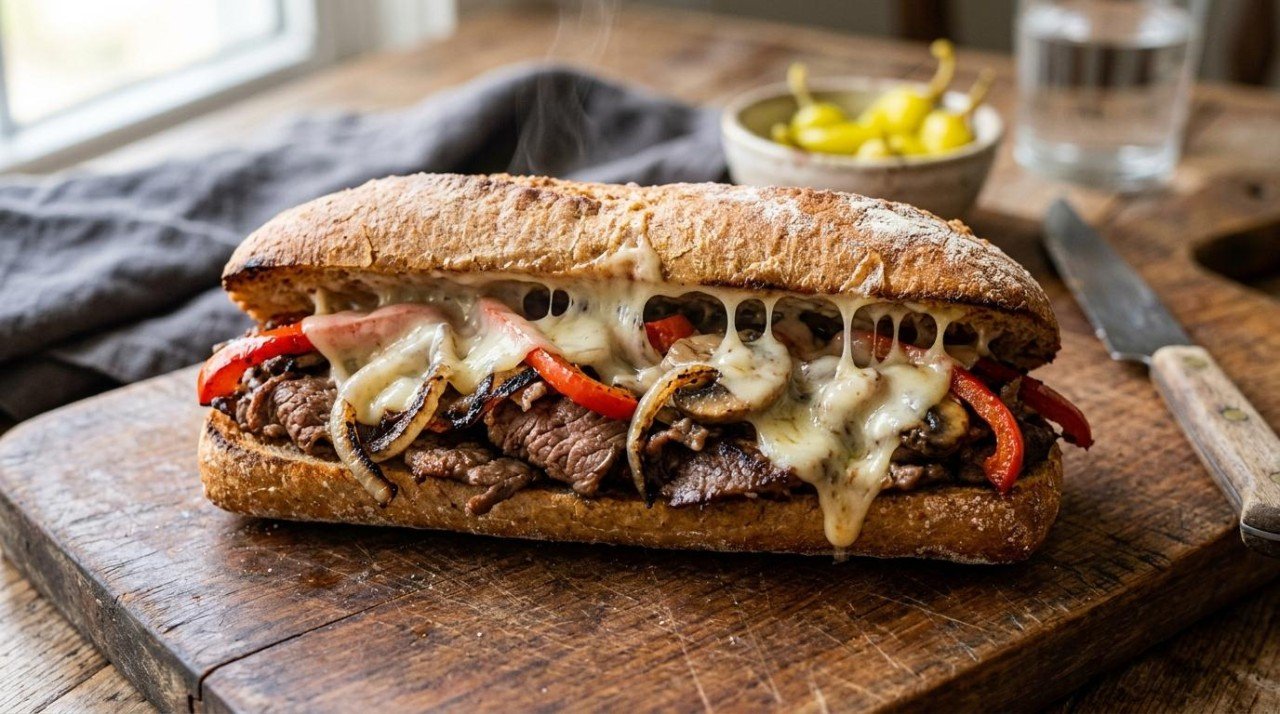
A Philly cheesesteak is one of the great one-pan sandwiches: shaved beef hitting a hot griddle, onions going soft and sweet beside it, cheese melting into the pile before the whole thing gets scooped into a roll. Pat and Harry Olivieri put the first one together in the early 1930s at a South Philadelphia hot dog stand. The cheese did not show up until the 1950s.
We ran a standard version through Eat Well Planner's Nutrition Score - the same number a visitor sees on any public recipe page. It came back 36 out of 100, with three warnings: saturated fat, sodium, and added sugar.
We rebuilt it to 63. It is still a cheesesteak - still shaved beef, still a griddle, still cheese melted over the top in the pan. And the swap everyone argues about, the cheese, turned out to be worth exactly one point on its own. The thing that actually moved the number was half a teaspoon of salt, and only because of where it came in the order.
The original: what's in it and how it scores
Here is the version we scored, for four sandwiches:
- 1 1/2 lb ribeye steak, shaved thin
- 2 tablespoons vegetable oil
- 1 medium yellow onion (about 7 oz), sliced
- 1/2 cup (4 oz) Cheez Whiz
- 4 white hoagie rolls (about 3 1/2 oz each)
- 1 teaspoon salt
Nutrition Score: 36/100. Per serving that is about 830 calories, 46.5 g protein, 18.2 g saturated fat, 1,660 mg sodium, and 2.8 g fiber. Three things hold it down:
- Saturated fat, flagged very high at 78% of a day's value in one sandwich. The ribeye carries roughly two thirds of it and the Whiz about a fifth - worth knowing before you blame the cheese. Harvard's Nutrition Source notes that "The Dietary Guidelines for Americans recommends getting less than 10 percent of calories each day from saturated fat," with the American Heart Association going further at 7 percent.
- Sodium, also flagged very high at 72% of the 2,300 mg ceiling - from the Whiz, the roll, and a teaspoon of griddle salt. Harvard notes that "Most Americans consume at least 1.5 teaspoons of salt per day, or about 3400 mg of sodium, which contains far more than our bodies need."
- One plant, and almost no fiber. A single onion is the entire vegetable content of the sandwich. Fiber comes in at 2.8 g, about 10% of a day.
There is also 5.5 g of added sugar per serving, which surprised us until we looked at where it comes from: processed cheese spread and a soft white roll both carry it.
What is already fine, though, is a lot. Per serving the original is an excellent source of vitamin B12 (216% DV), zinc (89%), phosphorus (85%), iron (84%), niacin (78%), vitamin B6 (63%), riboflavin (61%), and thiamine (60%), with 46.5 g of protein. That is the beef, and it is why a cheesesteak starts at 36 instead of in the teens. Nobody here is taking the beef out.
The upgrades
Five changes, scored cumulatively in this order. If you only make one, make the first - it is the biggest, and it is the only one that asks you to give up nothing at all.
1. Load the griddle with vegetables
- Swap: Nothing removed - a bigger onion (10 oz), plus 1 large bell pepper and 7 oz of mushrooms
- Score impact: +8 points (36 → 44)
- What it changes: Fiber from 2.8 g to 4.3 g, plant points from 1 to 3, vitamin C from nothing to 65% DV
- What it costs you: About 10 more minutes of griddle time, and roughly 30 calories a serving
The single most valuable change to a cheesesteak is not a substitution. It is adding food. Peppers and mushrooms take the sandwich from one plant to three, and in Philadelphia this is not heresy - peppers and mushrooms are a standard order, not a diet modification.
Cook them hard. Give them room in the pan and let them go past soft into deeply browned, 12 to 15 minutes, until the onions are sweet and the mushrooms have driven off their water and started to color. Crowded, steamed vegetables are watery and make the roll soggy; properly browned ones taste like they belong there. Variety is what earns the points, too - three different plants beat three times as much onion, which is the same principle behind the 30 different plants a week target for gut health.
One free upgrade inside this one: use a red bell pepper instead of a green one. Red peppers are just green peppers left on the plant to ripen - as the Tufts Health & Nutrition Letter puts it, "Red, yellow and orange bell peppers are simply the ripe forms of different green peppers, which is why they tend to cost more," with red peppers "loaded with beta-carotene (a form of vitamin A)." In our testing the color swap did not change the score at all, but it pushed vitamin C from 63% to 87% of a day's value and cleared low vitamin A off the weakness list. Free nutrition, identical number. Green is completely fine if that is what is in the fridge.
2. Top round instead of ribeye
- Swap: 1 1/2 lb ribeye → 1 1/2 lb top round
- Score impact: +6 points (44 → 50)
- What it changes: Saturated fat from 18.3 g to 7.9 g per serving - clearing the very-high flag - plus 177 fewer calories and 7 g more protein
- What it costs you: Marbling, which means less margin for error at the knife and on the griddle
This is the swap that does the heaviest nutritional lifting, and it is not a compromise on authenticity: the traditional cheesesteak is made with "thinly sliced rib-eye or top round beef." Top round has been a legitimate cheesesteak cut the whole time. It also takes total fat from 45.7 g to 23.0 g a serving and drops trans fat from 1.4 g to zero.
The honest cost is that ribeye's fat is forgiving and top round's leanness is not. Two techniques close most of the gap. First, get it thin: wrap the steak and freeze it 15 to 20 minutes before slicing, because as Tasting Table explains, "At room temperature beef is just too soft and squishy to be sliced easily with a knife. Putting it in the freezer firms it up and makes getting clean slices a lot easier." Slice against the grain with a sharp knife. Second, cook it fast and stop early - a screaming hot pan, 45 seconds undisturbed, then chop and toss for about a minute. Lean beef held on the griddle "just to be sure" is what turns tough.
3. A whole wheat roll
- Swap: White hoagie rolls → whole wheat hoagie rolls
- Score impact: +3 points (50 → 53)
- What it changes: Fiber from 4.3 g to 6.3 g per serving (21% DV), a fourth plant point, and added sugar down from 5.5 g to 3.0 g - which clears that flag
- What it costs you: The roll is the part of this sandwich people are most attached to - be choosy
Refining is not a small edit. Harvard's Nutrition Source notes the process "strips away more than half of wheat's B vitamins, 90 percent of the vitamin E, and virtually all of the fiber."
That said, this is the swap most likely to get noticed at the table, because a cheesesteak roll is supposed to be soft, slightly salty, and just sturdy enough to hold together. Buy a soft whole wheat hoagie roll, not a dense seeded loaf, and warm it before filling - a cold roll is what makes whole wheat read as heavy. If the only whole wheat option at your store is a brick, keep the white roll and take the other four swaps; we scored that too, and you still land at 61.
4. Real provolone instead of Cheez Whiz
- Swap: 1/2 cup (4 oz) Cheez Whiz → 3 oz sliced provolone
- Score impact: +3 points (53 → 56)
- What it changes: Sodium from 1,690 mg to 1,350 mg per serving, added sugar from 3.0 g down to 1.0 g, plus more calcium and protein
- What it costs you: The Whiz. There is no version of this where provolone tastes like Cheez Whiz.
Here is the part we promised to be straight about. If you love Cheez Whiz on a cheesesteak, you are not wrong, and the numbers are on your side more than you would expect: tested on its own against the original, swapping to provolone is worth exactly 1 point. One. It is the weakest single swap in this entire post. Cheez Whiz is not what is wrong with a cheesesteak.
What provolone actually does is unlock the next swap, which is the most interesting thing we found. Keep reading before you decide - and note that Whiz was a late arrival anyway, introduced at Pat's in the late 1950s, more than twenty years after the sandwich itself. Provolone has as much claim to the roll as Whiz does. Three ounces of it, laid over the pile and melted in the pan for 30 seconds, gives you a real cheese pull; a splash of water under a lid steams it along if it is stubborn. Our mozzarella substitutes guide covers which melting cheeses behave the same way if provolone is not your favorite.
Take the Guesswork Out of Eating Well
Eat Well Planner helps you organize your favorite recipes, plan balanced meals, and automatically generate shopping lists — all in one place. Whether you're tracking macros, managing dietary restrictions, or just trying to stop asking "what's for dinner?", we've got you covered.
Our AI-powered tools can adapt any recipe to your dietary needs, help you discover new meals you'll love, and even log your nutrition effortlessly. It's meal planning made simple.
Start Organizing Your Meals — Free5. Halve the added salt
- Swap: 1 teaspoon salt → 1/2 teaspoon
- Score impact: +7 points (56 → 63)
- What it changes: Sodium from 1,350 mg to 1,060 mg per serving - 59% of the daily limit down to 46%, moving sodium from "very high" to merely "high"
- What it costs you: Nothing you will taste, once the vegetables are properly browned
This is the finding of the post. Tested on its own against the original recipe, halving the salt is worth 1 point. Applied last, after the Whiz was gone, it is worth 7.
The reason is that the score's sodium warning has tiers, and on the original a half teaspoon of salt still was not enough to get under the "very high" line - the cheese and the roll were already carrying too much. Only once the processed cheese was out did the last 290 mg matter enough to cross a threshold. So the cheese swap's real value is not its own 3 points. It is that it makes the salt cut worth 7. Together, the pair is worth 10 points; separately, tested against the original, they are worth 1 each.
This is the general lesson we keep running into: sodium is mostly not the salt shaker. As Harvard puts it, "Most of the salt in our diets comes from commercially prepared foods, not from salt added to cooking at home or even from salt added at the table before eating." Fix the packaged ingredient first, and your own restraint at the stove starts to count for something.
What we kept (on purpose)
All 1 1/2 lb of beef stayed, and we checked the price of trimming it. Cutting the steak to about 1 lb scored 62 - one point lower - because protein per serving falls with it. A cheesesteak with less steak in it is not a better cheesesteak or a better score.
The full-size rolls stayed too. Dropping to smaller 2 1/2 oz rolls scored 63, exactly the same, while cutting 68 calories and 1 g of fiber. If you want a lighter sandwich, that is a fair trade; the score does not reward you for it, so we kept the roll people actually want.
The 2 tablespoons of oil stayed as plain neutral oil, and that one genuinely surprised us - see below.
We stopped at 63, and here is exactly where the ceiling is. Leaving the cheese off entirely scores 68, five points higher, with saturated fat down to 4.7 g a serving. That is the honest ceiling for this build, and we did not take it, because a cheesesteak without cheese is a steak sandwich. The two warnings that remain - sodium at 46% of a day and saturated fat at 35% - are what it costs to keep a cheese-covered beef sandwich on a roll, and we would rather say that plainly than pretend the number can go higher without the dish going away.
The healthier version: full recipe
Nutrition Score: 63/100. Makes 4 sandwiches.
- 1 1/2 lb top round steak
- 2 tablespoons neutral oil (canola, soybean, or other vegetable oil)
- 2 medium yellow onions (about 10 oz), sliced thin
- 1 large red bell pepper (about 7 oz), sliced thin
- 7 oz white or cremini mushrooms, sliced
- 3 oz provolone, thinly sliced
- 4 whole wheat hoagie rolls (about 3 1/2 oz each)
- 1/2 teaspoon salt
- Black pepper, to taste
- Wrap the steak tightly in plastic and freeze for 15 to 20 minutes, until firm but not frozen solid. Slice it as thin as you can against the grain with a sharp knife.
- Heat 1 tablespoon of the oil in a large cast-iron skillet or on a griddle over medium-high heat. Add the onions, bell pepper, and mushrooms, spread them out, and cook, stirring occasionally, until deeply browned and sweet, 12 to 15 minutes. Season with 1/4 teaspoon of the salt and move them to one side of the pan or onto a plate.
- Turn the heat to high and add the remaining oil. Spread the beef in a single layer and leave it undisturbed for 45 seconds, until it browns.
- Chop and toss the beef with a stiff spatula until just cooked through, about 1 minute more. Season with the remaining 1/4 teaspoon salt and black pepper. Do not keep cooking it - lean beef toughens fast.
- Return the vegetables to the pan, toss everything together, and divide the mixture into 4 piles.
- Lay the provolone over the piles and let it melt, 30 to 60 seconds. If it is slow, add a splash of water to the pan and cover for 20 seconds to steam it.
- Split and warm the rolls, then scoop a pile into each one, cheese side up. Serve immediately.
Per serving, before and after:
- Nutrition Score: 36 → 63
- Calories: about 830 → about 675
- Saturated fat: 18.2 g → 8.3 g (78% → 35% of the daily value; the very-high flag cleared)
- Sodium: 1,660 mg → 1,060 mg (72% → 46% of the daily limit)
- Fiber: 2.8 g → 6.3 g (10% → 21% of the daily value)
- Protein: 46.5 g → 56.6 g (58% → 70% of the daily value)
- Total fat: 45.4 g → 24.7 g, and trans fat 1.4 g → 0.15 g
- Added sugar: 5.5 g → 1.0 g (flag cleared)
- Plant points: 1 → 4
- Vitamin C: not a highlight → 87% of the daily value
- Warning flags: 3 → 2
The finished sandwich is an excellent source of vitamin B12 (125% DV), vitamin B6 (112%), niacin (109%), iron (103%), phosphorus (95%), vitamin C (87%), riboflavin (79%), zinc (76%), and protein (70%), with 21% of a day's fiber and 37% of its calcium.
Swaps we tested and skipped
- Olive oil instead of neutral oil (scored 61). The genuine surprise of this test - it made the score worse by 2 points. Ordinary soybean or canola vegetable oil carries meaningful omega-3 ALA, which the score rewards; olive oil has very little, and swapping it out dropped ALA off the highlight list entirely. This is a quirk of this specific dish, not a knock on olive oil, which we recommend constantly elsewhere - see our olive oil substitutes guide for where each oil earns its place. On a ripping-hot griddle you want a high-smoke-point neutral oil anyway.
- Keeping the Cheez Whiz (scored 55). Less a rejection than a priced option, and the honest answer to the question every Philadelphian is about to ask. Build everything else in this post and put the Whiz back, and you land at 55 instead of 63 - so the Whiz costs 8 points in the finished sandwich, mostly because its sodium keeps that flag pinned at "very high." That is still 19 points better than where you started. If Whiz is the reason you eat cheesesteaks, take the other four swaps and keep it.
- Less beef (scored 62). Cutting the steak to 1 lb dropped the score by a point. Protein is doing real work here; taking it out does not help.
Make it fit other diets
Gluten-free: the roll is the only real obstacle - use gluten-free hoagie rolls, warmed, or skip the bread and serve the beef and vegetables over roasted potatoes as a cheesesteak skillet. Dairy-free: a good melting dairy-free provolone-style slice works, or skip the cheese and finish with a spoonful of the pan juices - remember that scored 68 without it. Lower sodium still: a low-sodium fresh mozzarella in place of the provolone drops it further, at the cost of the sharper flavor. In Eat Well Planner you do not have to work any of this out by hand - ask the AI recipe chat to "make this gluten-free" and Recipe Variations rewrites the whole recipe with the swaps already in place.
Do this to any recipe you love
None of this was guesswork. Every score and delta above came out of Eat Well Planner's Make It Healthier feature, which proposes swaps like these and runs each one through a calculator to verify the real nutritional gain before it shows you the suggestion. Each swap was then stacked in the Recipe Playground, where the score moves with every edit - which is how we caught the thing that makes this post: that the cheese swap and the salt cut are each worth 1 point alone and 10 points together.
Run the same process on the sandwich your family actually makes. Import it from a website, a photo, or an Instagram reel, see where it honestly scores, and let Make It Healthier show you which changes are worth making and which ones just make the dish worse. Keep the cheesesteak. Just make the numbers better.