In the spring of 2021, a registered dietitian in Boston named Amy Wilichowski posted a short video of herself spooning pesto into a hot pan and cracking eggs directly into it. Her pitch was as simple as the recipe: use pesto instead of the oil you would normally fry eggs in. She had been putting pesto on her eggs after cooking them anyway, so why not cook them in it? Within weeks the video had millions of views, and by that June the Boston Globe reported it had passed 11 million.
It deserved the attention. Pesto is already mostly olive oil, so using it as the cooking fat costs you nothing, and the basil and Parmesan toast in the pan into something nutty and browned that plain fried eggs never manage. Five years later it is still one of the few viral breakfasts that people actually kept making.
So we scored it. The standard version — two eggs fried in a couple of spoonfuls of jarred pesto, served on white sourdough toast — comes out at 49 out of 100 on Eat Well Planner's Nutrition Score. Not a disaster. Not good, either. Three changes take it to 84, and none of them touch the part that made it go viral. Here is each one, with the number it actually moved.
The viral version: what is in it and how it scores
There is no single canonical recipe — that is part of why it spread — but the version everybody makes is remarkably consistent. Per serving:
- 2 large eggs
- 2 tablespoons jarred basil pesto (about 1 oz)
- 1 thick slice of white sourdough, toasted (about 2 oz)
Nutrition Score: 49/100. Per serving, that works out to 480 calories, 20 g protein, 1.8 g fiber, 31 g total fat (6.9 g saturated, 29% of the Daily Value), and 710 mg sodium — 31% of a day's worth before noon.
The score breaks down by health dimension, and the spread is telling: energy and recovery scored 66, weight management 60, but gut health came in at 31, longevity at 45, and heart health at 46. The three flags the score raised were low fiber, low plant diversity, and low vitamin C, with sodium and saturated fat both marked as cautions.
What is already fine — and it is a lot. The eggs are doing excellent work. This breakfast delivers 63% of the Daily Value for choline, 53% for iron, 46% for B12, 45% for riboflavin, 38% for biotin, and a quarter of your protein for the day. Nothing about the eggs needs fixing, and the pan-fried-in-pesto technique is not the problem either. If you came here worried that the trend was secretly bad for you, it is not.
What drags it down is the jar and the bread. Jarred pesto carries more salt than most people assume. USDA's data puts refrigerated pesto at 603 mg of sodium per 100 g, and the shelf-stable kind — the jar in the pantry — at 998 mg per 100 g, averaged across twelve samples that ranged from 866 to 1,270. Two tablespoons of that shelf-stable pesto is roughly 320 mg of sodium on its own, and then the bread brings its own. For context, the FDA sets the Daily Value at less than 2,300 mg and notes that Americans average about 3,400 mg, with over 70% of it coming from packaged and prepared foods rather than the salt shaker.
The white toast is the other half. At 1.8 g of fiber per serving, this breakfast covers a rounding error of the 25 to 35 g a day most adults need — and most Americans only get about 15 g as it is. The plate also scores zero plant points, because a spoonful of processed sauce does not count as a serving of plants no matter how much basil went into the jar.
The upgrades
We scored each change on top of the last, in this order, so the numbers below are what each swap is worth at that point in the build.
1. Make the pesto instead of buying it (+15 points)
- Swap: 2 tablespoons jarred pesto → homemade walnut-basil pesto
- Score impact: +15 points (49 to 64)
- What it changes: Sodium drops from 710 mg to 460 mg per serving, calories from 480 to 428, saturated fat from 6.9 g to 5.8 g, and omega-3 ALA jumps from 13% to 54% of the Daily Value
- What it costs you: Five minutes and a food processor. Nothing in flavor — most people prefer it
This is the whole post in one swap, and it is worth more than the other two combined. The issue with jarred pesto is the ratio: it is built oil-first, because oil is cheap, shelf-stable, and keeps the basil from browning. Ours goes the other way — a full ounce of fresh basil for two servings, and just one tablespoon of extra virgin olive oil instead of the four or so hiding in an equivalent scoop from the jar.
Two details make it work without salt. First, walnuts instead of pine nuts. Nut substitution is standard practice in non-traditional pesto — almonds, cashews, pistachios and walnuts all get used for cost and availability — and walnuts bring something pine nuts do not: an ounce of them carries over 2,500 mg of ALA, the plant omega-3. Toast them for two minutes if you want the flavor louder. Second, a teaspoon of lemon juice. Acid does a lot of the job people reach for salt to do, which is why 2 tablespoons of real Parmesan is enough seasoning here on its own.
If you only make one change from this entire post, make this one.
2. Put it on whole grain bread (+9 points)
- Swap: White sourdough → 100% whole wheat or whole grain sourdough
- Score impact: +9 points (64 to 73)
- What it changes: Fiber goes from 2.1 g to 3.9 g per serving; protein from 20.7 g to 22.6 g
- What it costs you: A denser, nuttier slice. Under a runny yolk and a pile of pesto, you will not think about it
Refining wheat is not a small edit to the grain. It strips more than half of wheat's B vitamins, 90% of its vitamin E, and virtually all of its fiber. Going the other direction is one of the better-supported swaps in nutrition: a meta-analysis of more than 786,000 people found that eating 70 g of whole grains a day was associated with 22% lower total mortality and 23% lower cardiovascular mortality.
One technique note. Whole grain slices toast drier than white sourdough, so give them an extra minute and press the pesto into the warm surface rather than spreading it on cold bread — it soaks in instead of sitting on top.
3. Add tomatoes and a handful of arugula (+11 points)
- Swap: Add 1 cup halved cherry tomatoes and a loose cup of arugula per two servings
- Score impact: +11 points (73 to 84)
- What it changes: Fiber from 3.9 g to 4.9 g, vitamin C from nothing to 18% DV, plant points from 2.5 to 4.5, plus potassium and a big lift in vitamin K
- What it costs you: Sixty seconds of slicing. No cooking, no cleanup
This is the highest return per unit of effort in the post, and it is the one people skip. Adding raw vegetables closed both of the remaining flags on the score at once — low vitamin C and low plant diversity — and it is the reason the gut health dimension finished at 80 after starting at 31.
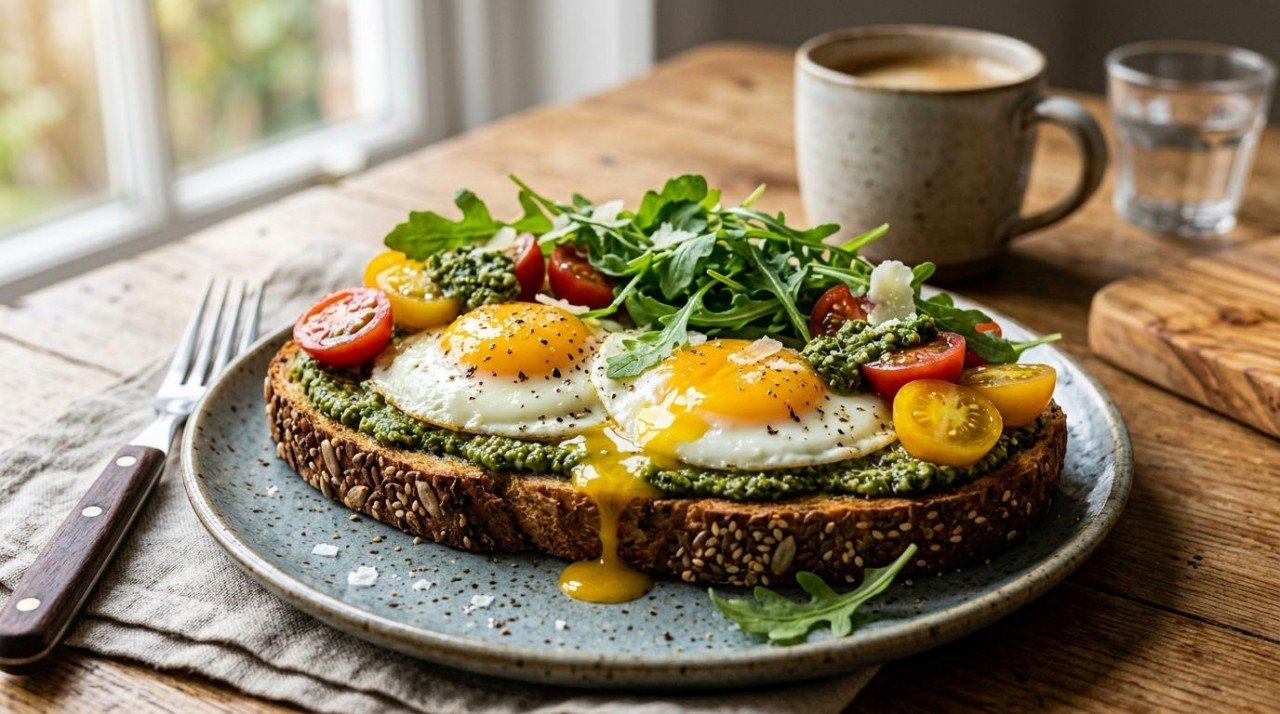
It also improves the eating. Fried eggs in pesto on toast is a rich, fatty, one-note mouthful by design. Peppery arugula and acidic tomato cut straight through it, the same way a squeeze of lemon does. Build it in order: pesto on the toast, arugula, tomatoes, then the egg on top, so the greens do not wilt into steam under the yolk.
Take the Guesswork Out of Eating Well
Eat Well Planner helps you organize your favorite recipes, plan balanced meals, and automatically generate shopping lists — all in one place. Whether you're tracking macros, managing dietary restrictions, or just trying to stop asking "what's for dinner?", we've got you covered.
Our AI-powered tools can adapt any recipe to your dietary needs, help you discover new meals you'll love, and even log your nutrition effortlessly. It's meal planning made simple.
Start Organizing Your Meals — FreeWhat we kept on purpose
Four things stayed, and all four were deliberate:
- Both yolks. They are where the choline, the vitamin D, most of the B12, and all of the runny-yolk appeal live.
- Real Parmesan. Two tablespoons does the seasoning work of a much bigger pinch of salt.
- Real olive oil. Less of it, not a substitute for it.
- The method. Frying the eggs in the pesto is the entire idea. Nothing here changes it.
We stopped at 84. Saturated fat is still flagged at 25% of the Daily Value in the finished version, and we left it there on purpose: that number is the yolks and the Parmesan, and removing either one stops it from being pesto eggs. Every remaining point costs more than it is worth.
The healthier pesto eggs: full recipe
Nutrition Score: 84/100. Serves 2, about 15 minutes.
For the walnut-basil pesto (makes about 1/3 cup, enough for both servings):
- 2 cups loosely packed fresh basil leaves (about 1 oz)
- 2 tablespoons walnuts
- 2 tablespoons finely grated Parmesan
- 1 small garlic clove
- 1 tablespoon extra virgin olive oil
- 1 teaspoon lemon juice
- 1 to 2 teaspoons water, to loosen
For the eggs and toast:
- 4 large eggs
- 2 thick slices whole grain sourdough or 100% whole wheat bread
- 1 cup cherry tomatoes, halved
- 1 loose cup arugula
- Black pepper and red pepper flakes
- Pulse the basil, walnuts, Parmesan, garlic, lemon juice and olive oil in a small food processor until coarse — you want texture, not a smooth puree. Add water a teaspoon at a time until it is spoonable.
- Taste it before you salt it. The Parmesan and lemon usually carry it on their own; the scored version above contains no added salt at all.
- Toast the bread while you halve the tomatoes.
- Set a skillet over medium-low. Spoon about half the pesto into the pan in two puddles, spreading each to roughly the width of an egg, and let it warm for 30 seconds until it smells green and toasty. Keep the heat gentle — this is Wilichowski's own advice, and it matters, because pesto has solids in it and scorches faster than plain oil.
- Crack two eggs directly onto the pesto. Cover the pan and cook 3 to 4 minutes, until the whites are set and the yolks are still runny.
- Spread the remaining pesto on the toast. Layer arugula, then tomatoes, then the eggs. Finish with black pepper and red pepper flakes.
Per serving, original vs. improved:
- Nutrition Score: 49 → 84
- Calories: 480 → 437
- Protein: 20 g → 23 g
- Fiber: 1.8 g → 4.9 g
- Total fat: 31 g → 25 g
- Saturated fat: 6.9 g → 5.9 g
- Sodium: 710 mg → 430 mg
- Omega-3 (ALA): 13% DV → 57% DV
- Plant points: 0 → 4.5
The finished plate earns "good source of" marks for vitamin K (76% DV), choline (66%), ALA omega-3 (57%), phosphorus (56%), iron (52%) and fiber, on 43 fewer calories than the version it replaced.
Swaps we tested and skipped
The ricotta or whipped cottage cheese layer
This is the one we expected to work. Wilichowski's own version puts ricotta on the toast, the internet has been whipping cottage cheese onto everything for two years, and the reasoning — more protein, holds you until lunch — is sound. It does not survive scoring.
Half a cup of cottage cheese on top took the finished version from 84 down to 77. Protein did exactly what everyone expects, climbing from 23 g to 30 g per serving, but sodium went back up from 430 mg to 620 mg and saturated fat rose to 28% DV, and the score weighs those against the protein gain. A scant half cup of whole milk ricotta was worse: 84 down to 72, with saturated fat jumping from 5.9 g to 8.9 g, or 38% of the Daily Value.
The satiety instinct was not wrong — the salt and saturated fat riding along with it were the problem. If the creamy layer is your favorite part, a no-salt-added cottage cheese or part-skim ricotta will land somewhere better than what we tested, and our cottage cheese substitutes guide covers the trade-offs. Worth testing yourself rather than taking our number for it.
Swapping half the eggs for egg whites
This one did score higher — 84 up to 88 — and we still rejected it. Dropping two yolks cut choline from 66% to 35% DV, B12 from 45% to 26%, and knocked vitamin D off the highlights entirely. It also removes the runny yolk, which is the point of the dish. Four points is not a good trade for that.
Make it fit other diets
- Dairy-free: Replace the Parmesan with a tablespoon of nutritional yeast and a small pinch of salt. You lose some savory depth; the lemon covers more of it than you would think.
- Gluten-free: Any whole grain gluten-free bread works. Check the label — some run noticeably higher in sodium, which eats into the gain from swap one.
- Nut-free: Pumpkin seeds give you the texture, though most of the omega-3 improvement came from the walnuts specifically.
- Vegan: Honestly, no. The eggs are the recipe. The pesto, whole grain toast, tomatoes and arugula make a genuinely good breakfast with white beans instead — it is just a different dish.
In the app, you do not have to work these out by hand: ask AI Recipe Chat to make this dairy-free and it rewrites the whole recipe with the substitutions already worked in, quantities adjusted.
Do this to the next recipe you save
Pesto eggs turned out better than its reputation in one direction and worse in another. The technique was never the problem, and the eggs were carrying the whole thing. The two ingredients nobody thinks about — what came out of the jar and what the toast was made of — were worth 24 of the 35 points.
That is the pattern almost every recipe follows, and it is why guessing does not work. In Eat Well Planner you can import any recipe from a URL, an Instagram reel or a YouTube video, see its Nutrition Score, and run Make It Healthier — which proposes swaps like these and verifies the real nutritional gain with a calculator before it shows you a single one. The Recipe Playground is where you argue with it: keep the ricotta, drop the Parmesan, use a different bread, and watch what each edit does to the score before you commit.
Next time a breakfast blows up on your feed, import it and score it before you decide how you feel about it. Sometimes it is fine. Sometimes it is 35 points from being genuinely great.