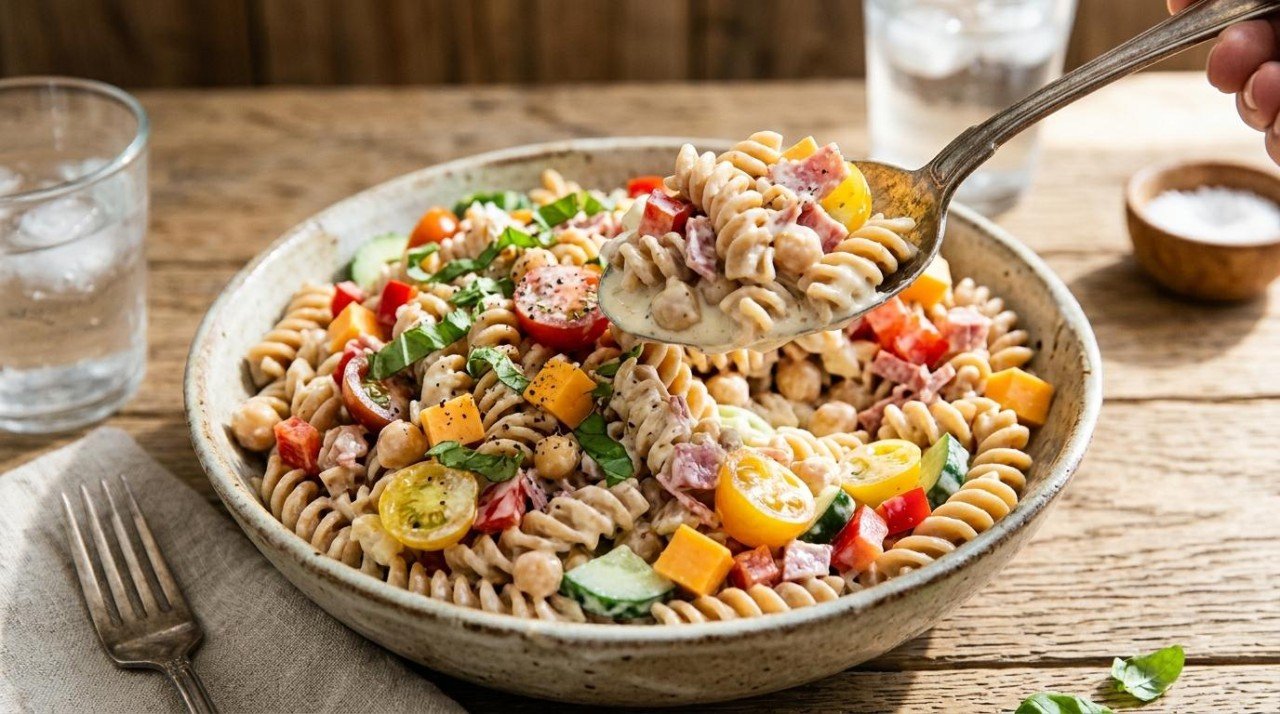
Creamy pasta salad is the potluck dish nobody plans and everybody eats. Rotini, a lot of mayonnaise, a splash of bottled Italian dressing, some celery, cubes of cheddar and a handful of diced salami. It gets made in a bowl the size of a sink, it sits on the table for three hours, and it disappears anyway.
We ran the standard version through our Nutrition Score expecting it to land somewhere in the forties, alongside its cousin the creamy potato salad. It came back at 32 out of 100 — the lowest opening number we have scored in this series for a side dish. Potato salad has potatoes doing quiet nutritional work in the background. This one has refined pasta doing almost nothing, and two thirds of a jar of mayonnaise on top of it.
We rebuilt it to 72. It is still creamy, still cold, still has cheddar and salami in it. Here is every swap and exactly what it was worth — including the change every healthy-eating article tells you to make, which turned out to be worth three points, and which we made anyway.
The original: what is in it and how it scores
The version we scored is the deli-case and church-potluck standard, built to serve eight as a side:
- 1 lb rotini (dry weight), boiled and cooled
- 1 1/2 cups mayonnaise
- 1/2 cup bottled Italian dressing
- 1 cup diced celery and 1/2 a red onion
- 6 oz cheddar, cut into cubes
- 4 oz salami, diced
- 1 teaspoon salt and plenty of black pepper
Per serving that is about 681 calories, 16.1 g of protein, 2.3 g of fiber, 47 g of total fat, 11.2 g of saturated fat and roughly 1,120 mg of sodium. The score flags two things as high: sodium at 49% of a day's limit and saturated fat at 48%. One serving — one eighth of the bowl, and nobody eats one eighth of the bowl — is most of a day's saturated fat allowance in a side dish.
Now the honest part, because the original is not a nutritional void. Its three listed strengths are omega-3 ALA, vitamin K and folate, and the first two are coming from the mayonnaise. Most American mayo is mostly soybean oil, which Harvard names among the main plant sources of ALA and also lists as a real dietary source of vitamin K, along with salad dressings made from it. The enriched pasta brings genuine thiamine, folate, niacin and iron. This is not a bowl of nothing.
What drags it to 32 is three things, in order of damage:
- Sodium. 1,120 mg a serving, and only about a quarter of it is the teaspoon of salt. The rest is the bottled dressing, the cheddar and the salami — all three are cured or manufactured with salt as a primary ingredient. For context, Americans already average about 3,400 mg a day against a 2,300 mg ceiling, roughly 75% of it from processed food.
- Fiber, or the absence of it. 2.3 g a serving. Refining wheat removes more than half its B vitamins, 90% of its vitamin E and virtually all of the fiber, and a pound of white rotini is the largest single ingredient in the bowl. Adults need 25 to 35 g a day and most Americans get about 15.
- Almost no plants. 2.25 plant points for an entire bowl — wheat, celery, onion, and a trace from the dressing. Vitamin C reads as zero. There is nothing green in it that has not been pickled or bottled.
The dimension breakdown says the same thing more bluntly: gut health 22, heart health 28, longevity 29.
The upgrades: six swaps, 40 points
Each swap below was scored on top of the ones before it, in the order shown, so the deltas add up to the real total. Where a swap is worth something very different on its own, we say so — that turned out to be the most useful thing we learned here.
1. Rebuild the dressing instead of pouring two of them
- Swap: 1 1/2 cups mayonnaise plus 1/2 cup bottled Italian dressing → 3/4 cup mayonnaise, 3/4 cup plain whole-milk Greek yogurt, 2 tablespoons apple cider vinegar, 1 tablespoon Dijon and 1 tablespoon olive oil
- Score impact: +8 points (32 to 40)
- What it changes: 144 calories off a serving, saturated fat 11.2 g to 8.9 g, sodium 1,120 mg to 870 mg, added sugar effectively to zero, protein up 2 g
- What it costs you: A tang the bottled dressing used to fake with sugar. It reads as intentional rather than as a compromise.
The bottled Italian is the ingredient to lose first. It exists in the original recipe to add acid and salt, and it brings sugar and a long ingredient list along for the ride. Two tablespoons of cider vinegar and a spoon of Dijon do the same job with more character, and the Dijon also emulsifies, which keeps the dressing from separating in the fridge.
Halving the mayonnaise and making up the volume with Greek yogurt is the standard move, and it works here better than it does in most dishes because nothing is ever heated — the yogurt has no chance to split. Use full-fat strained Greek yogurt, not nonfat. Nonfat is thinner and sourer, and you will end up compensating with salt.
2. Whole wheat rotini, same pound
- Swap: 1 lb white rotini → 1 lb whole wheat rotini
- Score impact: +8 points (40 to 48)
- What it changes: Fiber from 2.4 g to 5.8 g a serving; more magnesium, potassium and zinc
- What it costs you: A nuttier, slightly chewier noodle — genuinely hard to notice in a cold, heavily dressed salad
Whole wheat pasta is a hard sell in a bowl of buttered noodles and an easy one here. Cold, coated in a thick dressing, cut with vinegar and studded with cheese, the flavor difference is the smallest it will ever be. It is the highest-value swap in this post per unit of complaint, and if you are the kind of household where half the table would notice, use half white and half whole wheat — it still moves.
One technique note that matters more with whole wheat than white: cook it well past al dente. America's Test Kitchen recommends about three minutes past, because as pasta cools "the starch chains creep back together, forming tight microscopic crystals" and al dente pasta turns rubbery in the fridge. Whole wheat starts firmer, so this is not optional. If you are still choosing a box, our pasta substitution guide covers what actually swaps for what.
3. Half the pasta, and vegetables in its place
- Swap: 1 lb pasta → 8 oz, plus 2 cups cherry tomatoes, a red bell pepper, half an English cucumber, more celery, basil and parsley
- Score impact: +3 points (48 to 51)
- What it changes: Plant points 3.25 to 6.75, vitamin C from zero to 40 mg (42% DV), 81 calories off a serving
- What it costs you: Nothing on the plate. It costs you ten minutes of chopping.
Here is the honest bit. This is the swap every healthy-eating article leads with, and on our score it is worth three points — the smallest delta in the post. Fiber actually went down, from 5.8 g to 4.2 g, because halving the pasta removed more fiber than the vegetables added back. Cucumbers and tomatoes are mostly water.
We kept it anyway, and would keep it if it scored zero, for two reasons. It is what turns the dish from a bowl of dressed noodles into something with color and crunch in it, which is the whole texture argument for a cold salad. And plant variety is a real target that the overall score only partly captures: the American Gut Project found people eating more than 30 different plant types a week had meaningfully more diverse gut microbiomes than those eating ten or fewer. This one bowl moves you 4.5 plants closer, which is why we track it separately — more on that in 30 plants a week.
4. A can of chickpeas
- Swap: Add one 15-oz can of chickpeas, drained and rinsed
- Score impact: +5 points (51 to 56)
- What it changes: Fiber 4.2 g back up to 6.3 g, protein 15.5 g to 18.0 g, potassium 480 mg to 560 mg, one more plant
- What it costs you: Nothing, if you dry them properly. Wet chickpeas water down the dressing.
This is the swap that put the fiber back that the previous one took out, and it is the reason the vegetable swap survives scrutiny. It is also the clearest demonstration in this post that the score is not a calorie counter: calories per serving went up from 446 to 509 and the score rose five points, because what came with those calories was fiber, protein and minerals.
Chickpeas belong in a cold pasta salad the way they belong in a Greek salad — they take on dressing, they are firm, and they mean a portion actually holds you. Eating legumes about four times a week is associated with a 14% lower risk of coronary artery disease, and pulses lower LDL cholesterol by about 6% in pooled analyses.
5. Cheese and salami become accents, not ingredients
- Swap: 6 oz cubed cheddar → 3 oz sharp cheddar; 4 oz salami → 2 oz, diced fine
- Score impact: +10 points (56 to 66) — the biggest delta in the post
- What it changes: Saturated fat 9.2 g to 6.3 g, sodium 940 mg to 740 mg, 73 calories off a serving
- What it costs you: Real ground, and this is the swap to argue with. Protein drops from 18.0 g to 14.0 g.
Two rules make this survivable. Use sharp cheddar, not mild — sharpness is concentration, so half as much reads as the same amount of cheese. And dice the salami small rather than cubing it, so 2 oz turns up in every forkful instead of in four lucky bites. Cured meat as a seasoning is how Italian cooking has always used it.
The receipt on why order matters: we also tested this exact cut on the untouched original, and there it was worth 3 points, not 10. The same change is worth more once the dressing and the pasta have stopped dominating the numbers. That is not a scoring quirk — it is a real thing about food. Trimming the cheese in a bowl that is two thirds mayonnaise barely registers.
6. Half the salt
- Swap: 1 teaspoon salt → 1/2 teaspoon
- Score impact: +6 points (66 to 72)
- What it changes: Sodium 740 mg to 600 mg a serving, 32% DV down to 26%
- What it costs you: Nothing you will taste, because of the order we did this in
On its own, against the original recipe, cutting this same half teaspoon was worth 2 points and would have made the salad taste flat. Applied last — after the vinegar, the Dijon, the sharp cheddar and the salami are all in there doing seasoning work — it is worth 6 and you cannot tell. Acid is what lets you take salt out without the dish going dull, which is why we put the vinegar in first and took the salt out last.
Take the Guesswork Out of Eating Well
Eat Well Planner helps you organize your favorite recipes, plan balanced meals, and automatically generate shopping lists — all in one place. Whether you're tracking macros, managing dietary restrictions, or just trying to stop asking "what's for dinner?", we've got you covered.
Our AI-powered tools can adapt any recipe to your dietary needs, help you discover new meals you'll love, and even log your nutrition effortlessly. It's meal planning made simple.
Start Organizing Your Meals — FreeWhat we kept, and what keeping it costs
Everything below stayed in the finished recipe. We scored what putting the original version back would cost, from 72:
- The mayonnaise (3/4 cup). Going back to the full 1 1/2 cups with no yogurt: 60, twelve points down. Going the other way and dropping the mayo entirely scores 75 — three points we turned down, see below.
- The cheddar (3 oz). Back up to 6 oz: 66, six points down.
- The salami (2 oz). Taking it out completely scores 78. Six points, declined.
- The whole wheat pasta. White rotini instead: 65, seven points down.
- The 1/2 teaspoon of salt. Removing it entirely scores 77. Five points, declined, because unseasoned pasta salad is not a thing anyone finishes.
And here is where we stopped. At 72 the score still flags saturated fat at 27% DV and sodium at 26% DV as high, and both flags trace to the cheese and the cured meat. Every remaining point lives there. We are not taking them out, because a creamy pasta salad with no cheese and no salami is a cold vegetable bowl with noodles in it — a perfectly good thing to eat, and not this dish. The makeover stops at the last swap that leaves it recognizable.
The healthier version: full recipe
Nutrition Score: 72 out of 100. Serves 8 as a side.
- 8 oz whole wheat rotini
- 3/4 cup mayonnaise
- 3/4 cup (180 g) plain whole-milk Greek yogurt
- 2 tablespoons apple cider vinegar, plus more for serving
- 1 tablespoon Dijon mustard
- 1 tablespoon olive oil
- 1/2 teaspoon salt, plus salt for the pasta water
- 1/2 teaspoon black pepper
- 2 cups cherry tomatoes, halved
- 1 large red bell pepper, diced
- 1/2 English cucumber, quartered lengthwise and sliced
- 3 stalks celery, thinly sliced
- 1/2 small red onion, finely diced
- One 15-oz can chickpeas, drained, rinsed and patted dry
- 3 oz sharp cheddar, cut into small cubes
- 2 oz salami, finely diced
- 1/2 cup lightly packed fresh basil leaves, torn
- 1/4 cup chopped fresh parsley
- Boil the rotini in well-salted water until about 3 minutes past al dente — soft all the way through, still holding its shape. Whole wheat pasta firms up considerably as it chills, so cooking it to al dente here gives you a rubbery salad tomorrow.
- Drain and run under cold water until the pasta is cool, then shake the colander well and leave it to drain while you make the dressing.
- Whisk the mayonnaise, Greek yogurt, cider vinegar, Dijon, olive oil, 1/2 teaspoon salt and the black pepper together in a large bowl. Taste it now — it should be sharper than you think it needs to be, because the pasta will mute it.
- Add the drained pasta to the bowl and toss it with about a third of the dressing while it is still slightly damp. Let it sit 10 minutes; it absorbs dressing far better now than it will once it is cold.
- Add the tomatoes, bell pepper, cucumber, celery, red onion, chickpeas, cheddar and salami. Fold everything through the remaining dressing.
- Fold in the basil and parsley last so they stay green. Chill at least 1 hour.
- Before serving, taste again. It will have tightened in the fridge — loosen it with a splash of cider vinegar rather than more mayonnaise, which is how you keep the score and the flavor.
Per serving, original versus this one:
- Nutrition Score: 32 → 72
- Calories: 681 → 436
- Protein: 16.1 g → 14.0 g
- Fiber: 2.3 g → 6.3 g (21% DV, an excellent source)
- Total fat: 47.4 g → 27.6 g
- Saturated fat: 11.2 g (48% DV) → 6.3 g (27% DV)
- Sodium: 1,120 mg (49% DV) → 600 mg (26% DV)
- Added sugar: 1.9 g → effectively zero
- Potassium: 270 mg → 530 mg
- Vitamin C: 0 mg → 40 mg (42% DV)
- Plant points: 2.25 → 7.75
- Gut health dimension: 22 → 75
The finished salad comes out an excellent source of vitamin K, omega-3 ALA, vitamin C, phosphorus, iron, folate, biotin, B6, niacin, riboflavin, thiamine, fiber and zinc — and it still has salami in it.
Swaps we tested and skipped
- All Greek yogurt, no mayonnaise: scores 75. Three points better and 126 calories lighter, and we turned it down. Without any mayo the dressing goes thin and sharp, and by day two it reads like a tzatziki noodle bowl. Creamy pasta salad has to be creamy or it is a different dish.
- Grilled chicken breast instead of the chickpeas: scores 68. Four points down, despite taking protein to 18.3 g, because it costs 2.1 g of fiber and a plant. If you want the protein, the better move is to add the chicken as well as the chickpeas — that version scores 76 at 20.8 g of protein, and turns a side into a lunch.
- Dropping the salami: scores 78. The single biggest remaining point gain, and a straight refusal. Two ounces across eight servings is doing more flavor work than anything else in the bowl.
- No salt at all: scores 77. Real points on paper. Not real food.
Make it fit other diets
The salad takes variations well because nothing depends on gluten, dairy or meat structurally — it all just gets folded in cold. For gluten-free, chickpea or brown rice rotini both hold up in a cold salad (we did not score that swap, so treat it as a cooking recommendation rather than a verified number). For vegetarian, leave the salami out and add 1/4 cup toasted sunflower seeds for the salty crunch — the no-salami version scored 78, so you gain rather than lose. For dairy-free, use all mayonnaise instead of the yogurt and swap the cheddar for extra chickpeas and a spoonful of capers.
In the app you do not have to work any of that out by hand: ask for a dairy-free or gluten-free version of a saved recipe and Recipe Variations rewrites the whole thing with the substitutions already made, then scores the result so you can see what the variation cost or gained.
Do this to your own recipes
Nothing here required special ingredients or a rewrite. Six swaps, none of which change what the dish is, moved a beloved potluck side from 32 to 72 — and the two most surprising results, that trimming the cheese is worth three points early and ten points late, and that adding vegetables barely moves the number while still being worth doing, only showed up because every step was measured instead of assumed.
You can run the same process on the pasta salad your family actually makes. Import it into Eat Well Planner from a website, a photo of a handwritten card or an Instagram reel, and it gets a Nutrition Score with the same breakdown you have been reading. Then Make It Healthier proposes swaps for that specific recipe, with the nutritional gain verified by a calculator before the suggestion is ever shown to you. If you want to argue with it — keep the full pound of pasta, double the salami, put the bottled dressing back — the Recipe Playground lets you edit ingredients and watch the score move per change, so you can decide what a thing is worth to you instead of being told.
Keep the dish. Change the numbers around it.