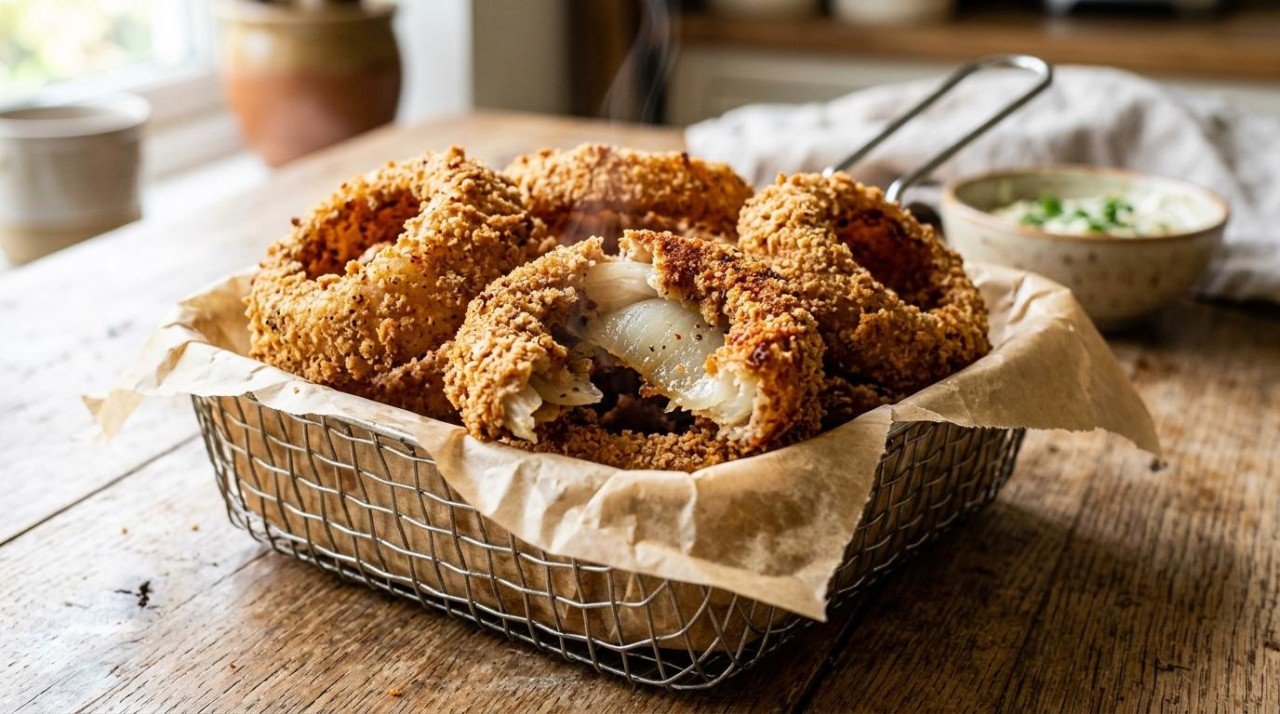
Onion rings have a strange nutritional secret. The onion inside them is one of the best-scoring foods in the kitchen. On its own, a plain yellow onion scores 89 out of 100 in Eat Well Planner's Nutrition Score. Then we coat it in flour, buttermilk, egg and bread crumbs, drop it in a pot of oil, salt it, and it comes out of the fryer at 48.
So this makeover had an unusually clear target. The onion was never the problem. The coat was. We scored a standard batch of homemade buttermilk onion rings, then rebuilt the coating one verified swap at a time. The finished rings score 89, the same as the raw onion they started as. They are still golden, still crunchy, and still gone within five minutes of leaving the oven.
Along the way we found one swap where the score and the truth disagreed. We took the points out rather than publish them. That story is in "What we kept."
The original: what's in it and how it scores
The classic homemade version, for four people: 2 large yellow onions (about 600 g of rings), dredged in about 1/2 cup of all-purpose flour, dipped in low-fat buttermilk beaten with an egg, pressed into about 1 cup of plain dry bread crumbs, and deep-fried. A teaspoon of salt gets split between the flour and a sprinkle over the hot rings. You eat the oil the coating absorbs, not the whole pot, so we modeled that at 80 g, a little under 6 tablespoons across the batch.
Nutrition Score: 48/100. Per serving: 427 calories, 9.3 g protein, 4.4 g fiber, 23.3 g total fat, 3.7 g saturated fat, 830 mg sodium, and 430 mg potassium. One caution flag: sodium, at 36% of a day's reference. The flagged weaknesses are high omega-6, low vitamin D and low EPA/DHA omega-3. Plant points: 1.
Start with what is genuinely fine, because there is a lot of it. The onion carries most of the fiber: 2.9 of those 4.4 g. Onions are also one of the everyday foods that naturally contain inulin-type fructans, a prebiotic fiber that a 2021 systematic review in Advances in Nutrition links to better laxation, better gut barrier function and more satiety. There is no added sugar. Enriched flour and bread crumbs make a serving an excellent source of thiamine (40% of a day's reference), iron (34%) and folate (33%).
Three things pull the score down, and every one of them is in the coating.
- Sodium. 830 mg per serving is 36% of the 2,300 mg Daily Value, and the FDA calls 20% DV or more per serving high. About 580 mg of that is the teaspoon of salt. Most of the rest, about 180 mg, comes from the bread crumbs.
- The frying oil. 20 of the 23 g of fat per serving is absorbed oil, enough omega-6 to trip the app's fatty-acid balance flag.
- Refined grains. White flour and white crumbs add calories and bulk. They don't add the fiber a grain coating could carry.
The upgrades
We applied these in order and re-scored after each one, so every delta is what that change was worth at that point in the build. If you only make one change, make the first two together. We'll show you why.
1. Bake them on a rack with one tablespoon of oil
- Swap: About 6 tablespoons of absorbed frying oil to 1 tablespoon (14 g) of oil, toasted into the crumbs, baked at 425F on a wire rack
- Score impact: +10 points (48 to 58)
- What it changes: Calories from 427 to 279 per serving, total fat from 23.3 g to 6.8 g, saturated fat from 3.7 g to 1.5 g. The omega-6 flag clears
- What it costs you: The bubbly, blistered crust of a batter-fried ring. What you get instead is an even, crackly, golden crumb
In our french fries and fish and chips makeovers, turning off the fryer turned out to be a small lever. Here it is a real one. A breaded ring is mostly coating by surface area, and the coating is what soaks up oil. That oil was the whole omega-6 problem, and baking removes 148 calories a serving.
Baked onion rings usually fail in one of two ways: pale, soft crumbs, or a coating that slides off. America's Test Kitchen ran into the second one in testing. Their fix started with coating the raw rings in flour first so the wet layer has something to cling to, and we do the same. Our other move is to put the oil where the color needs to be. Instead of pouring it on the pan, toss the tablespoon of oil with the crumbs and toast them in a skillet until golden before you coat anything. The oven then only has to cook the onion and set the coating, because the browning is already done. A wire rack lets hot air reach the underside, so there is no soggy bottom and no flipping.
2. Cut the salt to a scant quarter teaspoon
- Swap: 1 teaspoon (6 g) salt to a scant 1/4 teaspoon (1 g), sprinkled over the hot rings only
- Score impact: +15 points (58 to 73)
- What it changes: Sodium from 830 mg to 350 mg per serving (36% to 15% of a day's reference). The caution flag clears
- What it costs you: Less than you would expect, because all the salt is now on the surface, where you taste it first
This is the biggest single number in the post. Here is why the first two swaps belong together. We scored each of them alone on the original recipe:
- Bake them, keep the salt: 48 to 58 (+10)
- Keep frying, cut the salt: 48 to 59 (+11)
- Do both: 48 to 73 (+25)
Together they are worth 4 points more than the two parts added up. Whichever problem you leave in place keeps a ceiling over the score. Salt is also sensitive at this level. A level 1/4 teaspoon (1.5 g) instead of a scant one (1 g) scores the finished recipe at 87 rather than 89. Half a gram across four servings costs two points.
Where the salt goes matters as much as how much. In the original, half of it disappears into the flour, and you never taste it. Salting only the hot rings puts every grain on the outside.
3. Season the crumbs instead of the flour
- Swap: Nothing to 2 teaspoons smoked paprika, 1 1/4 teaspoons garlic powder, 1/2 teaspoon black pepper and 1/4 teaspoon cayenne, stirred into the toasted crumbs
- Score impact: +5 points (73 to 78)
- What it changes: Fiber from 4.4 g to 5.0 g, potassium from 430 mg to 470 mg, plant points from 1 to 2
- What it costs you: Nothing. This is the step that makes a quarter teaspoon of salt taste like enough
Smoked paprika does two jobs here. It adds a faint smoky, "fried" flavor that a baked coating otherwise lacks, and it deepens the color, so the rings look as golden as they taste. Add the spices after toasting the crumbs, because paprika and garlic powder scorch fast in a hot skillet.
4. Make your own whole wheat crumbs
- Swap: 1 cup plain dry bread crumbs to 4 slices (140 g) of 100% whole wheat bread, pulsed into crumbs and toasted
- Score impact: +8 points (78 to 86)
- What it changes: Fiber from 5.0 g to 6.0 g, protein from 9.7 g to 10.7 g, sodium down another 40 mg, plant points from 2 to 3
- What it costs you: A slightly nuttier, less shattering crumb than panko. Toasting closes most of that gap. It also adds about 1 g of added sugar per serving from the bread
Refining wheat strips out the bran and germ, and Harvard's Nutrition Source notes that this removes more than half of wheat's B vitamins, 90 percent of the vitamin E, and virtually all of the fiber. Making crumbs from a loaf you already own also means you control what is in them. Check that the bread says "100% whole wheat," with whole wheat flour listed first (our guide to buying bread that is actually whole grain covers the label tricks).
We also tested store-bought low-sodium panko in this slot. It cut sodium further, to 200 mg per serving, and still scored 84, five points below the whole wheat crumbs, because the fiber went with it. More options are in our bread crumbs substitution guide.
5. Whole wheat flour for the dredge
- Swap: 1/2 cup all-purpose flour to 1/2 cup (60 g) whole wheat flour
- Score impact: +2 points (86 to 88)
- What it changes: Fiber from 6.0 g to 7.2 g, potassium to 550 mg, plant points to 4
- What it costs you: Nothing you can detect. The flour is a thin undercoat buried under the crumbs
Small, but free. The flour's only job is to give the wet layer something to grip, and whole wheat flour does that just as well. If you want to go another way, our all-purpose flour substitutes guide covers the breading options.
6. Thinned Greek yogurt instead of buttermilk
- Swap: 3/4 cup low-fat buttermilk to 1/2 cup (120 g) plain nonfat Greek yogurt whisked with 1/4 cup water
- Score impact: +1 point (88 to 89)
- What it changes: Protein from 11.0 g to 12.6 g, saturated fat from 1.5 g to 1.3 g, sodium from 310 mg to 280 mg
- What it costs you: Nothing. The tang is almost identical
One point is honest, not dramatic. Buttermilk is already a lean ingredient, so there was little to fix. We keep this swap for a kitchen reason. Thinned Greek yogurt is thicker than buttermilk, so it holds a heavier layer of crumbs and drips less on the way to the rack. If you already have buttermilk in the fridge, use it. Swapped back into the finished recipe, it scores 88. Our buttermilk and Greek yogurt guides cover the other options.
Take the Guesswork Out of Eating Well
Eat Well Planner helps you organize your favorite recipes, plan balanced meals, and automatically generate shopping lists — all in one place. Whether you're tracking macros, managing dietary restrictions, or just trying to stop asking "what's for dinner?", we've got you covered.
Our AI-powered tools can adapt any recipe to your dietary needs, help you discover new meals you'll love, and even log your nutrition effortlessly. It's meal planning made simple.
Start Organizing Your Meals — FreeWhat we kept (on purpose)
The egg, even though removing it scored 6 points higher. This is the one we want you to read. Taking the egg out of the finished recipe scored 95. We did not publish that, because it isn't a real improvement. The egg is the only ingredient here with vitamin D and the EPA/DHA type of omega-3. It carries a small amount of each, and the score flags them as "low." Remove the egg and those nutrients drop to zero. The score skips nutrients a recipe has none of, so the flags vanish and the number jumps. You end up with less protein, not a healthier ring. Scores are tools, and every tool has edges. When a number rewards you for removing something good, trust the nutrition over the number. The egg also helps the coating set, and the real cost is modest: 0.4 g of saturated fat per serving.
The tablespoon of oil. Baking with no oil at all scored 85, four points lower, and gives you dry, dusty crumbs. That tablespoon is what gets the crumbs golden and carries most of the recipe's omega-3. Doubling it to 2 tablespoons scored 87 and brought back the omega-6 flag. One tablespoon is right in both directions. Use vegetable or canola oil; our vegetable oil guide covers the alternatives.
Where we stopped. The next moves would be skipping the crumbs or cutting the rings thinner to lower the coating-to-onion ratio. At that point you are eating roasted onions. A makeover that needs a disclaimer has failed.
The healthier version: full recipe
Nutrition Score: 89/100. No caution flags. Serves 4.
- 2 large yellow onions (about 1 1/3 lb / 600 g)
- 4 slices (140 g) 100% whole wheat bread
- 1 tablespoon (14 g) vegetable or canola oil
- 2 teaspoons (5 g) smoked paprika
- 1 1/4 teaspoons (4 g) garlic powder
- 1/2 teaspoon (1 g) freshly ground black pepper
- 1/4 teaspoon cayenne pepper
- 1/2 cup (60 g) whole wheat flour
- 1/2 cup (120 g) plain nonfat Greek yogurt
- 1/4 cup (60 ml) water
- 1 large egg
- A scant 1/4 teaspoon (1 g) fine salt
- Heat the oven to 425F. Set a wire rack inside a large rimmed baking sheet; if your onions are big, use two.
- Tear the bread into pieces and pulse in a food processor into coarse crumbs. Heat a large skillet over medium heat, add the crumbs and the oil, and toss until evenly coated. Cook, stirring often, for 6 to 8 minutes, until the crumbs are dry, crisp and deep golden. Tip them into a shallow dish, stir in the smoked paprika, garlic powder, black pepper and cayenne, and let them cool for a few minutes.
- Peel the onions and cut them crosswise into 1/2-inch slices. Separate the slices into rings.
- Put the flour in a second shallow dish. In a third, whisk the Greek yogurt, water and egg until smooth and pourable.
- Working a few rings at a time, toss them in the flour and shake off the excess. Dip them in the yogurt mixture and let the extra drip off, then press them into the crumbs until coated on all sides. Lay them on the rack in a single layer, not touching.
- Bake for 15 to 20 minutes, until the coating is crisp and a deep golden brown and the onions are tender when pierced with a knife. No flipping needed on a rack.
- Air fryer version: cook in batches in a single layer at 375F for 8 to 10 minutes, until crisp and the onions are tender.
- Sprinkle the salt over the hot rings right away and serve immediately.
Per serving, original versus improved:
- Nutrition Score: 48 to 89
- Calories: 427 to 273
- Protein: 9.3 g to 12.6 g
- Fiber: 4.4 g to 7.2 g
- Total fat: 23.3 g to 6.8 g
- Saturated fat: 3.7 g to 1.3 g
- Sodium: 830 mg (36% DV) to 280 mg (12% DV)
- Potassium: 430 mg to 520 mg
- Plant points: 1 to 4
A serving of the finished rings is an excellent source of phosphorus (36% of a day's reference), iron (31%), vitamin B6 (30%), thiamine (26%), fiber (24%) and riboflavin (21%). It is a good source of protein, magnesium, zinc, potassium, folate and vitamin C.
Swaps we tested and skipped
Every score below is the finished 89-point recipe with that one change.
- Everything right, but still deep-fried: 73. Whole wheat crumbs, spices, yogurt, low salt, back in the fryer. That's 16 points below the baked version, but still 25 points above the original. If you're keeping your fryer, the other swaps still pay.
- Sweet onions instead of yellow: 87. Vidalia-style onions are the classic onion ring pick for their mild flavor, but they carried less fiber (5.7 g against 7.2 g per serving) and less potassium. Use them if you love them. It's only two points.
- Olive oil instead of vegetable oil: 87. Canola scored 88. At a tablespoon, the oil choice barely matters, but olive oil is not the upgrade people assume here.
- Nutritional yeast in the crumbs: 88. It added fiber and protein and still cost a point. It is a nice savory note if you want it, just not a points play.
- Ketchup for dipping (1/4 cup across four people): 75. Fourteen points, from the added sugar and sodium. Ranch dressing cost five (84). If you want a dip, the garlic-dill yogurt dip from our french fries makeover suits these too. We didn't score it on this recipe.
Make it fit other diets
For gluten-free, use gluten-free bread for the crumbs and a gluten-free flour blend or rice flour for the dredge. For dairy-free, whisk the egg with unsweetened plain soy yogurt instead of Greek yogurt. For vegan, leave out the egg too; thick plant yogurt holds the crumbs on its own. We didn't score these versions. The fastest way to get one is to import this recipe into Eat Well Planner and ask Recipe Variations for the version you need. It rewrites the whole recipe with the swaps and quantities already worked in.
Do this to any recipe you cook
None of these numbers were guesses. Every score came from the same Nutrition Score that runs on every recipe you save in Eat Well Planner. The per-swap deltas came from the Recipe Playground, where you change one ingredient and watch the score move before committing to anything. It is also where you would catch something like the egg: a number that moves for a reason worth questioning.
That's the loop. Import a recipe from a website, an Instagram reel or a YouTube video, look at what the score flags, and let Make It Healthier propose the swaps. A calculator checks each one for a real nutritional gain before you ever see it. Most comfort food is a good ingredient wearing a heavy coat. Find out which part of your favorite dish is the coat.