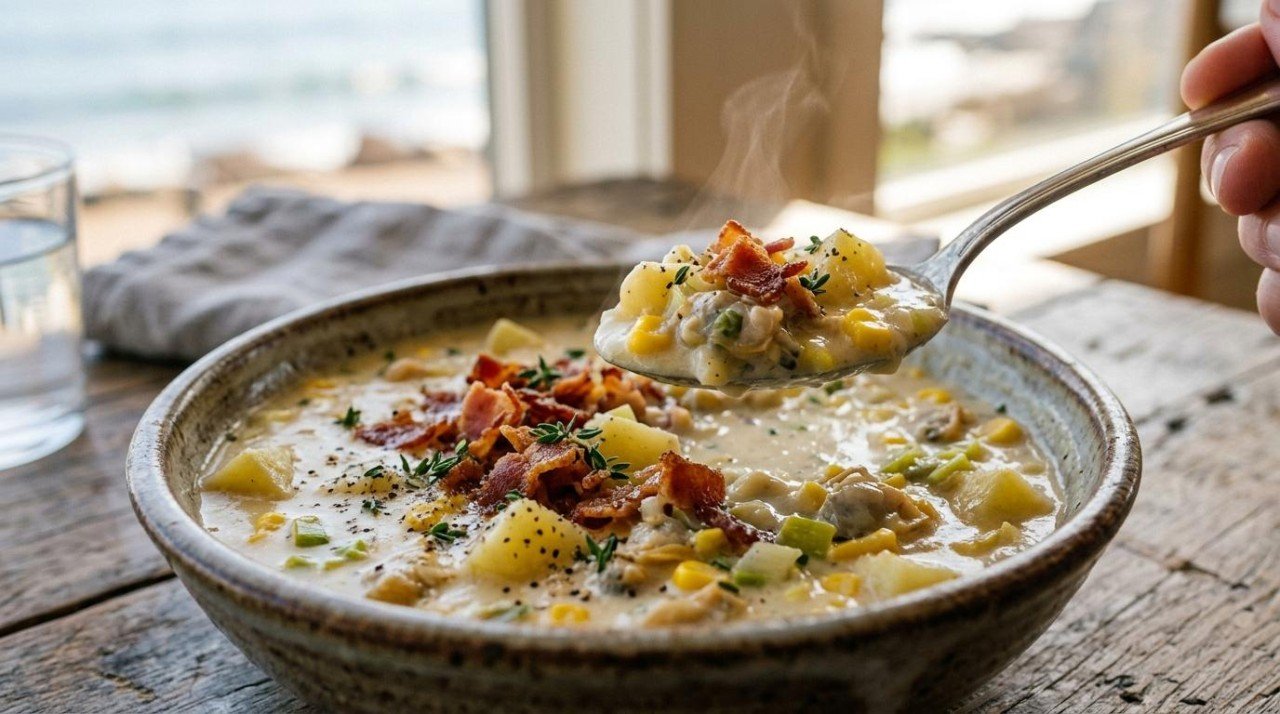
New England clam chowder is one of the few soups people are genuinely loyal to. It should be thick enough that the spoon leaves a trail, pale and faintly sweet from the dairy, studded with soft potato, and it should taste unmistakably of the sea. Get it wrong and it is wallpaper paste. Get it right and there is nothing else quite like it.
So we built a standard version — bacon, butter, a flour roux, a pound and a half of potatoes, two cans of clams, and two cups of heavy cream — and ran it through Eat Well Planner's Nutrition Score, the same number that appears on any public recipe page. It came back 39 out of 100. One bowl carried 31.4 g of saturated fat — 134% of a day's value — and 838 calories.
We got it to 90. That is the biggest swing we have measured in this series, and almost none of it came from the places you would expect. The clams stayed in full — they turn out to be the single best thing in the pot. The bacon stayed in. And the cauliflower trick that every lightened-up chowder recipe recommends made the score go down.
The original: what's in it and how it scores
Here is the version we scored, sized for four bowls:
- 4 slices bacon (about 4 oz), 2 tablespoons butter
- 1 medium onion, 2 celery stalks
- 1/4 cup all-purpose flour, for the roux
- 1 1/2 lb russet potatoes, diced
- 2 cans (6.5 oz each) chopped clams, drained
- 1 cup bottled clam juice
- 2 cups heavy cream
- 1 teaspoon salt, black pepper, dried thyme
Nutrition Score: 39/100. Per bowl that is about 838 calories, 28.1 g protein, 47.7 g carbohydrate, 3.5 g fiber, 59.7 g total fat, 31.4 g saturated fat, and 1,340 mg sodium.
Start with what is already excellent, because this dish has more going for it than almost anything else we have put through the scorer. A single bowl delivers 455% of a day's vitamin B12, 70% of the vitamin B6, 67% of the phosphorus, and 47% of the iron — and that iron is heme iron, the form Harvard's Nutrition Source notes is better absorbed than the non-heme iron in plants, with oysters, clams, and mussels named at the top of the list. There is also 28 g of protein and a third of a day's EPA and DHA in there. All of that is the clams. They are the reason this recipe was never going to be a lost cause.
Two things drag it down, and they are both concentrated in a very small number of ingredients:
- Saturated fat, flagged very high at 134% of a day's value in one bowl. Harvard Health puts a sensible daily budget at about 16 g for women and 19 g for men, or roughly 7% of calories. This bowl is 31.4 g. Two cups of heavy cream, 2 tablespoons of butter, and four slices of bacon are three separate sources of the same thing, stacked.
- Sodium, flagged very high at 58% DV — 1,340 mg, from the bacon, the bottled clam juice, the canned clams, and a teaspoon of added salt. Harvard's Nutrition Source puts the ceiling at 2,300 mg a day, against an American average of about 3,400 mg.
And one quieter problem: 3.5 g of fiber, in a bowl of soup whose only vegetables are an onion, two celery stalks, and a pile of potato. Average US fiber intake already sits around 17 g a day against a recommended 25 to 38 g. A 838-calorie meal contributing 3.5 g of that is a missed opportunity, not a crime.
The upgrades
Five changes, each scored cumulatively on top of the last. We list them in the order you would actually cook them rather than in order of size, so the recipe at the end makes sense — but if you only make one change, make the first one. It is the one that moves the most for the least.
1. Heavy cream out, whole milk in — and let the potatoes do the thickening
- Swap: 2 cups heavy cream to 2 cups whole milk, with about a third of the cooked potato blended into the base
- Score impact: +11 points (39 to 50)
- What it changes: Saturated fat from 31.4 g to 9.2 g a bowl, calories from 838 to 499
- What it costs you: Body, if you skip the puree step. Do not skip the puree step.
This is a texture problem disguised as a nutrition problem. Cream is thick because it is fatty; milk is not. If you swap one for the other and change nothing else, you get thin chowder, and thin chowder is a failed chowder no matter what it scores. The fix is already floating in the pot. Russet potatoes are high in starch, and when that starch is heated in liquid the granules swell and burst, releasing starch into the liquid and thickening it — the same mechanism a roux uses, just from a vegetable you were adding anyway. Scoop out about a third of the cooked potato, blend it smooth with a ladle of the broth, and stir it back in.
This is also closer to the historical dish than the cream version is. Early New England chowder did not contain milk at all and was thickened with crushed hardtack or crackers. Nobody has been protecting a cream tradition here for three hundred years.
One honest warning: high-fat dairy is much less likely to curdle in hot soup than lower-fat dairy, so trading cream for milk means the pot needs more care at the end. Add the milk at the end, off a hard simmer, and never let the pot boil after it goes in. See our heavy cream substitutes guide for how this plays out in other dishes.
2. Give the chowder actual vegetables
- Swap: Add 1 large leek, 1 cup corn, and 1 large carrot; double the celery from 2 stalks to 4
- Score impact: +9 points (50 to 59)
- What it changes: Fiber from 3.5 g to 6.4 g a bowl, plant points from 3.5 to 6.5
- What it costs you: Nothing. This is the swap that tastes better, not worse.
Nine points for adding vegetables to a soup is a bigger payout than cutting the bacon, and it is the change most lightened-up chowder recipes never make because they are busy taking things out. Leek is the important one: it is the same allium family as the onion, so it does not fight the dish, and it goes silky rather than sharp. Corn belongs in chowder by birthright — corn chowder exists — and it brings back a little of the sweetness the cream was providing. The carrot mostly buys color.
Three extra plants also nudges you along on the 30-different-plants-a-week target that gut microbiome research keeps pointing at, which a bowl of cream and potato was contributing almost nothing to.
3. Bacon from four slices to one
- Swap: 4 oz bacon down to 1 oz, crisped separately and crumbled over the top
- Score impact: +6 points (59 to 65)
- What it changes: Sodium from 1,410 mg to 1,030 mg a bowl, calories from 578 to 475
- What it costs you: Less rendered fat to cook the vegetables in, so you need a little oil
The trick is where the bacon goes. Four slices rendered into the base gives you a diffuse, background smokiness that most people could not identify blindfolded. One slice crisped hard and crumbled on top at the table gives you a sharp, unmistakable hit of bacon in every third spoonful, because it is dry and salty and hitting your tongue directly instead of being dissolved into a whole pot of soup. You taste it more, not less. Our bacon substitutes guide covers the same principle applied elsewhere.
4. Salt from 1 teaspoon to 1/3 teaspoon
- Swap: 1 teaspoon added salt down to 1/3 teaspoon, salted at the end rather than the start
- Score impact: +14 points (65 to 79)
- What it changes: Sodium from 1,030 mg to 650 mg a bowl
- What it costs you: Real seasoning, unless you replace it with acid and thyme
This was the largest single delta in the build, and the reason is worth understanding, because it is not that salt is worth 14 points. We also tested the exact same cut earlier in the process, right after the cream swap, and there it was worth one point. Same swap, same recipe, one point versus fourteen. What changed is that by step 4 the sodium had come down far enough that this last cut carried it across a threshold in the scoring, from the very high band into merely high. Nutrition scoring is not linear, and neither is your blood pressure — the last few hundred milligrams that get you under a line are worth more than the first few hundred that do not.
Do not just remove the salt, though. Salt the pot at the end, after the potatoes have absorbed what they are going to absorb, so you taste what you are actually seasoning. Then add a squeeze of lemon or a splash of the clam juice to sharpen it. Acid does a lot of what salt does for perceived flavor — that is the whole premise of salt, fat, acid, heat. The corn and leek help too, since both bring sweetness that reads as seasoned. And the extra potassium from all those vegetables matters here in its own right: potassium offsets some of sodium's effect on blood pressure.
5. Butter out, olive oil in
- Swap: 2 tablespoons butter to 1 tablespoon olive oil for the roux
- Score impact: +11 points (79 to 90)
- What it changes: Saturated fat from 7.0 g to 4.3 g a bowl; clears the saturated fat flag entirely
- What it costs you: A little dairy richness, mostly masked by the milk and the potato
Eleven points for two tablespoons of butter looks absurd until you notice what it does: it takes saturated fat below the flag threshold, so the recipe stops carrying a caution at all. The remaining fat is monounsaturated instead. Olive oil makes a perfectly good roux — you are cooking flour in fat for two minutes, and the fat does not need to be butter to do that. The butter's flavor was doing very little in a pot that also contains bacon, clams, and thyme. If you want to keep it, our butter substitutes guide walks through the other options, but this one is close to free.
Take the Guesswork Out of Eating Well
Eat Well Planner helps you organize your favorite recipes, plan balanced meals, and automatically generate shopping lists — all in one place. Whether you're tracking macros, managing dietary restrictions, or just trying to stop asking "what's for dinner?", we've got you covered.
Our AI-powered tools can adapt any recipe to your dietary needs, help you discover new meals you'll love, and even log your nutrition effortlessly. It's meal planning made simple.
Start Organizing Your Meals — FreeWhat we kept (on purpose), and where we stopped
All of the clams, and all of the bottled clam juice. Halving the clam juice scored 92 instead of 90 — two points for giving up the thing that makes chowder taste like the ocean rather than like potato soup. We declined. And we tested adding more clams, which went the other way (66 at that stage against 65) because the extra sodium cancels the extra iron and B12. Two cans is the right number.
The bacon. Removing it entirely scored 94. That is a real, measured 4 points we are choosing not to take, because a New England chowder with no pork in it is a different soup, and this series does not deal in soups nobody wants to eat twice. Four points is the honest price of the bacon. Pay it if you think it is worth it — we do.
Whole milk, not 2%. Swapping to 2% scored 89 against whole milk's 90, and 2% curdles more easily. There is no reason to do it.
The finished chowder still carries one flag: sodium, at 26% of a day's value per bowl. Between two cans of clams and a cup of clam juice, that is simply what a chowder made of shellfish is, and the fix would be to use less shellfish. That is where we stop.
The healthier version: full recipe
Nutrition Score: 90/100. Makes 4 generous main-course bowls.
- 1 oz bacon (about 1 thick slice), diced
- 1 tablespoon olive oil
- 1 medium yellow onion (about 5 oz), diced
- 1 large leek (about 5 oz trimmed), white and light green parts, sliced and rinsed well
- 4 celery stalks (about 5 1/2 oz), diced
- 1 large carrot (about 3 1/2 oz), diced
- 1/4 cup all-purpose flour
- 1 cup bottled clam juice
- 1 1/2 cups water
- 1 1/2 lb russet potatoes, peeled and cut into 1/2-inch dice
- 1 cup corn kernels (about 5 oz), fresh or frozen
- 1/2 teaspoon dried thyme
- 2 cans (6.5 oz each) chopped clams, drained
- 2 cups whole milk
- 1/3 teaspoon salt
- 1/2 teaspoon black pepper
- Cook the diced bacon in a dry pot over medium heat until it is properly crisp, 5 to 7 minutes. Lift it out onto a paper towel and set it aside — it goes on top at the end, not into the soup.
- Add the olive oil to the bacon fat left in the pot. Add the onion, leek, celery, and carrot and cook 7 to 8 minutes, until everything is soft and the leek has collapsed.
- Sprinkle in the flour and stir constantly for 1 to 2 minutes, until it coats the vegetables and smells toasty rather than raw.
- Pour in the clam juice a splash at a time, whisking smooth after each addition, then add the water the same way. Rushing this is how you get lumps.
- Add the potatoes and thyme. Bring to a gentle simmer and cook 15 to 18 minutes, until the potatoes are completely tender.
- Scoop out about a third of the potatoes with a slotted spoon, blend them smooth with a ladle of the cooking liquid, and stir the puree back into the pot. This is the step that replaces the cream, so take it all the way to smooth. Add the corn.
- Turn the heat to low and let the pot stop bubbling. Stir in the milk, then the clams. Bring it back to steaming but never to a simmer — boiling now will curdle the milk and turn the clams to rubber.
- Season with the salt and pepper now, at the end, and taste. Add a squeeze of lemon if it needs sharpening. Serve with the crisp bacon crumbled over each bowl.
Per bowl, original versus improved:
- Nutrition Score: 39 to 90
- Calories: 838 to 455
- Saturated fat: 31.4 g (134% DV, flagged very high) to 4.3 g (no flag)
- Sodium: 1,340 mg (58% DV) to 610 mg (26% DV)
- Fiber: 3.5 g to 6.4 g (22% DV)
- Protein: 28.1 g to 23.6 g — this one moved the wrong way, and it is the cream and bacon leaving
- Vitamin B12: 455% DV to 473% DV
- Iron: 47% DV to 52% DV
- Plant points: 3.5 to 6.5
Two numbers moved the wrong way and it would be dishonest not to name them: protein, above, and vitamin A, which fell from 56% DV to 38% because heavy cream is a genuinely good source of it. What moved up is the long tail. Four nutrients crossed from the "good source" tier into "excellent" — vitamin C from 16% to 25% DV, calcium from 15% to 26%, folate from 13% to 20%, and fiber from 12% to 22% — which is what happens when you put a pound of vegetables into a soup that had almost none. If you are wondering whether all that B12 is worth caring about, it depends a lot on your age and what else you eat.
Swaps we tested and skipped
- Cauliflower for half the potato: 87, down 3 points. The standard advice in every lightened chowder recipe, and it made the score worse and the chowder worse. Cauliflower has almost no starch to give, so the body you lose from the potato does not come back, and 87 versus 90 says the trade is not even nutritionally worth it. Skip it.
- Evaporated milk instead of whole milk: 48 against whole milk's 50 at the same stage, with more saturated fat and more sodium. It is the classic thrifty chowder base and it does hold up better to heat, but on the numbers whole milk wins. See our evaporated milk guide for where it does earn its place.
- Turkey bacon instead of real bacon: 92, up 2 points. Two points for a garnish that does not crisp the same way. We would rather have one slice of the real thing.
- Whole wheat flour for the roux: 90, exactly the same. No score change, but it adds 0.6 g fiber and a plant point, so do it if you have it. It slightly darkens the chowder, which some people mind.
- Oyster crackers: 86, down 4 points for half an ounce per bowl. Less damaging than we expected. If crackers are the thing that makes it chowder for you, four points is a fair price.
Make it fit other diets
Gluten-free: skip the roux entirely and let the potato puree do all the thickening — we scored this and it came to 89, one point below the flour version. Blend half the potatoes instead of a third if you want it thicker. Dairy-free: this one is harder than it looks, because unsweetened oat or cashew milk changes the flavor as much as the texture, and coconut milk sends the saturated fat straight back up. Treat it as its own recipe rather than a one-for-one swap. In Eat Well Planner, the AI Recipe Chat can rewrite this exact chowder for either restriction with the full ingredient list in context, and Recipe Variations will produce the whole adapted recipe in one step.
Do this to your own recipes
Everything above came out of the app. The scores are Eat Well Planner's Nutrition Score, the per-swap deltas came from the Recipe Playground — where you change one ingredient and watch the number move before you commit to anything — and the swap candidates came from Make It Healthier, which proposes changes and runs each one through a calculator to verify the gain before it ever shows it to you. That is why we could tell you that cauliflower makes it worse and that the same salt cut is worth 1 point or 14 depending on when you make it.
Import your own chowder recipe from any website, Instagram reel, or YouTube video, and it will be scored in seconds. Then run Make It Healthier on it and see what it finds. Your version probably has different problems than ours did — and the point of scoring it first is that you fix the ones you actually have, not the ones a magazine told you to worry about.