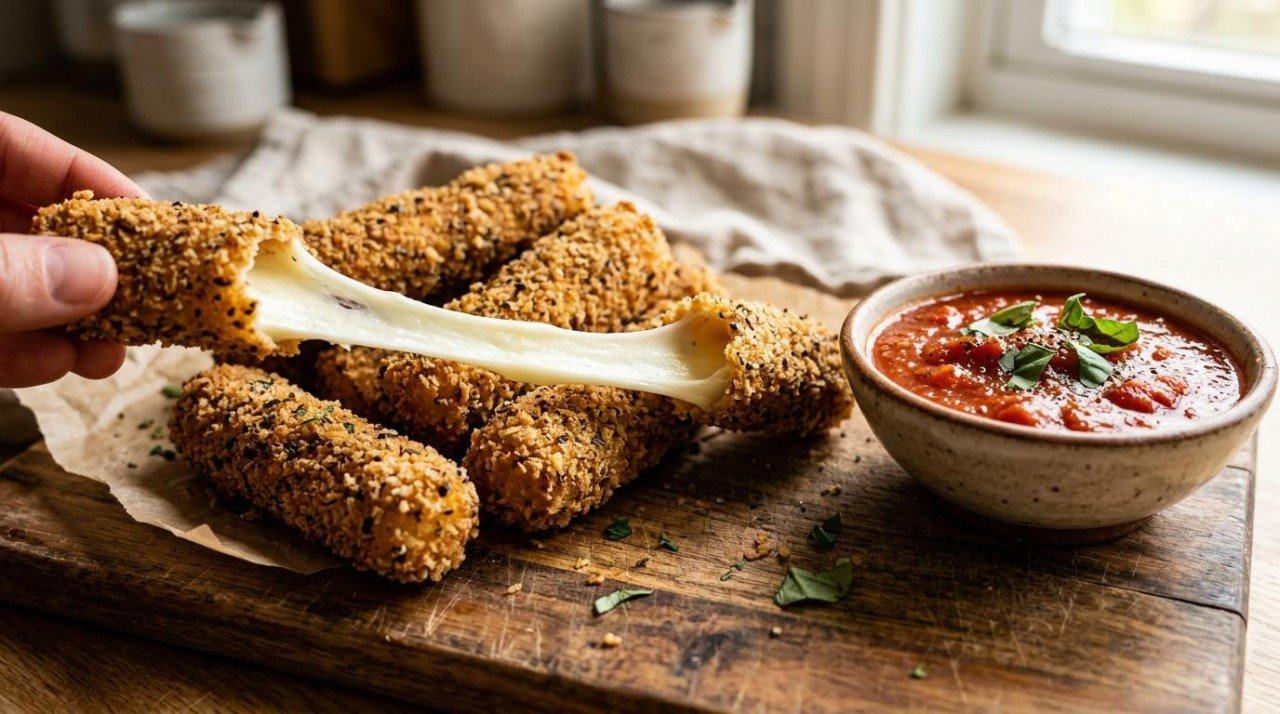
The mozzarella stick is not Italian and it is barely a recipe. Breading and frying a slice of cheese appears in a French household manual from 1393, but the thing you actually order was invented in Wisconsin in the mid-1970s and carried across America by TGI Fridays, Bennigan's, and Applebee's in the 1980s. It is bar food, and it is very good bar food.
We built a standard homemade batch in Eat Well Planner and ran it through the app's Nutrition Score. It came back at 36 out of 100, with two caution flags. We rebuilt it one verified swap at a time and got to 60 - and the sticks still pull when you tear one open.
Two surprises. The change every healthy-mozzarella-stick article leads with - turning off the fryer - was worth one point on its own, despite stripping 133 calories and 15 grams of fat from every serving. And the most valuable single change was the thing nobody thinks about, because it is not even the food: the dip.
The original: what's in it and how it scores
The standard homemade version, serving four: 12 ounces (340 g) of low-moisture whole milk mozzarella cut into 12 sticks, dredged in 1/4 cup all-purpose flour, dipped in 2 beaten eggs, coated in about 1 cup (110 g) of Italian seasoned bread crumbs, deep-fried, and served with 1 cup of jarred marinara. Since you eat what the sticks absorb rather than the pot, we modeled the absorbed oil at about 1/3 cup (73 g) across the batch.
Nutrition Score: 36/100. Per serving (3 sticks plus sauce): 607 calories, 27.0 g protein, 2.6 g fiber, 41.6 g total fat, 15.4 g saturated fat, 1,270 mg sodium, 2.0 g added sugar. Two cautions, both flagged very high: saturated fat at 66% of a day's reference, sodium at 55%. Plant points: 1.
Plenty here is good, and we are not going to manufacture problems. A serving is an excellent source of calcium (51%), phosphorus (59%), protein (34%), riboflavin (37%), vitamin B12 (32%), and zinc (30%). Real mozzarella is real food. Three things hold the score down:
- Sodium, 1,270 mg. The cheese carries plenty, but the biggest single contributor is the breading - Italian seasoned bread crumbs run about 2,100 mg of sodium per 100 g, roughly four and a half times what plain whole wheat panko carries.
- Saturated fat, 15.4 g. This is the cheese, and there is no clever way around it: 12 ounces across four servings is 3 ounces each.
- One plant point. The whole plate contains exactly one plant, and it is the tomato in the dip.
One comparison first. The same amount of food using frozen breaded sticks from a box, same jarred marinara, scores 35 - a point below the homemade deep-fried version despite 190 fewer calories a serving, because it lands 1,280 mg of sodium and still one plant point. Making them yourself is already the upgrade. We are just finishing the job.
The upgrades
We applied these in order and re-scored after each, so every number is what that change is worth at that point in the build. The order matters more here than in almost any recipe we have rebuilt.
1. Whole wheat panko instead of Italian seasoned bread crumbs
- Swap: 1 cup seasoned bread crumbs and 1/4 cup all-purpose flour → 1 cup whole wheat panko and 1/4 cup whole wheat flour
- Score impact: +4 points (36 to 40)
- What it changes: Sodium from 1,270 mg to 820 mg per serving - the caution drops from very high to high. Fiber from 2.6 g to 4.3 g, plant points from 1 to 3
- What it costs you: Nothing, and you gain crunch. Panko shards are bigger and drier, so they crisp harder
Four hundred and fifty milligrams of sodium removed by changing which bag you buy. Seasoned crumbs are largely a salt delivery system, so we add the flavor back as dry seasoning in swap 5. The fiber matters more than it looks: refining strips more than half of wheat's B vitamins, 90 percent of the vitamin E, and virtually all of the fiber, and most Americans manage about 15 g a day against the 25 to 35 g they need. If whole wheat panko is hard to find, our bread crumb substitutes guide covers what else coats and crisps.
2. Make the marinara yourself, and make twice as much
- Swap: 1 cup jarred marinara → a 15-minute sauce from a 14.5 oz can of crushed tomatoes, tomato paste, garlic, olive oil, oregano, red pepper flakes, and basil, yielding about 1 3/4 cups
- Score impact: +7 points (40 to 47) - the biggest move in the post
- What it changes: Added sugar from 1.6 g to 0.4 g, fiber from 4.3 g to 5.6 g, plant points from 3 to 5, and vitamin C, vitamin B6, and potassium onto the highlights list
- What it costs you: Fifteen minutes and one small pan
Applied on its own to the untouched original - change nothing else, just the dip - this is worth 6 points (36 to 42), more than any other single change we tested. Run it backwards and it holds: take the finished 60-point recipe, put the jar back, and it falls to 53.
Part of that is the sugar and salt a jar carries and a can of crushed tomatoes does not. The rest is volume - doubling the sauce puts nearly half a cup of cooked tomato in every serving, and simmering tomatoes in olive oil shifts lycopene toward its more absorbable cis-isomers. One tomato sauce study found 13-, 5-, and 9-(Z)-lycopene rising 31%, 18%, and 15% over the cook, with beta-carotene up 40%. If you do not keep tomato paste around, our tomato paste substitutes guide has the reduction ratios.
3. Freeze them hard, then air fry
- Swap: About 1/3 cup absorbed frying oil → 1 tablespoon olive oil across the batch, air fried at 400F
- Score impact: +3 points (47 to 50)
- What it changes: Calories from 635 to 501 per serving, total fat from 42.7 g to 28.0 g, saturated fat from 15.5 g to 13.6 g
- What it costs you: Some of the blistered fryer crust. The technique buys back most of it
Applied alone to the original, turning off the fryer moves the score 36 to 37. One point, for removing 133 calories and 15 grams of fat. The Nutrition Score is largely a nutrient-density measure, and with both cautions still standing the fat reduction has nowhere to go. Those calories are real and they matter to you - they just do not move a density score while a 1,270 mg sodium flag sits on top of it.
The technique is the swap, so do not improvise. Freeze the cut cheese solid before breading - about an hour - then bread, bread a second time, and freeze again at least 30 minutes before cooking. The first freeze makes the cheese melt slowly enough for the crust to set; the second glues the coating on. Rachel Cooks tested this and air fries at 400F for 5 to 6 minutes, and is straight about the result: a little cheese still escapes, but skipping the freezes loses far more. Expect one casualty in twelve, and eat that one at the counter.
4. Twelve ounces of cheese down to eight
- Swap: 12 oz mozzarella across 12 sticks → 8 oz across the same 12 sticks
- Score impact: +6 points (50 to 56)
- What it changes: Saturated fat from 13.6 g to 9.6 g - the caution drops from very high to high - calories from 501 to 417, sodium from 760 mg to 620 mg
- What it costs you: Protein, from 28.3 g to 22.1 g, and slimmer sticks
Eight ounces across twelve sticks is about two-thirds of an ounce each - roughly the size of a restaurant mozzarella stick. The 12-ounce version most home recipes call for is the outlier. Cut slimmer batons and you get the same count, the same pull, and more crust per bite.
This is also the clearest proof that order matters. Make this cut alone on the untouched original and it is worth 1 point (36 to 37), despite removing 84 calories and 3.9 g of saturated fat. Make it fourth, after the sodium has come down, and the same cut is worth 6. For context on the target: the Dietary Guidelines cap saturated fat at less than 10 percent of daily calories, and the American Heart Association at 7 percent.
5. Ground flaxseed and real seasoning in the crust
- Swap: Add 1/4 cup ground flaxseed, 1 teaspoon garlic powder, 1 teaspoon dried oregano, and 1/2 teaspoon black pepper to the panko
- Score impact: +4 points (56 to 60)
- What it changes: Fiber from 5.6 g to 7.7 g, plant points from 5 to 6.5, omega-3 ALA up to 98% of a day's reference
- What it costs you: The crust browns faster, so watch the last minute
Flaxseed is the richest plant source of omega-3 ALA, about 23 g per 100 g, alongside 28 g of fiber per 100 g, and a quarter cup vanishes into a panko crust. Of the +4, the flax is worth 3 and the seasoning 1 - the seasoning is there to make the crust taste like something now the salted crumbs are gone. It also takes the batch to 6.5 plant points from 1: tomato, garlic, basil, oregano, flax, wheat, and chili all count separately toward the 30-plants-a-week target.
Take the Guesswork Out of Eating Well
Eat Well Planner helps you organize your favorite recipes, plan balanced meals, and automatically generate shopping lists — all in one place. Whether you're tracking macros, managing dietary restrictions, or just trying to stop asking "what's for dinner?", we've got you covered.
Our AI-powered tools can adapt any recipe to your dietary needs, help you discover new meals you'll love, and even log your nutrition effortlessly. It's meal planning made simple.
Start Organizing Your Meals — FreeWhat we kept (on purpose)
Whole milk mozzarella. Part-skim is the swap every article leads with, so we tested it twice. On the original it was worth 2 points; on the finished recipe it is worth 1 (60 to 61), because while saturated fat falls from 9.9 g to 8.6 g, sodium climbs from 620 mg to 750 mg - part-skim is a saltier cheese. Take the trade if you want it, but in a dish whose premise is the pull, the cheese is not where we economize.
The tablespoon of olive oil. We tested dropping it for pure dry air frying and the score went down, 60 to 59. It browns the crust and costs a point to skip.
All twelve sticks. We stopped at 8 ounces, and we know what the next step was worth: 6 ounces scores 65. That is 14 grams of cheese per stick, and at that point you are eating a breadstick with an apology inside. Sixty is what this dish can carry and still be itself.
The healthier version: full recipe
Nutrition Score: 60/100, up 24 points. Makes 12 sticks, serves 4.
For the sticks:
- 8 oz (227 g) low-moisture whole milk mozzarella, cut into 12 sticks about 3 inches long
- 1/4 cup (30 g) whole wheat flour
- 2 large eggs, beaten
- 1 cup (110 g) whole wheat panko bread crumbs
- 1/4 cup (25 g) ground flaxseed
- 1 teaspoon garlic powder
- 1 teaspoon dried oregano
- 1/2 teaspoon black pepper
- 1 tablespoon extra virgin olive oil, or olive oil spray
For the marinara (makes about 1 3/4 cups):
- 1 can (14.5 oz / 400 g) crushed tomatoes
- 1 1/2 tablespoons (25 g) tomato paste
- 2 teaspoons extra virgin olive oil
- 2 cloves garlic, grated
- 1/2 teaspoon dried oregano
- 1/4 teaspoon red pepper flakes
- 1/4 cup fresh basil, torn
- Cut the mozzarella into 12 sticks, spread them on a parchment-lined tray, and freeze 1 hour, until rock solid. Do not skip this.
- Make the sauce while they freeze. Warm the 2 teaspoons of olive oil in a small saucepan over medium heat, add the garlic and cook 30 seconds until fragrant, then stir in the tomato paste and cook another minute until it darkens. Add the crushed tomatoes, oregano, and red pepper flakes, and simmer gently 15 to 20 minutes. Off the heat, stir in the basil.
- Set up three shallow bowls: whole wheat flour in the first, beaten eggs in the second, and the panko, flaxseed, garlic powder, oregano, and black pepper stirred together in the third.
- Roll each frozen stick in flour, then egg, then the panko mixture. Then dip it back in the egg and back in the panko a second time. The double coat is what keeps the cheese inside.
- Return the breaded sticks to the tray and freeze again at least 30 minutes. They keep this way up to 3 months, so make a double batch.
- Toss or spray them with the tablespoon of olive oil, then air fry at 400F for 5 to 6 minutes in a single layer with space between them. In an oven, bake at 425F on a preheated sheet pan about 10 minutes, turning once. Line the basket or pan - expect one or two to leak.
- Rest 1 minute, then serve hot with the warm marinara in a bowl big enough to dip properly.
Per serving, original vs. improved:
- Nutrition Score: 36 → 60
- Calories: 607 → 455
- Protein: 27.0 g → 23.4 g
- Fiber: 2.6 g → 7.7 g
- Total fat: 41.6 g → 24.4 g
- Saturated fat: 15.4 g → 9.9 g (66% → 42% of a day's reference)
- Sodium: 1,270 mg → 620 mg (55% → 27%)
- Added sugar: 2.0 g → 0.4 g
- Plant points: 1 → 6.5
- Gut health sub-score: 25 → 58
The improved version is an excellent source of omega-3 ALA (98%), phosphorus (61%), iron (51%), calcium (39%), biotin (37%), protein (29%), zinc (29%), riboflavin (29%), vitamin B6 (28%), and fiber (26%). Both cautions remain - saturated fat at 42%, sodium at 27% - and that is the honest ceiling. This is a plate of fried cheese. It will not score 90, and anything claiming otherwise has taken the cheese out.
Swaps we tested and skipped
- Grated parmesan in the crust: 58. Two points down. The classic move for adding flavor to a breading here just adds saturated fat and 110 mg of sodium a serving. Use the garlic powder.
- Almond flour crust instead of panko: 61. The low-carb swap actually beat our version by a point, which surprised us - but it gets there with 36.9 g of fat per serving against our 24.4 g, and almond flour goes soft and sandy where panko shatters. One point, and a worse mozzarella stick.
- Skipping the oil entirely: 59. One point down and a paler crust.
- The two-minute version. Change only the bread crumbs and nothing else: 39. If that is all you will do tonight, it is still 3 points and 450 mg of sodium.
Make it fit other diets
For gluten-free, use gluten-free panko and a cup-for-cup blend or plain cornstarch for the dredge; the flaxseed already carries the fiber. Dairy-free is the hard one - most vegan mozzarella is starch and coconut oil and behaves differently under heat, so start with a block-style brand that promises a firm melt and freeze it longer. Our mozzarella substitutes guide covers which alternatives actually stretch. In the app, AI Recipe Chat rewrites this exact recipe for either restriction, and Recipe Variations returns the finished version in one step.
Do this to your own recipes
None of this was guesswork. We imported the recipe, read its Nutrition Score and caution flags, tested each swap in the Recipe Playground to watch the score move per edit, and kept only what the calculator confirmed. That is Make It Healthier working the way it does on your own recipes: import from any URL, Instagram reel, or YouTube video, get the real score, and see swaps checked against the nutrition math before they are ever suggested.
The lesson that outlives mozzarella sticks is the one from swaps 3 and 4: each was worth a single point alone, and 3 and 6 points in sequence, because a dish with two problems does not reward you for fixing one. If a change you were sure about barely moved the needle, go find the second flag. Then rebuild something else you love - the buffalo wings hit the same ceiling.