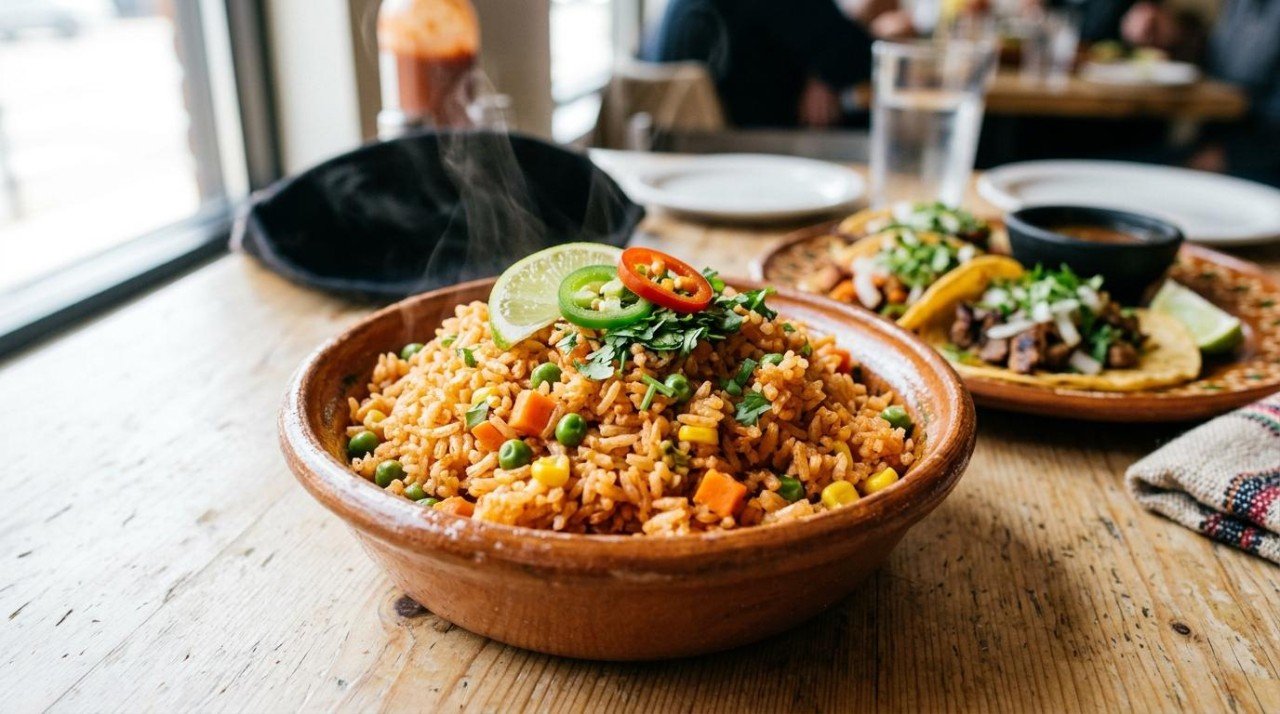
Mexican rice (arroz rojo, or the "Spanish rice" on so many American menus) is the side dish that makes a plate feel complete. Toasted grains, tinted orange-red with tomato, fluffy enough to soak up salsa and bean juice, next to tacos, enchiladas, or just a fried egg. It is also one of the most-searched side dishes online, and nearly every home version leans on the same shortcut: a spoonful of tomato-chicken bouillon granules.
We scored the standard version in Eat Well Planner's Nutrition Score, the same number that appears on any public recipe page. It came out at 36 out of 100, which is low for something that is mostly rice and tomato. The reason is almost entirely salt, and it hides in three places, not one.
Our rebuilt version scores 91 out of 100, 55 points higher. It is still red, still toasty, still the rice you want next to your tacos. Every swap below carries the real score change it earned, including one that earned nothing at all.
The original: what's in it and how it scores
The version most home cooks make goes like this, for six servings of about 3/4 cup each:
- 1 1/2 cups long-grain white rice, toasted in 2 tablespoons vegetable oil
- 1/2 white onion and 2 cloves garlic
- One 8-ounce can of tomato sauce
- 2 cups regular chicken broth
- 1 tablespoon tomato-chicken bouillon granules (caldo de tomate)
Nutrition Score: 36/100. Start with what is already fine, because there is a lot of it. Each serving has about 230 calories, only 5.5 g of fat (mostly unsaturated, from the oil), half a gram of saturated fat, and essentially no added sugar. The canola oil even makes it an excellent source of plant omega-3 (ALA). This is not a heavy dish. Three things hold the score down:
- Sodium: about 880 mg per serving. That is 38% of the 2,300 mg Daily Value in a side dish, before the tacos, cheese, and salsa it sits next to. The FDA notes that Americans already average about 3,400 mg a day, and that over 70% of it comes from packaged and prepared foods. Bouillon is a perfect example.
- Fiber: 0.8 g per serving. White rice has had its bran and germ milled away, so there is very little left to work with.
- Almost no vegetables. Onion, garlic, and tomato sauce add up to just 2.25 plant points, and the score flags vitamin A as low.
Here is where the sodium in the pot actually comes from. The tablespoon of bouillon carries about 45% of it (roughly 400 mg per serving). But the regular chicken broth brings another 34% (about 300 mg), and the canned tomato sauce adds the last 20% (about 180 mg). Hold onto that breakdown, because it explains the strangest result in this makeover.
The upgrades
Six changes, scored one on top of the other in the order below. The first four do nearly all the work.
1. Replace the bouillon and broth with unsalted stock, cumin, and more garlic
- Swap: Bouillon granules and regular broth → 2 cups unsalted chicken stock, 1/2 teaspoon salt, 1 teaspoon ground cumin, and double the garlic
- Score impact: +10 points (36 → 46)
- What it changes: Sodium drops from about 880 mg to about 400 mg per serving, and the high-sodium caution clears
- What it costs you: The bouillon's MSG-style savory punch. Cumin, extra garlic, and the later swaps fill most of that gap
Here is the result that surprised us: dropping the bouillon alone scored +0. We took the granules out and kept the regular broth, and the score stayed at 36. Sodium fell to about 480 mg per serving, but that is still enough to keep the high-sodium flag on, and the flag is what holds the score down. "Skip the bouillon" is the advice everyone gives, and on its own it does not move the number. The broth has to go too.
Unsalted stock gives you control: you add a measured half teaspoon of salt instead of whatever the bouillon and the broth carton decide for you. If you are swapping out broth in other recipes, our chicken broth substitutes guide covers the options. And a toasty spice like cumin does a lot of the "this tastes seasoned" work that salt usually does.
One honest footnote: a few of these points come from a quirk in how the score handles trace nutrients. Bouillon and broth carry a sliver of vitamin B12, too little to matter, and the score grades a tiny amount as "low" but ignores a nutrient that is absent entirely. When we added back a single gram of bouillon, the score dropped 3 points and the "Low Vitamin B12" weakness came back. The sodium cut is the real story. The B12 shift is the scale being picky.
2. Switch to long-grain brown rice
- Swap: 1 1/2 cups long-grain white rice → 1 1/2 cups long-grain brown rice
- Score impact: +17 points (46 → 63)
- What it changes: Fiber nearly triples (0.8 g → 2.2 g per serving), and the rice becomes a good source of magnesium, niacin, and phosphorus
- What it costs you: A chewier, nuttier grain and about 25 extra minutes on the stove
This is the biggest single lever in the makeover. Brown rice keeps the bran and germ that milling strips away, and the evidence for that matters: in the large cohort studies summarized by Harvard's Nutrition Source, people who ate brown rice two or more times a week had an 11% lower risk of type 2 diabetes than those who rarely ate it, while the heaviest white rice eaters had a 17% higher risk.
Brown rice toasts just as nicely as white and holds its shape well in tomato broth, so it does not turn mushy. If the texture is a dealbreaker, go half and half: in the finished recipe, a 50/50 blend scored 85, versus 91 for all brown and 75 for all white. Our white rice substitutes guide has more grain options if you want to go further.
3. Fold in peas and carrots
- Swap: Nothing → 1 heaping cup frozen peas and carrots
- Score impact: +10 points (63 → 73)
- What it changes: Fiber climbs to 3 g per serving, the "low vitamin A" flag clears, and plant points rise to 4.5
- What it costs you: Nothing. Peas and carrots are a classic in restaurant-style Mexican rice
No chopping required: scatter them over the rice for the last few minutes of cooking, and they steam on top. We also checked how much they matter in the finished recipe. Take them out and the score falls from 91 to 81.
4. Swap the canned tomato sauce for blended fresh tomatoes
- Swap: 8 oz canned tomato sauce → about 5 Roma tomatoes (10 oz), blended with the onion and garlic, plus 1 tablespoon tomato paste
- Score impact: +14 points (73 → 87)
- What it changes: Sodium falls from about 420 mg to about 240 mg per serving, and the rice becomes a good source of vitamin C
- What it costs you: One minute with a blender. The flavor gets brighter and fresher
Remember the sodium breakdown? With the bouillon and broth gone, the canned tomato sauce was the last hidden salt source, and it was keeping sodium just high enough to bring the flag back once the peas and carrots were in. Swapping it out cleared the flag and unlocked 14 points. The same swap on the original recipe was worth only +5, because the bouillon was still dominating. That pattern shows up again and again in these makeovers: a fix that looks small at the start becomes huge once the bigger problem is gone.
Blending fresh tomato with onion and garlic is also how many traditional arroz rojo recipes start, so this is a step toward the classic, not away from it. A spoonful of tomato paste brings back the deep red color and concentrated flavor of the canned sauce. Short on time? No-salt-added canned tomato sauce scored 89 in the finished recipe, just 2 points behind fresh. Regular tomato sauce put back in scored 77.
5. Finish with jalapeno, cilantro, and lime
- Swap: Nothing → 1 small jalapeno, 1/2 cup cilantro, and 1 tablespoon lime juice
- Score impact: +1 point (87 → 88)
- What it changes: Plant points rise from 5.5 to 6.75
- What it costs you: Nothing, unless you are in the cilantro-tastes-like-soap camp
The score barely notices this one, and that is fine: it is here for flavor. Lower-sodium cooking tastes flat without something bright and sharp, and a squeeze of lime with fresh herbs does what the extra salt used to do. (If you are out of limes, our lime juice substitutes guide has you covered.)
6. Toast the rice in 1 tablespoon of oil instead of 2
- Swap: 2 tablespoons oil → 1 tablespoon
- Score impact: +3 points (88 → 91)
- What it changes: About 20 fewer calories per serving, and the score's last remaining weakness (low calcium) drops off the list
- What it costs you: You need to stir a bit more while toasting so nothing sticks
One tablespoon still coats every grain and gets the rice golden. That toasting step is what gives Mexican rice its nutty flavor and keeps the grains separate, so it stays.
What we kept (on purpose)
We kept the toast, because untoasted rice in tomato broth is just orange rice. We kept chicken stock rather than plain water. Water scored about the same, but stock tastes better. And we kept half a teaspoon of salt, because the score did too: the finished recipe scored 91 with that salt and 91 without it, so there is no reason to cook bland rice. The line is right there, though. At 3/4 teaspoon, the score dropped to 84 and the high-sodium flag came back.
Take the Guesswork Out of Eating Well
Eat Well Planner helps you organize your favorite recipes, plan balanced meals, and automatically generate shopping lists — all in one place. Whether you're tracking macros, managing dietary restrictions, or just trying to stop asking "what's for dinner?", we've got you covered.
Our AI-powered tools can adapt any recipe to your dietary needs, help you discover new meals you'll love, and even log your nutrition effortlessly. It's meal planning made simple.
Start Organizing Your Meals — FreeThe healthier version: full recipe
Nutrition Score: 91/100. Serves 6 (about 1 cup each).
- 1 1/2 cups long-grain brown rice
- About 5 Roma tomatoes (10 oz), roughly chopped
- 1/2 medium white onion (about 2 oz), roughly chopped
- 4 cloves garlic
- 1 tablespoon canola or vegetable oil
- 1 tablespoon tomato paste
- 2 cups unsalted chicken stock
- 1 teaspoon ground cumin
- 1/2 teaspoon salt
- 1 small jalapeno, seeded and minced
- 1 heaping cup (5 oz) frozen peas and carrots
- 1/2 cup chopped fresh cilantro
- 1 tablespoon lime juice, plus wedges for serving
- Rinse the rice in a fine-mesh strainer until the water runs mostly clear, then shake it as dry as you can.
- Blend the tomatoes, onion, and garlic until completely smooth (add a splash of the stock if the blender needs help getting started). You should have about 1 1/2 cups of puree.
- Heat the oil in a large, heavy pot with a tight lid over medium heat. Add the rice and toast it, stirring often, for 5 to 7 minutes, until the grains turn golden and smell nutty.
- Stir in the tomato paste and cook for 30 seconds. Pour in the tomato puree and let it bubble for 2 to 3 minutes, stirring, until it thickens slightly.
- Add the stock, cumin, salt, and jalapeno. Bring to a boil, then cover, turn the heat to low, and simmer for 40 minutes without lifting the lid.
- Scatter the frozen peas and carrots over the top without stirring. Cover again, turn off the heat, and let the pot rest for 10 minutes, so the vegetables steam and the rice finishes absorbing the liquid.
- Fluff gently with a fork, folding in the vegetables, cilantro, and lime juice. Taste, and serve with lime wedges.
Per serving, before and after:
- Nutrition Score: 36 → 91
- Calories: about 230 → about 242
- Sodium: about 880 mg → about 250 mg (from 38% to 11% of the daily limit)
- Fiber: 0.8 g → 3.2 g (now a good source)
- Protein: 4.6 g → 6.3 g
- Potassium: about 190 mg → about 370 mg
- Saturated fat: 0.5 g → 0.6 g
- Plant points: 2.25 → 6.75
Calories barely move, and that is not the point. The servings are bigger thanks to the vegetables, and the upgraded rice is now a good or excellent source of fiber, vitamin A, vitamin C, magnesium, iron, niacin, and potassium. That last one matters more than most people think: potassium is the other half of the salt equation, and this version nearly doubles it while cutting sodium by more than two-thirds. The CDC notes that too much sodium raises blood pressure and the risk of heart disease and stroke, and a side dish is an easy place to take some back.
Swaps we tested and skipped
- Dropping the bouillon but keeping regular broth (+0). The most common "healthier Mexican rice" tip. Sodium still sat at about 480 mg per serving, enough to keep the flag on, and the score did not move at all.
- Cooking it with no salt at all (still 91). No gain over half a teaspoon, and noticeably flatter. Season the rice.
- A heavier hand with salt (84). Going from 1/2 to 3/4 teaspoon cost 7 points and brought the high-sodium flag back. Add the extra at the table if someone wants it.
- Putting the bouillon back for "just a little flavor" (65). A tablespoon of granules stirred into the finished recipe undid 26 points. Regular broth instead of unsalted stock did nearly the same damage (66).
Make it fit other diets
Vegetarian or vegan: use unsalted vegetable stock instead of chicken stock (we did not score this version). Gluten-free: this recipe has no gluten-containing ingredients, but check the stock label to be sure. In Eat Well Planner, you can ask the AI recipe chat to "make this vegan" and it rewrites the whole recipe with the swaps worked in.
Making a full taco night? Our healthier ground beef tacos and Chipotle burrito bowl makeover pair perfectly with this rice.
Do this to any recipe you love
Every number in this post came from Eat Well Planner's Nutrition Score. The app's Make It Healthier tool proposes swaps like these and has a calculator verify the real gain before showing you a suggestion. We ran each change in the Recipe Playground, which is how we caught that dropping the bouillon alone did nothing, that the canned tomato sauce was quietly worth 14 points, and that half a teaspoon of salt costs nothing at all.
Have a family Mexican rice recipe, or one you saved from a creator on Instagram or YouTube? Import it into the app and score it before you cook it. You will see exactly where the salt is hiding, and which fixes are worth making first.