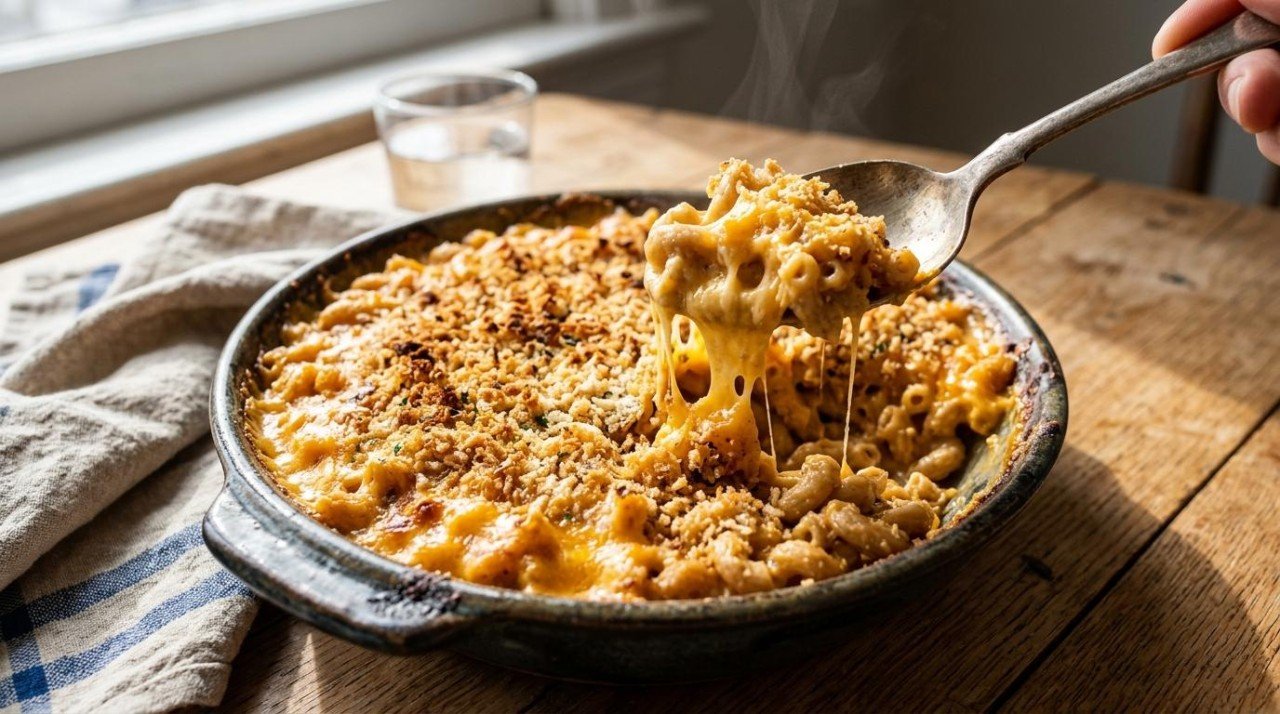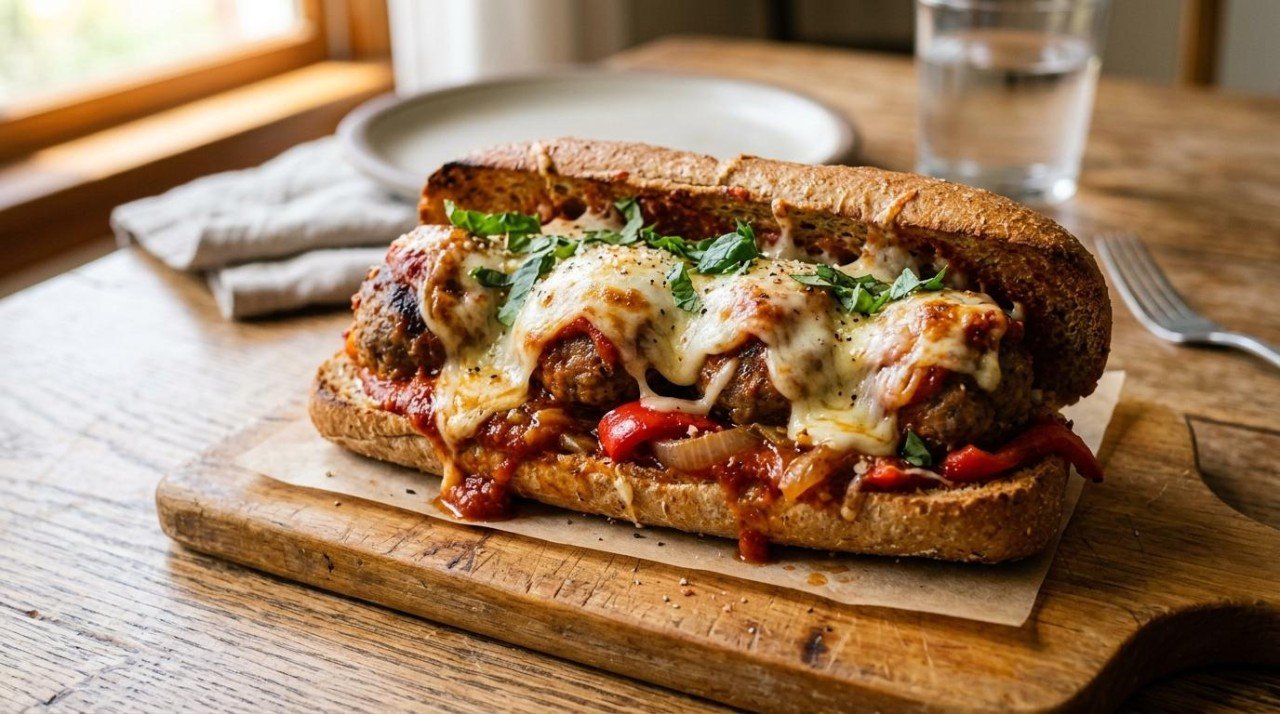
A meatball sub is not a subtle sandwich. Tender meatballs, a lot of red sauce, and melted cheese browned under the broiler, all packed into a roll that is somehow expected to hold together until the last bite. It is messy, filling, and one of the great Italian-American deli classics.
We scored the homemade version with the app's Nutrition Score and it came back at 38 out of 100. The usual advice for a sandwich like this is to cut the bread: go open-faced or scoop out the roll. We tested that. It did not help.
What worked was keeping the whole roll and changing what it is made of, then fixing the meatballs, cheese, sauce, and salt around it. The finished sub scores 78, and it is still a full, messy, cheesy meatball sub. Here is every swap and what it was worth.
The original: what's in it and how it scores
The version we scored makes 4 subs. The meatballs are 1/2 pound of 80/20 ground beef and 1/2 pound of ground pork, bound with 1/2 cup of dry breadcrumbs, 1/4 cup of grated Parmesan, an egg, garlic, dried oregano, and about a teaspoon of salt, then browned in 2 tablespoons of olive oil. They go into 4 white hoagie rolls (about 3 1/2 ounces each) with 2 cups of jarred marinara, 4 slices of provolone, and a cup of shredded mozzarella, and the whole thing goes under the broiler.
Per sub that comes to 970 calories, 48.8 g protein, 18.5 g saturated fat, 2,140 mg sodium, and 4.8 g fiber. Nutrition Score: 38.
Here is what drags it down:
- Sodium, flagged very high. 2,140 mg is 93% of the daily value in one sandwich. The FDA recommends less than 2,300 mg a day and notes that more than 70% of the sodium Americans eat comes from packaged and prepared foods. Same here: the salt you add is about 490 mg per sub, while the jarred marinara is about 525 mg, the rolls about 490 mg, and the two cheeses about 345 mg.
- Saturated fat, also flagged very high, at 18.5 g. About 8 g comes from the beef and pork, and nearly 7 g from the provolone and mozzarella.
- 4.8 g of fiber in a 970-calorie meal, and only 1.5 plant points.
- Added sugar, flagged high, at 6 g, split between the white roll and the jarred sauce.
What is already good: nearly 49 g of protein, and plenty of vitamin B12, iron, zinc, and phosphorus. The bones are fine. The details are where the points are.
The upgrades
We rebuilt the sub in the app's Recipe Playground, one change at a time. Every delta is cumulative, measured on top of the swap before it, and together they add up to exactly the 40 points between 38 and 78.
Upgrade 1: Keep the whole roll, make it 100% whole wheat
- Swap: White hoagie rolls → 100% whole wheat sub rolls, same size
- Score impact: +6 points (38 to 44)
- What it changes: Fiber nearly doubles, from 4.8 to 9 g per sub, and protein rises 2.5 g
- What it costs you: A nuttier, denser roll. Under meatballs, sauce, and melted cheese, it mostly reads as a good bakery roll
This is the bread story of this post: the problem with the hoagie roll was never how much of it there was. It was that it had almost no fiber. A useful test from Harvard's Nutrition Source is the carbohydrate-to-fiber ratio: look for 10 to 1 or lower. The white roll in our data is about 28 to 1. The 100% whole wheat roll is about 7 to 1.
Check the label, not the word "wheat." A softer store "whole wheat" roll with about a third less fiber (roughly 12 to 1) scored 71 instead of 78 in the finished recipe. Look for whole wheat flour first and about 6 g of fiber in a 3 1/2 ounce roll (more in our guide to buying bread that is actually whole grain). Then toast the split rolls for a few minutes before filling them, so a denser roll stays crisp under the sauce.
Upgrade 2: Put roasted peppers and onions inside
- Swap: Add 2 large red bell peppers and a yellow onion, sliced and roasted with 1/2 tablespoon olive oil
- Score impact: +5 points (44 to 49)
- What it changes: Plant points triple, from 1.5 to 4.5, and each sub now carries more than a day's vitamin C (137% of the daily value) plus more potassium and fiber
- What it costs you: About 50 more calories per sub, and a sweeter, more layered sandwich. We think it is better
This one adds instead of subtracts, which is why it scores so well so early. Peppers and onions are already a sub-shop classic, and they roast on a sheet pan next to the meatballs. Roasted, they turn soft and sweet and tuck in under the meatballs instead of sliding out. For more additions like this, see simple ways to sneak more plants into any meal.
Upgrade 3: Make the meatballs with lean beef and turkey
- Swap: 1/2 lb 80/20 ground beef + 1/2 lb ground pork → 1/2 lb 95% lean ground beef + 1/2 lb ground turkey
- Score impact: +8 points (49 to 57), the biggest single gain in the build
- What it changes: 152 fewer calories per sub, saturated fat from 18.7 to 13.1 g, and 3.5 g more protein
- What it costs you: Lean meatballs dry out easily. Upgrade 4 is how we fixed that
Pork is in the traditional blend for richness, and it brings a lot of fat with it. Lean beef keeps the beefy flavor, and turkey disappears into the garlic and oregano. Harvard's Nutrition Source lists meat and cheese among the top sources of saturated fat in the American diet, and this sandwich has both. For other blends, see our ground pork substitutes guide. Because the mix contains poultry, cook these to 165°F in the center.
Upgrade 4: Bind them with grated zucchini and oats
- Swap: 1/2 cup dry breadcrumbs → 1/2 cup rolled oats + 1 medium zucchini, finely grated and squeezed
- Score impact: +1 point (57 to 58)
- What it changes: 100 mg less sodium per sub (dry breadcrumbs are salted), plus a little more fiber and potassium and two more plant points
- What it costs you: Nothing you will notice. The zucchini is invisible once it is cooked
On the score, this is a small one. We kept it because it is what makes Upgrade 3 taste good. The oats do the job of breadcrumbs and the zucchini supplies the moisture, so lean meat comes out juicy instead of dense. Squeeze the zucchini in a clean towel first, or the mixture gets too loose to roll, and let the oats soak with it and the egg for 5 minutes before adding the meat. Whole wheat breadcrumbs scored 1 point lower and work fine too (more in our bread crumbs substitutes guide).
Upgrade 5: One cup of part-skim mozzarella, no provolone
- Swap: 4 slices provolone + 1 cup shredded whole-milk mozzarella → 1 cup shredded part-skim mozzarella
- Score impact: +6 points (58 to 64)
- What it changes: Saturated fat from 13.1 to 9.5 g per sub, 75 fewer calories, and 150 mg less sodium
- What it costs you: A thinner cheese layer and less of provolone's sharp bite. You still get a melted, browned top
A cup split across 4 subs is about an ounce each, plenty to melt into a browned layer under the broiler. If provolone is what makes it a meatball sub for you, a cup of it instead of the mozzarella scored 75 in the finished recipe, 3 points lower. That is a fair trade. Our mozzarella substitutes guide has other melting cheeses.
Upgrade 6: Bake the meatballs (0 points, and that is fine)
- Swap: Pan-frying in 2 tablespoons olive oil → baking on a parchment-lined sheet pan
- Score impact: +0 points (64 to 64)
- What it changes: 61 fewer calories and about 7 g less fat per sub
- What it costs you: Slightly less crust on the meatballs, which spend 10 minutes in sauce anyway
Frying was never the problem. Olive oil is mostly unsaturated fat, and when we put the frying oil back into the finished recipe, it scored 1 point higher, at 79. We bake anyway because it is easier: 16 meatballs on one pan, no splatter, and the oven is already on for the peppers. If you love a skillet crust, fry them. The score does not mind.
Upgrade 7: Make a 15-minute sauce from crushed tomatoes
- Swap: 2 cups jarred marinara → no-salt-added crushed tomatoes simmered with tomato paste, garlic, oregano, and fresh basil
- Score impact: +5 points (64 to 69)
- What it changes: Sodium from 1,830 to 1,320 mg per sub, and added sugar from 6 to 3.5 g (the rest is in the roll)
- What it costs you: 15 minutes of simmering while the meatballs bake
Starting from no-salt-added tomatoes lets you decide how salty the sandwich is, and two tablespoons of tomato paste give a quick sauce the deep, long-simmered flavor a jar normally supplies (our tomato paste substitutes guide helps if you are out). In the finished recipe, a low-sodium jarred marinara scored 71 and regular jarred marinara 65. If a jar is what makes this a weeknight dinner, buy the low-sodium one.
Upgrade 8: Cut the salt to 1/4 teaspoon
- Swap: About 1 teaspoon salt (5 g) → 1/4 teaspoon fine salt (1.5 g), all in the meatballs
- Score impact: +9 points (69 to 78)
- What it changes: Sodium from 1,320 to 980 mg per sub
- What it costs you: Very little, because the Parmesan, the cheese on top, and the roll are all salty already
Halving the salt on the original sub scored 0 points: with jarred sauce and two cheeses, the sodium was too high for one change to register. At the end of the build, this cut was worth 9. We see that pattern in almost every recipe we score. A scant 1/2 teaspoon is a fine middle ground at 76. The roll is now the biggest sodium source left, about 430 of the 980 mg, so compare labels if you want to go further.
Take the Guesswork Out of Eating Well
Eat Well Planner helps you organize your favorite recipes, plan balanced meals, and automatically generate shopping lists — all in one place. Whether you're tracking macros, managing dietary restrictions, or just trying to stop asking "what's for dinner?", we've got you covered.
Our AI-powered tools can adapt any recipe to your dietary needs, help you discover new meals you'll love, and even log your nutrition effortlessly. It's meal planning made simple.
Start Organizing Your Meals — FreeWhat we kept (on purpose)
The whole roll. Open-faced on half a roll, the finished sub had 127 fewer calories, but fiber fell from 10.8 to 7.8 g and the score dropped to 77. Scooping out some of the inside scored the same 78, so do that if you like a lighter sandwich, but it is not a health upgrade.
The Parmesan in the meatballs. A quarter cup carries a lot of flavor into lean meat, which is what lets us use so little salt. Our Parmesan cheese guide has options if you need them.
The broiler finish. Browned, bubbling cheese is the point. We stopped at eight swaps because the sodium left is mostly the roll and the cheese, and cutting either further starts to take away the sandwich.
The healthier version: full recipe
Nutrition Score: 78 (up from 38). Makes 4 subs.
For the meatballs
- 1 medium zucchini (about 7 oz), finely grated and squeezed dry
- 1/2 cup rolled oats
- 1/4 cup grated Parmesan
- 1 large egg
- 2 cloves garlic, minced
- 1 teaspoon dried oregano
- 1/4 teaspoon fine salt
- 8 oz 95% lean ground beef
- 8 oz ground turkey
For the sauce
- 1 3/4 cups no-salt-added crushed tomatoes (about 14 oz)
- 2 tablespoons tomato paste
- 2 cloves garlic, minced
- 1 teaspoon dried oregano
- A small handful fresh basil leaves (about 1/4 cup), torn
For the peppers and assembly
- 2 large red bell peppers, sliced
- 1 medium yellow onion, sliced
- 1/2 tablespoon olive oil
- 4 100% whole wheat sub rolls (about 3 1/2 oz each)
- 1 cup shredded part-skim mozzarella (4 oz)
- Heat the oven to 425°F and line two sheet pans with parchment paper.
- Toss the peppers and onion with the olive oil on one pan. Roast for about 25 minutes, stirring halfway, until soft and browned at the edges.
- In a large bowl, stir together the squeezed zucchini, oats, Parmesan, egg, garlic, oregano, and salt. Let it sit for 5 minutes so the oats soften.
- Add the beef and turkey and mix gently with your hands, just until combined. Roll into 16 meatballs, about 1 1/2 inches each, and space them out on the second pan.
- Bake the meatballs for 15 to 18 minutes, until browned and 165°F in the center.
- While they bake, simmer the crushed tomatoes, tomato paste, garlic, and oregano in a saucepan over medium-low heat for 10 to 15 minutes, stirring now and then. Stir in the basil, then add the meatballs and turn them to coat. Keep warm over low heat.
- Split the rolls lengthwise without cutting all the way through. Toast them open on a sheet pan in the oven for 3 to 4 minutes, until the insides are crisp.
- Turn the oven to broil. Fill each roll with peppers and onions, 4 meatballs, and some sauce, and top with 1/4 cup mozzarella.
- Broil for 2 to 3 minutes, watching closely, until the cheese is melted and browned in spots. Serve right away with any extra sauce on the side.
Per sub, original vs. healthier:
- Nutrition Score: 38 → 78
- Calories: 970 → 680
- Protein: 48.8 g → 50.2 g
- Saturated fat: 18.5 g → 8.3 g
- Sodium: 2,140 mg → 980 mg
- Fiber: 4.8 g → 10.8 g
- Added sugar: 6 g → 3.5 g
- Potassium: 1,010 mg → 1,340 mg
- Plant points: 1.5 → 7.75
It is still a big sandwich, and it is still not a low-sodium food. It is now also an excellent source of fiber, vitamin C, B vitamins, and potassium, and it is filling for the right reasons.
Swaps we tested and skipped
- Open-faced on half a roll (77, -1). The classic "less bread" move lost more fiber than it saved in calories. See "What we kept."
- A softer store "whole wheat" roll (71, -7). Not all wheat rolls are equal. Check the fiber on the label.
- Provolone instead of part-skim mozzarella (75, -3). A reasonable choice if you love it, but not a free one.
- Low-sodium jarred marinara (71, -7) or regular jarred marinara (65, -13). The homemade sauce takes 15 minutes and was worth it.
- Whole wheat breadcrumbs instead of oats (77, -1). Nearly a tie. Use whichever you have.
For another take on the same meatball problem, our healthier spaghetti and meatballs uses lean beef and mushrooms instead of turkey and zucchini.
Make it fit other diets
- Gluten-free: Use certified gluten-free oats in the meatballs (they are otherwise gluten-free already) and a gluten-free sub roll. Toasting matters even more here.
- Dairy-free: Swap the Parmesan in the meatballs for 2 tablespoons of nutritional yeast and skip the mozzarella or use a dairy-free shred that melts.
Or let the app do it: open the recipe in Eat Well Planner and ask Recipe Variations for a gluten-free or dairy-free version, and it rewrites the whole recipe with the swaps worked in.
Do this to any recipe you love
Every number in this post came from tools you can use on your own recipes. Import a recipe from any website, Instagram reel, or YouTube video, and Eat Well Planner gives it a Nutrition Score. Tap Make It Healthier and it suggests swaps like these, checking the real gain with a calculator before it shows you anything. Want to keep the provolone or the pork? Try it in the Recipe Playground, see exactly what it costs, and make it up somewhere else.