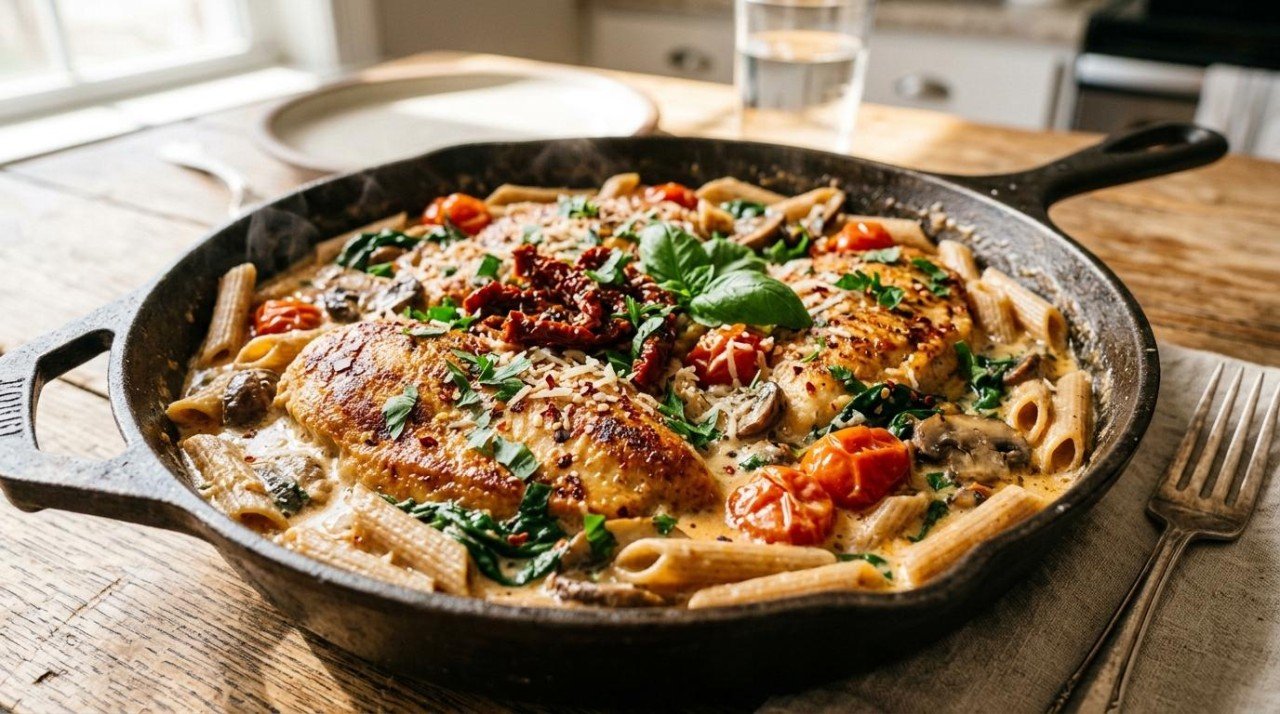
Marry Me Chicken is chicken breasts seared and finished in a sauce of heavy cream, parmesan, garlic, and sun-dried tomatoes. It was developed in 2016 by Lindsay Funston, then an editor at Delish, under the working title "Sicilian Chicken Skillet." As the Boston Globe recounts, a videographer tasted it on set and said "I'd marry you for that chicken," and the name stuck. It has since spawned Marry Me pasta, a long tail of Marry Me everything, and a permanent slot in a lot of weeknight rotations.
It deserves the hype. It is a genuinely good pan sauce built on real ingredients, and it takes about half an hour. But we ran the standard build through Eat Well Planner's Nutrition Score - the same at-a-glance number that shows on any public recipe page - and it came back 39 out of 100.
So we rebuilt it. Same seared chicken, same glossy sun-dried tomato sauce, same parmesan, and it now scores 81 out of 100. That is 42 points, and every swap below carries the real, verified score change it earned, in the order we applied them.
The original: what's in it and how it scores
Here is the version we scored, for four people, served the way most people actually eat it - over pasta:
- 1 1/2 lb boneless skinless chicken breasts, dredged in 1/4 cup all-purpose flour
- 2 tablespoons olive oil and 2 tablespoons butter
- 3 cloves garlic, 1 teaspoon red pepper flakes, 1 teaspoon dried thyme
- 3/4 cup chicken broth and 1 cup heavy cream
- 1/2 cup grated parmesan
- 1/2 cup sun-dried tomatoes packed in oil, plus fresh basil
- About 1 teaspoon salt, and 8 oz dry white pasta to serve
Nutrition Score: 39/100. Now the diagnosis, because understanding why a recipe scores the way it does is what lets you fix your own. Per serving, the original runs about 844 calories, 53 g protein, 19.2 g saturated fat, roughly 1,090 mg sodium, and 3.2 g fiber. Three things hold it back:
- Saturated fat is very high - 19.2 g per serving, or 82% of a day's worth on the Nutrition Facts scale. The American Heart Association recommends no more than about 13 grams a day on a 2,000-calorie diet, so a single serving already clears that. When we tested the ingredients one at a time, swapping the cup of heavy cream out took 9.5 g of that 19.2 g off the plate, and dropping the butter took another 3.2 g.
- Sodium is high - roughly 1,090 mg, about 47% of the day. The AHA puts the ceiling at 2,300 mg with an ideal nearer 1,500 mg, and notes that cutting back by 1,000 mg a day measurably improves blood pressure. Here it comes from three places at once: regular chicken broth, salted parmesan, and the salt you add.
- Almost nothing green - 3.2 g of fiber and 2 plant points, with a flag for low plant diversity. The sun-dried tomatoes, garlic, and basil are the entire plant contribution.
What is already fine, and worth defending? A lot. Protein is excellent at 53 g per serving, and the chicken makes this an outstanding source of niacin (129% of the daily value), vitamin B6 (94%), and phosphorus (89%). The sun-dried tomatoes are not a problem - they are concentrated tomato, and they are the dish. There is no added sugar and nothing ultra-processed anywhere in it. This is real cooking. The issue is one ingredient doing far too much of the work.
The upgrades
Six swaps, scored cumulatively in this order. They are ordered by score impact, and the first one alone is worth a third of the total gain.
1. Heavy cream to evaporated milk, thickened with cornstarch
- Swap: 1 cup heavy cream to 1 cup evaporated milk plus 1 tablespoon cornstarch
- Score impact: +14 points (39 to 53)
- What it changes: Saturated fat drops from 19.2 g to 9.7 g per serving, total fat from 43 g to 26 g, and calories from 844 to 726
- What it costs you: Very little, if you thicken it. Straight evaporated milk makes a thinner sauce than cream, and it is faintly sweeter
This is the swap that carries the post. Evaporated milk is milk cooked down to about half its water, so it brings the concentrated dairy body a pan sauce needs at a fraction of the fat. It is also unusually well behaved on the stove, holding together in a simmering sauce where regular milk would thin out or break. Our evaporated milk guide and heavy cream guide both go deeper on where this swap works and where it does not.
The technique that makes it indistinguishable: whisk 1 tablespoon of cornstarch into the cold evaporated milk before it goes anywhere near the pan, then add it off the heat and bring it back to a bare simmer. The starch replaces the viscosity that cream's fat was providing, so the sauce still coats the back of a spoon and still clings to pasta. Add it near the end of cooking rather than boiling it hard for ten minutes. The faint sweetness disappears entirely under the parmesan, garlic, and sun-dried tomatoes.
2. Low-sodium broth and half the added salt
- Swap: Regular chicken broth to low-sodium, and 1 teaspoon of salt down to 1/2 teaspoon kosher
- Score impact: +6 points (53 to 59)
- What it changes: Sodium falls from 49% to 31% of the daily value at this point in the build
- What it costs you: Real, but fixable. Undersalted food tastes flat unless you replace the seasoning some other way
This is the swap people skip because it sounds boring, and it is the second-biggest on the list. It also proves the numbers here are live rather than decorative: we scored the finished recipe again with 3 g of salt instead of 2 g, and that single gram costs 2 points. That is how tightly sodium is weighted.
You do not have to eat bland chicken to get it. The parmesan and the sun-dried tomatoes are already salty and are doing more seasoning work than most cooks credit them for. Push the red pepper flakes and thyme up, hit the finished pan with a squeeze of lemon, and be generous with black pepper and fresh basil. Acid and heat both read as "seasoned" on the palate in a way that lets you get away with less salt.
3. Drop the butter, keep the olive oil
- Swap: Remove the 2 tablespoons of butter; sear in the 2 tablespoons of olive oil alone
- Score impact: +5 points (59 to 64)
- What it changes: Saturated fat from 9.8 g to 6.6 g per serving, and 52 calories off the plate
- What it costs you: A little of the browned-butter richness in the sear. Honestly, less than you would expect
In most recipes we would defend the butter, because butter is usually doing something no substitute does. Here it is not. The butter goes in at the sear alongside olive oil that is already in the pan, and everything it contributes - richness, browning, mouthfeel - is being contributed again a minute later by the parmesan and the reduced dairy. It is the one genuinely redundant fat in the recipe, so it is the easy 5 points.
Get your pan properly hot and let the chicken sit undisturbed for three to four minutes a side. The fond you build that way is where the sauce's depth actually comes from.
4. Add 5 oz of spinach
- Swap: Fold 5 oz of fresh spinach into the sauce at the end
- Score impact: +7 points (64 to 71)
- What it changes: Vitamin K jumps to the recipe's top strength, plant points go from 2 to 3, and vitamin C and folate climb
- What it costs you: Nothing. It wilts into the sauce and disappears
Plenty of Marry Me Chicken variations already do this, and the score explains why it is worth the ten seconds. Spinach cooks down to almost nothing in a hot cream sauce, so 5 oz - a whole clamshell - vanishes into four servings without changing the texture or the flavor profile at all. Stir it in off the heat after the sauce has thickened and let residual heat do the wilting.
5. White pasta to whole wheat
- Swap: 8 oz dry white pasta to 8 oz dry whole wheat pasta
- Score impact: +6 points (71 to 77)
- What it changes: Fiber nearly doubles, from 3.8 g to 7.2 g per serving, and adds magnesium, B vitamins, and a plant point
- What it costs you: A nuttier, firmer noodle. Under a sauce this assertive, it is barely noticeable
Refining wheat strips the bran and germ, which takes with it more than half of wheat's B vitamins, 90% of its vitamin E, and virtually all the fiber. That matters because most Americans eat about 15 g of fiber a day against a recommended 25 to 35 g, and fiber is what makes a meal this rich actually keep you full. Our pasta substitutes guide ranks the other options if whole wheat is not your thing.
Cook it a minute short of the package time and finish it in the sauce with a splash of pasta water. Whole wheat pasta goes from firm to mushy faster than white does, and it drinks up more sauce, so hold back a little liquid.
6. Add mushrooms and cherry tomatoes
- Swap: Add 5 oz sliced cremini mushrooms and 1 cup halved cherry tomatoes
- Score impact: +4 points (77 to 81)
- What it changes: Plant points go from 4 to 6, fiber to 8.3 g, vitamin C to 39% of the daily value
- What it costs you: Five minutes and a slightly less monolithic sauce
The original's standing flag was low plant diversity, and this is what clears it. Creminis brown in the same pan and add savory depth that reads as more sauce rather than more vegetables; the cherry tomatoes burst and add bright acid against the richness. Together with the spinach, garlic, sun-dried tomatoes, and whole wheat, the finished dish contributes 6 of the 30 different plants a week associated with greater gut microbiome diversity in the American Gut Project - from a starting point of 2. If you track plant points, one dinner just did a fifth of your week.
Take the Guesswork Out of Eating Well
Eat Well Planner helps you organize your favorite recipes, plan balanced meals, and automatically generate shopping lists — all in one place. Whether you're tracking macros, managing dietary restrictions, or just trying to stop asking "what's for dinner?", we've got you covered.
Our AI-powered tools can adapt any recipe to your dietary needs, help you discover new meals you'll love, and even log your nutrition effortlessly. It's meal planning made simple.
Start Organizing Your Meals — FreeWhat we kept (on purpose)
The parmesan stays at a full 1/2 cup, and this is the most interesting number in the whole exercise. We scored the finished recipe with the parmesan halved to 1/4 cup, and it came back at 81 - exactly the same score. Halving the cheese buys you literally nothing, and it costs you the salty, nutty backbone of the sauce. So it stays.
The chicken breasts stay, whole and dredged. The sun-dried tomatoes stay, packed in oil, at the full 1/2 cup. The red pepper flakes, garlic, thyme, and fresh basil all stay untouched. And the olive oil stays, because it is now the only fat doing the searing.
Where we stopped: at 81, with sodium and saturated fat still carrying "high" flags. That is the honest ceiling for seared chicken in a cheese-enriched cream sauce over pasta. Going further means taking out the parmesan or the pasta, and at that point you are not eating Marry Me Chicken anymore.
The healthier version: full recipe
Nutrition Score: 81/100. Serves 4.
- 1 1/2 lb (680 g) boneless skinless chicken breasts, halved horizontally into cutlets
- 1/4 cup (30 g) all-purpose flour, for dredging
- 1/2 teaspoon kosher salt (about 2 g), plus plenty of black pepper
- 2 tablespoons olive oil
- 5 oz (150 g) cremini mushrooms, sliced
- 3 cloves garlic, minced
- 1 teaspoon crushed red pepper flakes
- 1 teaspoon dried thyme
- 1/2 cup (60 g) sun-dried tomatoes packed in oil, drained and sliced
- 3/4 cup (180 ml) low-sodium chicken broth
- 1 cup (240 g) evaporated milk
- 1 tablespoon (8 g) cornstarch
- 1/2 cup (45 g) finely grated parmesan
- 1 cup (150 g) cherry tomatoes, halved
- 5 oz (150 g) fresh spinach
- 1/4 cup (10 g) fresh basil, torn
- 8 oz (227 g) dry whole wheat pasta, to serve
- Bring a large pot of water to a boil for the pasta. Whisk the cornstarch into the cold evaporated milk in a measuring cup and set it aside.
- Season the chicken cutlets with the salt and black pepper, then dredge them in the flour and shake off the excess.
- Heat the olive oil in a large skillet over medium-high until it shimmers. Sear the cutlets undisturbed for 3 to 4 minutes a side, until deeply browned and just cooked through. Transfer to a plate.
- Add the mushrooms to the same pan and cook for 4 to 5 minutes, until browned and their liquid has cooked off. Add the garlic, red pepper flakes, thyme, and sun-dried tomatoes and cook for 1 minute more.
- Start the pasta now, cooking it 1 minute short of the package time. Reserve a cup of the cooking water before draining.
- Pour the broth into the skillet and scrape up every browned bit from the bottom. Simmer for 2 minutes to reduce slightly.
- Take the pan off the heat, whisk in the evaporated milk and cornstarch mixture, then return it to a bare simmer for 2 to 3 minutes until it thickens enough to coat a spoon. Do not let it boil hard.
- Stir in the parmesan until it melts, then the cherry tomatoes. Add the spinach in handfuls off the heat and stir until it wilts into the sauce.
- Return the chicken and any resting juices to the pan and spoon the sauce over. Toss the drained pasta in, loosening with pasta water as needed.
- Taste, add black pepper and a squeeze of lemon if it needs lift, and scatter the basil over the top.
Per serving, original versus improved:
- Nutrition Score: 39 to 81
- Calories: 844 to 690
- Saturated fat: 19.2 g (82% DV) to 6.7 g (29% DV)
- Total fat: 43.2 g to 21.9 g
- Sodium: about 1,090 mg (47% DV) to about 720 mg (31% DV)
- Fiber: 3.2 g (11% DV) to 8.3 g (28% DV)
- Protein: 53.3 g to 59.4 g
- Plant points: 2 to 6
The finished dish is a good source of vitamin K (177% DV), niacin (147%), phosphorus (124%), vitamin B6 (112%), protein (74%), iron (61%), potassium (52%), and magnesium (50%).
Swaps we tested and skipped
- Greek yogurt instead of evaporated milk - it scored 85, four points higher, and we still did not take it. This is the honest one. Yogurt's proteins are already fragile from the lactic acid in it, and heat makes them clump and separate out of the sauce. Cream does not have this problem because it is mostly fat and very little protein. You can stabilize yogurt by whisking cornstarch into it and tempering it with hot sauce first, and if you want those extra four points that is exactly how to do it - but you also get a distinctly tangy sauce that fights the sun-dried tomatoes rather than supporting them. Four points is not worth a sauce that might break and does not taste like the dish.
- Farro instead of whole wheat pasta: it scored 78, three points lower. Farro is an excellent grain and we expected it to win. It did not - whole wheat pasta simply carries more fiber and minerals per dry ounce here. It is also a bigger change to what the dish is. Whole wheat pasta wins on both counts.
- Dry-packed sun-dried tomatoes instead of oil-packed: 0 points. The obvious "cut the oil" move, and it moved the score not at all. The oil-packed ones are softer, more flavorful, and are what the dish is built on, so there is no reason to switch.
- Halving the parmesan: 0 points. Covered above, but worth repeating, because "use less cheese" is the reflex advice on every creamy recipe and here it is simply wrong.
Make it fit other diets
For gluten-free, skip the flour dredge entirely (season and sear straight) and use gluten-free pasta or serve over polenta - the cornstarch already thickens the sauce, so nothing else changes. For dairy-free, full-fat oat cream plus nutritional yeast in place of the evaporated milk and parmesan gets closest; canned coconut milk works too but brings its own flavor to the party. In Eat Well Planner, Recipe Variations does either rewrite in one step - ask for "make this dairy-free" on your saved copy and you get the whole recipe back with the substitutions already worked in, rescored.
Do this to any recipe you love
Nothing above required a nutrition degree. Every number came from the app: import the recipe, look at the Nutrition Score, open Make It Healthier, and the AI proposes swaps like these - with a calculator verifying the actual nutritional gain before a suggestion is ever shown to you. The per-swap deltas in this post came from the Recipe Playground, where you can change one ingredient and watch the score move in real time. Want to keep the butter? Put it back and see exactly what it costs, then make it up somewhere else.
Saw a different version of this on TikTok or Instagram? Paste the link straight into Eat Well Planner and it will pull out the ingredients, instructions, and nutrition, then score it before you cook it. It is free, and it works on any recipe you already love.