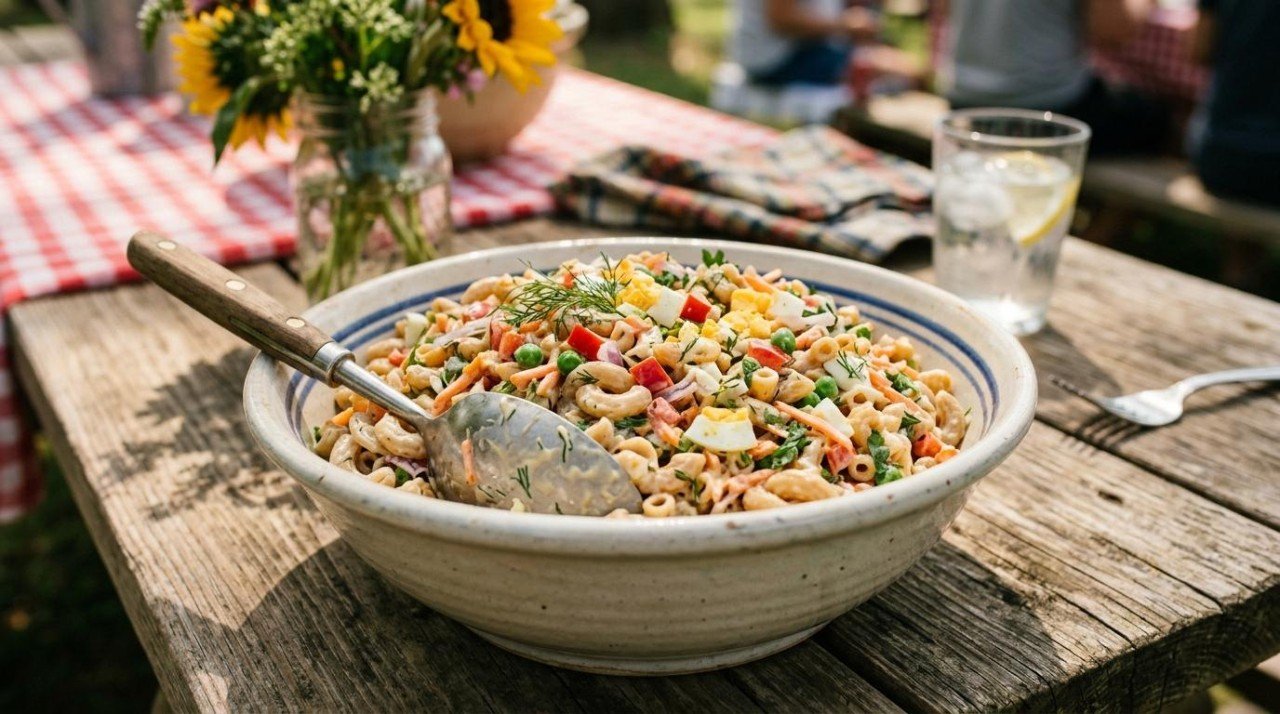
Macaroni salad is the cookout side with the least ambition and the most loyalty. Elbows, a lot of mayonnaise, a spoonful of sugar, some celery and onion, a little relish. It never changes, and nobody wants it to. It is usually sitting next to the potato salad and the creamy pasta salad, and it is usually the first one gone.
We ran the classic version through our Nutrition Score and it came back at 38 out of 100. Then we rebuilt it one swap at a time to 86. Half of the mayonnaise is still in it, it is still creamy, still cold, still unmistakably macaroni salad.
This post goes deeper on one question the other two salads only touched: how much of the mayo can you trade for Greek yogurt, and where does the trade stop paying? We scored five different ratios, twice. The answer is more interesting than "use less mayo."
The original: what is in it and how it scores
The version we scored is the classic American deli-style bowl, serving eight as a side:
- 1 lb elbow macaroni (dry weight), boiled and cooled
- 1 1/2 cups mayonnaise
- 2 tablespoons sugar
- 2 tablespoons vinegar and 1 tablespoon yellow mustard
- 1/4 cup sweet pickle relish
- 1 cup diced celery and 1/2 cup diced red onion
- 1 teaspoon salt and black pepper
Per serving that is about 522 calories, 8.1 g of protein, 2.4 g of fiber, 31.9 g of fat, 4.8 g of saturated fat and 650 mg of sodium, plus 5.6 g of added sugar. The score flags three things as high: sodium (28% of a day's limit), added sugar (21%) and saturated fat (21%).
Credit first, because this bowl is not empty. Its listed strengths are omega-3 ALA, vitamin K and folate. The first two come from the mayonnaise: most American mayo is made with soybean or canola oil, which Harvard names among the main plant sources of ALA and also lists, along with dressings made from those oils, as a real source of vitamin K. The enriched pasta adds folate, thiamine and iron. Keep that in mind when we get to the mayo ratio, because it is why "no mayo" is not automatically the winner.
What holds it at 38:
- It is almost all pasta and dressing. Celery and onion are the only vegetables, and there are 2.25 plant points in the whole bowl. Vitamin C reads as zero. The gut health dimension scores 30.
- Refined pasta, and a pound of it. Refining wheat strips out more than half its B vitamins, 90% of its vitamin E and virtually all of its fiber. Adults need 25 to 35 g of fiber a day, and most Americans get about 15. This serving offers 2.4.
- Sodium and sugar from three directions. The salt, the mayonnaise and the sweet relish all carry sodium, and the sugar and relish together put 5.6 g of added sugar in a side dish.
The upgrades: six swaps, 48 points
Each swap was scored on top of the ones before it, in the order shown, so the deltas add up to the real total. Where a swap was worth something very different on the untouched original, we say so.
1. Make it a vegetable salad that happens to have macaroni in it
- Swap: Celery from 1 cup to 1 1/2 cups, plus 1 diced red bell pepper, 1 heaping cup of thawed frozen peas, 1 shredded carrot and a big handful of fresh dill
- Score impact: +16 points (38 to 54)
- What it changes: Fiber 2.4 g to 4.0 g, potassium 200 mg to 330 mg, vitamin C 0 to 40 mg, plant points 2.25 to 5.5
- What it costs you: Nothing you will miss. More crunch, more color, and every bite tastes less like plain noodle
This is the biggest single delta in the post, and the easiest swap to make. Peas and diced pepper are already traditional in plenty of family recipes, and they are the right size: cut everything about as small as an elbow, so each forkful gets a little of each. Frozen peas need no cooking; thaw them under cold water with the drained pasta.
Calories went up slightly here (522 to 547) and the score jumped anyway. The score is measuring what a serving delivers, not what it costs.
2. Whole wheat elbows
- Swap: 1 lb white elbow macaroni to 1 lb whole wheat elbow macaroni
- Score impact: +12 points (54 to 66)
- What it changes: Fiber 4.0 g to 6.8 g, potassium 330 mg to 420 mg, one more plant point
- What it costs you: A slightly nuttier, browner noodle. Under a creamy, tangy dressing, most people do not clock it
Cold, heavily dressed salads are the most forgiving place to try whole wheat pasta. Tested alone on the original it was worth +11, so this one does not depend on the order. Check that the box says 100% whole wheat. Our pasta substitution guide covers the other options if whole wheat is not your thing.
3. Half the mayo, half Greek yogurt
- Swap: 1 1/2 cups mayonnaise to 3/4 cup mayonnaise plus 3/4 cup plain Greek yogurt
- Score impact: +6 points (66 to 72)
- What it changes: 128 calories off a serving, total fat 32.4 g to 17.1 g, saturated fat 4.9 g to 2.6 g (off the caution list), protein up 2 g, sodium down 120 mg
- What it costs you: A little tang. At 1:1, the mayo still sets the flavor
This is the swap the whole post is built around, so we did not just score one version. We scored every quarter step from all mayo to all yogurt, first on the original recipe and again on the finished one:
- All mayo (100/0): 38 on the original, 75 on the finished recipe
- 3/4 mayo, 1/4 yogurt: 41, then 81
- Half and half (what we published): 43, then 86
- 1/4 mayo, 3/4 yogurt: 45, then 89
- All yogurt (0/100): 46, then 89
Two things jump out. First, on the original recipe the whole range is only 8 points. Swapping out every drop of mayo from a bowl that is still white pasta and relish barely moves it. On the finished recipe the same range is 14 points, because once the pasta and vegetables are fixed, the dressing is most of what is left. Second, the score stops caring at 1/4 mayo. Going from a quarter to zero scores exactly the same, 89 to 89, because the last bit of mayo is bringing ALA and vitamin K along with its fat.
We published the half-and-half version because macaroni salad is a mayo-forward dish and the 1:1 ratio still tastes like it. If you like a tangier salad, 1 part mayo to 3 parts yogurt is worth 3 more points and is the most the ratio has to give. Going all yogurt buys nothing extra on the score and turns it into a yogurt dish. More on both in our mayonnaise and Greek yogurt substitution guides.
We scored the yogurt as nonfat Greek. Nonfat works well here because the mayo is already supplying the richness; 2% is fine too and adds about 0.4 g of saturated fat per serving. Nothing in this salad is heated, so the yogurt has no chance to split.
4. Dill pickle instead of sweet relish and sugar
- Swap: 1/4 cup sweet pickle relish and 2 tablespoons sugar out; a scant 1/2 cup of chopped dill pickle in
- Score impact: +2 points (72 to 74)
- What it changes: Added sugar 5.4 g to essentially zero a serving, one more plant point
- What it costs you: The sweet edge. This is the swap that changes the flavor most, and the one to skip if your family's version is supposed to taste sweet
On the untouched original this swap scored +0, and putting the full 2 tablespoons of sugar back into the finished recipe costs only one point (86 to 85). At this amount, sugar is not what is dragging macaroni salad down. So treat it as a flavor choice, not a health rule. We like the sharper, dill-forward version with the acid doing the work the sugar used to do; a sugar substitution is an option if you want sweetness without the grams.
5. Four hard-boiled eggs
- Swap: Add 4 chopped hard-boiled eggs
- Score impact: +7 points (74 to 81)
- What it changes: Protein 11.3 g to 14.4 g, plus choline, B12 and riboflavin
- What it costs you: About 37 calories a serving. Many family recipes already include them
Eggs are optional in a lot of macaroni salads and standard in plenty of others. Here they are the swap that turns a side mostly made of carbs into one with real protein. Tested alone on the original, eggs were worth +5. They pay more here because there is less else for the score to object to.
6. Cut the salt in half, last
- Swap: 1 teaspoon salt to 1/2 teaspoon
- Score impact: +5 points (81 to 86)
- What it changes: Sodium 570 mg to 420 mg a serving
- What it costs you: Very little, because the pickle, mustard, vinegar and dill are now carrying the flavor
The same cut on the original recipe was worth exactly +1. This is the pattern we keep seeing in these makeovers: salt cuts are worth more the cleaner the rest of the recipe is, and they taste better once the acid is already in. Taking out the last 1/2 teaspoon of salt scored 86 again, no gain, so we left it in. For context, Americans average about 3,300 mg of sodium a day against a 2,300 mg ceiling, roughly 75% of it from processed food.
The technique part: why elbows, and why macaroni salad goes dry
Elbows are small, hollow and curved, so the dressing gets inside the noodle as well as on it. That is great for flavor and terrible for leftovers: pasta keeps absorbing dressing as it chills, which is why yesterday's bowl looks tight and dry. Two fixes from America's Test Kitchen's macaroni salad both apply here. Cook the macaroni until it is very soft, because softer pasta absorbs less dressing as it cools. And hold back 1/2 cup of the dressing to stir in just before serving. The same test kitchen explains that pasta goes through retrogradation as it cools, so noodles that were al dente when hot turn overly firm cold. Whole wheat elbows start firmer, so take them well past the package time.
This matters even more with half yogurt. You are using less fat, so a dry bowl is more noticeable. The reserved dressing fixes that.
What we kept (on purpose)
Half the mayonnaise, for flavor and for the ALA and vitamin K the score credits it with. The full pound of pasta: halving it and leaning on the vegetables scored 84, two points lower, because the whole wheat elbows are carrying most of the fiber now. And the last 1/2 teaspoon of salt, because removing it scored nothing and the bowl would taste flat.
We stopped at 86 because the next moves — all yogurt, no salt, fewer noodles — either scored nothing or scored worse, and would make the bowl taste less like macaroni salad.
Take the Guesswork Out of Eating Well
Eat Well Planner helps you organize your favorite recipes, plan balanced meals, and automatically generate shopping lists — all in one place. Whether you're tracking macros, managing dietary restrictions, or just trying to stop asking "what's for dinner?", we've got you covered.
Our AI-powered tools can adapt any recipe to your dietary needs, help you discover new meals you'll love, and even log your nutrition effortlessly. It's meal planning made simple.
Start Organizing Your Meals — FreeThe healthier version: full recipe
Nutrition Score: 86 (up from 38). Serves 8 as a side. Prep 25 minutes, cook 15 minutes, chill at least 1 hour.
Ingredients
- 1 lb 100% whole wheat elbow macaroni
- 4 large eggs
- 3/4 cup mayonnaise
- 3/4 cup plain Greek yogurt (nonfat or 2%)
- 2 tablespoons apple cider vinegar
- 1 tablespoon yellow mustard (or Dijon)
- 1/2 teaspoon salt
- 1/2 teaspoon black pepper
- 1 1/2 cups diced celery (about 3 ribs)
- 1 large red bell pepper, diced small (about 1 cup)
- 1 heaping cup frozen peas, thawed
- 1 medium carrot, shredded (about 1/2 cup)
- 1/2 cup finely diced red onion
- Scant 1/2 cup chopped dill pickle (about 2 small spears)
- 1/2 cup chopped fresh dill, loosely packed
Instructions
- Bring a large pot of water to a boil and cook the macaroni about 3 minutes past the package's al dente time, until it is soft all the way through. All the salt in this recipe is in the dressing, so salt the water lightly or not at all.
- Meanwhile, put the eggs in a small saucepan, cover with cold water, bring to a boil, then cover, take off the heat and let stand 11 minutes. Move them to ice water, then peel and chop.
- Drain the macaroni, rinse under cold water until cool, and shake it well to get rid of the water. Rinse the thawed peas with it.
- Whisk the mayonnaise, Greek yogurt, vinegar, mustard, salt and pepper in a large bowl. Set aside 1/2 cup of the dressing in the fridge.
- Add the macaroni, peas, celery, bell pepper, carrot, red onion, pickle, dill and eggs to the bowl and fold until everything is coated.
- Cover and chill at least 1 hour. Just before serving, stir in the reserved dressing. Taste for salt and acid; a splash more vinegar usually does more than more salt.
- Keeps 3 to 4 days in the fridge. If it tightens up, loosen it with a spoonful of yogurt or a splash of vinegar.
Per serving: original vs. healthier
- Nutrition Score: 38 to 86
- Calories: 522 to 421
- Protein: 8.1 g to 14.4 g
- Fiber: 2.4 g to 6.8 g (23% DV)
- Saturated fat: 4.8 g to 3.4 g
- Sodium: 650 mg to 420 mg
- Added sugar: 5.6 g to essentially zero
- Potassium: 200 mg to 480 mg
- Vitamin C: 0 to 40 mg (41% DV)
- Plant points: 2.25 to 7.5
All three cautions are gone. The finished bowl scores 93 for gut health (up from 30) and is now a good or excellent source of fiber, vitamin C, phosphorus, iron, vitamin K, magnesium, B6, zinc and choline. One number moved the wrong way, and we want to be upfront about it: omega-3 ALA dropped from 130% to 71% of the daily value, because half the mayo is gone. Still an excellent source, just less of one.
Seven and a half plant points from one side dish is a real share of the 30-plants-a-week target, which is a gut-health number the original bowl barely touched.
Swaps we tested and skipped
- Light mayonnaise instead of the mayo-yogurt blend: 74. Twelve points below the published version. Light mayo cuts fat with water, starch and sugar, and it carries more sodium per spoonful. Half regular mayo plus yogurt beats all light mayo easily.
- Pickle brine for tang: -2. A popular trick is to replace the sugar with a splash of pickle juice. Brine is salt water, and 2 tablespoons cost 2 points mid-build. The vinegar already does the job.
- Half the pasta: 84. Fewer noodles, more vegetables sounds right, but the whole wheat elbows are the main fiber source by this point, and halving them lost two points.
- White elbows in the finished recipe: 74. If whole wheat is a dealbreaker in your house, this is what the switch back costs. Twelve points, the second biggest lever here.
- All Greek yogurt, no mayo: 89. Three points better, the same score as a 1:3 blend, and it no longer tastes like macaroni salad. If you want those points, go 1:3 and keep a little mayo.
Make it fit other diets
- Egg-free: Leave out the eggs and the bowl scores 79, still more than double the original.
- Gluten-free: Use gluten-free elbows. We did not score this one; bean- and rice-based pastas vary too much from box to box to quote one number.
- Vegan: Vegan mayo, a plain unsweetened plant yogurt and no eggs. Not scored.
The app's Recipe Variations will rewrite this exact recipe for any of these in one step, and you can score the result before you make it.
Do this to your own family's recipe
Every macaroni salad is somebody's grandmother's recipe, and yours probably has a detail ours does not: ham, cheese cubes, more sugar, Miracle Whip. That is the point of the tools we used. Import your recipe into Eat Well Planner from a website, a photo of the recipe card, or a video, and it gets a Nutrition Score right away. Make It Healthier proposes swaps like the ones above and checks each gain with a calculator before you see it, and the Recipe Playground shows you what any single change is worth, so you can keep the sweet relish and win the points back somewhere else.