Hummus is one of the few foods that shows up on health-food lists and party tables with equal confidence. It is chickpeas, sesame, lemon, garlic and olive oil — five ingredients a nutritionist would tell you to eat more of. So when we ran a standard homemade batch through the app's Nutrition Score, we half expected it to come back in the eighties and end the post right there.
It came back at 59 out of 100.
Not because hummus is secretly bad for you. It is not. The score's diagnosis pointed at two boring, entirely fixable things, and neither was the tahini or the chickpeas. We rebuilt it to 83 keeping all five ingredients — then found a fourth change, not in the recipe at all, that mattered more than the other three combined.
The original: what is in it and how it scores
Here is the version we scored: a composite of the recipes that dominate the first page of results for "hummus recipe" — Inspired Taste's and Cookie and Kate's among them — plus the drizzle people actually pour over the bowl. Eight servings of about 1/4 cup:
- 1 (15 oz) can chickpeas, drained (250 g)
- 1/4 cup tahini (60 g)
- 1/4 cup lemon juice (60 g)
- 2 garlic cloves (6 g)
- 3 tablespoons olive oil blended in, plus 2 tablespoons drizzled over the bowl (67 g total)
- 3/4 teaspoon salt (4.5 g)
- 1/2 teaspoon ground cumin
Score: 59/100. Per 1/4 cup serving: 165 calories, 13.3 g total fat, 1.9 g saturated fat, 3.6 g protein, 2.8 g fiber, 300 mg sodium, 80 mg potassium.
What is already good (and it is most of it)
The score lists folate, iron and thiamine as strengths, and it is not being polite. A quarter cup delivers 16% of the Daily Value for folate, 14% for iron, 12% for phosphorus and 11% for thiamine — from a dip. Chickpeas are the reason. Harvard's Nutrition Source notes that eating legumes about four times a week has been associated with a 14% lower risk of coronary artery disease, and that a pooled analysis of eleven trials found pulses lowered total cholesterol by about 7% and LDL by about 6%. The tahini is not just making it creamy either: sesame paste is one of the densest plant sources of calcium, iron and phosphorus in a normal kitchen.
The olive oil is fat we have no argument with — the FDA allows a qualified health claim that about 1 1/2 tablespoons a day of high-oleic oils may reduce coronary heart disease risk. Read that claim closely, though, and you find the catch that runs through this whole post: the benefit holds when the oil replaces fats higher in saturated fat, and when it does not increase total calories. Olive oil earns its keep as a substitution, not as an addition.
What actually drags it down
The score flagged three weaknesses: low vitamin A, high omega-6, and high sodium. Vitamin A is a fair criticism of a beige dip and not one worth chasing. The other two are the story:
- Sodium: 300 mg per quarter cup. That is about 2,400 mg in the whole bowl, from a recipe with one salty ingredient in it. The FDA puts average American intake at about 3,400 mg a day against a limit of under 2,300 mg. About a quarter of it came from a place most people never think about: the can.
- Five tablespoons of oil, 45% of the calories. The 67 g of olive oil is 592 of this batch's 1,323 calories. It is not unhealthy fat. It is just a lot of fat doing a job that something else in the bowl can do better.
Worth saying plainly, because it cuts against the usual advice: the store-bought tub is not the villain here. Sabra's classic hummus runs 130 mg of sodium per 2 tablespoons — about 260 mg per quarter cup, slightly less than the homemade version we just scored. Its real compromise is the third ingredient on the label: soybean oil, not olive oil. That is the line to read if you buy hummus. But do not assume your own bowl is automatically better, because ours was not.
The upgrades
Three changes, applied in this order, each one scored on top of the last. None of them removes an ingredient.
1. Cut the salt to a third of a teaspoon and let the lemon and garlic work
- Swap: 3/4 teaspoon salt to 1/3 teaspoon; lemon juice from 1/4 cup to 5 tablespoons; garlic from 2 cloves to 3; cumin from 1/2 to 1 teaspoon
- Score impact: +13 points (59 to 72)
- What it changes: Sodium from 300 mg to 180 mg per serving
- What it costs you: Genuinely less salty. The first spoonful tastes sharper and more garlicky, and it takes a day in the fridge to settle
This is the biggest single lever in the recipe and it is free. Salt is not the only thing that makes food taste seasoned — acid and pungency do a lot of the same work, which is why a hummus with real lemon and three raw garlic cloves can carry half the salt without tasting flat. Add the extra lemon before you add the extra salt, and taste in between.
If a third of a teaspoon really does taste thin to you, going back up to a half teaspoon scores 81 instead of 83. Two points is a fair price for a dip you will actually finish, and it is still 140 mg less sodium per serving than where we started. (Out of lemons? Our lemon juice substitutes guide covers what works here, and the fresh garlic guide has the clove-to-powder conversions.)
2. Cook the chickpeas yourself instead of opening a can
- Swap: One 15 oz can, drained, to 1/2 cup dried chickpeas soaked and simmered soft
- Score impact: +7 points (72 to 79)
- What it changes: Sodium from 180 mg to 110 mg; fiber up to 3.2 g, protein to 4.2 g, potassium from 90 mg to 140 mg per serving
- What it costs you: An overnight soak and an hour of unattended simmering. No flavor cost at all — it is better
Canned chickpeas carry roughly 250 mg of sodium per 100 g from the packing liquid, and draining alone leaves most of it clinging to the beans. Cooked from dried in unsalted water, the same weight has almost none — plus more chickpea per gram, which is where the extra fiber and protein come from.
Not soaking beans overnight? Draining and rinsing the can is a real version of the same move: Tufts' Health & Nutrition Letter cites research finding it removes about 41% of the sodium on average. Built with rinsed canned chickpeas, our final recipe still scores 73 — fourteen points above where we started, for no extra work. (If beans and your digestion have a complicated relationship, we wrote about why that happens and what fixes it.)
3. Let the tahini carry the richness instead of the oil
- Swap: Tahini from 1/4 cup to 6 tablespoons; olive oil from 5 tablespoons to 2 teaspoons, drizzled on at the end
- Score impact: +4 points (79 to 83)
- What it changes: 175 calories to 133 per serving, total fat 13.3 g to 8.1 g, saturated fat 1.95 g to 1.1 g; calcium up to 70 mg, iron to 26% DV
- What it costs you: Nothing, if you replace the volume with ice water. Skip that step and it turns stiff and pasty
Only four points, and that number is honest — the score does not punish olive oil much, and it should not. But it cuts a quarter of the calories, drops "high saturated fats" off the weakness list, and trades oil calories for sesame minerals. Tahini brings calcium, iron and phosphorus with its fat. Olive oil brings fat.
The technique is the whole trick, and it is what restaurant hummus has been doing all along. Blend the tahini with the lemon juice, garlic and salt first, on its own, until it seizes up and turns pale and stiff, then stream in ice water a tablespoon at a time until it loosens into a smooth cream. Rainbow Plant Life's Lebanese-style method uses 6 to 10 tablespoons of ice water and keeps olive oil out of the blend entirely, treating it strictly as a topping — which is how it is done across the Levant. The ice water is not a diet trick; it is what produces the fluffy texture people are trying to buy with oil. Cooking the chickpeas until they genuinely fall apart does the rest: one test of three methods found overcooked chickpeas beat hand-peeled ones for smoothness. (Tahini jar empty? Our tahini substitutes guide has a section for exactly this recipe.)
Take the Guesswork Out of Eating Well
Eat Well Planner helps you organize your favorite recipes, plan balanced meals, and automatically generate shopping lists — all in one place. Whether you're tracking macros, managing dietary restrictions, or just trying to stop asking "what's for dinner?", we've got you covered.
Our AI-powered tools can adapt any recipe to your dietary needs, help you discover new meals you'll love, and even log your nutrition effortlessly. It's meal planning made simple.
Start Organizing Your Meals — FreeThe upgrade that is not in the recipe
Here is where the numbers got interesting. Nobody eats hummus alone, so we scored the thing people actually eat: a snack plate with 1/2 cup of hummus on it.
- Original hummus + 1 oz pita chips: score 50. 459 calories, 850 mg sodium, 6.6 g fiber, 2.5 plant points
- Upgraded hummus + the same 1 oz pita chips: score 68. 394 calories, 460 mg sodium, 8.1 g fiber
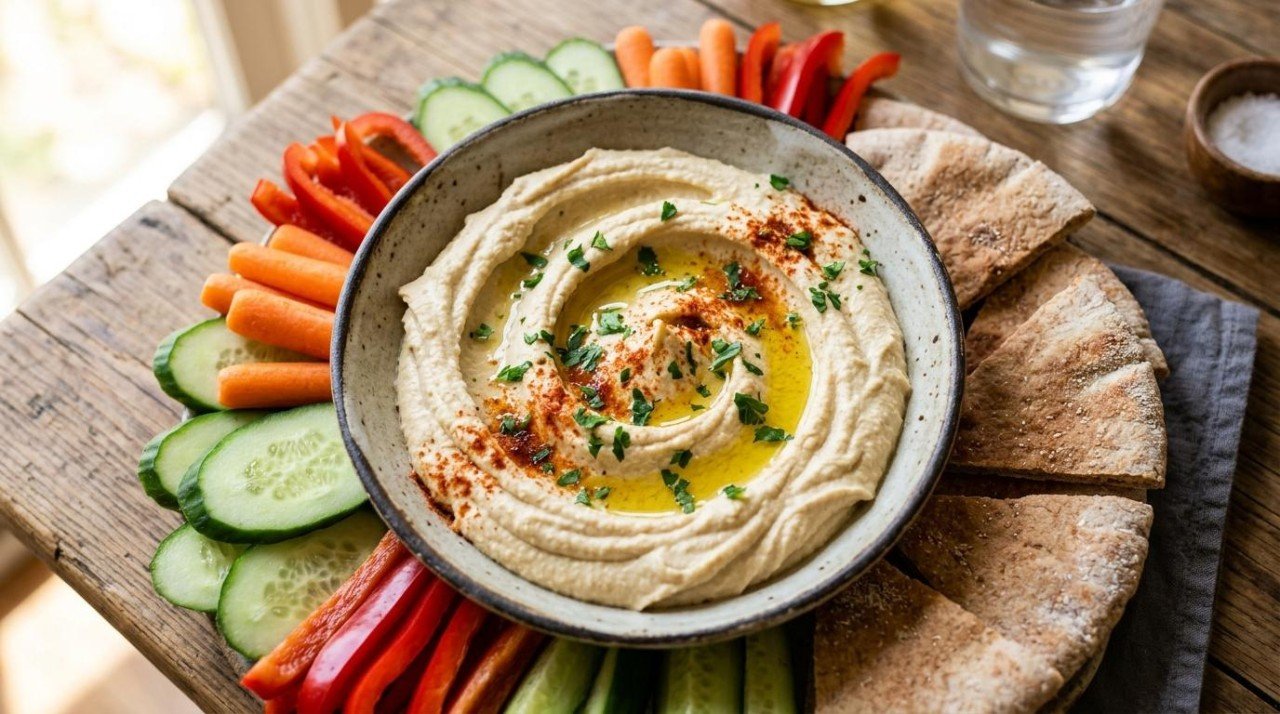
- Upgraded hummus + cucumber, carrot and red bell pepper + half a whole wheat pita: score 94. 390 calories, 390 mg sodium, 11.1 g fiber, 730 mg potassium, 6.5 plant points
Fixing the dip moved the plate 18 points. Fixing the dipper moved it another 26 — for the same calories. Pita chips carry 3.8 g of fiber per 100 g against whole wheat pita's 6.1, bring most of that 850 mg of sodium, and add nothing to plant diversity. The vegetables take the plate from 2.5 plant points to 6.5 and land it at 94% of the Daily Value for vitamin C and 56% for vitamin A — the exact weakness the original hummus was flagged for. In the American Gut Project, people eating more than 30 different plant types a week had measurably more diverse gut bacteria than those eating ten or fewer, regardless of whether they called themselves vegan or omnivore.
Keep the pita. Make it whole wheat, make it half of one, and put a pile of raw vegetables next to it. That is the whole intervention.
What we kept on purpose
The 2 teaspoons of olive oil drizzled over the finished bowl: leaving it off scores 84 instead of 83, one point for the best mouthful of the dish. And all the tahini, and then some — the dish is called hummus bi tahina, and taking the sesame out to save fat is not a healthier hummus, it is a worse chickpea puree. That is where we stopped.
The healthier version: full recipe
Score: 83/100. Makes about 2 cups, 8 servings of 1/4 cup.
- 1/2 cup (100 g) dried chickpeas
- 1/2 teaspoon baking soda, for the cooking water
- 6 tablespoons (90 g) tahini, well stirred
- 5 tablespoons (75 g) fresh lemon juice, from about 2 lemons
- 3 garlic cloves (9 g), roughly chopped
- 1 teaspoon ground cumin
- 1/3 teaspoon (2 g) fine sea salt
- 6 to 8 tablespoons ice water
- 2 teaspoons extra virgin olive oil, for drizzling
- Sumac or paprika and chopped parsley, for serving (optional, not included in the scored numbers)
- Cover the dried chickpeas with 3 inches of cold water and soak 8 to 12 hours. They will roughly double.
- Drain, put in a saucepan with the baking soda and fresh water to cover by 2 inches. Bring to a boil, then simmer 45 to 60 minutes, skimming the foam, until a chickpea smears to paste between your fingers with no resistance. Overcooked is the goal. Drain and rinse; you should have about 1 1/2 cups (250 g).
- Put the tahini, lemon juice, garlic, cumin and salt in a food processor and run for 1 minute. It will seize and turn pale and stiff. This is correct.
- With the motor running, stream in ice water 1 tablespoon at a time until it loosens into a smooth, pourable cream, 30 to 60 seconds more.
- Add the warm chickpeas and process 3 to 4 minutes, scraping down twice. The long blend is where the texture comes from — do not cut it short.
- Add more ice water a tablespoon at a time until the hummus falls softly off a spoon. Taste and adjust lemon and salt.
- Spread in a shallow bowl, make a well with the back of a spoon, drizzle the olive oil into it, and finish with sumac or paprika and parsley. Serve with raw vegetables and half a whole wheat pita per person.
Per 1/4 cup serving, original vs. improved:
- Nutrition Score: 59 to 83
- Calories: 165 to 133
- Total fat: 13.3 g to 8.1 g
- Saturated fat: 1.9 g to 1.1 g
- Protein: 3.6 g to 4.8 g
- Fiber: 2.8 g to 3.5 g
- Sodium: 300 mg to 110 mg
- Potassium: 80 mg to 160 mg
- Calcium: 50 mg to 70 mg
The finished dip is a good source of iron (26% DV per serving), phosphorus (20%), folate (17%), thiamine (15%) and fiber (12%). A short-cut version using a rinsed can of chickpeas instead of dried scores 73.
Swaps we tested and skipped
Replacing half the tahini with nonfat Greek yogurt: scores 87. Four points higher than our final recipe, and we still did not do it. It drops iron from 26% to 20% of the Daily Value, phosphorus from 20% to 16%, fiber from 3.5 g to 3.0 g and calcium from 70 mg to 50 mg per serving, and it makes the dip dairy, which puts it off the table for vegan and dairy-free readers. It is a nice cold dip. It is not hummus. (Trying it anyway? Our Greek yogurt substitutes guide covers the swaps in the other direction.)
Taking the tahini out entirely: scores 83. Identical to our recipe, at 66 calories a serving instead of 133 — and worse in every way that matters. Calcium falls from 70 mg to 20 mg, iron from 26% to 14% DV, plant points from 2.5 to 1.5, and sodium reappears on the weakness list because the dish is now too thin to carry it. Zero points gained, half the minerals lost, and a bowl of lemony chickpea paste.
Skipping the finishing drizzle: scores 84. One point. Not worth it.
Make it fit other diets
Hummus is already vegan, dairy-free and gluten-free as written — the pita next to it is the only thing that is not.
- Gluten-free: serve with raw vegetables and seed crisps instead of pita.
- Higher protein: stir a spoonful of hemp hearts in at the end, or top the bowl with roasted chickpeas.
- Low-FODMAP: swap the raw garlic for garlic-infused olive oil in the drizzle and keep the portion to 2 tablespoons.
In the app, asking the AI to rewrite the recipe for any of these takes one step and gives you a full adjusted recipe rather than a note to yourself.
Do this to your own recipes
The useful part of this exercise was not the 24 points. It was finding out that the sodium was hiding in the can and the calories were hiding in the drizzle, when everyone assumes hummus lives or dies on the tahini. You cannot guess that. You have to score it.
That is what Eat Well Planner's Make It Healthier does: import any recipe — a URL, an Instagram reel, a YouTube video — and the app scores it, then proposes swaps with the gain verified by a calculator before you ever see the suggestion. The per-swap deltas in this post came out of the Recipe Playground, where you change one ingredient and watch the score move in real time. Want to keep the full five tablespoons of olive oil? Put it in, see what it costs, and decide for yourself.