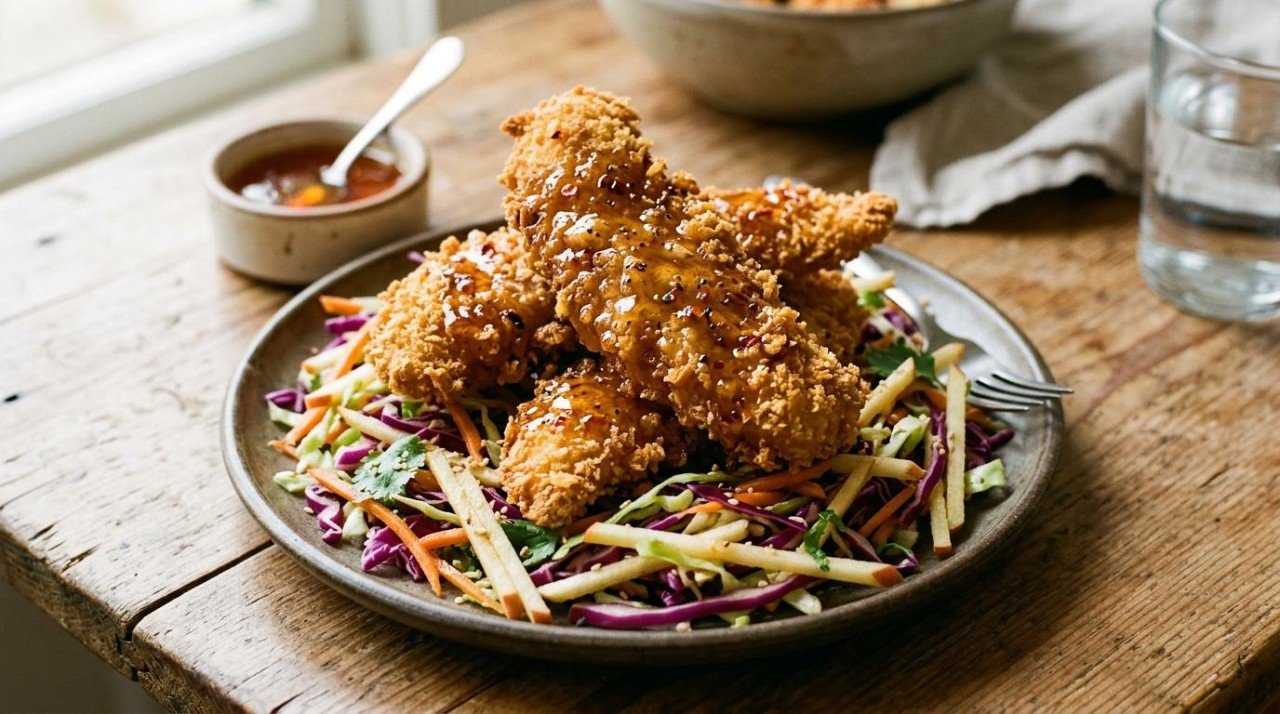
Hot honey chicken is the most successful flavor idea of the decade. The honey itself traces to Mike Kurtz, who tasted chili-infused honey at a pizzeria in Brazil in 2004, spent years perfecting his own version, and started drizzling it on pizza at Paulie Gee's in Brooklyn in 2010. Sixteen years later it is on fried chicken in every direction: tenders, sandwiches, biscuits, chain menus, and an endless scroll of videos where somebody pours a shimmering ribbon of it over a pile of craggy, golden chicken in slow motion.
That pour is the whole appeal, and it is also the problem. We built the standard viral version, deep-fried buttermilk tenders with about half a cup of hot honey going over the top, and ran it through our Nutrition Score. It came back at 30 out of 100. Then we rebuilt it to 63, still crunchy, still sweet-hot, still the dish.
Two things surprised us on the way. The single biggest gain in the entire makeover had nothing to do with the chicken. And two of the swaps everyone assumes are the healthy ones, air-frying it and skipping the breading altogether, both made the score go down.
The viral version: what is in it and how it scores
The build we scored, four servings:
- 1.5 lb chicken breast, cut into tenders
- 1 cup buttermilk for the brine, plus 1 egg
- 1 cup all-purpose flour and 2 tablespoons cornstarch for the dredge
- About 2 1/2 teaspoons salt across the brine and the dredge, plus garlic powder and black pepper
- Deep-fried in neutral oil (about 3.5 oz of it ends up absorbed into the crust)
- Hot honey: 1/2 cup honey, 2 tablespoons butter, 1 tablespoon hot sauce, 2 teaspoons red pepper flakes
Per serving that is 789 calories, 46.5 g of protein, 36.6 g of fat, 8.0 g of saturated fat, 1,680 mg of sodium, 34.9 g of added sugar, and 1.4 g of fiber.
Start with what is genuinely good here, because there is real food in this. One serving carries 46.5 g of protein, 111% of a day's niacin, 87% of vitamin B6, and 70% of phosphorus. Chicken breast is chicken breast. Nobody needs to feel bad about eating this.
Two numbers push it down to 30, and the score flags both at its highest caution level:
- Added sugar: 34.9 g per serving. That is more than the American Heart Association's entire daily limit for women (24 g) and almost all of the 36 g limit for men, from a drizzle. Honey is not nutritionally different here from any other syrup: it counts as added sugar, and half a cup of it split four ways is 2 tablespoons a plate.
- Sodium: 1,680 mg per serving, 73% of a day. The 2,300 mg ceiling for chronic disease risk reduction is nearly gone in one dinner, and the average American is already running around 3,400 mg a day.
Underneath those two, the quieter problem: 1.4 g of fiber and 0.75 different plants in the entire dish. Recommended fiber is 25 to 35 g a day and most Americans get about 15. This plate contributes almost nothing to that, because a plate of tenders is chicken, wheat, oil, and sugar. There is no vegetable anywhere in it.
The upgrades: six swaps, 33 points
Each swap below was scored on top of the one before it, in the order we made them, so the deltas add up to the real total. If you make exactly one change, make the first one. It does not touch the chicken at all.
1. Put a slaw under it
- Swap: Serve the tenders on a bed of cabbage slaw (green and red cabbage, carrot, red onion, cider vinegar, olive oil, Dijon)
- Score impact: +11 points (30 to 41)
- What it changes: Fiber from 1.4 g to 5.2 g, plants from 0.75 to 4.75, potassium up by nearly half
- What it costs you: Ten minutes with a knife, and nothing at all on the chicken
The biggest single lever in the makeover, and it is an addition rather than a subtraction. Nothing about the chicken changes. You just stop eating it on a bare plate. That is worth more than the crust, the fryer, and the salt combined, which is not what anybody expects when they open a post like this one.
It also earns its place on the plate for a reason that has nothing to do with the score: hot honey is sweet and rich, and raw cabbage dressed with cider vinegar is sharp and cold. The acid resets your palate between bites, so the fifth tender tastes like the first instead of like syrup. This is the same reason pickles come with fried chicken sandwiches. If you want the vinegar slaw as a dish in its own right, we rebuilt classic coleslaw separately, and the finding there was similar: the cabbage was never the problem.
2. Measure the hot honey instead of pouring it
- Swap: 1/2 cup honey → 2 tablespoons honey, stretched with 1 tablespoon cider vinegar and kept just as hot
- Score impact: +8 points (41 to 49)
- What it changes: Added sugar from 34.9 g to 8.6 g per serving, about 96 calories off
- What it costs you: The slow-motion pour. The flavor is arguably better.
Here is the part worth internalizing: the amount of honey a recipe calls for is set by how it looks on camera, not by how it tastes. Two tablespoons of honey across four servings, cut with vinegar and carrying the same butter, hot sauce, and pepper flakes, still coats every tender in a glossy sweet-heat glaze. What you lose is the pool of honey left on the plate at the end, which nobody eats anyway.
Cutting the honey by three quarters and adding acid also makes the sauce taste hotter, because sugar mutes capsaicin. If you want it hotter still, that is free: more pepper flakes and more hot sauce cost you nothing in the score. Our honey substitutes guide covers what happens if you try to replace it entirely, and the short answer is that in a glaze this thin, you mostly cannot.
3. Whole wheat panko instead of the flour dredge
- Swap: 1 cup all-purpose flour → 2 cups whole wheat panko breadcrumbs
- Score impact: +3 points (49 to 52)
- What it changes: Fiber to 6.2 g, carbs down from 51 g to 42 g, adds B vitamins and vitamin E
- What it costs you: A nuttier, darker crust. It is also a crunchier one.
Refining wheat strips more than half of its B vitamins, 90% of its vitamin E, and virtually all of its fiber, so a white flour dredge is close to nutritionally inert. It is there for texture. Whole wheat panko does the texture job better: the shards are bigger and stay separate, which is exactly what you want when you are not submerging them in oil.
One honest note on the number. Panko brings sodium with it, roughly 130 mg a serving, which eats into the gain. That is why this swap is worth 3 points here rather than more, and it is also why the next swap is worth so much. See the bread crumbs guide if your store only carries the white kind.
4. Cut the salt by 40% and pay for it in spice
- Swap: 2 1/2 teaspoons salt → 1 1/2 teaspoons, plus a tablespoon of smoked paprika, more garlic and onion powder, and cayenne
- Score impact: +8 points (52 to 60)
- What it changes: Sodium from 1,870 mg to 1,290 mg per serving (81% to 56% of a day's limit)
- What it costs you: Nothing, if you actually add the spice. Everything, if you just use less salt.
This is the swap with the most useful lesson in it. We also tested cutting the same 6 grams of salt on the original recipe, changing nothing else, and it was worth 2 points. The identical change here, after the sugar has already come down, is worth 8. Same salt, four times the payoff, because the score responds hardest to whatever is currently the worst thing about a dish. While 35 g of added sugar was sitting at the top of the caution list, sodium barely registered. Fix the sugar and sodium becomes the thing standing between you and a better number.
The technique half matters as much. Smoked paprika, garlic powder, onion powder, and cayenne all read as savory depth, so a crust seasoned hard with them does not taste under-salted. Salt cut without replacement tastes like a diet.
5. Air-fry it instead of deep-frying
- Swap: Deep fry → air fryer or 425F oven on a wire rack, with 1 1/2 tablespoons olive oil tossed through the crumbs
- Score impact: -1 point (60 to 59)
- What it changes: 180 calories off, total fat from 43.0 g to 23.0 g, saturated fat from 9.0 g to 6.5 g (the build had crept up from the original 36.6 g of fat because the slaw dressing added a tablespoon and a half of olive oil)
- What it costs you: A point, honestly. And a slightly less uniform crust.
We tested air-frying on its own too, with nothing else changed, and it moved the original score from 30 to 30. Zero. Then applied here at the end of the build, it costs a point.
The reason is that frying oil is not only fat. Neutral vegetable oils are among the better everyday sources of the plant omega-3 ALA and of vitamin E, and the original's 1.9 g of ALA a serving was one of the few nutrients the score actually liked about it. Pour the oil away and that leaves too. The score is measuring nutrient density, not calories, so it does not hand out points for a smaller number on a calorie label.
We kept the air fryer anyway, and this is the one place in the post where we overrode the number. Twenty grams of fat and 180 calories a serving is a real difference in a dish people eat regularly, and the ALA is easy to get back from a tablespoon of olive oil in the slaw dressing, where it is not deep-frying anything. We reached the same conclusion when we rebuilt classic fried chicken: baked is not automatically healthier, and if somebody tells you it is, they have not measured it.
To make the oven version genuinely crunchy rather than pale and splotchy, toast the panko first. Spread the crumbs on a sheet pan with the oil, bake 4 to 5 minutes until light golden, then bread the chicken. This is the single technique that separates good baked breaded chicken from sad baked breaded chicken, because the crumbs arrive already browned instead of hoping to brown in the time it takes the chicken to cook.
6. Three more plants in the slaw
- Swap: Add a julienned crisp apple, 3 scallions, and a handful of parsley to the slaw
- Score impact: +4 points (59 to 63)
- What it changes: Fiber to 8.1 g, plants to 8.75, vitamin C to 73% of a day
- What it costs you: Two more minutes of knife work
This buys back the point the air fryer cost, four times over, for ingredients that cost about a dollar. Apple in particular is doing double duty: it is sweet and crisp, so it covers the sweetness you took out of the honey while adding fiber instead of sugar.
The plant count is worth paying attention to on its own. In the American Gut Project, people eating more than 30 different plant types a week had measurably different gut microbiomes than people eating fewer than 10, with more of the bacteria that ferment fiber into short-chain fatty acids. The original version of this dish contributed 0.75 plants toward that week. This one contributes 8.75, from a dinner that is still fried chicken with hot honey on it.
Take the Guesswork Out of Eating Well
Eat Well Planner helps you organize your favorite recipes, plan balanced meals, and automatically generate shopping lists — all in one place. Whether you're tracking macros, managing dietary restrictions, or just trying to stop asking "what's for dinner?", we've got you covered.
Our AI-powered tools can adapt any recipe to your dietary needs, help you discover new meals you'll love, and even log your nutrition effortlessly. It's meal planning made simple.
Start Organizing Your Meals — FreeWhat we kept on purpose
The 2 tablespoons of butter in the hot honey. We tested taking it out. The score went down a point, to 62, despite dropping 5.8 g of fat and 3.2 g of saturated fat a serving. Some of the plate's vitamin A is coming from it, and taking it out drops the finished dish from 53% to 47% of a day's worth. The sauce needs it anyway: butter is what makes a honey glaze cling to a crust instead of running off it.
The buttermilk brine. It is worth almost nothing to the score directly, and it is doing three jobs anyway. It tenderizes, it glues the crumbs on, and most of it goes down the drain before cooking. Our buttermilk substitutes guide covers the milk-and-vinegar version if you do not want to buy a carton for one cup.
Real honey, real chicken breast, real crunch. We stopped at the point where the next change would have made it a different dinner. You will see exactly where that line was in the next section.
The healthier version: full recipe
Final score: 63 out of 100, up 33 points from the original. Serves 4.
For the chicken
- 1.5 lb (680 g) boneless, skinless chicken breast, cut lengthwise into tenders
- 1 cup buttermilk
- 1 1/2 teaspoons fine salt (about 8 g), divided
- 2 cups (about 125 g) whole wheat panko breadcrumbs
- 1 1/2 tablespoons olive oil
- 1 large egg
- 2 tablespoons cornstarch
- 1 tablespoon smoked paprika
- 1 1/2 teaspoons garlic powder
- 1 1/2 teaspoons onion powder
- 3/4 teaspoon cayenne pepper
- 3/4 teaspoon black pepper
For the hot honey
- 2 tablespoons honey
- 2 tablespoons butter
- 1 tablespoon hot sauce
- 1 tablespoon apple cider vinegar
- 2 teaspoons crushed red pepper flakes
For the slaw
- 4 cups shredded green cabbage (about 10 oz)
- 2 cups shredded red cabbage (about 5 oz)
- 2 medium carrots, shredded
- 1/2 small red onion, sliced paper thin
- 1 crisp apple (Honeycrisp or Granny Smith), julienned
- 3 scallions, sliced
- 1/4 cup chopped flat-leaf parsley
- 2 tablespoons apple cider vinegar
- 1 1/2 tablespoons olive oil
- 2 teaspoons Dijon mustard
- Put the chicken tenders in a bowl or zip-top bag with the buttermilk and 1/2 teaspoon of the salt. Refrigerate at least 1 hour and up to 8.
- Heat the oven to 400F. Spread the panko on a sheet pan, drizzle with the olive oil, toss with your hands until evenly coated, and bake 4 to 5 minutes, stirring once, until light golden. Do not skip this. Tip into a shallow dish.
- Stir the smoked paprika, garlic powder, onion powder, cayenne, black pepper, and remaining 1 teaspoon salt together. Add half to the toasted panko and toss.
- Whisk the egg, cornstarch, the other half of the spice mix, and 3 tablespoons of the buttermilk brine into a smooth, thick batter. Lift the tenders out of the brine, let them drip, and turn them through the batter to coat.
- Press each tender firmly into the seasoned panko on both sides so the crumbs stick. Set on a wire rack over a sheet pan.
- Raise the oven to 425F and bake 15 to 20 minutes, until the crust is deep golden and the thickest tender reads 165F. In an air fryer, 400F for 12 to 15 minutes, in a single layer, flipping once.
- While the chicken bakes, toss all the slaw ingredients together in a large bowl. Let it sit at least 10 minutes so the cabbage softens slightly and takes on the vinegar. Do not salt it.
- Warm the honey, butter, hot sauce, cider vinegar, and pepper flakes in a small pan over low heat, whisking, until melted and glossy, about 2 minutes. Keep it warm.
- Pile the slaw onto four plates, lay the tenders on top, and spoon the hot honey over, about 1 1/2 tablespoons of sauce per plate. Serve straight away, while the crust is loud.
How one serving compares, viral version versus this one:
- Nutrition Score: 30 → 63
- Calories: 789 → 615
- Added sugar: 34.9 g → 8.6 g
- Sodium: 1,680 mg → 1,300 mg (73% → 56% of the daily limit)
- Fiber: 1.4 g → 8.1 g (an excellent source, at 27% of a day)
- Total fat: 36.6 g → 23.1 g
- Saturated fat: 8.0 g → 6.5 g
- Protein: 46.5 g → 48.5 g
- Potassium: 780 mg → 1,310 mg
- Different plants: 0.75 → 8.75
Added sugar has dropped off the highest caution band entirely. Sodium is still flagged, and we are not going to pretend otherwise: 1,300 mg is a lot, and it is the honest ceiling for breaded chicken that tastes like breaded chicken. The finished plate is an excellent source of vitamin K, vitamin B6, niacin, phosphorus, vitamin C, protein, pantothenic acid, vitamin A, riboflavin, potassium, and fiber. The gut health sub-score went from 18 to 63, weight management from 36 to 75, and heart health from 29 to 53.
Swaps we tested and skipped
Dropping the honey entirely. Hot sauce, vinegar, butter, and pepper flakes with no honey at all scores 68, five points above ours. It is also not hot honey chicken. Five points is not worth deleting the reason you clicked on this, and if you are eating 8.6 g of added sugar in a dinner that also carries 8 g of fiber and nearly nine different plants, the sugar is not the thing to worry about.
Skipping the breading and grilling the chicken. This is the swap every healthy-eating article reaches for, and it is the one that backfired hardest. Grilled tenders with the same slaw and the same measured hot honey score 57, a full 6 points below the breaded, air-fried version, at 476 calories. Losing the whole wheat panko costs almost 2 g of fiber and a stack of B vitamins, and losing the buttermilk brine and the crumbs together takes protein down from 48.5 g to 41.0 g a serving. Fewer calories, worse nutrition, and no crunch. If you want grilled chicken, eat grilled chicken. Do not eat it and believe you did the healthier thing.
Air-frying and calling it a day. Covered above and worth repeating, because it is the most common version of this makeover on the internet: air-frying the original and changing nothing else takes the score from 30 to 30.
Make it fit other diets
For gluten-free, swap the whole wheat panko for crushed gluten-free cornflakes or GF panko and add a teaspoon of psyllium or ground flax to the crumbs so you keep some of the fiber you would otherwise lose. For dairy-free, brine in unsweetened soy or almond milk with a tablespoon of vinegar per cup, and use olive oil in place of the butter in the hot honey, accepting a slightly thinner glaze. For higher protein with more forgiveness, chicken thighs work here and dry out far less, though they cost a couple of points. In Eat Well Planner you do not have to work any of this out yourself: ask the AI to rewrite this recipe as gluten-free or dairy-free and it hands back the full ingredient list and steps with the swaps already made.
Do this to any recipe you love
We would have written a completely different article without the numbers. Every instinct pointed at the fryer. The fryer was worth zero. What was actually worth 33 points was a bowl of shredded cabbage, a measuring spoon, and a tablespoon of paprika.
Every score and delta in this post came from Eat Well Planner's Make It Healthier tool, which proposes swaps for any recipe and runs a calculator to verify the real nutritional gain before it shows you the suggestion, so the ones that are worth nothing get caught instead of published. We watched each change land in the Recipe Playground, where you edit one ingredient and see the score move live with a delta for that edit. Want to keep the full half cup of honey and make it up somewhere else? Try it there and find out exactly what it costs.
You can do this to your own food. Saw the pour on TikTok or Instagram? Paste the video link straight into the app. It pulls out the ingredients and steps, scores the recipe, tells you what is dragging the number down, and shows you which changes would move it and by how much, before you turn the oven on. We gave the fried chicken sandwich and buffalo wings the same treatment.