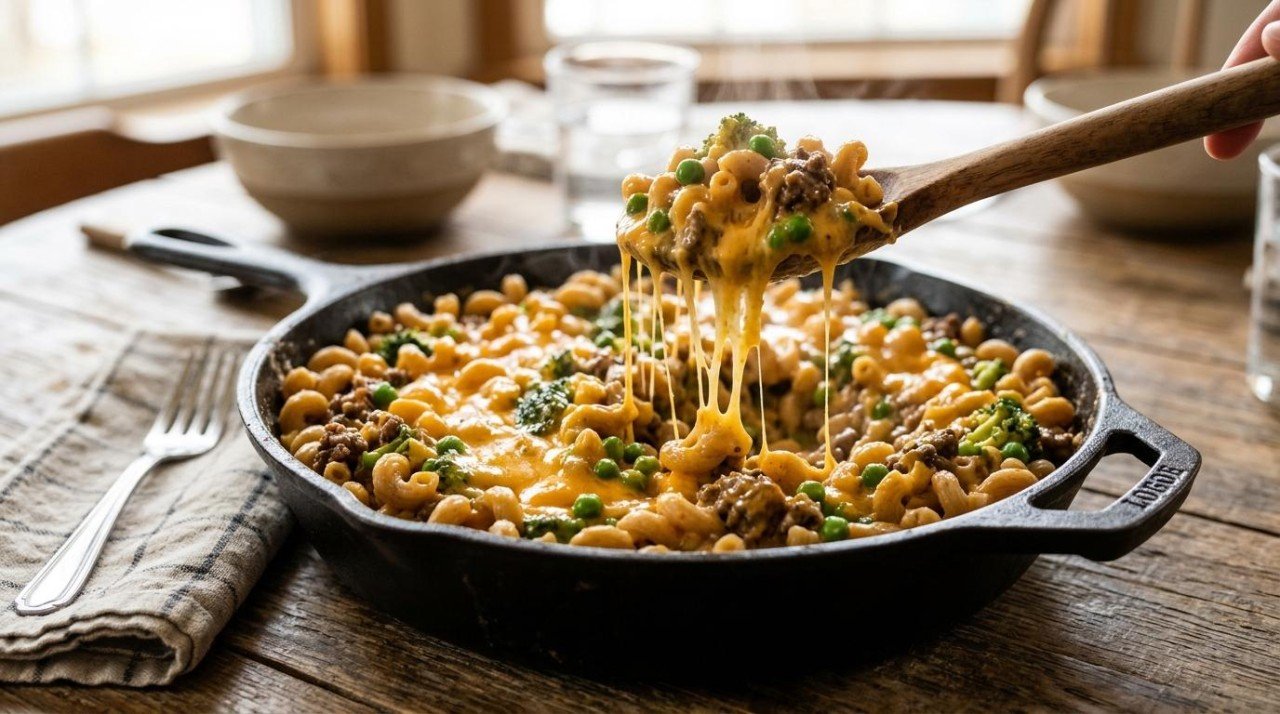
Hamburger Helper is the weeknight dinner a lot of us grew up on. One skillet, one pound of ground beef, a box, and twenty minutes later there is a pan of saucy, cheesy cheeseburger macaroni that every kid at the table will eat. That is a real achievement, and it is why "homemade Hamburger Helper" is one of the most searched comfort-food recipes there is.
So we scored it. Made by the box directions, Cheeseburger Macaroni comes back at 43 out of 100 on the Eat Well Planner Nutrition Score. Then we scored the most popular kind of homemade copycat, the one that melts a block of Velveeta into the pan, and it scored 40. Homemade is not automatically healthier.
Our version keeps the one-skillet method, the creamy orange sauce, and the cheeseburger flavor, and it scores 84. That is 41 points higher, with half the sodium, seven times the fiber, and two vegetables your family will barely notice. Here is every swap and exactly what it was worth.
The original: what's in it and how it scores
The boxed version is simple: the Cheeseburger Macaroni box holds enriched macaroni and a powdered sauce mix (cornstarch, salt, modified whey, sugar, then 2% or less of dried tomato, onion, garlic, and cheese). You brown 1 pound of lean ground beef, then simmer it with the mix, 2 cups of milk, and 1 1/4 cups of water. It makes 5 servings. We scored it exactly that way, with 2% milk, and modeled the mix from its label (630 mg of sodium per serving of dry mix).
- Nutrition Score: 43 / 100
- Calories: about 336
- Saturated fat: about 4.8 g
- Sodium: about 730 mg
- Fiber: about 1 g
- Protein: about 25 g
- Plant points: less than 1
The diagnosis is short. The biggest drag is sodium: about 730 mg a serving, almost a third of the FDA's 2,300 mg Daily Value, and nearly all of it comes from the sauce packet. Fiber is barely there, because refined macaroni and cornstarch are the only carbs. And there is nothing green at all, which is why the score also flags low vitamin C and vitamin K.
What is already fine is worth saying. Made with lean beef, the box is actually moderate on saturated fat, and it is a real protein dinner with plenty of vitamin B12, zinc, and iron from the beef. One caveat: plenty of people make it with whatever ground beef is in the fridge. Made with 80/20 beef instead of lean, the same box scores 35. Made with whole milk instead of 2%, it scores 38.
What about homemade copycats?
Most homemade Hamburger Helper recipes swap the packet for processed cheese. A popular example is Beyer Beware's Cheeseburger Macaroni: 1 pound of ground beef, burger seasoning, ketchup, mustard, 2 cups of elbows, 12 ounces of Velveeta, and a splash of milk, for 4 servings. It is a good recipe, and the ketchup and mustard give it real cheeseburger flavor. We scored it with lean beef (to match the box), modeled Velveeta from its current label, and treated the burger seasoning as mostly salt, like most store blends. It came back at 40, with about 1,940 mg of sodium a serving. Twelve ounces of Velveeta carries more sodium than the whole box of sauce mix, and the ketchup and seasoning add more. Ditching the box only helps if the sauce that replaces it is better.
The upgrades
Eight changes, scored cumulatively against production nutrition data: each one stacked on the last, in this order. The first four are the ones that matter most. If you only make one, make the vegetables.
1. Make the sauce from scratch with real cheddar
- Swap: The sauce packet becomes milk, 4 oz of sharp cheddar, tomato paste, mustard, onion powder, garlic powder, paprika, and 1/2 teaspoon of salt
- Score impact: +3 points (43 to 46)
- What it changes: Sodium drops from about 730 mg to 490 mg a serving, and the ingredient list becomes things you can name
- What it costs you: Five more minutes and a cheese grater. It tastes more like a cheeseburger than the box does
This swap looks small on the score, and that is worth understanding. Sodium fell by a third, but 4 ounces of real cheddar roughly doubled the saturated fat, so the two moves mostly cancel out. It is still the foundation of everything that follows, because a scratch sauce is a sauce you can add vegetables to. Tomato paste and yellow mustard are the trick for cheeseburger flavor: they bring the ketchup-and-mustard tang of a burger without the sugar and salt of a half cup of ketchup.
Sharp cheddar matters here. An aged, sharp cheese delivers more flavor per ounce than mild, so the sauce tastes cheesy with less of it. Grate it yourself and toss it with the cornstarch before it goes in, which helps it melt smoothly instead of clumping. Our cheddar cheese substitutes guide covers what else works if you want a different cheese.
2. Whole wheat elbows
- Swap: Regular elbow macaroni to 100% whole wheat elbows
- Score impact: +5 points (46 to 51)
- What it changes: Fiber doubles, from 1.9 g to 3.9 g a serving
- What it costs you: A slightly nuttier, firmer noodle that disappears under the cheese sauce
Refining wheat removes, in Harvard's words, "more than half of wheat's B vitamins, 90 percent of the vitamin E, and virtually all of the fiber". Whole wheat elbows put that back at no extra effort. In a one-pot dish they need a minute or two longer than white pasta and soak up a little more liquid, which the recipe below accounts for. For other noodle options, see our pasta substitutes guide.
3. Stir in peas and broccoli
- Swap: Add 1 cup of frozen peas and 2 cups of small broccoli florets in the last few minutes of simmering
- Score impact: +16 points (51 to 67)
- What it changes: Fiber climbs to 6.5 g, the low vitamin C and vitamin K flags disappear, and plant points jump
- What it costs you: Green bits in the macaroni. Peas are the easiest sell to kids. Chopping the broccoli small helps
This is the biggest single move in the post, and it is the one we would tell anyone to make first. It also works on its own: at the end of the build, taking the peas and broccoli back out cost 14 points. Cheeseburger macaroni has almost no vegetables in any version, and most of us are short on them already. CDC data found that only 9.3% of U.S. adults met the vegetable intake recommendation. A skillet dinner you already make is the easiest place to fix that.
Both go in frozen or fresh. Add the broccoli about 4 minutes before the pasta is done and the peas for the last 2 minutes, so the broccoli is tender and the peas stay bright and sweet.
4. Hide butternut squash in the sauce
- Swap: Whisk 1 cup of butternut squash puree into the milk
- Score impact: +4 points (67 to 71)
- What it changes: More fiber and potassium, plus most of the vitamin A in the finished dish (46% of the Daily Value per serving)
- What it costs you: Nothing anyone will notice. The sauce turns the exact orange the box does
This is the sneaky one. Butternut squash puree is mild, slightly sweet, and the same color as cheddar sauce, so it reads as "extra creamy" instead of "vegetable." It also gives the sauce body, which is what lets us use less cheese two steps from now. We used the same trick in our healthier baked mac and cheese. Frozen squash puree is easiest. Steamed and mashed fresh squash works too. Finely grated carrot is a fine stand-in (it scored 1 point lower at the end).
5. Use 95% lean ground beef
- Swap: 90% lean ground beef to 95% lean
- Score impact: +5 points (71 to 76)
- What it changes: Saturated fat falls from 9.3 g to 7.7 g a serving, protein goes up slightly
- What it costs you: Slightly less beefy richness, but the sauce carries the flavor
This is the easiest swap in the whole post, since it is the same pound of beef cooked the same way. It works especially well here because the beef is simmered in sauce, so it cannot dry out the way a lean burger patty does. Bonus: 95% lean barely renders any fat, so there is nothing to drain. Our ground beef substitutes guide covers turkey, lentils, and other options if you want to go further.
6. Pull the cheddar back to 3 ounces
- Swap: 4 oz of sharp cheddar to 3 oz
- Score impact: +4 points (76 to 80)
- What it changes: Saturated fat drops to 6.6 g a serving, sodium dips slightly
- What it costs you: Very little, because the squash is already doing the creamy work
Once the squash gives the sauce body, the cheese only has to bring flavor, and 3 ounces of sharp cheddar still tastes clearly cheesy across five servings. Putting the fourth ounce back at the end costs exactly these 4 points. We tested going down to 2 ounces too (see the skipped swaps).
7. Skim milk in the sauce
- Swap: 2% milk to skim milk
- Score impact: +4 points (80 to 84)
- What it changes: Saturated fat falls to 5.6 g a serving, with the same protein and calcium
- What it costs you: Nothing you can taste once the cheese and squash are in
On its own, skim milk would make a thin sauce. Here, the squash, the cheese, the cornstarch, and the starch the pasta releases as it simmers all thicken it, so the milk's fat is not doing much work. Our milk substitutes guide has notes for dairy-free versions.
8. Halve the salt
- Swap: 1/2 teaspoon of salt to 1/4 teaspoon
- Score impact: +0 points (84)
- What it changes: Sodium drops from about 470 mg to 360 mg a serving
- What it costs you: Nothing. Cheddar and mustard already season the sauce
The score did not move, because at 470 mg the dish was no longer flagged for sodium. We kept the cut anyway. Cheddar, mustard, and tomato paste bring plenty of seasoning, and 110 mg less sodium per serving is a real change, even if the score does not reward it. Taste at the end and add a pinch more if you want it. Leaving the salt out entirely also scored 84.
What we kept (on purpose)
Real cheddar, even though it is the main source of saturated fat left in the dish. A pound of beef for five servings, so it is still a hearty beef dinner with about 36 g of protein per serving. The one-skillet method, so there is no extra pot to wash and it is still a 30-minute dinner. And the tomato paste and mustard, because without them this is just beef and noodles, not cheeseburger macaroni.
Take the Guesswork Out of Eating Well
Eat Well Planner helps you organize your favorite recipes, plan balanced meals, and automatically generate shopping lists — all in one place. Whether you're tracking macros, managing dietary restrictions, or just trying to stop asking "what's for dinner?", we've got you covered.
Our AI-powered tools can adapt any recipe to your dietary needs, help you discover new meals you'll love, and even log your nutrition effortlessly. It's meal planning made simple.
Start Organizing Your Meals — FreeThe healthier version: full recipe
Healthier Hamburger Helper (Homemade Cheeseburger Macaroni): Nutrition Score 84 / 100, up from 43 for the box and 40 for the Velveeta copycat. Serves 5. Prep 10 minutes, cook 25 minutes.
Ingredients
- 1 lb 95% lean ground beef
- 1 teaspoon onion powder
- 3/4 teaspoon garlic powder
- 1 teaspoon paprika (smoked is great here)
- 1/2 teaspoon black pepper
- 2 tablespoons tomato paste
- 2 cups skim milk
- 1 1/2 cups water
- 1 cup butternut squash puree (frozen and thawed, or steamed and mashed)
- 1 teaspoon yellow mustard
- 1/4 teaspoon salt
- 2 cups (about 7 oz) 100% whole wheat elbow macaroni
- 2 cups small broccoli florets
- 1 cup frozen peas
- 3 oz sharp cheddar, freshly grated (about 3/4 cup)
- 1 tablespoon plus 1 teaspoon cornstarch
Instructions
- In a large, deep skillet over medium-high heat, cook the beef for 6 to 8 minutes, breaking it up, until browned. 95% lean beef renders very little fat, so there is usually nothing to drain.
- Stir in the onion powder, garlic powder, paprika, pepper, and tomato paste, and cook for 1 minute, until the tomato paste darkens slightly.
- Add the milk, water, squash puree, mustard, and salt, and stir until smooth. Bring to a simmer, then stir in the macaroni.
- Cover, reduce the heat to medium-low, and simmer for 6 minutes, stirring every couple of minutes so the pasta does not stick.
- Stir in the broccoli, cover, and simmer 2 more minutes. Stir in the peas, cover, and cook 2 to 3 minutes more, until the pasta and broccoli are tender. If it looks dry before the pasta is done, add a splash of water.
- Toss the grated cheddar with the cornstarch. Take the skillet off the heat, add the cheese, and stir until it melts into a smooth sauce.
- Let it stand for 3 to 5 minutes to thicken, then taste, adjust the salt and pepper, and serve.
Per serving: box vs. copycat vs. makeover
- Nutrition Score: 43 (box) / 40 (Velveeta copycat) / 84 (makeover)
- Calories: about 336 / 646 / 442
- Sodium: about 730 mg / 1,940 mg / 360 mg
- Saturated fat: about 4.8 g / 9.5 g / 5.6 g
- Fiber: about 1 g / 2 g / 7.4 g
- Protein: about 25 g / 42 g / 36 g
- Plant points: less than 1 / less than 1 / 6
One honest note on those numbers: our serving has more calories and slightly more saturated fat than the box. That is because it is a bigger plate of food. It has more pasta, real cheese, and over a pound of vegetables spread across five servings, where the box is about 6 ounces of dry mix stretched to five. Per serving it also carries 46% of the Daily Value for vitamin A, 54% for vitamin C, and 25% for fiber, none of which the box comes close to.
Swaps we tested and skipped
- Velveeta instead of cheddar (+3, to 87). This is the honest surprise. Today's Velveeta is made with skim milk, canola oil, and milk protein concentrate, so ounce for ounce it carries much less saturated fat than aged cheddar, and the score rewards that. But it added about 130 mg of sodium per serving, and the score does not account for how processed an ingredient is. We kept the real cheese. If you want those 3 points, 2 ounces of cheddar gets you the same 87 (next line).
- Only 2 ounces of cheddar (+3, to 87). It clears the saturated fat flag completely, but the sauce starts tasting like creamy beef pasta with a hint of cheese. If your family is fine with that, go for it. We think 3 ounces is where it still tastes like cheeseburger macaroni.
- Keeping white elbows (-3). At the end of the build, white pasta scored 81 instead of 84. It is not a big loss, so if whole wheat is a dealbreaker at your table, keep every other swap and you are still near the top.
- Grated carrot instead of squash (-1). It scored 83. It is a good option if you have carrots and no squash, but it is less invisible in the sauce.
- Keeping 2% milk (-4). It is a real difference on the score and not on the plate, which is why skim made the cut.
If you are keeping the box
Not every night is a from-scratch night. If the box is staying in your pantry, two changes do most of the work: make it with 95% lean beef and stir in 1 cup of peas and 2 cups of broccoli. That scored 65, up from 43, with no other changes. The sodium stays at about 740 mg because it lives in the packet, so the box can only climb so far, but it is a 22-point upgrade for the cost of a bag of frozen vegetables.
Make it fit other diets
- Gluten-free: Use a brown rice or chickpea elbow and check that the cornstarch and mustard are certified gluten-free. Legume pastas cook faster, so start checking a few minutes early.
- Dairy-free: Use unsweetened soy milk and a dairy-free cheddar-style shred, and lean on the squash puree and a tablespoon of nutritional yeast for the cheesy flavor.
- Vegetarian: Replace the beef with 1 1/2 cups of cooked brown or green lentils, added with the milk.
Or let the app do it: import this recipe into Eat Well Planner and ask Recipe Variations to "make this gluten-free" or "make this vegetarian." You get a full rewritten recipe with the substitutions already worked in.
Do this to any recipe
Everything in this post came from the same steps you can run on your own recipes. Import a recipe from any website, Instagram reel, or YouTube video, and Eat Well Planner gives it a Nutrition Score. Tap Make It Healthier and the AI proposes swaps like the ones above, each checked by a nutrition calculator before you see it. Want to keep the 2% milk, or try the Velveeta? Open the Recipe Playground and watch the score change with every edit, then make up the points somewhere else. Same dinner, better numbers, and you decide where to stop.