Guacamole has a strange reputation. It shows up on "foods to eat in moderation" lists because of the fat, and it shows up on "superfood" lists because of the same fat, and most people end up eating it with a vague sense that they are getting away with something.
So we ran it through the app's Nutrition Score to find out which story is true. Classic homemade guacamole - avocado, onion, tomato, cilantro, lime, jalapeno, salt - scores 73 out of 100 on its own. Served the way people actually eat it, in a bowl with a couple of ounces of tortilla chips per person, the whole snack scores 81.
That 81 is the number to sit with for a second, because it is higher than the dip alone, and it is higher than most people would guess. Guacamole and chips is a genuinely good snack. Our rebuilt version gets it to 90 - but the interesting part is where those nine points came from, because it was not where we expected.
The original: what is in it and how it scores
Here is the version we scored, at four servings. It is the standard restaurant-style build, nothing fancy:
- 3 ripe Hass avocados (about 14 oz of flesh)
- 1/4 cup finely diced white onion
- 1 Roma tomato, diced
- 2 tablespoons chopped cilantro
- 1 tablespoon fresh lime juice
- 1 jalapeno, minced
- 1/2 teaspoon salt
- 8 oz tortilla chips (2 oz per person)
Score: 81/100. Per serving: 433 calories, 26.4 g fat, 3.7 g saturated fat, 48.4 g carbs, 10.1 g fiber, 6.2 g protein, 480 mg sodium, 650 mg potassium.
What is already good (which is most of it)
The score flags fiber, vitamin K and vitamin B6 as strengths, and it is not being generous. A single serving of this delivers 34% of the Daily Value for fiber, 33% for vitamin K, 31% for pantothenic acid, 30% for vitamin B6, 28% for vitamin E, 27% for phosphorus, 24% for folate and 20% for magnesium. That is a snack doing the work of a small meal.
The fat, which is the thing everyone worries about, is the least of the problems. Harvard's Nutrition Source puts a medium avocado at 22 g of fat, of which about 67% is monounsaturated - the same family of fat that dominates olive oil - against just 3 g saturated. In the Nurses' Health Study and Health Professionals Follow-up Study, which tracked more than 110,000 people for 30 years, eating two or more servings of avocado a week (a serving being half an avocado) was associated with a 16% lower risk of cardiovascular disease and a 21% lower risk of coronary heart disease.
The fat is also doing a job inside the bowl. In a crossover study published in The Journal of Nutrition, adding 150 g of avocado to salsa raised lycopene absorption 4.4-fold and beta-carotene absorption 2.6-fold compared to the same salsa without it. The avocado is not just sitting alongside the tomato; it is helping you absorb what is in it.
And the fiber matters more than the fat ever did. Analysis of NHANES data covering more than 14,600 US adults found that only 5% of men and 9% of women hit their daily fiber recommendation. Ten grams in one snack is a meaningful dent in a gap almost nobody closes.
What actually drags it down
The score's listed weaknesses were low vitamin A, high omega-6 and high sodium. Not fat. Not calories. Three specific, fixable things:
- Sodium. 480 mg per serving, most of it from the chips and the half-teaspoon of salt. The FDA puts average American intake at about 3,400 mg a day against a recommended limit of under 2,300 mg, so 480 mg from a snack is a real line item.
- Not enough plants. The whole bowl scored 4.25 plant points. Six ingredients, and four of them are present in trace amounts. There is a lot of avocado and very little of everything else.
- The chip-to-guac ratio. This is the one worth explaining properly.
The chips are not the villain (the third handful is)
We expected the chips to be the story. They are not - or at least, not in the way the "chips are the problem" framing suggests. We scored the same guacamole with four different chip amounts:
- Guacamole alone, no chips: 73
- Plus 1/2 oz of chips per person: 81
- Plus 1 oz (the label serving): 84
- Plus 2 oz: 81
- Plus 3 oz: 75
A modest handful of chips improves the score. The dip alone is a lopsided thing - a lot of fat, very little protein or carbohydrate - and a serving of chips rounds it into something more like a balanced snack. The peak sits right around the printed serving size on the bag. Then it falls, and by the third ounce you have handed back everything the avocado gave you.
So the honest diagnosis is not "swap out the chips." It is that guacamole is a good dip that gets buried under its own delivery vehicle, and the amount of dipper is doing more to the numbers than the recipe of the dip. Which points at where the upgrade has to happen.
A note on the tub
Everything above assumes guacamole made from avocados. Store-bought is a different question, and the honest answer is that it varies enormously - which is exactly why the label matters. When The Irish Times went through the supermarket tubs on sale in Ireland, one own-brand organic version was 95.5% avocado with a short ingredient list, one supermarket guacamole was 69% avocado behind a long run of preservatives and firming agents, and one branded chunky guacamole was 14% avocado, with water as the leading ingredient and modified corn starch, potato flakes, wheat flour and dried glucose syrup filling the gap.
That was the Irish market, and US formulations differ - some of the best tubs on American shelves are genuinely just avocado, onion, lime and salt. But the range is the point. Turn the tub over. If avocado is not the first ingredient and a high percentage, none of the numbers in this post apply to what you are eating.
The upgrades
Four changes, scored one at a time, each one applied on top of the last so the deltas are real. Highest impact first.
1. Replace half the chips with vegetable dippers
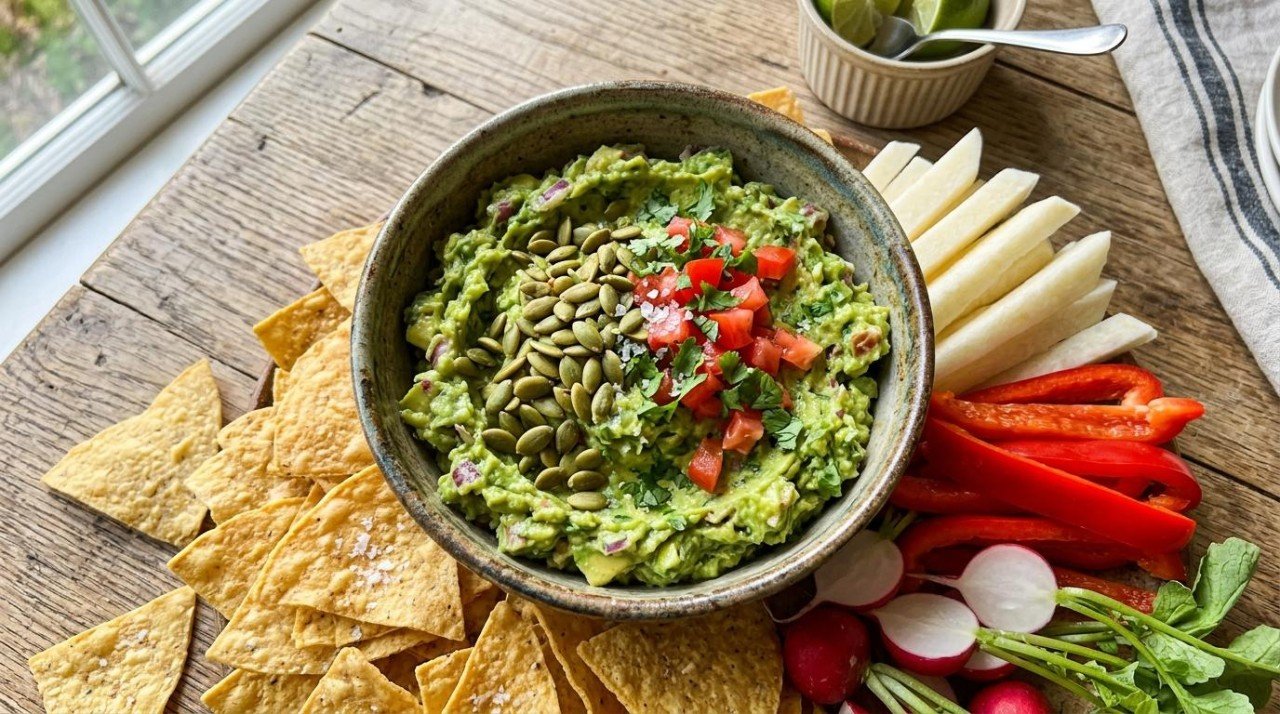
- Swap: 8 oz tortilla chips → 4 oz chips plus jicama sticks, red bell pepper strips and halved radishes
- Score impact: +7 points (81 → 88)
- What it changes: Fiber 10.1 g → 11.2 g, sodium 480 mg → 400 mg, calories 433 → 331, plant points 4.25 → 7.25
- What it costs you: Almost nothing, if you cut them right. You still get chips.
This is the whole makeover in one move, and it works because it is an addition, not a subtraction. Nobody is being handed a plate of celery and told it is basically the same. Half the chips stay. The rest of the bowl gets crunchy, neutral, scoopable vegetables that were made for this job.
Jicama is the standout and the one most Americans skip. Cleveland Clinic puts a cup of raw jicama at 49 calories with 6.4 g of fiber and 26.3 mg of vitamin C, and much of that fiber is inulin - a prebiotic that feeds gut bacteria rather than just adding bulk. It is crisp like a water chestnut, faintly sweet, and it does not go limp in a bowl over an hour the way cucumber does. Peel it, cut it into flat planks about the width of a chip, and it scoops as well as anything from a bag.
Radishes and bell pepper strips finish the job. The radish brings a peppery bite that plays off the lime; the red bell pepper is where a startling amount of the vitamin C in the final version comes from. If you want to go further: cutting the chips out entirely scores 94. We did not do that, for reasons covered below.
2. Add toasted pepitas
- Swap: Add 1/4 cup (about 1 1/2 oz) roasted unsalted pepitas, scattered on top
- Score impact: +1 point (88 → 89)
- What it changes: Protein 5.0 g → 8.0 g per serving; adds magnesium and zinc; plant points 7.25 → 8.25
- What it costs you: Nothing. It is better this way.
One point is a small score move, and we are not going to pretend otherwise - but it buys a 60% increase in protein, which is the one macronutrient guacamole is genuinely short on. Pepitas are among the better plant sources of magnesium, and they add the crunch that people are usually chasing when they reach for the fourth chip.
Toast them first. Two or three minutes in a dry skillet over medium heat, until they puff and start popping, transforms them from bland to nutty. Scatter them on right before serving so they stay crisp, not five minutes early when they will soften in the moisture from the tomato.
3. Load the guacamole with more of what is already in it
- Swap: Double the onion, use 2 Roma tomatoes instead of 1, quadruple the cilantro, double the lime and the jalapeno
- Score impact: +1 point (89 → 90)
- What it changes: Fiber 11.7 g → 12.2 g; potassium 840 mg → 920 mg; more volume per avocado
- What it costs you: A chunkier, fresher, less silky dip. Whether that is a cost depends on which camp you are in.
Another honest single point. But this is the swap that changes the eating experience most, because it changes the ratio of dip to avocado - the same three avocados now make noticeably more guacamole, and every scoop carries vegetables instead of just mashed fat. The extra lime and jalapeno also matter for the next swap, since acid and heat are what let you get away with less salt.
Potassium is worth a note here. Average US intake runs around 2,496 mg a day against adequate intakes of 3,400 mg for men and 2,600 mg for women, and the CDC notes that increasing potassium intake can help lower blood pressure. The improved bowl carries 920 mg per serving. Going up on potassium while going down on sodium is the exact direction most American snacks travel in reverse.
If you want to push the vegetable content further, these are the ingredients with their own substitution guides - useful when you are out of one: onion, cilantro (including what to do if it tastes like soap to you), and lime juice.
4. Halve the salt
- Swap: 1/2 teaspoon salt → 1/4 teaspoon
- Score impact: +0 points at this stage in the build (90 → 90)
- What it changes: Sodium 400 mg → 260 mg per serving
- What it costs you: Almost nothing, once the extra lime and jalapeno are in
We are including a zero-point swap because the score is not the only thing that matters and pretending otherwise would be dishonest. By the time the vegetable dippers have diluted the sodium across the bowl, cutting the salt no longer moves the number. It still removes 140 mg of sodium per serving, which is real.
Worth knowing: if this is the only change you make, applied to the original recipe with its full 8 oz of chips, it is worth +1 point (81 → 82) and drops sodium from 480 mg to 340 mg. Swaps interact, and where a change lands in the sequence affects what it is worth. That is also why salt this dip at the end, tasting as you go - the lime and the jalapeno do a lot of the work salt usually gets credit for.
What we kept, on purpose
All three avocados. Every gram of the fat. The full 4 oz of tortilla chips. The salt, in a reduced but real amount.
This is a party dip. The line we would not cross is the one where the bowl stops being something people crowd around. There is a version of this post where we halve the avocado, stretch it with yogurt, ban the chips and publish a bigger number - and nobody makes it twice.
Take the Guesswork Out of Eating Well
Eat Well Planner helps you organize your favorite recipes, plan balanced meals, and automatically generate shopping lists — all in one place. Whether you're tracking macros, managing dietary restrictions, or just trying to stop asking "what's for dinner?", we've got you covered.
Our AI-powered tools can adapt any recipe to your dietary needs, help you discover new meals you'll love, and even log your nutrition effortlessly. It's meal planning made simple.
Start Organizing Your Meals — FreeThe healthier version: full recipe
Final score: 90/100. Serves 4.
For the guacamole:
- 3 ripe Hass avocados (about 14 oz of flesh)
- 2 tablespoons fresh lime juice
- 1/2 medium white onion, finely diced (about 3 oz)
- 1 to 2 jalapenos, seeded and minced (about 3/4 oz)
- 1/2 cup packed chopped cilantro
- 1/4 teaspoon fine salt, plus more to taste
- 2 Roma tomatoes, seeded and diced (about 5 oz)
- 1/4 cup roasted unsalted pepitas (about 1 1/2 oz)
For the dippers:
- 4 oz tortilla chips (about 1 oz per person)
- 1 small jicama, peeled and cut into flat sticks (about 5 oz)
- 1 large red bell pepper, cut into wide strips (about 5 oz)
- 6 to 8 radishes, halved or quartered (about 3 1/2 oz)
- Toast the pepitas in a dry skillet over medium heat for 2 to 3 minutes, shaking the pan, until they puff and begin to pop. Tip onto a plate to cool.
- Halve and pit the avocados, scoop the flesh into a bowl, and add the lime juice immediately. Mash with a fork to a chunky texture, leaving some pieces whole.
- Stir in the onion, jalapeno, cilantro and salt. Taste before adding more salt - the acid and the heat carry a lot of the seasoning.
- Fold in the diced tomato last, gently, so it does not break down and water out the dip.
- Scatter the toasted pepitas over the top just before serving.
- Cut the jicama and bell pepper into flat, chip-width planks and halve the radishes. Arrange them around the bowl with the tortilla chips.
- Serve right away. To hold it, press plastic wrap directly onto the surface of the guacamole so no air touches it.
Per serving: original vs. improved
- Nutrition Score: 81 → 90
- Calories: 433 → 399
- Protein: 6.2 g → 8.3 g
- Fiber: 10.1 g → 12.2 g (41% DV)
- Total fat: 26.4 g → 24.8 g
- Saturated fat: 3.7 g → 3.8 g
- Carbs: 48.4 g → 39.4 g
- Sodium: 480 mg → 260 mg
- Potassium: 650 mg → 920 mg
- Plant points: 4.25 → 8.25
The improved bowl also picks up vitamin C in a big way - 85% of the Daily Value per serving, up from 20% - almost entirely from the bell pepper and jicama. Vitamin C moves from being absent from the score's strengths to leading them. The only remaining flagged weakness is omega-6, which comes with the corn oil in the chips and the fat in the pepitas, and is not something we would chase further at the cost of the dish.
Swaps we tested and skipped
All three of these scored higher than the version we published. We rejected them anyway, and the reasons are worth more than the points.
- Cutting the chips entirely (score: 94). Four more points, and it is a legitimately great weeknight snack - if you want it, swap the chips for extra jicama and cucumber and you have the highest-scoring version in this post. But this is a recipe for a bowl on a table with people around it, and a guacamole platter with no chips is a different social object. Make the 94 for yourself on a Tuesday.
- Greek yogurt for half the avocado (score: 92). More protein, fewer calories, and a genuinely better number. It is also not guacamole. Yogurt brings a lactic tang that fights the lime instead of supporting it, and the texture goes smooth and dip-like rather than chunky. If a creamy, high-protein green dip is what you are after, that is a fine thing to make - see the Greek yogurt guide - but do not call it a healthier guacamole.
- Green peas for a quarter of the avocado (score: 92). The famous one. It scores well, it adds fiber and protein, and it turns guacamole into a pleasant pea dip with avocado in it. The sweetness is the giveaway. Skipped.
Make it fit other diets
Guacamole starts out vegan, gluten-free, dairy-free and nut-free, which is most of the work already done. The two adjustments people actually need:
- Strictly gluten-free: the guacamole is fine; check the chip bag, since some corn chips are made on shared lines with wheat products.
- Low FODMAP: onion is the problem, and fishing it out later does not help because the fructans dissolve into the dip. Use the green tops of scallions instead, and check the onion substitutes guide for the full reasoning.
In Eat Well Planner, the AI recipe chat will do either rewrite in one step with the whole recipe in context, so you get the adjusted amounts rather than a generic tip.
Do this to your own recipes
Nothing here required guessing. Every number in this post came from the same Nutrition Score that runs on any recipe in Eat Well Planner - import from a URL, an Instagram reel or a YouTube video, and it gets scored the moment it lands in your recipe book. From there, Make It Healthier proposes swaps like these and runs each one through a calculator before showing it to you, and the Recipe Playground - where the per-swap deltas in this post came from - lets you change one ingredient and watch the score move. Want to keep all 8 oz of chips? See what it costs, and make it up somewhere else.
The best thing the score did here was tell us we were wrong. We came in expecting to indict the chips and found a snack that was already good, with its real problems somewhere else. That is the part worth borrowing: run the recipe you already love through it before you decide what needs fixing.