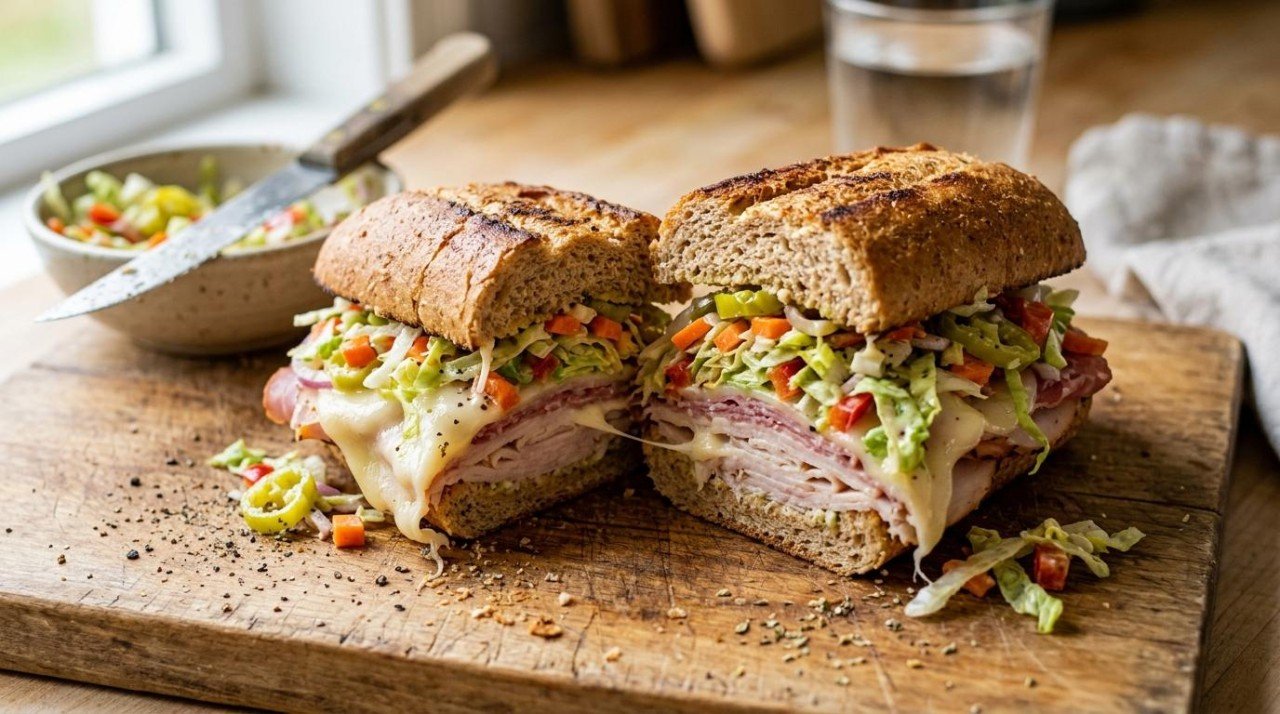
In late March 2022, Gray Fultz of Richmond, Virginia posted a video of herself piling a creamy, mayo-dressed iceberg salad onto a loaded Italian sub. As The Takeout documented, that video did about 801,000 views and set off one of the most durable food trends of the last few years. Her advice was simple: "Put the grinder salad on ANY SANDO to make it amazing."
She was right. The chopped, dressed salad is a genuinely great idea — it seasons every bite instead of leaving you with a dry sandwich and a sad leaf of lettuce hanging out the side. It is also, structurally, a vegetable delivery vehicle bolted onto a pile of cured meat, which makes it an unusually interesting thing to score.
So we did. We ran a representative viral build through Eat Well Planner's Nutrition Score — the same at-a-glance number you see on any public recipe page — and it came back 37 out of 100, at 1,153 calories per sandwich. Then we rebuilt it to 65 out of 100, and it is still a crunchy, garlicky, pepperoncini-flecked Italian grinder. That is 28 points, and every swap below carries the real, verified score change it earned.
The original: what's in it and how it scores
Here is the version we scored, making two sandwiches:
- 2 white sub rolls (about 170 g total)
- 3 oz salami, 2 oz capocollo, 1 oz pepperoni
- 3 oz provolone
- Grinder salad: 1/2 cup mayonnaise, 2 tablespoons red wine vinegar, 2 cloves garlic, 1 teaspoon dried oregano, 1/4 teaspoon salt
- About 4 cups shredded iceberg lettuce (200 g), 1/4 red onion, 1/3 cup sliced pepperoncini
- 1 medium tomato, sliced
Nutrition Score: 37/100. Now the diagnosis, because knowing why a recipe scores the way it does is what lets you fix your own. Per sandwich, the original runs about 1,153 calories, 40.6 g protein, 24.7 g saturated fat, 2,830 mg sodium, and 3.6 g fiber. Three things hold it back:
- Sodium is very high — 2,830 mg in one sandwich, against an American Heart Association ceiling of 2,300 mg a day and an ideal closer to 1,500 mg. This is not one villain. It is the cured meat, the cheese, the roll, the pickled peppers, and a quarter teaspoon of added salt, all stacking.
- Saturated fat is very high — 24.7 g, or 105% of a day's worth. The AHA suggests less than 6% of calories, about 13 grams a day. Half a cup of mayonnaise and 6 oz of cured pork will do that.
- Almost no fiber — 3.6 g, from a white roll and a head of iceberg. The salad looks like a lot of vegetables but iceberg is mostly water, and 4.5 plant points is thin for a dish with a salad built into its name.
What is already fine, and worth defending? More than you would guess. Protein is excellent at 40.6 g. The dressing is real mayonnaise, garlic, vinegar and oregano rather than something from a bottle, and the sandwich is an outstanding source of vitamin K, thiamine, iron and B12. Nobody needs to feel bad about this sandwich. It has a proportion problem, not a concept problem.
One structural thing to understand before the swaps, because it explains everything that follows. Eat Well Planner flags a nutrient as high at 20% of its daily ceiling and very high at 50%. The original is sitting at 123% for sodium and 105% for saturated fat — miles into the red on both. Until those two flags come down out of the very high band, the score barely responds to anything else you do. That is why the first six swaps look modest and the seventh looks enormous.
The upgrades
Seven swaps, applied cumulatively in this order. If you only make one, make the first — it is the biggest calorie cut in the list for the smallest flavor cost.
1. Rebuild the dressing on Greek yogurt
- Swap: 1/2 cup mayonnaise → 1/2 cup plain Greek yogurt + 2 tablespoons mayonnaise
- Score impact: +4 points (37 → 41)
- What it changes: 232 fewer calories per sandwich, total fat from 84.8 g to 55.7 g, saturated fat from 24.7 g to 20.6 g, and protein up from 40.6 g to 46.3 g
- What it costs you: Almost nothing, as long as you keep those two tablespoons of real mayonnaise
Half a cup of mayonnaise is roughly 780 calories, and it is doing one job here: making the salad creamy enough to cling. Greek yogurt does that job too, with a tang that suits a sandwich already carrying vinegar and pickled peppers. No heat is involved anywhere in this dressing, so the usual worry about yogurt splitting does not apply.
We kept two tablespoons of real mayo deliberately. It is an emulsion of egg yolk and oil, and it coats shredded lettuce in a way yogurt alone does not — without it the dressing reads thin and a little chalky. We tested dropping it entirely and the score did not move, so there was no reason to give up the texture. Our mayonnaise substitutes guide covers the full range, and the Greek yogurt guide has the ratios.
2. Shift the meat ratio toward turkey
- Swap: 3 oz salami + 2 oz capocollo + 1 oz pepperoni → 4 oz sliced turkey breast + 2 oz salami
- Score impact: +3 points (41 → 44)
- What it changes: Sodium from 2,590 mg to 1,740 mg, saturated fat from 20.6 g to 14.1 g, 152 fewer calories — and protein actually rises slightly
- What it costs you: Some richness. Keeping real cured meat in the build is what stops this tasting like a turkey sandwich
This is the biggest real-world change in the whole makeover and it buys 3 points, which is exactly why we show the numbers instead of asking you to trust us. It strips 850 mg of sodium and 6.5 g of saturated fat out of one sandwich while protein holds — and the score shrugs, because both flags are still pinned in the very high band.
It is worth knowing what cured meat is, separate from the score. The WHO's cancer agency classifies processed meat — anything "transformed through salting, curing, fermentation, smoking" — as Group 1, carcinogenic to humans, with each 50 g eaten daily associated with about an 18% higher risk of colorectal cancer. The operative word is daily. This is an argument for cured meat being a flavoring rather than the bulk of a sandwich, which is precisely the change here, not an argument for never eating salami again.
3. Turn the salad into an actual salad
- Swap: Add 1 shredded carrot, 1/2 thinly sliced red bell pepper, and a handful of torn basil
- Score impact: +4 points (44 → 48)
- What it changes: Fiber from 3.6 g to 5.0 g, plant points from 4.5 to 6.75, and vitamin C jumps to 120% of the daily value
- What it costs you: Three minutes with a box grater, and the sandwich gets better
The grinder salad is the best structural idea in this recipe and the viral version underuses it. You already own a bowl of dressed, chopped vegetables — there is no reason for it to be 90% iceberg. Shredded carrot brings sweetness and a firmer crunch that survives the dressing, red bell pepper brings the vitamin C, and basil makes the whole thing taste more Italian than dried oregano alone ever will.
Shred everything on the same fine setting so it packs into the roll instead of sliding out the back. Plant variety is its own goal — different plants feed different gut bacteria, which is the idea behind eating 30 different plants a week — and this swap alone adds 2.25 of those plants to a single sandwich.
4. Whole wheat roll
- Swap: White sub rolls → whole wheat sub rolls
- Score impact: +2 points (48 → 50)
- What it changes: Fiber from 5.0 g to 6.7 g, added sugar from 5.2 g to 0.9 g, and another plant point
- What it costs you: A nuttier, sturdier roll. Get a good one or this swap is a chore
Two points looks like a poor return for changing the bread, and on its own it is even worse — we scored the whole wheat roll against the untouched original and it moved the score by exactly zero. What earns its place is the added sugar: swapping the roll took it from 5.2 g to 0.9 g per sandwich and cleared that caution flag entirely, because a lot of soft white sub rolls are sweetened and most whole wheat ones are less so.
The sturdier crumb is a practical win too, since a wet dressed salad will destroy a flimsy roll. Watch the label rather than the color — our guide on buying bread that is actually whole grain covers the traps.
5. Drop the added salt
- Swap: Remove the 1/4 teaspoon of salt from the dressing
- Score impact: +2 points (50 → 52)
- What it changes: Sodium from 1,790 mg to 1,490 mg per sandwich
- What it costs you: Nothing detectable. Taste it before you reach for the salt
This is the closest thing to a free swap in the entire series. Between the pepperoncini and their brine, the cured pork and the provolone, there is nothing here that needs seasoning — and 300 mg of sodium is a lot to spend on a reflex.
If the salad tastes flat, splash in a tablespoon of the pepperoncini brine instead: it brings acidity and heat along with its salt, so you get more flavor per milligram. And if you want to work on the other half of the sodium equation, potassium is the nutrient most people are missing — the carrot, pepper and tomato take this build to 30% of the daily value.
6. Two ounces of provolone, not three
- Swap: 3 oz provolone → 2 oz provolone
- Score impact: +3 points (52 → 55)
- What it changes: Saturated fat from 14.7 g to 12.3 g, sodium from 1,490 mg to 1,390 mg, 49 fewer calories
- What it costs you: One ounce of cheese. Melt it under the broiler and you will not miss it
Here is the finding that surprised us most in this whole makeover: we also tested this exact swap on the untouched original, and it scored 36 — one point worse than doing nothing. Same swap, same gram reduction, opposite sign.
The reason is that cheese is not only saturated fat. It is also calcium and protein, and on the original those losses outweighed a saturated fat cut that was never going to escape the very high band anyway. By step six the flags had come down far enough for the trade to pay. Order matters, which is a genuinely useful thing to know and almost impossible to intuit — it is the kind of thing you only see when a calculator is checking every step.
7. One ounce of cured meat, and make it capocollo
- Swap: 2 oz salami → 1 oz capocollo
- Score impact: +10 points (55 → 65) — the biggest jump in the makeover
- What it changes: Sodium from 1,390 mg to 1,060 mg and saturated fat from 12.3 g to 9.7 g — which finally drops both flags out of the very high band
- What it costs you: Less than you think, if you slice it paper-thin and spread it across the whole sandwich
Ten points for one ounce of deli meat. This is the gate opening: sodium lands at 46% of its ceiling and saturated fat at 41%, both now merely high, and the score is suddenly free to reward everything the previous six swaps put in.
Two separate decisions are bundled here, and we scored them apart. Cutting from 2 oz to 1 oz was worth 7 points on its own; making that ounce capocollo instead of salami was worth 3 more. The reason is structural: capocollo is a whole-muscle salume, dry-cured from the pork neck and shoulder, while salami is ground meat blended with pork back fat — which is what gives it, in Wikipedia's phrasing, "very high saturated fatty acid and cholesterol content." One is a cured cut of pork; the other is cured pork plus added fat.
Buy it sliced as thin as the counter will go, and lay it in loose folds across the full length of the roll rather than stacking it in one place. An ounce of paper-thin capocollo covers more sandwich than two ounces of thick-cut salami, and it is the aroma doing most of the work anyway.
Take the Guesswork Out of Eating Well
Eat Well Planner helps you organize your favorite recipes, plan balanced meals, and automatically generate shopping lists — all in one place. Whether you're tracking macros, managing dietary restrictions, or just trying to stop asking "what's for dinner?", we've got you covered.
Our AI-powered tools can adapt any recipe to your dietary needs, help you discover new meals you'll love, and even log your nutrition effortlessly. It's meal planning made simple.
Start Organizing Your Meals — FreeWhat we kept (on purpose)
A makeover that guts the dish is a failed makeover. We kept real cured pork, real provolone, two tablespoons of real mayonnaise, the full 1/3 cup of pepperoncini, the garlic, the iceberg, and the toasted roll. We kept iceberg specifically — romaine has more nutrients per leaf, but iceberg's whole job here is a cold, watery crunch against warm melted cheese, and nothing else does it as well.
We also stopped on purpose. Removing the cured meat altogether and going to 6 oz of turkey scores 73 — eight points above where we landed, and the highest number we found. We are not printing that as the recipe, because a grinder with no cured pork in it is a turkey sub. The salami and capocollo are the reason this sandwich tastes like a deli. If you would happily eat a turkey sub, take the 73 with our blessing; the app will show you the same number we saw.
And we will not oversell 65. This sandwich still carries high sodium and high saturated fat flags at 46% and 41% of their daily ceilings. That is the honest ceiling for an Italian deli sandwich, and it is a very different thing from the 123% and 105% we started with.
The healthier version: full recipe
Nutrition Score: 65/100. Makes 2 sandwiches. About 15 minutes of prep, 8 minutes in the oven.
For the grinder salad:
- 1/2 cup (120 g) plain Greek yogurt
- 2 tablespoons (30 g) mayonnaise
- 2 tablespoons red wine vinegar
- 2 cloves garlic (6 g), grated or pressed
- 1 teaspoon dried oregano
- Red pepper flakes and black pepper, to taste
- About 4 cups (200 g) iceberg lettuce, finely shredded
- 1 medium carrot (60 g), coarsely grated
- 1/2 red bell pepper (80 g), very thinly sliced
- 1/4 red onion (40 g), sliced paper-thin
- 1/3 cup (50 g) sliced pepperoncini, plus a splash of their brine
- Small handful fresh basil (5 g), torn
For the sandwiches:
- 2 whole wheat sub rolls (about 170 g total)
- 2 oz (57 g) provolone, sliced
- 4 oz (113 g) sliced turkey breast
- 1 oz (28 g) capocollo, sliced paper-thin
- 1 medium tomato (120 g), sliced
- Whisk the Greek yogurt, mayonnaise, red wine vinegar, garlic, oregano, red pepper flakes and black pepper together in a large bowl. Do not add salt; taste at the end instead.
- Soak the sliced red onion in cold water for 10 minutes, then drain well. This takes the harsh bite out without cooking it.
- Heat the oven to 375F. Split the rolls lengthwise, lay the provolone on the bottom halves, and toast for 5 to 8 minutes, until the rolls are golden and the cheese has melted.
- While the rolls toast, add the shredded iceberg, carrot, bell pepper, drained onion, pepperoncini and basil to the dressing. Toss until everything is coated. Taste, and add a splash of pepperoncini brine if it needs lift.
- Lay the turkey over the melted provolone, then drape the capocollo on top in loose folds, spread along the whole length of the roll.
- Add the tomato slices, then pile the grinder salad on generously and close the sandwich, pressing down firmly.
- Cut in half and eat right away. Dressed salad on toasted bread waits for nobody.
Per sandwich, here is the before and after:
- Nutrition Score: 37 → 65
- Calories: about 1,153 → about 662 (down 43%)
- Sodium: about 2,830 mg → about 1,060 mg (down 63%, from 123% of the daily ceiling to 46%)
- Saturated fat: 24.7 g → 9.7 g (down 61%, from 105% of the daily value to 41%)
- Total fat: 84.8 g → 30.0 g
- Fiber: 3.6 g → 6.7 g
- Added sugar: 5.4 g → 0.9 g
- Protein: 40.6 g → 40.2 g (held, with 3 oz less cured meat)
- Plants on the plate: 4.5 → 7.75
The finished sandwich is also an excellent source of vitamin C (119% of the daily value), vitamin B6 (82%), niacin (74%), vitamin K (63%), iron (61%) and B12 (61%), and clears the FDA's excellent-source bar for fiber at 23%.
Swaps we tested and skipped
- No cured meat at all, 6 oz turkey (scored 73). The highest score we found, and the one we turned down. Covered above: it is a better sandwich by the numbers and a different sandwich on the plate.
- 1 oz salami instead of 1 oz capocollo (scored 62). Three points lower, purely because of the added back fat in salami. If salami is the flavor you want, this is a perfectly good place to land — you keep 25 of the 28 points.
- Half the pepperoncini (scored 54). Cutting the peppers to save sodium cost a point rather than gaining one, because you lose their vitamin C and plant point too. Keep the peppers. They are the best flavor-per-milligram ingredient in the sandwich.
- Dropping the mayonnaise entirely (scored 55). An exact tie with keeping two tablespoons, so we kept them. When a swap costs texture and buys nothing, it is not a healthier recipe, just a worse one.
- Skipping the roll and eating it as a salad (scored 59). Six points lower than the sandwich, which surprises people every time. You throw away the whole grain, its fiber and its plant point, and the score notices. It is 430 calories if you want a lighter lunch, but it is not the healthier choice.
- A tablespoon of olive oil in the dressing (scored 65). An exact tie, for 60 more calories per sandwich. Traditional, and entirely your call.
Make it fit other diets
Gluten-free: the salad and fillings are already there — swap in a gluten-free roll, and check the deli meat labels, since fillers vary by brand. Dairy-free: use a plain unsweetened plant yogurt in the dressing and skip the provolone; lean on extra pepperoncini and a little olive oil so the sandwich does not read as lean and dry. Vegetarian: marinated artichoke hearts and roasted red peppers in place of the meats give you the same salty, acidic punch, though you will want white beans or extra cheese to replace the protein. In Eat Well Planner you do not have to work any of this out by hand — ask the AI recipe chat for a dairy-free version of this exact recipe and it rewrites the whole thing with the swaps already worked in.
Do this to any recipe you love
None of this was guesswork. Every score and delta in this post came from Eat Well Planner's Make It Healthier tool, which proposes swaps like these and runs a calculator to verify the real nutritional gain before it shows you the suggestion — so you never make a change that does not actually help. We tested each one in the Recipe Playground, watching the score move per edit, and that is how we caught the things intuition gets wrong here: that cutting the cheese is worth +3 points late and -1 early, that eating it as a salad instead of a sandwich is worse, and that one ounce of cured pork was worth more than the previous six swaps combined.
The next viral sandwich is already being filmed. When it lands, paste the TikTok, Instagram or YouTube link straight into Eat Well Planner, let it pull out the ingredients and nutrition, and look at the score before you decide how you feel about it. Then hit Make It Healthier and find out which swaps are worth making — and which ones would just cost you the sandwich.