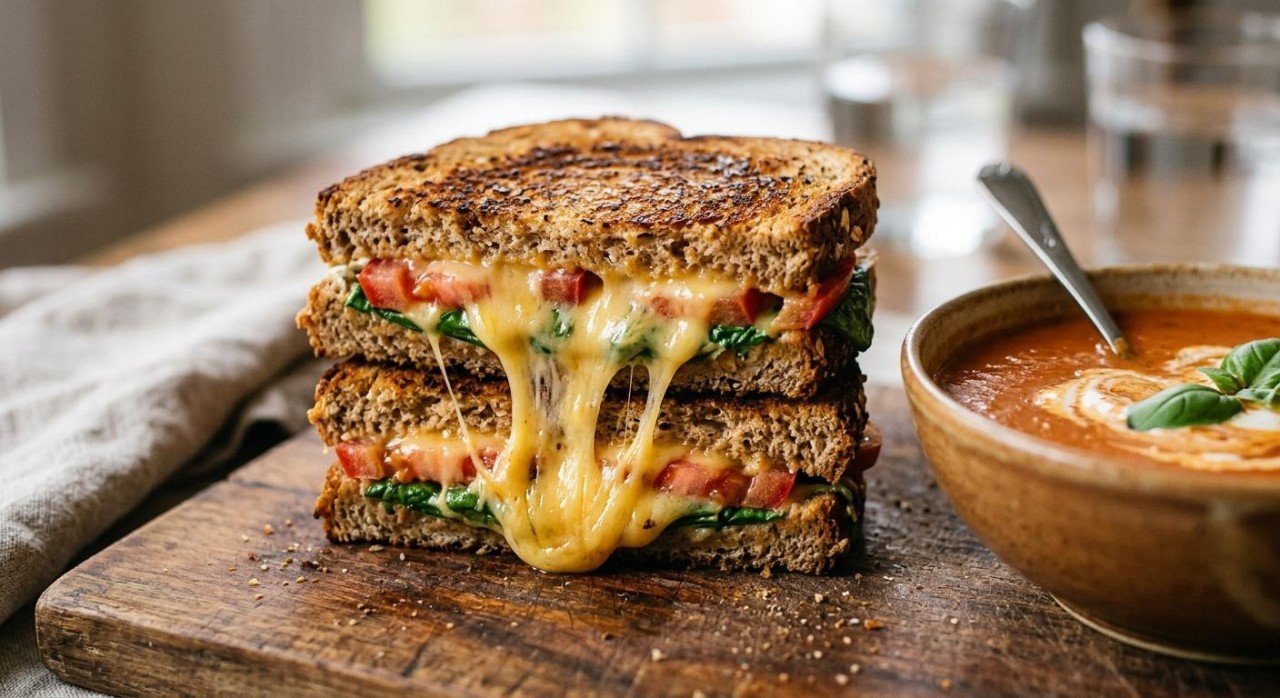
Few things are as uncomplicatedly good as a grilled cheese. Buttery, crisp-edged bread, a molten middle that pulls into strings when you tear it in half, maybe a bowl of tomato soup for dunking. It is comfort food in its purest form, and there is a reason it has been an American lunch-counter staple for a hundred years.
So this is not a post about giving up grilled cheese, or pretending a pile of vegetables is the same thing. It is about a specific question: the classic version — white sandwich bread, American cheese, a generous slather of butter — scores 26 out of 100 on our Nutrition Score. Can we push that number up without losing the melt, the crunch, or the point?
Turns out yes, and by a lot. Four swaps took it from 26 to 58 — a 32-point jump — and every one of them is verified: we scored the original, applied each change one at a time, and measured exactly what it was worth. The finished sandwich still browns, still pulls, still tastes like grilled cheese. Here is the whole build, with receipts.
The original: what is in it and how it scores
The version most of us grew up on is about as simple as a recipe gets. Per sandwich, roughly:
- 2 slices white sandwich bread
- 2 slices American cheese
- 1 to 1.5 tablespoons butter, spread on the outside
Scored per serving against our default profile, that lands at 26/100. The app flags three things dragging it down: high saturated fat, high sodium, and low plant diversity. Here is what that looks like in real numbers, per sandwich:
- Calories: about 430
- Saturated fat: about 17 g — already more than a full day in one sandwich, against the American Heart Association's target of roughly 13 grams (less than 6% of calories)
- Sodium: about 990 mg — close to half the 2,300 mg daily limit the AHA sets
- Fiber: 1.5 g
- Plant points: 0
The saturated fat and sodium come from the same two places: processed American cheese, which is engineered to be salty and meltable, and the butter. The near-zero fiber is the white bread — refined flour has had the bran and germ stripped out, taking most of the fiber, B vitamins, and minerals with them, per Harvard's Nutrition Source. And with no vegetables anywhere, there is nothing to move the plant-diversity needle.
What is worth saying just as clearly: this is not a nutritional disaster, and it is not a food to feel guilty about. It delivers real calcium, protein, and vitamin A. It is a genuinely satisfying meal. The goal here is not to fix something broken — it is to keep everything that makes it great and quietly repair the three weak spots.
The upgrades
Four swaps, in order of how much they move the score for how little they cost you at the table. If you only make the first two, you have already done most of the work.
1. White bread to 100% whole wheat
- Swap: White sandwich bread → 100% whole wheat
- Score impact: +9 points (26 → 35)
- What it changes: More than doubles the fiber (1.5 g → 3.4 g), adds B vitamins, iron, and magnesium, and puts the first plant point on the board
- What it costs you: A nuttier, slightly denser slice — most people stop noticing by the second bite
This is the single most important change, and the easiest. Whole wheat keeps the bran and germ that refining throws away, which is where the fiber and most of the micronutrients live. Harvard's researchers found people eating 2 to 3 servings of whole grains a day were about 30% less likely to have a heart attack over a decade — the fiber slows how fast starch turns to glucose, so you also get a steadier ride than white bread gives.
The one thing that matters here is buying real whole wheat, not brown-colored white bread. The label should say 100% whole wheat or list a whole grain as the first ingredient — if you want the full rundown, we wrote a guide to reading bread labels. A sturdy whole wheat also griddles beautifully, so you lose nothing on the crunch.
2. Add tomato and a handful of spinach
- Swap: Add thin tomato slices and a little spinach to the filling
- Score impact: +11 points (35 → 46)
- What it changes: Takes plant points from 1 to 3, and adds vitamin C, vitamin K, vitamin A, and potassium
- What it costs you: Almost nothing — if anything, the tomato's acidity cuts the richness and makes it taste better
This is the biggest single point-mover in the whole makeover, and it is the one that will feel most familiar — tomato in a grilled cheese is basically tradition, and spinach wilts down into the melt so completely that picky eaters rarely notice it. You are adding two different plants for real vitamins and, per gut-health research, more variety toward the 30-plants-a-week target that feeds a healthier microbiome.
The only technique note: tomato is wet, and wet is the enemy of crisp bread. Slice it thin, lay the slices on a paper towel with a light sprinkle of salt for a few minutes, then pat dry before building. Tuck the tomato and spinach between two thin layers of cheese so the cheese seals the bread from the moisture. Do that and the sandwich stays crisp.
3. Slathered butter to a thin brush of olive oil
- Swap: Butter on the outside → a thin brush of olive oil
- Score impact: +8 points (46 → 54)
- What it changes: Cuts saturated fat from about 17 g to about 7 g per serving, and drops roughly 85 calories
- What it costs you: A little of butter's browned-dairy flavor — the crisp itself is every bit as good, arguably better
This is the swap that does the heavy lifting on the number the app cares about most. Butter is mostly saturated fat; olive oil is mostly monounsaturated, the kind the AHA says lowers heart-disease risk when it replaces saturated fat. Brushed thin over the outside of the bread, olive oil crisps and browns exactly the way a light coat of butter does — a trick plenty of diner cooks already use.
Be honest with yourself about what you are trading: you do lose a bit of that specific buttery aroma. If that flavor is sacred to you, a middle path is to use half butter and half olive oil, or a very thin scrape of butter instead of a slather — you keep some of the taste and still cut most of the saturated fat. Either way, olive oil is the healthiest everyday swap for butter in a hot pan; there is more on when it works and when it does not in our butter substitutes guide and the olive oil guide.
4. American singles to sharp cheddar (and a little less of it)
- Swap: 2 slices American cheese → about 1 oz sharp cheddar per sandwich
- Score impact: +4 points (54 → 58)
- What it changes: Cuts sodium almost in half — from about 37% to 20% of the daily limit per serving — and trades ultra-processed cheese for real cheese
- What it costs you: A slightly less uniform, less glossy melt, and a sharper flavor (which is the whole idea)
The score only moves 4 points here, and I want to be straight about why that is still one of the best swaps on the list: the Nutrition Score is not the only thing that got better. Sodium is the story. American singles are built to be salty; a good aged cheddar carries far less sodium, and because sharp cheddar has so much more flavor, you can use noticeably less of it — about an ounce a sandwich instead of two full slices — and still taste plenty of cheese. More than 70% of the sodium most people eat comes from processed foods exactly like American singles, so this one swap quietly does real work.
Cheddar melts well — just melt it gently. Grate it or slice it thin, keep the pan at medium-low, and cover the pan for a minute to trap heat; aged cheeses can separate into oil if you blast them, so lower and slower is the move. You will not get the plasticky, uniform stretch of American, but you get a proper melt with real flavor.
Take the Guesswork Out of Eating Well
Eat Well Planner helps you organize your favorite recipes, plan balanced meals, and automatically generate shopping lists — all in one place. Whether you're tracking macros, managing dietary restrictions, or just trying to stop asking "what's for dinner?", we've got you covered.
Our AI-powered tools can adapt any recipe to your dietary needs, help you discover new meals you'll love, and even log your nutrition effortlessly. It's meal planning made simple.
Start Organizing Your Meals — FreeWhat we kept on purpose
A makeover that guts the dish is a failed makeover, so here is where we deliberately stopped:
- Real cheese, real fat. We did not reach for fat-free cheese or a butter-free dry pan. A grilled cheese needs fat to crisp and cheese that actually melts — we just chose better versions of both and used a sensible amount.
- Real bread. No cauliflower "bread," no low-carb novelty loaf. Whole wheat is still bread, it still griddles, and it still tastes like a sandwich.
- The technique. It is still cooked the same way — a real fat on the outside, a proper griddle, cheese melted through. Nothing about the method changed except the ingredients going into it.
That is the line we drew: every swap had to leave you with something you would still call, and still crave, as a grilled cheese. The next swap past this point starts breaking that promise — which brings us to the one we turned down.
The healthier version: full recipe
Final score: 58/100, up from 26. Makes 2 sandwiches.
Ingredients
- 4 slices 100% whole wheat bread
- 2 oz sharp cheddar cheese (about 1 oz per sandwich), grated or thinly sliced
- 1 tablespoon olive oil
- 1 medium tomato, thinly sliced
- 1 cup baby spinach (a generous handful per sandwich)
- Pinch of salt, for the tomato
Instructions
- Slice the tomato thin, lay the slices on a paper towel, sprinkle lightly with salt, and let sit 5 minutes. Pat dry — this keeps the sandwich from going soggy.
- Grate or thinly slice the cheddar so it melts quickly at a lower heat.
- Brush one side of each slice of bread with olive oil. That oiled side faces out.
- Build each sandwich oiled-side-out: a layer of cheese, then tomato and spinach, then the rest of the cheese, so the cheese seals the filling away from the bread. Top with the second slice, oiled side out.
- Cook in a skillet over medium-low heat, 3 to 4 minutes per side, until the bread is deep golden and the cheese is melted. Cover the pan for a minute if the cheese needs help catching up to the bread.
- Rest for a minute, cut on the diagonal, and serve. A bowl of tomato soup is not optional in this house.
Per serving, here is the before and after:
- Nutrition Score: 26 → 58
- Calories: about 430 → about 345
- Saturated fat: about 17 g → about 7 g
- Sodium: about 990 mg → about 460 mg
- Fiber: 1.5 g → 4.3 g
- Protein: 12 g → 15 g
- Plant points: 0 → 3
Same lunch, half the saturated fat, half the sodium, nearly triple the fiber, and a little more protein — with three plants where there were none.
Swaps we tested and skipped
Here is the honesty section that proves the numbers are real, because it is the one where we left points on the table on purpose.
Reduced-fat cheese. Nearly every "healthy grilled cheese" article online reaches for reduced-fat cheese, and the score loves it — swapping reduced-fat cheddar into our final recipe jumped it all the way to 71, thirteen points higher than the version we are recommending. We turned it down anyway, and it was not a close call. Fat is what makes cheese melt smoothly; it acts as a lubricant between the protein strands, and take it away and the cheese melts unevenly into a rubbery, grainy texture that can weep oil. This is a grilled cheese. The melt is the entire point. A 71 that does not pull into strings is a worse sandwich than a 58 that does — so we kept the real cheese and just used less of it.
Cauliflower or low-carb bread and fat-free cheese. We did not bother scoring these, because they fail the only test that matters: the result stops being a grilled cheese. If your goals are different and you want to chase them, that is a legitimate choice — just make it with your eyes open, which is exactly what the tools below are for.
Make it fit other diets
The same build adapts easily:
- Gluten-free: swap in a sturdy gluten-free bread — the cheese, tomato, and spinach are already gluten-free. Choose a denser loaf so it holds up to griddling.
- Dairy-free or vegan: this is the hard one, because vegan cheese melt varies wildly. Look for a cashew- or oil-based cheese specifically labeled for melting, and expect a different (still good) flavor.
You do not have to figure the swaps out by hand, either. In Eat Well Planner, the AI Recipe Chat and Recipe Variations can rewrite this exact sandwich as a full gluten-free or dairy-free recipe in one step, with the substitutions already worked in.
Do this to any recipe you love
Every number in this post came out of Eat Well Planner's Make It Healthier feature. That is the whole idea behind it: import a recipe you love — from a website, an Instagram reel, or a YouTube video — and the app scores it, then proposes concrete swaps like these, with a calculator verifying the real nutritional gain before it shows you the suggestion. No guessing, no vibes.
And when you want to make the call yourself — keep the full butter, use a little more cheese, add bacon and make it up elsewhere — the Recipe Playground lets you tweak ingredients and watch the score move with each edit, so you can see exactly what every choice is worth. Keep the dish you love. Just know what it is made of, and where the easy wins are hiding.