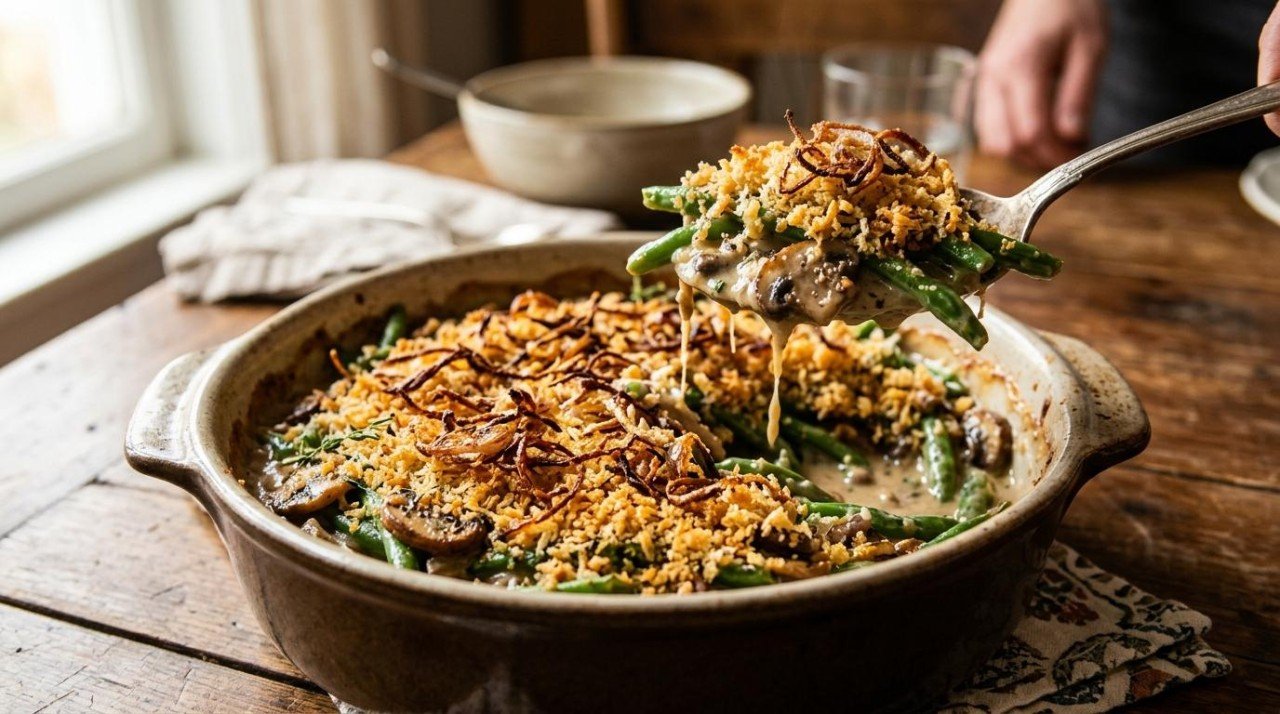
Green bean casserole is a marketing exercise that became a family tradition, and I mean that affectionately. In 1955, Dorcas Reilly, who worked in the Campbell Soup test kitchen in Camden, New Jersey, was asked for a side dish built from things people already had in the pantry. She came back with green beans, a can of cream of mushroom soup, milk, soy sauce, and a can of fried onions, called it Green Bean Bake, and it has been on more than half of American Thanksgiving tables ever since. Campbell's still sells half its annual cream of mushroom soup between November and January.
We ran the original through our Nutrition Score and got 53 out of 100 — which, honestly, is higher than most of the dishes we make over. It is not a calorie problem. It is a sodium problem sitting on top of a vegetable that has had most of the vegetable cooked out of it.
Then we rebuilt it and got 94. Still creamy, still mushroomy, still crunchy on top, still made in one dish in about 45 minutes. Here is every swap, what each one was actually worth, and the one place where the upgrade genuinely costs you something.
The original: what is in it and how it scores
We scored the canonical version, the one printed on the can, built to serve six:
- Two 14.5 oz cans of cut green beans, drained (about 4 cups)
- One 10.5 oz can of condensed cream of mushroom soup
- 1/2 cup of 2% milk
- 1 teaspoon of soy sauce and a dash of black pepper
- 1 1/3 cups of canned French fried onions
Per serving: 132 calories, 2.8 g protein, 13.5 g carbohydrate, 2.6 g fiber, 8.0 g fat, 1.6 g saturated fat, and 740 mg of sodium.
Start with what is already fine, because there is more of it than the dish's reputation suggests. At 132 calories a serving this is one of the lightest things on the holiday table — lighter than the mashed potatoes, lighter than the stuffing, lighter than the rolls. Saturated fat is 1.6 g, which is genuinely low. There is essentially no added sugar. Nobody needs to feel bad about this casserole, and the score agrees: 53 is a middling number, not a bad one.
What drags it down:
- Sodium: 740 mg per serving, 32% of a day's worth. Flagged high. That is a third of the daily limit in a side dish that is not even the thing you came for. The condensed soup, the canning liquid in the beans, and the fried onions each bring their own, and none of them is optional in the original.
- 1 plant point. The entire casserole contains one distinct plant. The mushrooms in cream of mushroom soup are present in trace amounts; the onions are a fried topping, not a vegetable.
- 2.8 g of protein and 2.6 g of fiber. For a dish built on a legume, that fiber number is low — the beans have been cooked twice and there are not many of them.
- High omega-6. The fried onions are the only real fat source, and they are fried in seed oil, so the fat profile of the whole dish is set by the topping.
For context on that sodium number: Americans average around 3,400 mg of sodium a day against a 2,300 mg threshold, and about 75% of it comes from processed food rather than the salt shaker. This dish is a small, delicious demonstration of exactly that.
The upgrades: three swaps, 42 points
Each swap is scored on top of the one before it, in the order we made them, so the deltas add up. If you only make one change, make the second one — it is worth more than the other two combined.
1. Fresh green beans instead of two cans
- Swap: Two 14.5 oz cans of green beans, drained → 1 1/2 lb fresh green beans, trimmed and blanched
- Score impact: +10 points (53 to 63)
- What it changes: Sodium from 740 mg to 530 mg per serving; fiber from 2.6 g to 4.3 g; vitamin K jumps to 42% of a day's worth and vitamin C to 15%, neither of which registered before
- What it costs you: Five minutes of trimming and a pot of boiling water. Nothing on the plate.
Canned green beans sit in salted liquid, and draining them removes the liquid but not the salt they have absorbed. Fresh beans arrive with essentially none. The swap also quietly increases the amount of vegetable in the vegetable dish — 1 1/2 lb of fresh beans is meaningfully more than two drained cans, which is where most of the extra fiber comes from. Most Americans get about 15 g of fiber a day against a 25 to 35 g target, so 1.7 g extra from a side dish is not nothing.
The texture argument matters more than the nutrition one. Blanch the beans for 4 minutes in boiling water and shock them in ice water, and they go into the casserole with some snap left. Canned beans are already past done before they see the oven, which is the real reason so many people say they do not like green bean casserole. They do not dislike the casserole. They dislike a soft bean.
2. A real mushroom sauce instead of the can
- Swap: One can of condensed cream of mushroom soup → 8 oz sliced cremini mushrooms, 2 tbsp olive oil, 3 tbsp flour, 3/4 cup unsalted chicken broth, 3/4 cup 2% milk, 2 cloves garlic, and fresh thyme
- Score impact: +27 points (63 to 90)
- What it changes: Sodium from 530 mg to 200 mg per serving — the high-sodium flag clears completely; protein from 4.3 g to 6.3 g; plant points from 1 to 2.5; riboflavin, niacin, pantothenic acid, and biotin all arrive as excellent sources
- What it costs you: Ten minutes at the stove, and one pan to wash. That is the whole price.
This is the swap. It is a plain white sauce with mushrooms in it: sweat the mushrooms until they brown, add garlic and thyme, stir in flour, then whisk in broth and milk. It thickens in about three minutes and tastes considerably more like mushrooms than the can does. Measured from the other end, the can is the single most expensive ingredient in the original — put it back into the otherwise-finished casserole and the score falls from 94 to 72.
The single biggest lever inside it is the broth. Use unsalted chicken broth and the finished casserole scores 94; use regular salted broth and the same recipe scores 82. Twelve points, for a carton choice made at the store — this is the same lesson our chicken broth substitutes guide keeps running into, which is that broth is mostly a salt delivery system unless you specifically buy the unsalted kind.
The fat you build the roux from matters more than it sounds like it should. We tested the identical sauce made with 2 tablespoons of butter instead of olive oil: the finished casserole drops from 94 to 70. Twenty-four points, for 2 tablespoons of fat spread across a dish that serves six. Partly that is the score working on ratios — at 180 calories a serving, this dish is so light that a little butter is a large share of the fat in it. Partly it is that the research keeps pointing the same direction: a 2025 JAMA Internal Medicine analysis of 221,054 people followed for over 30 years estimated that swapping 10 g of butter a day for plant oils was associated with 17% lower total mortality. If you want the butter, the butter substitutes guide covers the middle-ground options; you now know the price.
The mushrooms are doing real nutritional work too. They are a genuine source of B2, B3, B5, phosphorus, selenium, and potassium, which is exactly what shows up in the score's highlights. One remaining weakness in the finished dish is vitamin D — and mushrooms are the one ingredient here that can fix it, because they make vitamin D from ergosterol when they are exposed to ultraviolet light. Supermarket mushrooms grown indoors have almost none, while sun-exposed button mushrooms can reach 400 IU a serving. Look for the packs labeled vitamin D, or set yours gill-side up in direct sun before you cook them.
3. Crisp shallots and whole wheat panko instead of the can of fried onions
- Swap: 1 1/3 cups canned French fried onions → 2 shallots sliced thin, 1/2 cup whole wheat panko, 1 tbsp olive oil, all crisped in the oven
- Score impact: +5 points (90 to 95)
- What it changes: Sodium from 200 mg down to 100 mg per serving before any seasoning; plant points from 2.5 to 4.5; 19 calories off
- What it costs you: The specific crunch of the can. This is the swap you will notice.
Five points looks small, but that is because the sauce swap already fixed most of the sodium ahead of it. Measured at the end, this topping is worth more than it looks: put the canned fried onions back on the finished casserole and it drops from 94 to 82. Twelve points, sitting on top.
Be honest with yourself about what you are giving up. Canned fried onions are deep-fried in oil and engineered to stay crisp in a wet casserole for 25 minutes, and oven-crisped shallots are not quite that. What you get instead is browned shallot flavor, which is better, and an actual crunch from toasted panko, which is close. Toss the sliced shallots and panko with the oil, spread them on a sheet pan, and bake at 400 degrees F for 8 to 10 minutes while the sauce comes together — then scatter them on for the last 10 minutes of baking so they crisp rather than steam. Whole wheat panko is worth exactly one point over plain dry bread crumbs, which score 93 in the same recipe, so use what you have; if you need alternatives, the bread crumb substitutes guide has the full list, and the shallot substitutes guide covers what to do when your store has none.
Take the Guesswork Out of Eating Well
Eat Well Planner helps you organize your favorite recipes, plan balanced meals, and automatically generate shopping lists — all in one place. Whether you're tracking macros, managing dietary restrictions, or just trying to stop asking "what's for dinner?", we've got you covered.
Our AI-powered tools can adapt any recipe to your dietary needs, help you discover new meals you'll love, and even log your nutrition effortlessly. It's meal planning made simple.
Start Organizing Your Meals — FreeWhat we kept, and where we stopped
Some things stayed on purpose, and each one has a price we can name:
- The soy sauce. Dorcas Reilly's teaspoon of soy sauce is the secret of the original — it is what makes the sauce taste savory rather than like warm milk. It stays.
- Salt: 1/4 teaspoon, and no more. Unsalted, the casserole scores 95. With 1/4 teaspoon across six servings it scores 94 — one point, and it needs it. A full 1/2 teaspoon takes it to 83. That is the entire sodium story of this dish in three numbers.
- Real milk. The original calls for 2% and so do we. Whole milk is a fine choice if that is what is in the fridge, but it costs 7 points (94 to 87) for about a gram and a half of extra milk fat per serving.
- The creamy sauce itself. We never considered a broth-only version. A green bean casserole without a cream sauce is green beans.
The healthier version: full recipe
Nutrition Score: 94 out of 100. No caution flags, an excellent source of vitamin K, riboflavin, niacin, biotin, phosphorus, iron, B6, and pantothenic acid, and a good source of fiber, potassium, and vitamin C.
Serves 6. Prep 20 minutes, bake 25 minutes.
- 1 1/2 lb fresh green beans, trimmed and cut into 2-inch pieces
- 8 oz cremini mushrooms, sliced
- 2 tablespoons olive oil
- 3 tablespoons all-purpose flour
- 3/4 cup unsalted chicken broth
- 3/4 cup 2% milk
- 2 cloves garlic, minced
- 2 teaspoons fresh thyme leaves (or 3/4 teaspoon dried)
- 1 teaspoon soy sauce
- 1/4 teaspoon fine salt
- 1/4 teaspoon black pepper
- 2 shallots, sliced as thin as you can
- 1/2 cup whole wheat panko bread crumbs
- 1 tablespoon olive oil, for the topping
- Heat the oven to 400 degrees F. Bring a large pot of water to a boil.
- Boil the green beans for 4 minutes, then drain them and drop them straight into a bowl of ice water. Once cold, drain again and pat dry. They should still squeak.
- Toss the sliced shallots and panko with 1 tablespoon of olive oil on a small sheet pan and spread them out. Bake for 8 to 10 minutes, stirring once, until the shallots are golden at the edges and the crumbs are toasted. Watch them from minute 7 — shallots go from golden to black quickly. Set aside.
- Heat 2 tablespoons of olive oil in a large skillet over medium-high heat. Add the mushrooms in one layer and leave them alone for 3 minutes, then stir and cook another 4 to 5 minutes until they have released their liquid and browned.
- Add the garlic and thyme and cook for 30 seconds. Sprinkle the flour over the mushrooms and stir constantly for 1 minute, until no dry flour is visible.
- Whisk in the broth a splash at a time, then the milk. Bring to a gentle simmer and cook for 3 to 4 minutes, stirring, until the sauce coats the back of a spoon. Stir in the soy sauce, salt, and pepper.
- Fold the green beans into the sauce and transfer everything to a 2-quart baking dish. Lower the oven to 375 degrees F and bake for 15 minutes.
- Scatter the shallot-panko topping over the casserole and bake for another 10 minutes, until the sauce bubbles at the edges and the top is deep golden. Rest for 5 minutes before serving.
Per serving, original versus improved:
- Nutrition Score: 53 → 94
- Calories: 132 → 180
- Protein: 2.8 g → 6.7 g
- Fiber: 2.6 g → 5.0 g
- Saturated fat: 1.6 g → 1.6 g
- Sodium: 740 mg → 200 mg
- Plant points: 1 → 4.5
- Caution flags: high sodium → none
Yes, the improved version has more calories. It also has more than twice the protein, twice the fiber, and a quarter of the sodium, because there is simply more food in it — 1 1/2 lb of green beans and half a pound of mushrooms instead of two drained cans. That is a trade we will take on a holiday table every time. The plant points line matters more than it looks, too: going from one distinct plant to four and a half in a single side dish is real progress toward the 30 different plants a week that gut microbiome research keeps pointing at.
Swaps we tested and skipped
- Plain Greek yogurt instead of the milk: 97. The highest score we recorded, and it takes protein to 8.8 g a serving. We left it out because yogurt curdles when it is heated — its proteins are already fragile from the lactic acid. It can be stabilized with starch or tempered in off the heat, but a casserole that goes back in a 375-degree oven is not the place to find out you got it wrong.
- Sliced almonds in the topping: 93. Adds fiber, a plant point, and a good crunch, but it costs a point and adds 31 calories a serving. Genuinely a matter of taste — put them in if you like them.
- Dropping the mushrooms entirely: 92. Only 2 points, which surprised us. We kept them anyway, because at that point you are making a green bean casserole with no mushrooms in it.
- The 20-minute shortcut: 88. Fresh blanched beans plus a can of low sodium condensed cream of mushroom soup plus our oven-crisped topping, no homemade sauce at all. If you are cooking six other things on Thanksgiving morning, this is an excellent trade — 35 points over the original for about five minutes of extra work.
Make it fit other diets
- Vegan: unsweetened soy milk and unsalted vegetable broth in place of the milk and chicken broth. It scores 83 in our data — the drop is mostly sodium, since plant milks and vegetable broths carry more of it than unsalted chicken broth does.
- Gluten-free: skip the roux and thicken with 1 1/2 tablespoons of cornstarch whisked into the cold milk, and use gluten-free panko for the topping. Check your soy sauce, or use tamari.
- Dairy-free: unsweetened oat milk holds up best in a roux-thickened sauce.
In Eat Well Planner, you do not have to work any of these out by hand — ask the AI recipe chat to make this exact recipe vegan or gluten-free and Recipe Variations writes the whole thing back to you with the substitutions already worked in, then scores it so you can see what the change cost.
Do this to your own recipes
Nothing about this process was special to green bean casserole. We imported a recipe, looked at the score, read the two lines the score complained about, and tested swaps one at a time until the numbers stopped moving — which is exactly what Make It Healthier does inside Eat Well Planner. It proposes ingredient swaps for any recipe in your book, and a calculator verifies the actual nutritional gain before a suggestion is ever shown to you, so you never get told to do something that turns out to be worth nothing.
Import your family's version from a website, a screenshot, or an Instagram reel, score it, and see which of its ingredients are carrying the damage. If you want to poke at it yourself, the Recipe Playground lets you change one ingredient at a time and watch the score move — that is where every number in this post came from. And if your holiday menu needs the rest of the work, we have done the same thing to Thanksgiving stuffing, sweet potato casserole, and mashed potatoes and gravy.