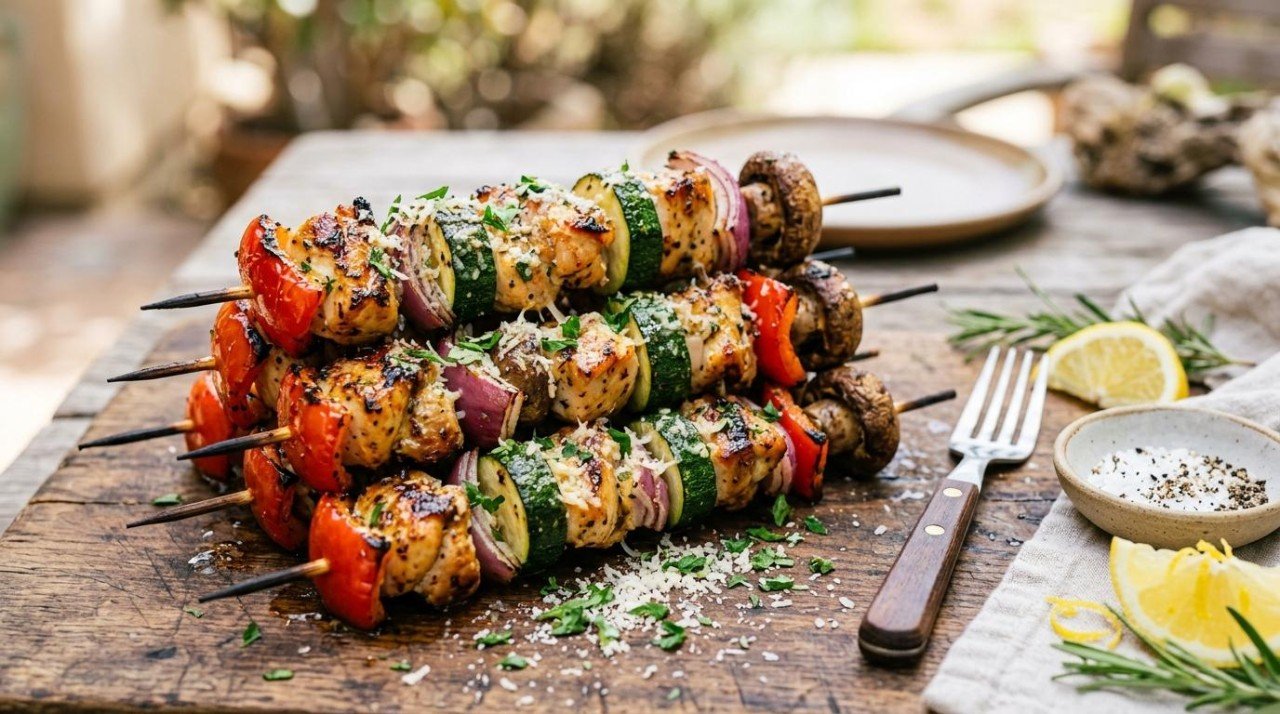
Garlic parmesan chicken skewers took over TikTok in 2023 and never really left. The formula is the same in every version: cubes of chicken threaded onto skewers, air fried until the edges go dark and crackly, then drenched in a molten garlic parmesan butter that pools on the plate. There is no single inventor to credit — dozens of creators posted their take within months of each other — but the air fryer version on Moribyan is among the most copied, and it is the one we scored.
It deserves the hype for one reason people rarely mention: it is real cooking. Chicken, garlic, cheese, herbs, an air fryer. No sauce packet, no breading, no deep fryer. That is a better starting point than most viral food.
And yet it came back from Eat Well Planner's Nutrition Score at 29 out of 100 — the same at-a-glance number a visitor sees on any public recipe page. So we rebuilt it, kept the garlic butter and the parmesan crust, and landed at 72 out of 100. That is 43 points, and every swap below carries the real, verified score change it earned.
The original: what's in it and how it scores
Here is the viral build we scored, for four people:
- 1 1/2 lb boneless skinless chicken thighs, cubed
- Marinade: 1 1/2 tablespoons olive oil, 1/2 tablespoon yellow mustard, paprika, Italian seasoning, garlic powder, onion powder, 1 teaspoon salt, black pepper
- Garlic parmesan butter: 1/2 cup (1 stick) melted butter, 1 tablespoon minced garlic, 3 tablespoons grated parmesan, fresh parsley, dried oregano, another 3/4 teaspoon salt
Nutrition Score: 29/100. Now the diagnosis, because knowing why a recipe scores the way it does is what lets you fix your own. Per serving, the original runs about 633 calories, 33.7 g protein, 18.7 g saturated fat, 1,220 mg sodium, and 1.0 g of fiber. Three things hold it back, and they are not the ones people assume.
- The baste is a stick of butter — split four ways, that is 2 tablespoons of butter per person, which alone is most of the 18.7 g of saturated fat on the plate. The American Heart Association recommends no more than about 13 grams a day on a 2,000-calorie diet, so one dinner clears a day and a half. The app flags this very high. Other popular versions are not far off — Little Spice Jar's uses 5 tablespoons.
- Salt gets added twice — once in the marinade and again in the butter, which lands the dish at 1,220 mg of sodium per serving, more than half a day against the AHA's 2,300 mg ceiling and an ideal closer to 1,500 mg. Also flagged very high. Interestingly, almost none of it comes from the parmesan.
- There is nothing on the skewer but chicken — 1.0 g of fiber, 2 plant points, and zero vitamin C. This is the real problem, and it is the quiet one. A skewer is a rack with room on it, and the viral version uses every inch for meat.
What is already fine, and worth defending? More than you would guess. Protein is strong at 33.7 g. The chicken makes this an excellent source of vitamin B6 (71% of the daily value), niacin (70%), and phosphorus (50%). The cooking method is genuinely good — air frying gets that crust with a fraction of the oil a deep fryer needs, and nothing here is breaded or battered. And the flavor engine, garlic and parmesan and herbs, costs almost nothing nutritionally.
This is not a recipe that needs rescuing from itself. It needs the butter dialed back, the salt halved, and the empty half of the skewer filled in.
The upgrades
Five swaps, applied cumulatively in this order. Read the first two even if you read nothing else — they are 23 of the 43 points. One structural note as you go: the score is gated by two very high flags, saturated fat and sodium. Until those clear, the number moves in fits and starts, which is why swap three looks disproportionate to what it actually changes.
1. Put vegetables on the skewers
- Swap: Chicken-only skewers → chicken alternated with red bell pepper, zucchini, red onion, and cremini mushrooms, plus cherry tomatoes on their own skewers
- Score impact: +16 points (29 → 45) — the biggest single move in the makeover
- What it changes: Fiber from 1.0 g to 4.5 g, plant points from 2 to 7, potassium from 550 mg to 1,180 mg, and vitamin C from zero to more than a full day's worth
- What it costs you: Nothing. It costs you ten minutes of chopping and gets you more dinner
Sixteen points, and we did not remove a single thing. That is the finding worth sitting with, because it runs against the instinct that a makeover means taking something away. The skewer was already half empty; a viral recipe optimized for how meat looks on camera left the obvious move on the table.
The technique matters more than the choice of vegetable. Cut everything to roughly the size of the chicken cubes so it all finishes together — bell pepper in 1-inch squares, zucchini in half-inch half moons, onion in wedges, mushrooms halved. Cherry tomatoes are the exception: they collapse in about four minutes, so give them their own skewers and add them at the end. Five different plants on one dinner is a real contribution to a weekly plant total, which is what the app's Plant Points tracker is counting.
2. Rebuild the garlic parmesan butter on olive oil
- Swap: 1/2 cup melted butter → 2 tablespoons butter plus 2 tablespoons olive oil
- Score impact: +7 points (45 → 52)
- What it changes: Saturated fat from 18.9 g to 8.8 g per serving — cut by more than half — and about 100 calories per serving
- What it costs you: A little of the pooling richness. The garlic and parmesan flavor is untouched
Half a cup of butter for four servings is a lot of butter for what is essentially a delivery system for garlic. The garlic, the parmesan, the parsley and oregano are doing the flavor work; the butter is doing the carrying. Olive oil carries just as well and brings monounsaturated fat instead of saturated, which is why it is the first swap in our butter substitutes guide.
We kept two tablespoons of real butter on purpose, and it matters. Butter contributes milk solids that brown, and a browned-butter note is a meaningful part of what people love here — an all-oil baste tastes cleaner but flatter. Warm the two fats together gently, then pull the pan off the heat before you stir in the garlic and cheese, so the garlic softens rather than fries and the parmesan does not seize into a grainy clump.
3. Cut the salt in half, and let garlic and lemon do the work
- Swap: 1 3/4 teaspoons total salt → 3/4 teaspoon, with the garlic tripled to 6 cloves and 2 tablespoons of lemon juice stirred into the baste
- Score impact: +14 points (52 → 66)
- What it changes: Sodium from 1,220 mg to about 640 mg per serving — clears the very high sodium flag entirely
- What it costs you: Genuinely nothing, provided you make the garlic and lemon part of the trade
Fourteen points for leaving out a teaspoon of salt looks absurd next to seven points for cutting 10 g of saturated fat, and the reason is structural rather than nutritional. Sodium had been pinned in the very high band since the first score, holding the number down no matter what else improved. Clearing it let the vegetables from swap one finally count. That is worth knowing about your own recipes: one flag stuck in the red can mask every other improvement you make.
Now the honest part — you cannot simply remove salt and expect the dish to taste the same. You replace what salt was doing, which here is making the food taste loud. Tripling the garlic and adding acid does that job: lemon juice brightens everything on the plate and makes food read as better seasoned than it is. Add the lemon off the heat, at the end, so it stays sharp. On its own, the lemon was worth exactly zero points. It is in the recipe because it is what makes the salt cut painless, and we would rather tell you that than pretend it was a nutrition move.
4. Marinate the chicken in Greek yogurt
- Swap: Oil-and-mustard marinade → 1/2 cup plain nonfat Greek yogurt with the same spices, mustard, and a tablespoon of olive oil
- Score impact: +2 points (66 → 68)
- What it changes: Protein from 37.0 g to 40.1 g per serving, calcium up about a quarter, and clears the low vitamin B12 flag the original carried
- What it costs you: Nothing, and it makes the chicken better. It does need 30 minutes ahead
Two points is a modest return, and we included this swap mostly for what it does in the pan. A yogurt marinade is standard technique for kebabs across South Asia and the Middle East for good reason. As molecular-biologist-turned-food-writer Nik Sharma explained to The Takeout, yogurt's lactic acid is far gentler on meat than the acetic acid in vinegar or the citric acid in lemon — you can leave chicken in it overnight without the mushy, chalky surface that harsher acids produce.
It also clings. A thick coating holds the paprika and herbs against the meat instead of sliding off into the air fryer basket, and it browns readily in dry heat. Wipe off the excess before threading, leaving a thin film — a thick layer will steam instead of char. Any plain unsweetened yogurt works; nonfat Greek is simply the thickest.
5. Make it half breast, half thigh
- Swap: 1 1/2 lb chicken thighs → 12 oz thighs plus 12 oz chicken breast
- Score impact: +4 points (68 → 72)
- What it changes: 76 fewer calories per serving, saturated fat from 8.8 g to 7.7 g, and protein up to 43.4 g
- What it costs you: Breast dries out faster than thigh. Do swap four first and this is a safe trade
We put this last deliberately, because the order changes whether it works. Chicken breast is leaner and higher in protein per ounce, but it has almost no intramuscular fat to protect it, and an air fryer at high heat is exactly where lean chicken goes to become sawdust. The yogurt marinade is the insurance — it holds moisture at the surface and buys you a minute or two of margin.
Keeping half the meat as thigh is the other half of the insurance. Thigh stays juicy through overcooking and carries more flavor, so a mixed skewer is far more forgiving than an all-breast one. Going all the way to breast did score higher — 74, two points above where we landed — and we passed on those two points for texture rather than nutrition; there is more on that below. Cut the breast cubes very slightly larger than the thigh cubes so they finish at the same moment, and pull everything at 165°F rather than guessing. Our chicken thigh substitutes guide covers the timing differences in more detail.
Take the Guesswork Out of Eating Well
Eat Well Planner helps you organize your favorite recipes, plan balanced meals, and automatically generate shopping lists — all in one place. Whether you're tracking macros, managing dietary restrictions, or just trying to stop asking "what's for dinner?", we've got you covered.
Our AI-powered tools can adapt any recipe to your dietary needs, help you discover new meals you'll love, and even log your nutrition effortlessly. It's meal planning made simple.
Start Organizing Your Meals — FreeWhat we kept (on purpose)
Real butter, real parmesan, all the garlic and then some, and the air fryer method that made this recipe famous. We also stopped somewhere specific, and it is worth naming: dropping the last two tablespoons of butter and going to an all-olive-oil baste scored 78 — six points higher than where we landed. We turned those points down. The dish is called garlic parmesan butter skewers, and a version with no butter in it is a different recipe wearing the same name. If you do not care about that, the six points are sitting right there and you should take them.
We are also not going to oversell the finish. At 72, this still carries high flags for saturated fat and sodium, and low vitamin D. That is the honest ceiling for chicken basted in garlic butter and cheese, and it is a ceiling we are happy under.
The healthier version: full recipe
Nutrition Score: 72/100. Serves 4. About 20 minutes of prep plus 30 minutes marinating, and 18 minutes of cooking.
For the chicken and marinade:
- 12 oz (340 g) boneless skinless chicken thighs, cut into 1 1/4-inch cubes
- 12 oz (340 g) boneless skinless chicken breast, cut into 1 1/4-inch cubes
- 1/2 cup (120 g) plain nonfat Greek yogurt
- 1 tablespoon (14 g) olive oil
- 1/2 tablespoon yellow mustard
- 1 1/2 teaspoons paprika
- 1 1/2 teaspoons dried Italian seasoning
- 1 teaspoon garlic powder
- 1/2 teaspoon onion powder
- 1/2 teaspoon fine salt
- 1/4 teaspoon black pepper
For the skewers:
- 2 red bell peppers (about 300 g), cut into 1-inch squares
- 1 medium zucchini (about 250 g), cut into 1/2-inch half moons
- 1 small red onion (about 150 g), cut into wedges
- 5 oz (150 g) cremini mushrooms, halved
- 1 1/3 cups (200 g) cherry tomatoes
For the garlic parmesan baste:
- 2 tablespoons (28 g) unsalted butter
- 2 tablespoons (28 g) olive oil
- 6 cloves garlic (about 25 g), finely minced
- 3 tablespoons (15 g) finely grated parmesan
- 2 tablespoons (8 g) fresh parsley, finely chopped
- 2 tablespoons (30 g) fresh lemon juice
- 1 teaspoon dried oregano
- 1/4 teaspoon fine salt
- 1/2 teaspoon black pepper
- Whisk the Greek yogurt, olive oil, mustard, paprika, Italian seasoning, garlic powder, onion powder, salt, and black pepper together in a large bowl. Add all the chicken and turn until every piece is coated. Cover and refrigerate at least 30 minutes, or overnight.
- If you are using wooden skewers, soak them in water for 30 minutes so they do not scorch.
- Warm the butter and olive oil together in a small pan over low heat until the butter melts. Take it off the heat, then stir in the garlic, parmesan, parsley, lemon juice, oregano, salt, and pepper. Set aside.
- Wipe the excess marinade off the chicken, leaving a thin film. Thread onto skewers, alternating chicken with bell pepper, zucchini, red onion, and mushrooms. Thread the cherry tomatoes onto separate skewers.
- Air fry the chicken skewers at 400°F for 8 minutes. Turn them, add the tomato skewers, and cook 6 to 8 minutes more, until the chicken is browned at the edges and reads 165°F at the center. (Oven method: 425°F on a wire rack set in a sheet pan, about 20 minutes, turning once, then 2 minutes under the broiler.)
- Brush the skewers generously with about two thirds of the garlic parmesan baste and return them to the air fryer for 2 minutes, until the cheese sets and turns golden.
- Spoon the remaining baste over the top, rest 5 minutes, and serve.
Per serving, here is the before and after:
- Nutrition Score: 29 → 72
- Calories: about 633 → about 549
- Saturated fat: 18.7 g → 7.7 g (down 59%)
- Sodium: about 1,220 mg → about 650 mg (down 47%)
- Total fat: 42.8 g → 26.5 g
- Fiber: 1.0 g → 4.6 g
- Protein: 33.7 g → 43.4 g (up 29%, on the same weight of chicken)
- Potassium: about 550 mg → about 1,290 mg
- Vitamin C: 0% of the daily value → 150%
- Plants on the plate: 2 → 7
Swaps we tested and skipped
- Dropping the butter entirely (scored 78). Six points higher, and covered above — the highest number we found and turned down. It is a legitimate choice, not a bad one. It is just not this recipe.
- Leaving out the parmesan (scored 74). Two points better, because the cheese is a small source of both sodium and saturated fat. Rejected without much debate. Three tablespoons of parmesan across four servings is not what is wrong with this recipe, and it is half the name of the dish.
- Doubling the parmesan (scored 69). Worth knowing in the other direction. If you are tempted to make up for less butter with more cheese, that trade costs three points and adds the sodium back. Add more garlic instead — it is free.
- All chicken breast (scored 74). Two points above where we landed, at 474 calories and 46.7 g of protein per serving. This one is a genuine judgment call rather than a rejection, and it comes down to how confident you are with a thermometer. All-breast skewers punish a minute of inattention in a way the half-and-half version does not. If you cook chicken often and pull it on time, take the two points.
Make it fit other diets
Gluten-free: you are already there — check only the Italian seasoning blend and the mustard, which are the two places gluten sneaks in. Dairy-free: use a plain unsweetened plant yogurt in the marinade and swap the butter for more olive oil; for the cheese, nutritional yeast plus a pinch of salt gets you closer than most dairy-free parmesans do, though you will lose the browning. Higher protein: shift the ratio toward breast, and see the note above about what that costs. In Eat Well Planner you do not have to reason any of this out by hand — ask the AI recipe chat to make this dairy-free and Recipe Variations rewrites the whole recipe with the swaps already worked in.
Do this to any recipe you love
None of this was guesswork. Every score and delta above came from Eat Well Planner's Make It Healthier tool, which proposes swaps like these and runs a calculator to verify the real nutritional gain before it shows you the suggestion — so you never chase a change that does not actually help. We tested each one in the Recipe Playground, watching the score move per edit, which is how we caught what intuition gets wrong here: that adding vegetables beat cutting the butter more than twice over, that a single teaspoon of salt was worth 14 points, and that taking the parmesan out would have bought us all of two.
The next viral recipe is already loading. When it shows up, paste the TikTok, Instagram, or YouTube link straight into Eat Well Planner, let it pull out the ingredients and nutrition, and look at the score before you decide how you feel about it. Then hit Make It Healthier and find out which swaps are worth making — and which ones would just take the butter out of your garlic butter.