Garlic bread is the only side dish people fight over. It arrives, it disappears, and somebody always goes back for the end piece with the extra-crisp crust. Nobody has ever asked whether it was a good idea.
So we ran a standard loaf through our Nutrition Score and got 28 out of 100. That is low, and the reason is not complicated. What is interesting is where the damage actually sits — because we assumed it was the stick of butter, and the butter turned out to be only half the story. The loaf underneath it was worth just as much.
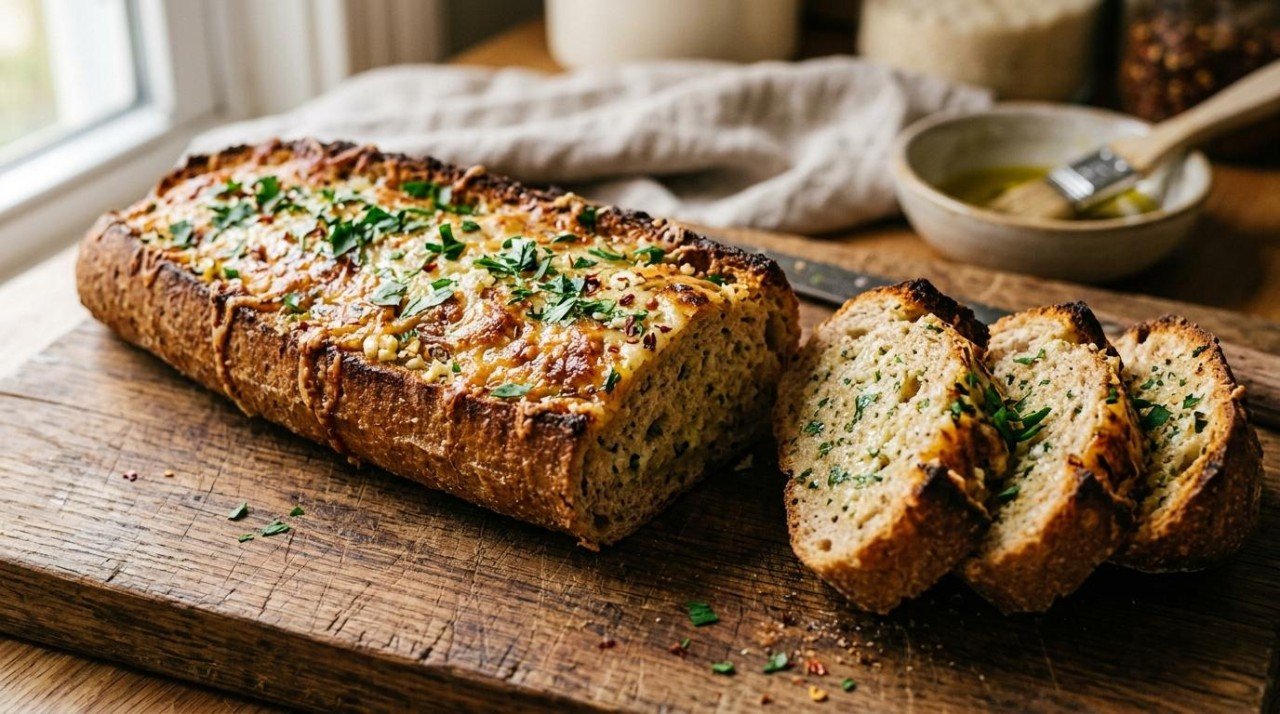
We rebuilt it to 71. It is still garlic bread: split loaf, crackling edges, garlic in every bite, browned cheese on top. It has about 5 g less saturated fat per serving, 230 mg less sodium, and nearly three times the fiber. Here is every swap, what each one is worth, and exactly what the butter costs if you want it back.
The standard loaf: what is in it and how it scores
The version we scored is the one most recipes describe, built to serve eight as a side:
- 1 white Italian loaf or French baguette, about 14 oz (400 g), split lengthwise
- 1 stick (1/2 cup, 113 g) of salted butter, softened
- 4 cloves of garlic, minced (12 g)
- 1/2 cup (45 g) of grated Parmesan
- 2 tablespoons (8 g) of chopped fresh parsley
- 1/2 teaspoon (3 g) of salt
Per serving that is about 266 calories, 7.7 g of protein, 14.2 g of fat, 1.2 g of fiber, and 590 mg of sodium.
Worth saying up front: this is not a junk recipe. There are six ingredients in it, five of them are real food, and there is no added sugar anywhere. The calories are not the problem either — 266 for a generous piece of bread is unremarkable. Two things drag the score down, and one of them is not the one everybody blames.
- Saturated fat: 7.5 g per serving, 32% of a day's worth. Flagged high. Harvard's Nutrition Source notes the Dietary Guidelines cap saturated fat at less than 10 percent of daily calories, with the American Heart Association going further at 7 percent. One slice of garlic bread is roughly a third of the day's allowance, before the meal it is sitting next to.
- Sodium: 590 mg, 26% of the daily limit. Also flagged high, against a ceiling of 2,300 mg a day. Only a fraction of that came from the salt we added. Bread carries salt, salted butter carries salt, and Parmesan is one of the saltiest cheeses in the case — which is why the CDC puts breads and rolls at the very top of its list of sodium sources in the American diet.
- Fiber: 1.2 g. White flour has had it removed on purpose.
- Plant points: 0.5 in the whole dish. A little garlic, a little parsley, and a loaf that no longer counts as a plant in any meaningful way.
There is a piece of history buried in that ingredient list. Garlic bread as Americans know it is an Italian-American invention, not an Italian one: its ancestor is bruschetta, bread toasted over coals and rubbed with pungent garlic, whose plainest Tuscan cousin is fettunta — literally a greased slice, served around November to show off the first olive oil of the season. Butter got into it because Italian immigrants arriving around the turn of the last century could get butter and could not easily get good olive oil. The butter was itself a substitution. Knowing that made the first swap feel less like a diet move and more like going home.
The upgrades: four swaps, 43 points
Each swap below is scored on top of the one before it, in the order we made them, so the deltas add up to the real total. If you only make one change, make the first one — though as you will see, the first two are worth almost exactly the same on their own.
1. Garlic butter becomes garlic olive oil
- Swap: 1/2 cup (113 g) salted butter → 1/4 cup (54 g) extra virgin olive oil
- Score impact: +12 points (28 to 40)
- What it changes: Saturated fat falls from 7.5 g to 2.1 g per serving; calories from 266 to 220; sodium from 590 mg to 510 mg
- What it costs you: The dairy-sweet, creamy note butter gives the crumb. You get fruit and pepper from the oil instead, and a crisper edge. This is the biggest flavor change in the post, and we are not going to pretend otherwise.
Before accepting this one we split it in two, because "less butter" and "different fat" are separate ideas and people conflate them constantly. Keeping the same 113 g but making it all olive oil scored 39. Keeping butter but halving it to 52 g scored 32. Changing the type of fat was worth eleven points; changing the amount was worth four. That ratio is the single most useful thing we learned scoring this recipe.
It also matches the evidence. Harvard's fats primer is blunt that cutting saturated fat only helps if what replaces it is unsaturated fat rather than refined carbohydrate, and the cleanest number on this exact trade comes from a 28-year study of 92,383 US health professionals: replacing 10 g a day of butter, margarine, mayonnaise, or dairy fat with olive oil was associated with 8 to 34 percent lower risk of death over the follow-up. Ten grams is under a tablespoon. This recipe takes 14 g of butter out of every serving. (Our butter substitutes and olive oil substitutes guides cover the ratios if you want to do this to something else.)
One technique note: use half as much oil as you would butter and brush it rather than spreading it. Butter is about 16 percent water, so a stick of it is mostly delivering fat you could deliver with far less oil. Brushed oil also spreads into the cut face evenly instead of sitting in a thick layer that soaks one strip and misses another.
2. The white loaf becomes a whole wheat one
- Swap: White Italian loaf → a 14 oz (400 g) 100% whole wheat baguette or loaf
- Score impact: +19 points (40 to 59)
- What it changes: Fiber from 1.2 g to 3.1 g per serving, protein from 7.5 g to 8.3 g, sodium down another 80 mg, plant points from 0.5 to 1.5
- What it costs you: A nuttier, denser, less airy chew. The crust crisps just as hard; the interior is chewier and less cloud-like.
Nineteen points is the biggest single number in this post, and it needs an honest caveat: order matters. Tested on its own against the untouched original — whole wheat loaf, stick of butter still in place — this swap scored 40, exactly what the olive oil swap scored on its own. Neither one is bigger than the other. Whichever you do second is worth more, because once a dish stops setting off its saturated fat flag, everything else it was doing well finally has room to count.
What you are buying is the part of the wheat that gets thrown away. Refining strips more than half of wheat's B vitamins, 90 percent of its vitamin E, and virtually all of its fiber; a meta-analysis Harvard cites linked 70 g of whole grains a day to 22 percent lower total mortality. The catch is at the store, not the oven — "wheat bread," "multigrain," and "stone ground" are all compatible with a mostly-white loaf. The first ingredient has to say whole. We wrote the ten-second checks up in how to buy bread that is actually whole grain.
3. Triple the garlic, halve the salt, triple the parsley
- Swap: 4 cloves garlic → 10 cloves (30 g); 1/2 teaspoon salt → 1/4 teaspoon (1.5 g); 2 tablespoons parsley → 1/4 cup (15 g)
- Score impact: +8 points (59 to 67)
- What it changes: Sodium from 430 mg to 360 mg per serving — from 26% of a day's limit in the original down to 16%
- What it costs you: Nothing, as long as you do all three parts. Cutting the salt alone tastes exactly as flat as you would expect.
These are one swap because they only work as one. Salt reduction fails as subtraction and succeeds as substitution — you need something else carrying the savoriness, and here it is garlic plus the glutamate already in the Parmesan. Umami compounds activate receptors that produce an enhanced perception of saltiness in low-sodium food, which is why a heavily garlicked slice with a quarter teaspoon of salt does not read as under-seasoned.
Two techniques are worth the trouble. First, crush or mince the garlic and let it sit for ten minutes before it goes anywhere near heat. Allicin does not exist in an intact clove — it is created when broken cell walls release an enzyme, and that enzyme is destroyed by heat. Penn State researchers found that garlic heated immediately after crushing lost its measured anticancer activity in rats entirely, while a ten-minute stand before cooking restored a good part of it. That is an animal study on one specific measure, not a health claim — but the chemistry is not in dispute and the ten minutes are free. Second, warm half the garlic gently in the oil before brushing, and stir the rest in raw off the heat. Warmed garlic goes sweet and round; raw garlic keeps the sharp top note. Using both is how you get three times the garlic without it tasting harsh. (See our fresh garlic guide and fresh parsley guide if you are short of either.)
4. Oregano, chili flakes, and lemon zest
- Swap: Add 2 teaspoons dried oregano, 1/2 teaspoon red pepper flakes, and the zest of a small lemon
- Score impact: +4 points (67 to 71)
- What it changes: Plant points from 1.5 to 3, fiber to 3.3 g, iron up to 21% of a day's value
- What it costs you: Ten seconds. It tastes more like something a restaurant made.
Four points for three things you already own is the best value in the recipe. Dried herbs, spices, and citrus zest all count as plants — the app's Plant Points tracker is built on the microbiome research suggesting the variety of plants you eat matters as much as the quantity, and this one step doubled what the loaf contributes. The zest is doing a different job: citrus oils read as brightness, and brightness is the other thing that makes food taste seasoned when the salt is down.
Take the Guesswork Out of Eating Well
Eat Well Planner helps you organize your favorite recipes, plan balanced meals, and automatically generate shopping lists — all in one place. Whether you're tracking macros, managing dietary restrictions, or just trying to stop asking "what's for dinner?", we've got you covered.
Our AI-powered tools can adapt any recipe to your dietary needs, help you discover new meals you'll love, and even log your nutrition effortlessly. It's meal planning made simple.
Start Organizing Your Meals — FreeWhat we kept, what we did not, and the price of both
The Parmesan stays. Halving it to 22 g scored 72 — one point. One point is not a reason to give up the browned, salty, crackling top that half the people at the table are actually there for. It stays at a full 1/2 cup, and now you know what that decision costs.
The butter does not stay — and here is its exact price. This is the honest hard part. Holding total fat constant and folding butter back into the oil, 1 tablespoon scores 61 and 2 tablespoons score 55. So a tablespoon of butter costs ten points and two cost sixteen. We left it out because at 71 the dish still tastes like garlic bread and the gap is too large to wave away, but this is a genuine preference call, not a nutrition fact. If buttery is the whole point of garlic bread for you, fold in a tablespoon at the end, take the 61, and you are still 33 points up on where you started.
Where we stopped. Cutting the last 1/4 teaspoon of salt entirely scored 77, six more points. We did not take it, because unsalted garlic bread tastes like a mistake and nobody would make this twice. Past that, the score's remaining complaints are low vitamin D, vitamin A, and B12 — none of which are a side dish's job. Seventy-one is close to the real ceiling for a loaf of bread with garlic on it.
The healthier version: full recipe (scores 71)
Serves 8, two pieces each. About 15 minutes of work, 15 minutes in the oven.
- 1 whole wheat baguette or 100% whole wheat Italian loaf, about 14 oz (400 g)
- 1/4 cup (54 g) extra virgin olive oil
- 10 medium garlic cloves (about 30 g), minced
- 1/2 cup (45 g) finely grated Parmesan
- 1/4 cup (15 g) fresh flat-leaf parsley, finely chopped
- 2 teaspoons (2 g) dried oregano
- 1/2 teaspoon (1 g) red pepper flakes
- Zest of 1 small lemon (about 1 1/2 teaspoons, 3 g)
- 1/4 teaspoon (1.5 g) fine sea salt
- Mince all the garlic and let it stand on the board for 10 minutes while you do everything else. Heat the oven to 400F.
- Put the olive oil and half the garlic in a small skillet over low heat. Warm gently for 5 to 6 minutes, until the garlic is fragrant and barely blond. Do not let it brown or it turns bitter. Pull it off the heat.
- Stir the remaining raw garlic, the parsley, oregano, red pepper flakes, lemon zest, and salt into the warm oil.
- Split the loaf lengthwise and lay both halves cut side up on a sheet pan. Brush the garlic oil over the cut faces, scraping the solids out of the pan and spreading them evenly to the edges. Let it soak in for 5 minutes.
- Bake for 10 to 12 minutes, until the surface is dry to the touch and the edges have started to crisp.
- Scatter the Parmesan over both halves and return to the oven for 3 to 4 minutes, until melted and patchy-golden. For a darker top, broil for 60 to 90 seconds and do not walk away.
- Rest 2 minutes, then cut each half into 8 pieces. Serve immediately — whole wheat crust softens faster than white as it cools.
Per serving, original versus improved:
- Nutrition Score: 28 → 71
- Calories: 266 → 216
- Saturated fat: 7.5 g → 2.3 g
- Total fat: 14.2 g → 10.0 g
- Sodium: 590 mg → 360 mg
- Fiber: 1.2 g → 3.3 g
- Protein: 7.7 g → 8.5 g
- Plant points: 0.5 → 3
The improved version carries no flagged cautions at all, where the original was flagged high for both saturated fat and sodium. It registers as an excellent source of vitamin K (31% DV), phosphorus (22%), and iron (21%), and a good source of fiber, protein, calcium, magnesium, zinc, thiamine, niacin, and vitamin B6.
Swaps we tested and skipped
Adding a mozzarella top: 55, down 16 points. Cheesy garlic bread is its own beloved thing, and we tested it fairly — about 4 oz (120 g) of mozzarella over the finished loaf. It puts protein up to 12 g a serving and calcium to 27% DV, but saturated fat goes back to 4.0 g and the sodium caution returns, and sixteen points is a steep bill. If you want it, the version to add it to is this one, not the buttered white original.
Garlic powder instead of fresh: 70, down 1 point. Nutritionally this is a wash, so use whichever you have. The reasons to use fresh here are flavor and the allicin chemistry above, not the score — and this is the one dish where powder genuinely cannot cover for fresh, since the garlic is the entire point.
Cutting the Parmesan in half: 72, up 1 point. Declined, as above. Not everything that scores higher is worth doing.
Make it fit other diets
- Vegan or dairy-free: replace the Parmesan with 2 tablespoons (15 g) of nutritional yeast stirred into the garlic oil. We scored it: 78, seven points above our version, with more fiber and less sodium. It browns differently and tastes savory-nutty rather than sharp, but it is the rare swap that costs almost nothing.
- Gluten-free: use a gluten-free baguette, and hunt for a whole grain one if you can. Most gluten-free loaves are built on white rice flour and tapioca starch, which hands back much of what the bread swap earned. Brush a little more oil, since they dry out faster in the oven.
- Lower sodium still: drop the added salt and lean on the garlic, zest, and chili. That is the 77 we mentioned, and it is genuinely worth trying if you are watching sodium closely.
If you would rather not work any of that out yourself, Eat Well Planner's Recipe Variations can rewrite this recipe dairy-free or gluten-free in one step, with the substitutions already worked into the ingredient list and the method.
Do this to any recipe you already love
Nothing here needed a special ingredient or a new technique. It needed knowing that the fat you use matters about three times more than how much of it you use, and that the loaf was costing as much as the stick of butter sitting on it. Neither of those is something you can eyeball.
That is what the app does. Import any recipe from a URL, an Instagram reel, or a YouTube video, and Eat Well Planner scores it and runs Make It Healthier against it: the AI proposes specific ingredient swaps, and a calculator verifies the actual nutritional gain before a suggestion is ever shown to you. Every number in this post came from that process and from the Recipe Playground, where you change one ingredient at a time and watch the score move — which is how we priced the butter down to the tablespoon.
One last thing about garlic bread specifically. It almost never gets eaten alone — it shows up next to a pasta built on the same white flour and the same dairy fat, and the side dish is rarely the part of that plate doing the most damage. So it is worth rebuilding the thing it usually arrives with, too: here is what happened when we scored million dollar spaghetti.