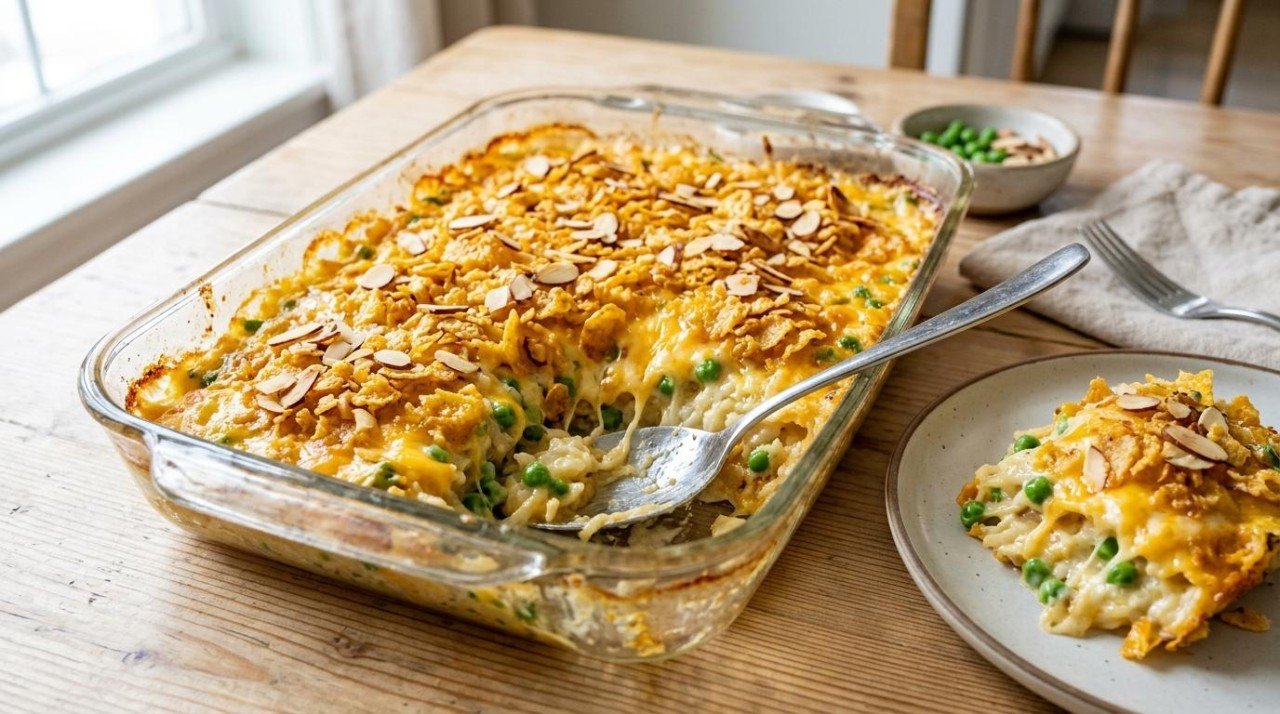
Funeral potatoes are the casserole that shows up whenever a community needs to feed people: after funerals, yes, but also at Easter, Thanksgiving, potlucks and every church supper in between. Shredded or diced potatoes get folded into a creamy, cheesy sauce, spread into a 9x13, buried under buttery cornflakes, and baked until bubbling. The dish is most closely tied to Utah and the Latter-day Saint Relief Society, whose members made it for post-funeral luncheons because cheap staples like condensed soup, cornflakes and potatoes made it quick to cook in big batches.
We ran a standard version through Eat Well Planner's Nutrition Score - the same number a visitor sees on any public recipe page. It came back 36 out of 100. The potatoes are not the problem. The problem is that the potatoes are almost the only thing in the dish that is not butter, cheese, sour cream or canned soup.
Then we rebuilt it to 88 out of 100. It is still creamy, still cheesy, still crunchy on top, and you can still make it the night before. Every swap below carries the exact score change it earned. One of them, cutting the cheese, was worth just 1 point on the original recipe and 19 points later in the chain. That gap is the most useful thing in this post.
The original: what's in it and how it scores
We scored the recipe from Spend With Pennies, a popular and typical version that serves eight:
- 1 bag (32 oz) frozen diced hash browns, thawed
- 4 tablespoons butter, with 1/2 onion softened in it
- 1 1/2 cups sour cream
- 2 cans (10.5 oz each) condensed cream of chicken soup
- 2 1/2 cups shredded cheddar
- 1 1/2 cups cornflakes tossed with 4 more tablespoons melted butter
Two notes on how we scored it. We counted the hash browns as plain raw potato, which is what a plain bag of frozen hash browns mostly is. And we did not score the soup as a single "condensed soup" entry. We rebuilt each can from Campbell's own nutrition label (120 calories, 8 g fat, 2 g saturated fat and 870 mg sodium per half cup, about 2.5 servings per can) using stock, starch, flour, oil, cream and salt, so the numbers stay tied to the real product.
Nutrition Score: 36/100. Per serving that is about 520 calories, 36.8 g total fat, 19.2 g saturated fat, 900 mg sodium, 1.9 g fiber and 13.7 g protein. Here is what drives it:
- Saturated fat, flagged very high - 19.2 g per serving, 82% of the daily value in one scoop of a side dish. Harvard Health puts the American Heart Association's suggested limit at 5% to 6% of calories, which is roughly 11 to 13 g a day on a 2,000-calorie diet. One serving is already past it. It comes from three places in close to equal parts: the stick of butter (about 7 g a serving), the cheddar (about 6.5 g) and the sour cream (about 5 g).
- Sodium, flagged - 900 mg, 39% of the daily value. The FDA notes that over 70% of the sodium Americans eat comes from packaged and prepared foods, and this recipe is a clean example: nobody adds a grain of salt, yet the two cans of soup carry well over half of it (about 520 mg a serving) and the cheddar about 225 mg more.
- Very little fiber - 1.9 g per serving, and only 3 plant points (Eat Well Planner's tally toward the 30-plants-a-week goal): potato, onion and corn.
What is already fine: potatoes are a real vegetable with real potassium (the original has 630 mg a serving), and the dish carries a decent 13.7 g of protein. The fortified cornflakes even make it an excellent source of iron. The base is sound. It is just buried.
The upgrades
Six swaps, applied cumulatively in this order. The first four take on the sodium and the saturated fat. The last two add the fiber and plants the dish never had.
1. Replace the two cans of soup with a 10-minute sauce
- Swap: 2 cans condensed cream of chicken soup → a quick sauce of 1/3 cup flour, 1 1/2 cups unsalted chicken stock, 1 cup 2% milk and 1/2 teaspoon salt
- Score impact: +5 points (36 → 41)
- What it changes: Sodium drops from 900 mg to 540 mg a serving, and the dish gains a little protein and calcium from the milk
- What it costs you: Ten minutes and a pot. The sauce tastes more like chicken and less like salt, and it holds the potatoes together just as well
Condensed cream soup is a thick, salty white sauce in a can, and this recipe uses two. Making your own is the same step most cooks already do: soften the onion, stir in flour, whisk in liquid until it thickens. Use unsalted stock, not just "low sodium," because that is where most of the saving comes from. The cream of mushroom soup substitutes guide uses the same method for any "cream of" casserole, and the chicken broth guide explains the stock labels.
Only +5 here, but put the cans back in the finished casserole and it costs 19 points (88 → 69).
2. Greek yogurt instead of sour cream
- Swap: 1 1/2 cups sour cream → 1 1/2 cups plain low-fat or nonfat Greek yogurt, stirred into the sauce off the heat
- Score impact: +2 points (41 → 43)
- What it changes: Saturated fat drops from 18.3 g to 13.8 g a serving, and protein goes up 3 g
- What it costs you: A bit more tang, which the cheese mostly covers. The real risk is curdling, and it is easy to avoid
Yogurt proteins clump when they are heated, which is what makes a yogurt sauce grainy. Ricardo's food chemistry guide gives two fixes that this recipe uses together: thicken with flour or starch before the yogurt goes in, and warm the yogurt slowly with a little of the hot sauce first. Our sauce from swap 1 already has the flour, and the recipe below has you temper the yogurt. More options are in the sour cream substitutes guide.
Only +2 at this point in the build. Put the sour cream back in the finished recipe and it costs 25 points (88 → 63), the most expensive put-back of all. Even half sour cream and half yogurt scored 76.
3. Trade the stick of butter for 3 tablespoons of oil
- Swap: 4 tbsp butter in the filling + 4 tbsp butter on the cornflakes → 2 tbsp canola oil for the onion and sauce + 1 tbsp canola oil on the topping
- Score impact: +7 points (43 → 50)
- What it changes: Saturated fat drops from 13.8 g to 7.7 g a serving and about 60 calories come off
- What it costs you: Some buttery flavor. In the filling you will not miss it under the cheese. On top, the cornflakes still toast golden and crisp with one tablespoon of oil, but they taste of toasted corn more than butter
A whole stick of butter is the single largest source of saturated fat in the original. Half of it is there to soften half an onion and the other half to coat a cup and a half of cereal, so both jobs work with far less fat. Canola also brings omega-3 ALA, which the score credits. See the butter substitutes guide for other options.
If the buttery topping is non-negotiable in your house, use 1 tablespoon of butter on the cornflakes instead of oil: the finished recipe scores 84 instead of 88. That is a perfectly reasonable trade. Putting all 8 tablespoons of butter back costs 16 points (88 → 72).
4. One cup of sharp cheddar instead of two and a half
- Swap: 2 1/2 cups (10 oz) cheddar → 1 cup (4 oz) sharp or extra-sharp cheddar, most stirred in and a little on top
- Score impact: +19 points (50 → 69)
- What it changes: Saturated fat drops from 7.7 g to 3.6 g a serving, sodium falls 140 mg, and about 85 calories come off
- What it costs you: Less stretch and less of a cheese pull. Not much less flavor, because sharp cheddar tastes much stronger than mild or medium
This is the swap that explains the whole makeover. On the original recipe, cutting the cheese this way scored +1. The butter and sour cream were still holding the saturated fat flag on, so removing 6 ounces of cheese barely registered. With those two fixed, the same cut is worth +19, and putting the full 2 1/2 cups back in the finished recipe costs 20 points (88 → 68). If you have ever made one "healthy" swap to a casserole and seen almost no difference, this is usually why: the swaps only pay off together.
Grate your own cheese from a block. It melts smoother than bagged shreds, which are coated in anti-caking starch, and that matters more when there is less of it. The cheddar cheese substitutes guide has other good melting cheeses.
5. Stir in two cups of peas
- Swap: Add 2 cups (about 10 oz) frozen peas, thawed
- Score impact: +17 points (69 → 86)
- What it changes: Fiber doubles (2.0 g → 4.1 g a serving), protein goes up 2 g, potassium and vitamin C go up, and the dish gains a plant point
- What it costs you: Green flecks in a beige casserole and little sweet pops of pea. Peas are already a common add-in, and they disappear into the sauce
This was the biggest single move on the original recipe too: peas alone took it from 36 to 45. If you only change one thing, change this. Fiber is what the original was missing most, and potatoes alone cannot supply it: a scoop of the original carries about 113 g of potato and 1.9 g of fiber. Two cups of peas spread across eight servings adds only about 1/4 cup per scoop, but that is enough to double it.
We tested broccoli instead (chopped small, same weight). It scored 84, two points under peas, and changes the dish more. Leaving the peas out of the finished recipe costs 13 points (88 → 75).
6. Add sliced almonds to the cornflakes
- Swap: Add 1/3 cup sliced almonds to the cornflake topping
- Score impact: +2 points (86 → 88)
- What it changes: A little more fiber (4.1 g → 4.5 g), protein and vitamin E, and another plant point
- What it costs you: About 25 calories a serving. In return, a second kind of crunch that toasts right along with the flakes
The cornflakes stay. They are the signature of the dish, and the fortified flakes are part of why the finished casserole is still an excellent source of iron. The almonds just make the topping better.
Take the Guesswork Out of Eating Well
Eat Well Planner helps you organize your favorite recipes, plan balanced meals, and automatically generate shopping lists — all in one place. Whether you're tracking macros, managing dietary restrictions, or just trying to stop asking "what's for dinner?", we've got you covered.
Our AI-powered tools can adapt any recipe to your dietary needs, help you discover new meals you'll love, and even log your nutrition effortlessly. It's meal planning made simple.
Start Organizing Your Meals — FreeWhat we kept (on purpose)
- The cornflakes. Whole wheat bread crumbs in their place scored exactly the same 88. The flakes are what make this dish funeral potatoes, and the score does not care, so they stay.
- All the potatoes. Swapping a quarter of them for cauliflower was +5 on the original but only +1 at the end (89). That matches what we found in our scalloped potatoes makeover: once the dish has real vegetables in it, cauliflower is not a magic trick. Use it if you like it.
- A full cup of real cheddar. 1 1/4 cups scored 84, four points less, and 1 cup of sharp cheddar is enough to taste in every bite.
- The salt. Leaving out the half teaspoon scored the same 88. Sodium would drop to 180 mg, but the potatoes taste flat without it, so we kept it.
- 2% milk. Skim scored 89, one point more, for a thinner sauce. Not worth it.
The healthier version: full recipe
Nutrition Score: 88/100. Serves 8 as a side. Prep 20 minutes, bake 45 to 50 minutes.
Ingredients
- 1 bag (32 oz) frozen diced or shredded hash browns, thawed (pick a bag of plain potatoes with no added oil or salt)
- 3 tablespoons canola oil, divided
- 1/2 medium yellow onion, finely chopped
- 1/3 cup all-purpose flour
- 1 1/2 cups unsalted chicken stock
- 1 cup 2% milk
- 1/2 teaspoon salt
- 1/2 teaspoon black pepper
- 1 1/2 cups plain low-fat or nonfat Greek yogurt
- 2 cups (about 10 oz) frozen peas, thawed
- 1 cup (4 oz) sharp or extra-sharp cheddar, freshly grated, divided
- 1 1/2 cups cornflakes, lightly crushed
- 1/3 cup sliced almonds
Instructions
- Heat the oven to 350°F and lightly oil a 9x13-inch baking dish. Spread the thawed hash browns on a towel and pat them dry so they do not water down the sauce.
- Heat 2 tablespoons of the oil in a large pot over medium heat. Add the onion and cook, stirring, until soft, about 5 minutes.
- Sprinkle in the flour and stir for 1 minute. Slowly whisk in the stock, then the milk. Simmer, whisking often, until the sauce is thick enough to coat a spoon, 4 to 5 minutes. Stir in the salt and pepper and take the pot off the heat.
- Let the sauce cool for 3 minutes. Put the yogurt in a bowl, whisk in a ladleful of the sauce, then stir the yogurt mixture back into the pot.
- Fold in the hash browns, peas and 3/4 cup of the cheddar. Spread the mixture in the baking dish and scatter the remaining cheddar on top.
- Toss the crushed cornflakes and almonds with the remaining 1 tablespoon oil and sprinkle them evenly over the casserole.
- Bake uncovered for 45 to 50 minutes, until the edges bubble and the topping is deep golden. Let it rest 10 minutes before serving.
Make ahead: Assemble through step 5, cover and refrigerate for up to a day. Add the topping right before baking, and give it 5 to 10 extra minutes in the oven since it starts cold.
Per serving: original vs. healthier
- Nutrition Score: 36 → 88
- Calories: 519 → 338
- Total fat: 36.8 g → 13.3 g
- Saturated fat: 19.2 g → 3.8 g
- Sodium: 900 mg → 320 mg
- Fiber: 1.9 g → 4.5 g
- Protein: 13.7 g → 15.8 g
- Potassium: 630 mg → 770 mg
- Plant points: 3 → 5
The finished casserole is an excellent source of vitamin B6 (46% DV), iron (44%), vitamin B12 (43%), omega-3 ALA (32%), vitamin C (25%) and potassium (23%), and a good source of fiber (15%) and vitamin E (14%). Neither saturated fat nor sodium is flagged as a caution anymore. The original was a better source of calcium (32% vs. 23% DV), which is simply what happens when you use 6 fewer ounces of cheese.
Swaps we tested and skipped
- Half sour cream, half yogurt. Scored 76. If you are nervous about yogurt, it is a fair middle ground, but the full swap is where the points are.
- Broccoli instead of peas. Scored 84. Fine, just two points behind peas and more of a change to the dish.
- Whole wheat crumbs instead of cornflakes. Scored 88, the same. With no gain, the traditional topping wins.
- A quarter of the potatoes swapped for cauliflower. Scored 89. One point for a softer texture.
- No salt at all. Scored 88, the same as with salt.
Make it fit other diets
- Gluten-free: Thicken the sauce with 3 tablespoons cornstarch whisked into the cold milk instead of the flour, and use cornflakes labeled gluten-free (many brands contain malt flavoring made from barley).
- Vegetarian: Use unsalted vegetable stock instead of chicken stock. Nothing else in the dish needs to change.
Eat Well Planner's Recipe Variations can rewrite this exact recipe for either one in a step, or you can ask the AI recipe chat for the specific swap you need.
Do this to any recipe
Everything above came from a workflow you can run on your own recipes. Import the version your family has made for decades from any website, Instagram reel or YouTube video, see its Nutrition Score, and tap Make It Healthier. The app suggests swaps like these and checks each gain with a calculator before showing it to you. Want to keep the full stick of butter on the cornflakes? Open the recipe in the Recipe Playground, see exactly what it costs, and make up the points somewhere else. If casseroles are your thing, the chicken broccoli rice casserole and green bean casserole makeovers follow the same approach.