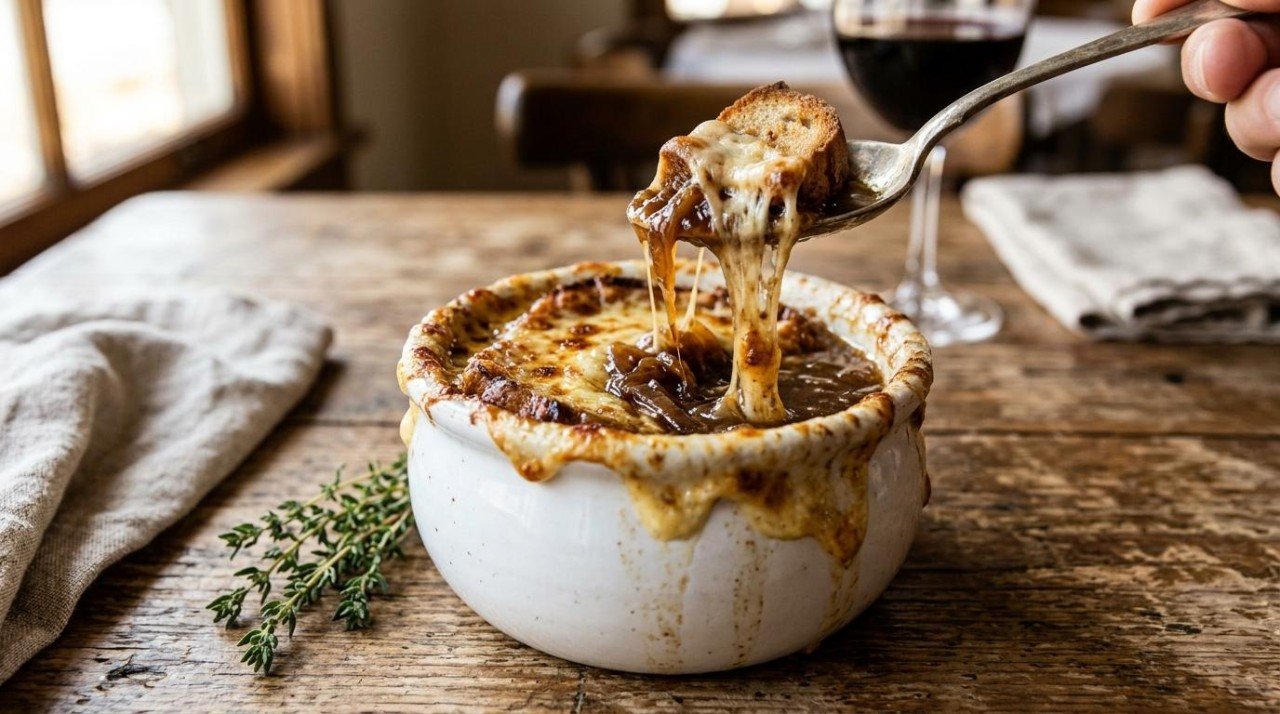
French onion soup is three pounds of onions cooked down until they are jammy and dark, a pot of beef broth, a splash of wine, and then the part everyone actually orders it for: a slab of toasted bread under a bubbling, browned cap of Gruyere that stretches all the way from the crock to your spoon. It is a bistro classic, a cold-weather staple, and one of the few soups people get excited about.
We ran a standard homemade version through Eat Well Planner's Nutrition Score - the same number a visitor sees on any public recipe page. It came back 47 out of 100. That is not a bad start. The onions are genuinely good food. The problem is that a single bowl carries 2,030 mg of sodium - 88% of a day - and most of it is in the broth.
We rebuilt it to 67 out of 100. Same deep brown onions, same toast, same Gruyere cap under the broiler. Every swap below carries the exact score change it earned in order. And here is the twist that makes this soup worth writing about: the swap every "healthy French onion soup" recipe tells you to make - unsalted broth - was worth minus one point when we made it first. The order you fix things in matters as much as what you fix.
The original: what's in it and how it scores
Here is the version we scored, serving six:
- 4 tablespoons butter
- 3 lb yellow onions, thinly sliced
- 1 teaspoon sugar and 1 teaspoon salt
- 2 tablespoons all-purpose flour
- 1/2 cup dry white wine
- 8 cups regular beef broth
- Fresh thyme and black pepper
- 6 thick slices of baguette, toasted (about 5 oz)
- 6 oz Gruyere and 1/4 cup Parmesan for the top
Nutrition Score: 47/100. Per bowl that is about 409 calories, 18.6 g protein, 5.0 g fiber, 19.3 g total fat, 10.8 g saturated fat and 2,030 mg sodium. Two flags hold it down:
- Sodium, flagged very high - 2,030 mg, 88% of the daily value in one bowl. Harvard's Nutrition Source notes that 2,300 mg a day is the maximum the National Academies list for chronic disease risk reduction, that that reducing sodium intake lowers blood pressure, and that soups are on the CDC's list of top sodium sources in the American diet. Here, roughly 58% of the bowl's sodium is the broth. A carton of regular beef broth is no small thing: Swanson's runs 830 mg per cup, and this pot holds eight cups of it. The teaspoon of salt adds another 19%, the cheese 12%, the baguette 7%.
- Saturated fat, flagged high - 10.8 g, 46% of a day. It comes from two places in about equal measure: the cheese cap (just over half) and the 4 tablespoons of butter used to cook the onions (about 40%).
Now what is already fine, and there is a lot of it. Onions are the backbone of this soup and they are a genuinely good backbone - a source of fructans and other prebiotic fibers. A 2024 study in mSystems found that onion extract increased butyrate-associated gut bacteria like Bifidobacterium and Faecalibacterium in fecal samples (a lab study, not a human trial, but a promising one). The original bowl is already an excellent source of phosphorus (51% DV), calcium (41%), iron (32%), thiamine (28%) and vitamin B6 (27%), with 5 g of fiber, nearly all of it from onions. Nobody needs to "fix" the onions. They are why the soup is worth keeping.
The upgrades
Six swaps, applied cumulatively in this order. The first four are about fat and fiber. The last two are about sodium, and they are saved for last on purpose - you will see why.
1. Toast whole wheat bread instead of baguette
- Swap: 6 thick slices of white baguette → 6 slices of 100% whole wheat bread (same 5 oz)
- Score impact: +3 points (47 → 50)
- What it changes: Fiber rises from 5.0 g to 6.0 g a bowl, a little sodium comes off, and you gain a plant point
- What it costs you: A slightly nuttier, denser raft. Once it is soaked in broth and buried under Gruyere, it is hard to tell
The toast in French onion soup exists to hold the cheese up and soak up the broth, and a sturdy whole wheat slice does both jobs at least as well as a baguette. Toast it until it is dry and crisp all the way through, so it softens in the broth instead of dissolving. Look for bread that lists whole wheat flour as the first ingredient - Harvard's Nutrition Source summarizes a meta-analysis of over 786,000 people in which 70 g of whole grains a day was linked to a 22% lower risk of death from all causes, compared with little or none.
2. Caramelize in 1 tablespoon of butter plus 2 tablespoons of canola
- Swap: 4 tablespoons butter → 1 tablespoon butter + 2 tablespoons canola oil
- Score impact: +3 points (50 → 53)
- What it changes: Saturated fat drops from 10.8 g to 8.0 g a bowl, and the oil adds plant omega-3s
- What it costs you: Very little. The onions brown the same way, and the one tablespoon of butter keeps that nutty, buttery note in the background
Three pounds of onions need fat to coat them, but they do not need it all to be butter. Most of the soup's flavor comes from the browning itself, and oil handles 45 minutes of slow cooking without the milk solids scorching. Harvard's Nutrition Source notes that replacing saturated fat with unsaturated fat lowers LDL cholesterol. We priced this at the end: the full 4 tablespoons of butter in the finished soup costs 15 points (67 → 52). Olive oil instead of canola works fine but scored 4 points lower (63), because canola carries more plant omega-3. Our butter substitution guide covers the other options.
3. Use 4 oz of Gruyere and skip the Parmesan
- Swap: 6 oz Gruyere + 1/4 cup Parmesan → 4 oz Gruyere, finely shredded
- Score impact: +1 point (53 → 54)
- What it changes: Saturated fat falls to 5.5 g a bowl, and about 55 calories come off
- What it costs you: A thinner cap - two-thirds of an ounce per bowl instead of a full ounce. Shred it fine and spread it to the edges, and it still melts into one browned sheet
Only one point here, and that is the score being cautious while sodium is still flagged very high. The real value shows up at the end: putting the full 6 oz of Gruyere and the Parmesan back into the finished soup costs 9 points (67 → 58). Gruyere has more flavor per ounce than almost any melting cheese, which is why less of it still tastes like French onion soup. Grating it finely matters more than the amount: fine shreds melt fast and cover the whole surface, while thick ones leave gaps. If you need to swap it out entirely, our Gruyere substitution guide ranks the alternatives for this exact soup. One honest cost: protein drops from 19.0 g to 14.6 g a bowl here, since the cheese was a big part of it.
4. Add a fourth pound of onions
- Swap: 3 lb onions → 4 lb onions
- Score impact: +2 points (54 → 56)
- What it changes: Fiber climbs to 7.4 g a bowl - up from 5.0 g in the original
- What it costs you: Nothing except 10 more minutes of slicing. The soup gets thicker and more onion-forward, which is the point
The easiest way to make this soup more nutritious is to make it more of what it already is. A fourth pound of onions cooks down to a surprisingly small pile, adds about 30 calories a bowl, and makes each spoonful more jammy. We also tested 8 oz of cremini mushrooms instead of the extra onions, and they scored the same, within a point. The onions keep it classic, so they won. (Want both? Mushrooms on top of the finished recipe score 70 - see the skipped swaps below.) If your onions are browning faster than they soften, our guide to cooking aromatics explains the heat and patience part.
5. Switch to unsalted beef broth
- Swap: 8 cups regular beef broth → 8 cups unsalted beef broth
- Score impact: +2 points (56 → 58)
- What it changes: Sodium falls from 1,840 mg to 690 mg a bowl - over 1,100 mg gone in one carton
- What it costs you: The broth tastes flat on its own. The caramelized onions, the wine, and the next step make up for it
This is the swap that teaches the lesson. Over 1,100 mg of sodium off every bowl, and the score moves only 2 points. When we made this swap first, on the untouched original, it scored minus one (47 → 46). The reason is thresholds: when saturated fat is still flagged and sodium is still sitting in a high band, the score cannot see the improvement yet. The regular broth in our data also carried a little niacin that the unsalted carton does not, which is why it can tip negative. But put regular broth back into the finished soup and it costs 11 points (67 → 56). Same carton, very different value, depending on what else has been fixed.
Read the label carefully. "Low sodium" is not low enough: Swanson's low-sodium beef broth still has 409 mg per cup. Built into the finished recipe, the low-sodium carton scored 55 - a point below even regular broth in our data, and 12 below unsalted. Look for "unsalted" or "no salt added." For more ways to build a deep, beefy base, see our beef broth substitution guide.
6. Halve the salt - and add a splash of vinegar
- Swap: 1 teaspoon salt → 1/2 teaspoon, plus 1 teaspoon sherry vinegar stirred in at the end
- Score impact: +9 points (58 → 67)
- What it changes: Sodium drops to 500 mg a bowl - 22% of the daily value, down from 88% in the original
- What it costs you: If you are used to restaurant French onion soup, this tastes a little less salty at first. The Gruyere and toast are salty enough to carry the bowl
Here is the payoff from saving sodium for last. Halving the salt on the original recipe was worth zero points (47 → 47). At this point in the build it is worth nine - the biggest single swap in the post, and it changes nothing you can see. The vinegar did not move the score (67 either way), but it is the cook's trick that makes a lower-salt soup taste finished: a little acid brightens the onions and wine the way extra salt would. Taste before you add it and after, and you will notice. Want to go further? Cutting the salt to 1/4 teaspoon scored 71. Putting the full teaspoon back costs 9 (58).
Add up the six swaps and you get +20 (3 + 3 + 1 + 2 + 2 + 9), exactly the distance from 47 to 67.
What we kept (on purpose)
The Gruyere cap stays, and it stays under the broiler. A tablespoon of butter stays for flavor. The white wine stays - it adds acidity and depth that the unsalted broth needs (our white wine substitution guide has alcohol-free options). The flour stays, too: two tablespoons give the broth body and carry B vitamins from enriched flour. And the slow caramelization stays, because no swap replaces it. Recipes love to say onions caramelize in 10 minutes; Slate tested this and found that even Julia Child's instructions call for 25 to 30 minutes of browning after the onions soften, and the writer recommends budgeting 45 to 50. That time is where the flavor comes from, and it is what lets this soup get away with less salt.
We stopped at 67 because the next moves would change the soup. The remaining flags are saturated fat (from the cheese and the one tablespoon of butter) and sodium (from the cheese and toast). Removing either one makes a different, less satisfying bowl.
Take the Guesswork Out of Eating Well
Eat Well Planner helps you organize your favorite recipes, plan balanced meals, and automatically generate shopping lists — all in one place. Whether you're tracking macros, managing dietary restrictions, or just trying to stop asking "what's for dinner?", we've got you covered.
Our AI-powered tools can adapt any recipe to your dietary needs, help you discover new meals you'll love, and even log your nutrition effortlessly. It's meal planning made simple.
Start Organizing Your Meals — FreeEvery number in this post came from the same tools inside Eat Well Planner. Import your own French onion soup recipe - from a website, a YouTube video, or an Instagram reel - and it gets a Nutrition Score instantly. Make It Healthier proposes swaps like these and verifies the real gain before showing them to you. The Recipe Playground lets you test them one at a time and watch the score move: put the Parmesan back, keep the baguette, and see exactly what it costs before you decide.
The healthier version: full recipe
Nutrition Score: 67/100 (up from 47). Serves 6. Prep 15 minutes, cook about 1 1/2 hours.
Ingredients
- 1 tablespoon butter
- 2 tablespoons canola oil
- 4 lb yellow onions (about 8 medium), halved and thinly sliced
- 1 teaspoon sugar
- 1/2 teaspoon salt, divided
- 2 tablespoons all-purpose flour
- 1/2 cup dry white wine
- 8 cups unsalted beef broth
- 4 to 5 sprigs fresh thyme
- 1/2 teaspoon black pepper
- 1 teaspoon sherry vinegar
- 6 slices 100% whole wheat bread (about 5 oz)
- 4 oz Gruyere, finely shredded (about 1 1/3 cups)
Instructions
- Heat the butter and canola oil in a large Dutch oven over medium heat. Add the onions and 1/4 teaspoon of the salt, toss to coat, cover, and cook for 10 minutes, until the onions wilt and release their liquid.
- Uncover, turn the heat to medium-low, and stir in the sugar. Cook for 45 to 60 minutes, stirring every few minutes, until the onions are deep brown and jammy. If the bottom of the pot starts to darken too fast, add a splash of water and scrape it up.
- Sprinkle the flour over the onions and stir for 1 minute. Pour in the wine and scrape up the browned bits from the bottom of the pot. Simmer for 2 minutes, until mostly reduced.
- Add the broth, thyme sprigs, pepper, and remaining 1/4 teaspoon salt. Bring to a boil, then reduce the heat and simmer for 25 minutes. Remove the thyme stems and stir in the sherry vinegar.
- Meanwhile, heat the broiler. Toast the bread slices on a baking sheet until dry and crisp on both sides, 1 to 2 minutes per side.
- Set 6 oven-safe bowls on a rimmed baking sheet and ladle in the soup. Top each with a slice of toast and about 2/3 oz of Gruyere, spreading the cheese to the edges. Broil for 2 to 4 minutes, until bubbling and browned in spots. Serve hot.
Per bowl: original vs. healthier
- Nutrition Score: 47 → 67
- Calories: 409 → 366
- Sodium: 2,030 mg → 500 mg
- Saturated fat: 10.8 g → 5.5 g
- Fiber: 5.0 g → 7.4 g
- Protein: 18.6 g → 17.1 g
- Gut health score: 47 → 66
- Heart health score: 44 → 64
The healthier bowl is an excellent source of phosphorus (47% DV), vitamin B6 (34%), plant omega-3 ALA (30%), calcium (29%), vitamin C (28%), iron (26%) and fiber (25%). Protein dips slightly because there is less cheese, and that is the one honest trade.
Swaps we tested and skipped
- Low-sodium broth instead of unsalted: 55, or 12 points below unsalted. The most common "healthy" swap, and it barely works.
- Skipping the bread: 62, or 5 points lower. The whole wheat toast carries fiber the score rewards, and the soup is not French onion without it.
- A can of white beans: 75, or 8 points higher, with 10 g of fiber and 21 g of protein a bowl (using no-salt-added beans, rinsed). We kept them out of the main recipe because they turn a clear, brothy soup into a bean soup. But if you want French onion soup as a full dinner, stir in a drained can with the broth. It is the biggest upgrade we found.
- 8 oz cremini mushrooms on top of the finished recipe: 70, or 3 points higher. A good add-in that deepens the savory flavor, but it is no longer quite the classic. Brown them separately before adding them so they don't steam.
- Only 3 oz of Gruyere: 70, or 3 points higher. Half an ounce per bowl no longer covers the top, so we stayed at 4 oz.
Make it fit other diets
- Vegetarian: Use unsalted vegetable or mushroom broth. A few dried porcini simmered in the broth replace some of the beefy depth (our vegetable broth guide has more ideas). We did not score this version.
- Gluten-free: Use gluten-free bread for the toast and thicken with 1 tablespoon of cornstarch slurry in place of the flour, or leave the flour out - the onions give the broth plenty of body.
- Dairy-free: Honestly, the cheese cap is the dish. Toast brushed with olive oil and a sprinkle of nutritional yeast is a decent substitute, but it is a different soup.
Eat Well Planner's Recipe Variations handles any of these in one step: ask for a vegetarian or gluten-free version of this exact recipe and get a full rewrite with the swaps already worked in, plus a new score.
Do this to any recipe
The lesson from this soup goes beyond French onion: the swap that matters most can look worthless if you make it too early. Unsalted broth scored -1 on the original and saved 11 points at the end. Halving the salt was worth zero on the original and nine at the end. If you only test one change at a time on an untouched recipe, you will throw away your best ideas. We used the same approach for French onion pasta and loaded baked potato soup - and the broth turned out to be the hidden lever both times.
Import a recipe you love, check its score, and let Make It Healthier find the swaps - with the gain verified before you ever change an ingredient.