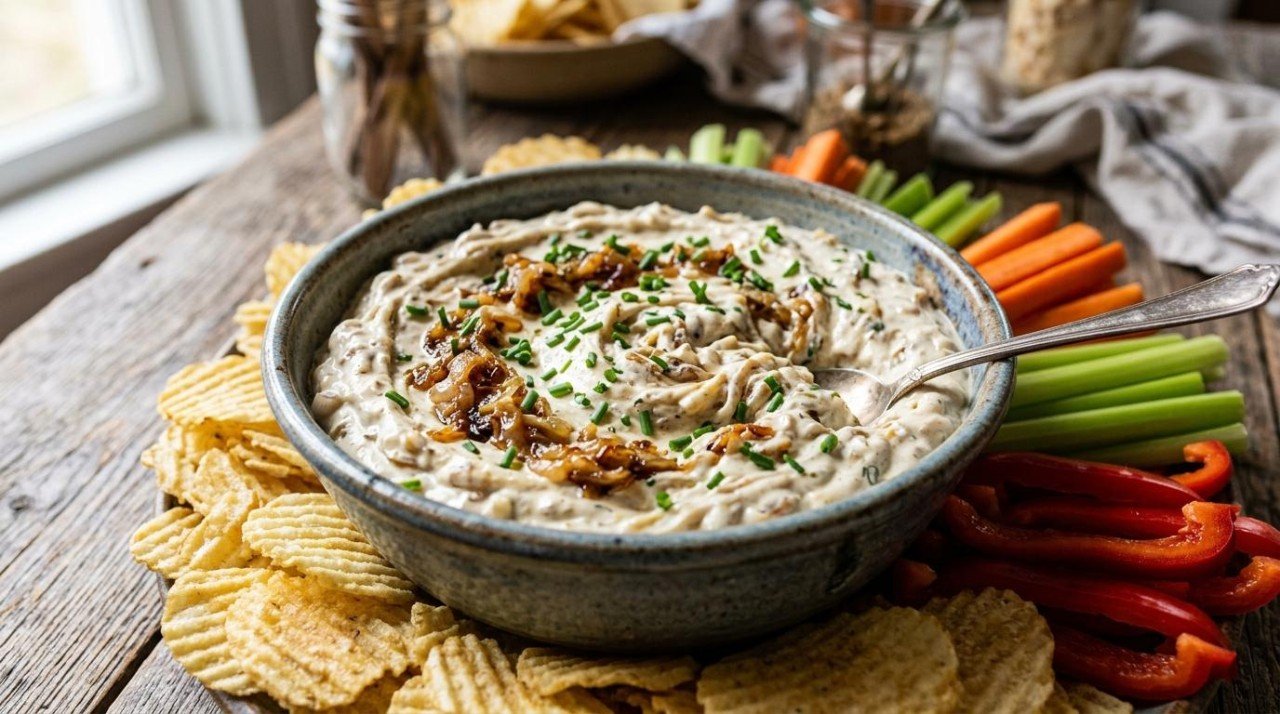
French onion dip has been the default party dip for about 70 years, and the recipe has barely changed: one envelope of onion soup mix stirred into a 16-ounce tub of sour cream, with a bag of ruffled potato chips on the side. It takes two minutes, everyone eats it, and the bowl is always empty first.
We ran that classic packet dip through our Nutrition Score and it came back at 26 out of 100. Then we rebuilt it one swap at a time, with real caramelized onions doing the work the packet used to do, and it finished at 92. It is still cold, creamy, savory and sweet-oniony, and it still has sour cream in it.
We also scored what actually ends up in your mouth at a party: a chip or a carrot stick with dip on it. That turned out to be the most interesting part, so stick around for it.
The original: what is in it and how it scores
The dip goes by two names because of where it came from. As Wikipedia tells it, an unknown cook in Los Angeles came up with it in 1954, it ran in a local paper, and it spread fast. Lipton promoted it on television in 1955 as "California Dip" and put the recipe on its onion soup package in 1958. The "French onion" name, borrowed from the soup, took over in the 1960s.
The version we scored is the one on the box:
- 16 oz sour cream
- 1 envelope onion soup and dip mix
The label on a current box of Lipton Recipe Secrets Onion Soup and Dip Mix lists 8 servings of 7 g per box, with 690 mg of sodium each. A box holds two envelopes, so one envelope carries roughly 2,760 mg of sodium. We modeled it as that much salt plus dehydrated onion, onion powder, cornstarch and a little sugar, which matches the label's calories and carbs. (The real mix also contains hydrolyzed soy protein, MSG, yeast extract and a few flavor enhancers, which add savoriness but almost no nutrition.) The batch makes about 2 cups, or 16 servings of 2 tablespoons.
Per 2-tablespoon serving that is about 60 calories, 5.1 g of fat, 3.0 g of saturated fat, 190 mg of sodium, 1 g of protein and essentially no fiber.
What holds it at 26:
- Saturated fat is nearly half the calories. Sour cream is cultured cream, and 3 g of saturated fat in a 60-calorie bite is a lot. That is 15% of a day's limit in two tablespoons, before anyone goes back for seconds.
- The packet is the sodium. More than 90% of the dip's sodium comes from that one envelope. The FDA's daily limit is 2,300 mg, Americans average about 3,400, and the FDA says over 70% of it comes from packaged and prepared foods. A dip mix is about as packaged as an ingredient gets.
- The onion is barely there. About 15 grams of dried onion and onion powder flavor 2 cups of sour cream. It tastes like onion, but there is not much onion in it.
What is already fine: it is not a sugar bomb, and sour cream brings a little riboflavin and vitamin A. The problems are the fat in the base and the salt in the packet, and both can be fixed without losing the dip.
The upgrades: five changes, 66 points
Each swap was scored on top of the ones before it, in the order shown, so the deltas add up to the real total. Where a swap was worth something different on the untouched original, we say so, because the difference turned out to be the story of this dip.
1. Make Greek yogurt most of the base
- Swap: 2 cups sour cream to 1 1/2 cups plain nonfat Greek yogurt and 1/2 cup sour cream
- Score impact: +14 points (26 to 40)
- What it changes: Calories per serving 60 to 31, saturated fat 3.0 g to 0.8 g, protein 1.0 g to 2.5 g
- What it costs you: More tang. With a quarter of the base still sour cream, it reads as onion dip, not as yogurt
Greek yogurt is thick enough to hold a chip, and its tang is close to sour cream's, since both are cultured dairy. The 1/2 cup of sour cream is there on purpose: it rounds off the yogurt's sharper edge and gives the dip its rich, coating feel. Our sour cream substitution guide and Greek yogurt guide go deeper on the swap.
We tested the full ratio ladder on the finished recipe, and 3 parts yogurt to 1 part sour cream is where we stopped. More on that in "What we kept."
2. Replace the packet's onion with real caramelized onions
- Swap: Dried onion, onion powder, cornstarch and sugar to 3 large yellow onions caramelized in 1 tablespoon of canola oil, plus 1 teaspoon Worcestershire sauce, 1/2 teaspoon garlic powder and black pepper (salt kept at the packet's level for now)
- Score impact: +18 points (40 to 58; +19 on the untouched original)
- What it changes: Fiber per serving goes from 0.1 g to 0.7 g, potassium rises, and 1 3/4 pounds of real onion goes into the bowl
- What it costs you: About 45 minutes at the stove. The flavor goes from salty-oniony to deep, sweet and savory, which is a trade almost nobody regrets
This is the step that makes it a different dip. Three large onions (about 1 3/4 pounds) cook down to roughly a cup of soft, jammy, brown onions that run through every bite. The Worcestershire sauce brings back some of the savory depth the packet got from MSG and yeast extract. Our Worcestershire guide has options if you are out.
Use all three onions. Two onions scored 7 points lower in the finished recipe; the onions are where the fiber and potassium come from. And use a neutral oil, not butter. Butter is what most scratch recipes call for, and it was the single most expensive choice we tested: caramelizing in 1 tablespoon of butter instead of canola took the finished dip from 92 to 66. Olive oil landed in between at 87. The dip is so lean by the end that one tablespoon of fat changes a lot. For the method, our aromatics guide covers why caramelizing is slow and why that is fine.
3. Cut the salt to 1/4 teaspoon
- Swap: About 2,760 mg of packet sodium (roughly 1 1/4 teaspoons of salt) to 1/4 teaspoon of salt
- Score impact: +17 points (58 to 75; +1 on the untouched original)
- What it changes: Sodium per serving 130 mg to 40 mg, and "High Sodium" drops off the weaknesses list
- What it costs you: Less than you would think. Sweet caramelized onions and Worcestershire do a lot of the seasoning
Look at those two numbers. On the original, cutting the salt was worth 1 point, because the saturated fat in all that sour cream was holding the score down no matter what happened to the sodium. Once the base and the onions were fixed, the same cut was worth 17 points, almost the biggest step in the build. We have seen this in almost every makeover we have scored: the salt cut does the most when it comes last.
We also scored 1/2 teaspoon in the finished recipe: 78 instead of 92. If your dip tastes flat after a night in the fridge, add salt a pinch at a time and taste as you go. A little more is a fair trade; just know that salt is the most expensive thing in this bowl.
4. Use light sour cream for the 1/2 cup that stays
- Swap: 1/2 cup regular sour cream to 1/2 cup light sour cream
- Score impact: +14 points (75 to 89), about 9 of which are real (see below)
- What it changes: Saturated fat per serving 0.6 g to 0.4 g
- What it costs you: Very little. Inside a yogurt-and-onion dip, nobody can pick out which sour cream you used
Read the label before you buy one. Some light sour creams get their body back with starches and gums, but the better ones are just cultured cream and skim milk (Daisy Light is one). That kind is simply sour cream with less fat, which is the whole point.
Now the honest part. Part of this jump is a quirk of how the score works. The catalog's regular sour cream carries a trace of EPA and DHA omega-3, and the score grades a trace amount as "low" while it skips nutrients that are not there at all. Light sour cream has none, so a "Low Omega-3" weakness quietly disappeared. When we added the same trace back to the light version, it scored 9 points above the regular one instead of 15. So the real gain from this swap is about 9 points, and the finished dip would score about 85 without the quirk. We are still making the swap, because the saturated fat cut is real. We just do not want to take credit for points we did not earn.
5. A big handful of fresh chives
- Swap: Add 1/3 cup finely chopped fresh chives
- Score impact: +3 points (89 to 92; +3 on the untouched original)
- What it changes: One more plant in the bowl
- What it costs you: Two minutes with a knife. You get a fresh, sharp onion note on top of the sweet cooked one
Chives are the classic garnish for this dip for a reason: the cooked onions are mellow, and the chives remind you it is an onion dip. Stir most of them in and scatter the rest on top. Our green onion guide works here too if your store is out of chives.
Take the Guesswork Out of Eating Well
Eat Well Planner helps you organize your favorite recipes, plan balanced meals, and automatically generate shopping lists — all in one place. Whether you're tracking macros, managing dietary restrictions, or just trying to stop asking "what's for dinner?", we've got you covered.
Our AI-powered tools can adapt any recipe to your dietary needs, help you discover new meals you'll love, and even log your nutrition effortlessly. It's meal planning made simple.
Start Organizing Your Meals — FreeWhat we kept (on purpose)
The sour cream. We tested the base at every ratio in the finished recipe:
- All light sour cream: 61
- Half Greek yogurt, half light sour cream: 75
- 3 parts yogurt, 1 part light sour cream (ours): 92
- All Greek yogurt: 94
The jump from half-and-half to 3:1 is big, and the last step is tiny. Going all-yogurt buys 2 points and loses the mellow richness that makes people call it onion dip and not "that yogurt thing." The 1/2 cup of sour cream earns its place.
The Worcestershire sauce. Taking it out did not change the score at all (92 either way), and it is the most important seasoning in the bowl after the onions.
The potato chips, if you want them. That is what the next section is about.
The real test: score the plate
Nobody eats onion dip with a spoon. So we scored 1 ounce of potato chips (about 15 chips) and 1 cup of crudites (carrot, celery, cucumber and red bell pepper), each with nothing, with 2 tablespoons of the packet dip, and with 2 tablespoons of ours.
- Chips alone: 48 (149 calories)
- Chips with packet dip: 33 (209 calories, 330 mg sodium, 4.0 g saturated fat)
- Chips with our dip: 59 (183 calories, 180 mg sodium, 1.3 g saturated fat)
- Vegetables alone: 87 (55 calories)
- Vegetables with packet dip: 54 (115 calories, 270 mg sodium)
- Vegetables with our dip: 93 (89 calories, 120 mg sodium)
- Double-dipped, 4 tbsp packet dip on the vegetables: 53
- Double-dipped, 4 tbsp of our dip on the vegetables: 94
The packet dip pulls down everything it touches: 15 points off the chips and 33 off the vegetables. Ours does the opposite. It raises the chips' score by 11 and nudges the vegetable plate up, mostly because it adds protein without adding much fat or salt. Double-dipping barely matters with the new version.
So if you are keeping the chips, this dip still helps. Putting out a tray of vegetables next to the chips helps more, and with this dip the vegetables actually get eaten. (We would have scored baked chips too, but our ingredient catalog does not have a separate entry for them, so we cannot give you a verified number.)
The healthier version: full recipe
Nutrition Score: 92 (up from 26). Makes about 3 cups, or 24 servings of 2 tablespoons. It keeps in the fridge for 4 days and tastes better on day two.
- 3 large yellow onions (about 1 3/4 lb), halved and thinly sliced
- 1 tablespoon canola oil
- 1/4 teaspoon salt, divided
- 1 teaspoon Worcestershire sauce
- 1 1/2 cups plain nonfat Greek yogurt
- 1/2 cup light sour cream
- 1/2 teaspoon garlic powder
- 1/4 teaspoon ground black pepper
- 1/3 cup finely chopped fresh chives
- Water, for deglazing
- Heat the oil in a large skillet over medium heat. Add the onions and a pinch of the salt and stir to coat. Cook, stirring every few minutes, until they soften and start to color, about 10 minutes.
- Lower the heat to medium-low and keep cooking, stirring more often as they darken, until the onions are deep golden brown and jammy, 30 to 40 minutes more. When brown bits stick to the pan, add a tablespoon of water and scrape them up. Repeat as needed.
- Stir in the Worcestershire sauce and cook 1 minute more. Transfer the onions to a cutting board, let them cool for 10 minutes, then chop them finely.
- In a medium bowl, whisk the Greek yogurt, light sour cream, garlic powder, pepper and the rest of the salt until smooth.
- Fold in the cooled onions and most of the chives. Cover and refrigerate for at least 1 hour so the flavors come together.
- Stir, taste, and adjust with a pinch more salt or pepper if needed. Scatter the remaining chives on top and serve cold with vegetables, chips or crackers.
Per 2-tablespoon serving, original vs. healthier:
- Nutrition Score: 26 vs. 92
- Calories: 60 vs. 34
- Fat: 5.1 g vs. 1.1 g
- Saturated fat: 3.0 g vs. 0.4 g
- Sodium: 190 mg vs. 40 mg
- Protein: 1.0 g vs. 1.9 g
- Fiber: 0.1 g vs. 0.7 g
We scored it with nonfat Greek yogurt. A 2% Greek yogurt will make it richer and should land somewhat lower. The onions can be caramelized up to 3 days ahead and kept in the fridge, which turns this into a five-minute dip on party day.
Swaps we tested and skipped
- The packet stirred into Greek yogurt (57). The popular shortcut, and a real improvement if you are keeping the packet. It fixes the fat but keeps every milligram of the packet's sodium, and there is still almost no onion in it. With our 3:1 yogurt and sour cream base, the packet version scored 40.
- Caramelizing in butter (66). The classic method, and 26 points below ours. One tablespoon of butter brings back the saturated fat flag the rest of the build worked to clear.
- All Greek yogurt (94). Covered above. Two points is not worth losing the sour cream's richness.
- Light sour cream as the whole base (61). It sounds like the easy fix, but it still carries far more saturated fat than yogurt and less protein. It does better as a supporting player.
Make it fit other diets
- Dairy-free or vegan: Use an unsweetened plain Greek-style coconut or almond yogurt and a plant-based sour cream. Traditional Worcestershire contains anchovies, so pick a vegan one. Check the yogurt label for added sugar.
- Gluten-free: The dip has no flour, but check your Worcestershire label, since some brands use malt vinegar. Serve it with vegetables or gluten-free crackers.
Or skip the label reading: Eat Well Planner's Recipe Variations rewrites any recipe for a diet in one step with the swaps already worked in, and the AI recipe chat can answer the "can I use this instead?" questions with the recipe right in front of it.
Do this to any recipe
Every number in this post came from the same tools you get in the app. Import a recipe from any website, Instagram reel or YouTube video, and it gets a Nutrition Score. Tap Make It Healthier and it proposes swaps like these, each one checked by a calculator before you see it. Want to keep the full cup of sour cream, or the butter in the onions? Open the recipe in the Playground, watch what each change costs, and make it up somewhere else.
If the bowl is going to be empty either way, it might as well be full of onions. The game-day spread has more where this came from, including a seven-layer dip and a queso that both went through the same process.