Every "healthy fries" article on the internet opens by telling you the fryer is the problem, hands you a tray of pale, leathery potato sticks, and calls it a win. Fries are salt, fat, crunch, and steam, and they have been winning that argument since the 1800s.
So we built a standard batch of homemade deep-fried fries in Eat Well Planner and ran it through the app's Nutrition Score. It came back at 55 out of 100, with exactly one caution flag. Then we rebuilt them one verified swap at a time and got to 93, with no flags at all - and they still shatter when you bite them.
The surprise was where the points were. Turning off the deep fryer, the change every article leads with, was worth 7 points. Cutting the salt was worth 20. And swapping the ketchup for a two-minute yogurt dip was worth 12 - almost twice what the fryer was worth.
The original: what's in it and how it scores
Classic homemade fries: 2 pounds (908 g) of russet potatoes, peeled, cut into batons, soaked, dried, fried twice in neutral oil, and salted the moment they come out - about a teaspoon (6 g) over a batch that serves four. Since you eat what the potatoes absorb rather than the pot of oil, we modeled the absorbed oil at about 1/3 cup (73 g), which lands the finished fries near the fat density USDA reports for restaurant french fries: 14.7 g of fat and 312 calories per 100 g (USDA FoodData Central). One note in the original's favor - it is peeled, but the russet entry in our data includes the skin either way, so if anything the 55 is generous.
Nutrition Score: 55/100. Per serving: 344 calories, 4.9 g protein, 2.9 g fiber, 18.4 g total fat, 2.5 g saturated fat, 590 mg sodium, 950 mg potassium, and zero added sugar. One caution: sodium, at 26% of a day's reference. Plant points: 1.
A lot of what is in that bowl is genuinely fine, and we are not going to manufacture problems. Fries are potatoes and oil - nothing ultra-processed, no added sugar. A serving is an excellent source of vitamin B6 (60% of a day's reference), potassium (28%), biotin (26%), and iron (25%), and a good source of thiamine, niacin, magnesium, and vitamin C. Saturated fat is a modest 2.5 g. This is not junk. It is a vegetable cooked badly.
Three things hold it down. Sodium first: 590 mg in a side dish is 26% of the 2,300 mg daily reference, and the FDA calls 20% DV or more per serving high. Then the oil - 18.4 g of fat a serving, enough omega-6 to trip the app's fatty-acid balance flag. And the plate is one plant repeated: a single plant point, no herbs, no color.
Two comparisons before we start. The bag of frozen fries in your freezer scores 37, eighteen points below the ones you fry yourself, with two caution flags instead of one - the par-frying oil and most of the salt are already in them. And Harvard's Nutrition Source, summarizing the observational research, notes that one daily serving of french fries tracked with an average weight gain of 3.75 pounds, against 0.66 pounds for baked, boiled, or mashed potatoes. The potato is not the variable. The preparation is.
The upgrades
We applied these in order and re-scored after each one, so every number is what that change is worth at that point in the build. The order matters here more than usual - hold on for the second swap.
1. Turn off the deep fryer: oven or air fryer, one tablespoon of oil
- Swap: About 1/3 cup of absorbed frying oil → 1 tablespoon (14 g) tossed through the whole batch, roasted at 450F or air-fried at 400F
- Score impact: +7 points (55 to 62)
- What it changes: Calories from 344 to 211 per serving, total fat from 18.4 g to 3.7 g, saturated fat from 2.5 g to 0.5 g
- What it costs you: Some of the glassy, shattering crust. The technique below buys most of it back, not all of it.
Seven points, for a change that strips 133 calories and three-quarters of the fat out of every serving. The reason is worth understanding: the Nutrition Score is mostly about nutrient density, and the frying oil was contributing things it gets credit for - ALA omega-3, vitamin E, vitamin K - which leave with it. The calorie and fat drop is real and it matters to you; it just does not move a density score much on its own. That last part is the whole trick, and the next swap explains it.
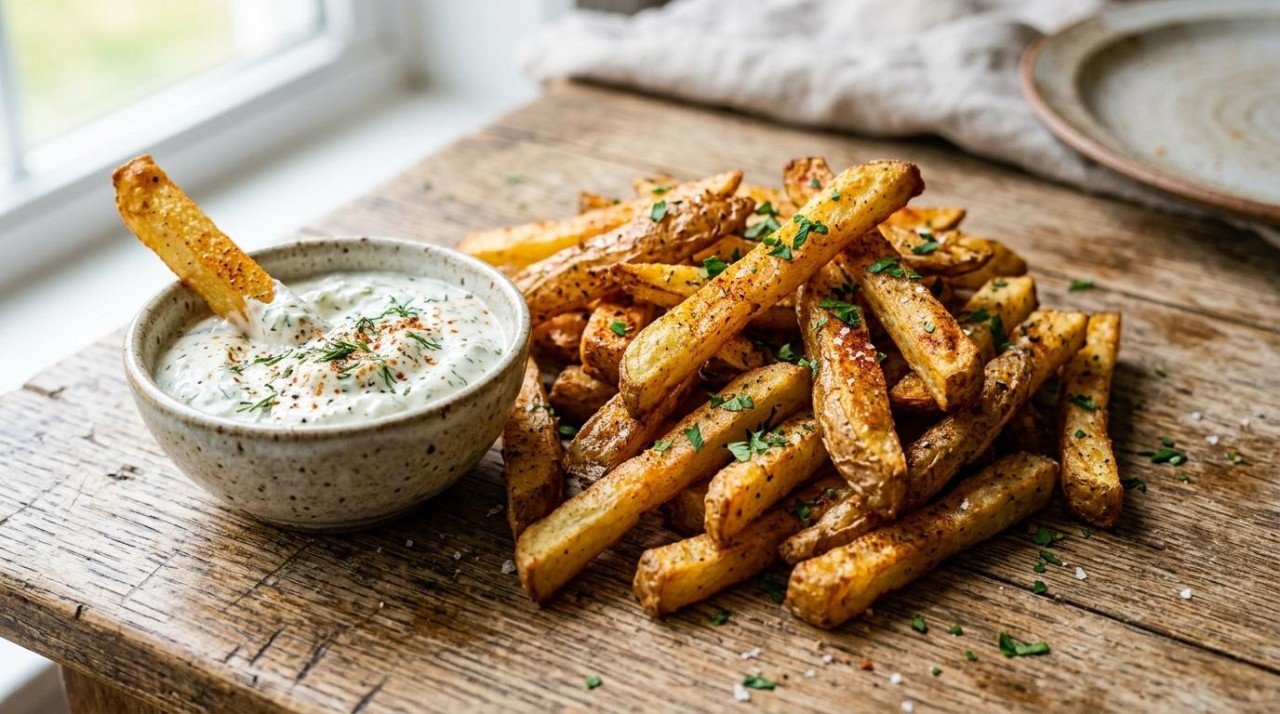
The technique is what makes or breaks this. Cut half-inch batons - America's Test Kitchen found shoestrings too fragile and thick-cut fries never lost the heavy texture of a baked potato - and roast at 450F on the lowest rack, on a sheet you preheated. Then dust the dried potatoes with cornstarch before the oil goes on. That is ATK's move too, and it is the best crispness trick a home oven has: the starch dries into a brittle shell that stands in for what a second fry does.
One bonus the score cannot see. The FDA notes that frying causes the highest acrylamide formation in potatoes and roasting causes less, and that soaking raw cut potatoes for 15 to 30 minutes first reduces it further. We soak anyway, for crispness. Same step.
2. Cut the salt by two-thirds, and give the spice rack the job
- Swap: 1 teaspoon (6 g) salt → 1/3 teaspoon (2 g), plus 2 teaspoons smoked paprika, 1 1/4 teaspoons garlic powder, and 1/2 teaspoon black pepper
- Score impact: +23 points (62 to 85) - +20 for the salt cut, +3 for the spices on top
- What it changes: Sodium from 590 mg to 210 mg per serving (26% to 9% of a day's reference). The caution clears, and so does every flagged weakness
- What it costs you: Less than you think, and only for about a week
Twenty points for taking two-thirds of a teaspoon of salt out of a batch that feeds four. Nobody writes that headline. Now the part that makes the order matter - we scored each of the first two swaps alone:
- Stop deep-frying, keep the salt: 55 → 62 (+7)
- Keep deep-frying, cut the salt: 55 → 64 (+9)
- Do both: 55 → 82 (+27)
Each on its own is worth single digits, because whichever flag you leave standing keeps a ceiling over the score. Remove both and you get 11 points more than the parts add up to - which is worth knowing about your own cooking: fixing one problem in a dish and being underwhelmed usually means there were two. Salt is unforgiving in the other direction too. A middle setting of 3 g instead of 2 g - half a teaspoon instead of a third - drops the score from 85 to 79. Six points for one gram across four servings.
The smoked paprika and garlic powder are not a moral substitute for salt, they are a practical one: they give your palate something to do while your salt threshold resets, which takes a couple of weeks. That is not hand-waving. In the SPICE randomized trial, adults coached to cook with spices and herbs cut their measured sodium excretion by 957 mg a day against people cutting salt on their own.
3. A fistful of fresh herbs at the end
- Swap: Nothing → 1 tablespoon chopped fresh rosemary in with the oil, 1/4 cup chopped fresh parsley tossed through the hot fries
- Score impact: +4 points (85 to 89)
- What it changes: Vitamin K from nowhere to 73% of a day's reference, vitamin C to 20%, iron from 29% to 33%, plant points from 1.75 to 2.25
- What it costs you: A dollar and thirty seconds.
Best value in the post per unit of effort, and it is pure addition - nothing is taken away. Rosemary goes on before roasting because it needs heat to bloom; parsley goes on after, off the heat, or it turns to green dust.
4. Change what you dip them in
- Swap: Ketchup → 1 cup plain nonfat Greek yogurt with grated garlic, lemon juice, and fresh dill
- Score impact: +5 points (89 to 94)
- What it changes: Protein from 5.4 g to 11.7 g per serving, calcium and vitamin B12 onto the highlights list for the first time, plant points to 2.75
- What it costs you: Ketchup. Which, for some people, is not nothing.
Here is the number that reframes the dish. We scored the finished recipe both ways - once with the dip, once with 1/4 cup of ketchup shared between four. With the dip: 93. With the ketchup: 81. What you dip them in is a twelve-point decision, and the ketchup is the only thing in this whole makeover that puts added sugar back on the plate.
The dip takes two minutes and no cooking, and it is thick enough to cling and sharp enough to cut the starch - which is the job ketchup was actually doing. Our Greek yogurt and fresh dill substitution guides cover it if you want to swap parts of it.
Take the Guesswork Out of Eating Well
Eat Well Planner helps you organize your favorite recipes, plan balanced meals, and automatically generate shopping lists — all in one place. Whether you're tracking macros, managing dietary restrictions, or just trying to stop asking "what's for dinner?", we've got you covered.
Our AI-powered tools can adapt any recipe to your dietary needs, help you discover new meals you'll love, and even log your nutrition effortlessly. It's meal planning made simple.
Start Organizing Your Meals — FreeWhat we kept (on purpose)
The skin. This is the one upgrade we cannot show you a score delta for - our russet data includes the skin either way, so the app scores peeled and unpeeled identically. The USDA numbers do not: 100 g of baked potato with the skin carries 2.2 g of fiber and 535 mg of potassium, against 1.5 g and 391 mg for the flesh alone. Harvard puts it plainly - most of a potato's fiber comes from the peel. It also crisps better than the flesh does.
The tablespoon of oil. We tested removing it, because plenty of recipes claim you can. Zero oil scored 91 - two points below one tablespoon - and added two flagged weaknesses, low omega-3 and low vitamin E, because that tablespoon was the only fat carrying them. It also gives you papery fries. One tablespoon is right in both directions: two tablespoons scores 90 and brings back the omega-6 flag the deep-fried original had.
One point spent on crunch. The 2 tablespoons of cornstarch take the score from 94 to 93 - the entire price of the crispest thing you can do to an oven fry, and we paid it without hesitating. Our cornstarch substitutes guide covers what to use if you are out; potato starch and rice flour both work here.
Where we stopped. The next obvious move is bulking the basket out with other vegetables, and that is where it stops being french fries. A dish that needs a disclaimer is a failed makeover.
The healthier version: full recipe
Nutrition Score: 93/100. No caution flags, no flagged weaknesses. Serves 4.
For the fries
- 2 lb (908 g) russet potatoes, scrubbed, skins on
- 1 tablespoon (14 g) vegetable or canola oil
- 2 tablespoons (16 g) cornstarch
- 2 teaspoons (5 g) smoked paprika
- 1 1/4 teaspoons (4 g) garlic powder
- 1/2 teaspoon (1 g) freshly ground black pepper
- 1/3 teaspoon (2 g) fine salt
- 1 tablespoon (4 g) finely chopped fresh rosemary
- 1/4 cup (15 g) chopped fresh flat-leaf parsley
For the garlic-dill dip
- 1 cup (240 g) plain nonfat Greek yogurt
- 2 cloves (6 g) garlic, grated
- 1 tablespoon (15 g) lemon juice
- 2 tablespoons (6 g) chopped fresh dill
- Heat the oven to 450F with a heavy rimmed baking sheet on the lowest rack. Scrub the potatoes but do not peel them, and cut them into 1/2-inch batons.
- Soak the cut fries in cold water for 20 minutes. Drain, spread on a clean towel, and blot completely dry - wet potatoes steam instead of crisping, and they spit on a hot pan.
- Toss the dry fries with the oil until every surface is slick. Combine the cornstarch, smoked paprika, garlic powder, pepper, salt, and rosemary, scatter it over, and toss until the coating is even and barely dusty.
- Spread the fries in a single layer on the preheated sheet. Roast 25 to 35 minutes, turning once at about 20 minutes, until golden yellow and crisp. Stop at golden - browned edges taste bitter and, per the FDA, carry more acrylamide. If your sheet is not nonstick or well seasoned, use parchment and trade a little crust for not losing half the batch to the pan.
- Air fryer version: 400F for 18 to 22 minutes, shaking the basket twice, in two batches so nothing overlaps. Same score, less time, marginally better crust.
- While they roast, stir together the yogurt, grated garlic, lemon juice, and dill, and grind in some black pepper. Chill until the fries are ready.
- Tip the hot fries into a bowl, toss with the parsley, and serve immediately with the dip. Fries wait for nobody.
Per serving, original versus improved:
- Nutrition Score: 55 → 93
- Calories: 344 → 275
- Protein: 4.9 g → 11.7 g
- Fiber: 2.9 g → 3.9 g
- Total fat: 18.4 g → 4.2 g
- Saturated fat: 2.5 g → 0.7 g
- Sodium: 590 mg (26% DV) → 230 mg (10% DV)
- Potassium: 950 mg → 1,120 mg
- Plant points: 1 → 2.75
The finished plate is an excellent source of vitamin K (73% of a day's reference), vitamin B6 (68%), phosphorus (35%), iron (35%), potassium (33%), biotin (27%), vitamin B12 (25%), and vitamin C (24%), and a good source of protein, fiber, calcium, magnesium, and folate. Read that potassium number next to the sodium one, since the two work against each other - this version improves both ends at once.
Swaps we tested and skipped
- Olive oil instead of neutral oil - 81, four points worse. The most-recommended swap in every healthy-fries article, and at this volume it backfires: one tablespoon across four servings brings so little ALA that the app flags low omega-3, which the vegetable oil was quietly covering. Canola scored exactly the same 85 as vegetable oil; avocado oil scored 79. Our vegetable oil and olive oil guides cover where each earns its place, and 450F roasting is not it.
- Sweet potato fries - 85, exactly the same score. Swapping every gram of russet for sweet potato did not move the number at all. Sweet potatoes bring more fiber (6.7 g against 3.5 g per serving at that stage) and a lot of beta-carotene; russets bring more protein, B6, and iron. They trade. Sweet potato fries are a different dish, not a healthier one - and harder to crisp, since they hold more sugar and less starch.
- No oil at all - 91. Two points down, two new flagged weaknesses, and fries you will not finish.
- Maximum-crunch oven fries - 73. The crispest oven-fry recipes preheat the pan with 5 tablespoons of oil and toss the potatoes in a sixth. Our finished version scored with that much oil: 73, twenty points below the one-tablespoon build, at 428 calories a serving. A genuinely better crust. Not a better fry.
- Everything right, still deep-fried - 76. Skin on, low salt, spices, herbs, yogurt dip, back in the fryer. Eighteen points below the same fries roasted - but still a 21-point gain on where we started, if you love your fryer and are not giving it up.
Make it fit other diets
The fries are already vegan, gluten-free, and dairy-free; only the dip needs changing. For dairy-free or vegan, unsweetened plain coconut or cashew yogurt with the same garlic, lemon, and dill works, though it gives up the protein and calcium that earned those five points - a tahini-lemon sauce thinned with water keeps some of both. Hand either to Recipe Variations in the app and the whole recipe gets rewritten in one step, quantities adjusted, instead of you doing the arithmetic.
Do this to any recipe you cook
None of these numbers were guesses. Every score came from the same Nutrition Score that runs on any recipe you save in Eat Well Planner, and the per-swap deltas came from the Recipe Playground, where you change one ingredient and watch the score move before committing to anything.
That is the loop: import a recipe from a website, an Instagram reel, or a YouTube video, look at what the score flags, and let Make It Healthier propose the swaps - each checked by a calculator that verifies the real nutritional gain before it reaches you. It is how we found out the ketchup mattered more than the fryer. Start with the dish you would genuinely miss. That is where the points are.