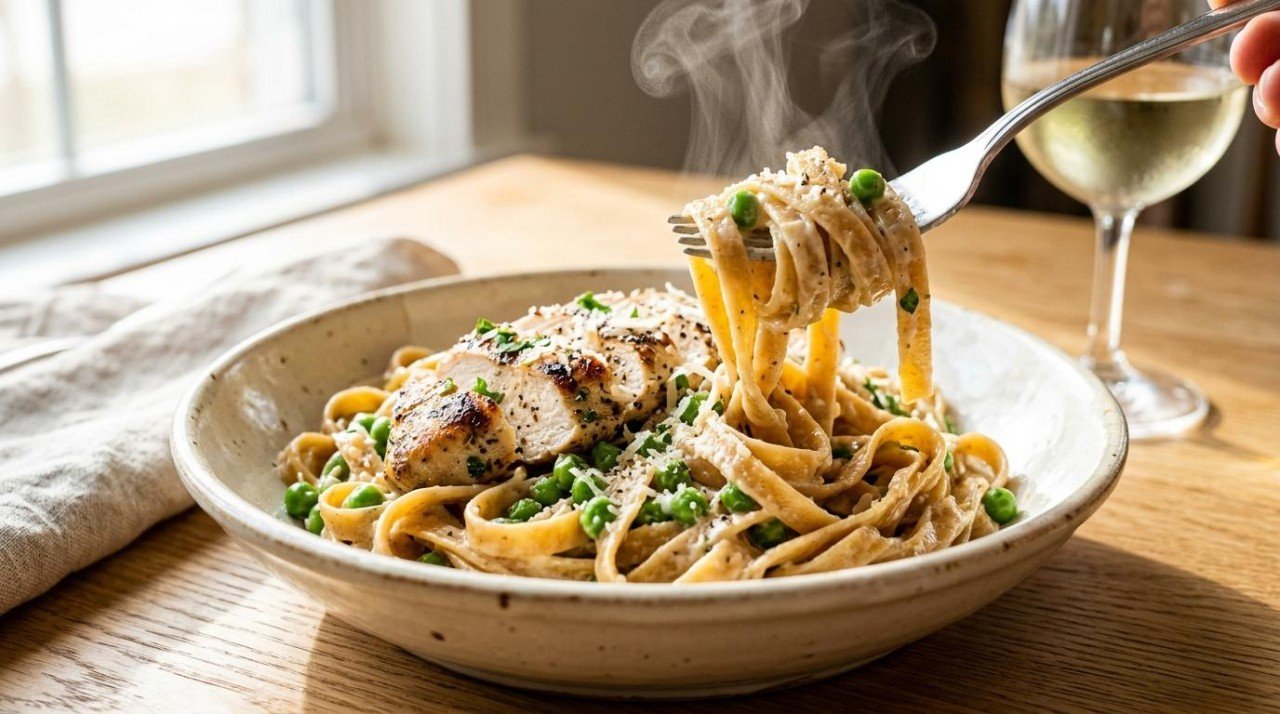
There is a reason fettuccine Alfredo is the dish people order when they want to be comforted. Silky, rich, unapologetically creamy, a tangle of wide noodles coated in a sauce that tastes like a hug. It is the pasta you crave on a cold night, the one kids never push around the plate, the one that somehow makes a bad day better.
Here is a fun bit of history, though: the original Alfredo did not have any cream in it at all. When Alfredo di Lelio invented it in Rome around 1908, it was three ingredients — fettuccine, young Parmesan, and butter — emulsified with a little pasta water into something glossy and light. The heavy cream is an American addition that came decades later. So a makeover is not a betrayal of this dish. In a way, it is a trip back toward where it started.
The version most of us actually make — heavy cream, a stick of butter, a mountain of Parmesan over refined fettuccine — scores 29 out of 100 on our Nutrition Score. Three swaps took it to 62, a 33-point jump, and every one of them is verified: we scored the original, applied each change one at a time, and measured exactly what it moved. The finished plate is still creamy, still comforting, still recognizably Alfredo. Here is the whole build, with receipts.
The original: what is in it and how it scores
The standard American restaurant-style version, serving four, is roughly:
- 1 lb dried fettuccine
- 1 cup heavy cream
- 1/2 cup (1 stick) butter
- 1 1/2 cups grated Parmesan
- 2 cloves garlic, salt, and pepper
Scored per serving against our default profile, that lands at 29/100. The app flags three weak spots: high saturated fat, low vitamin C, and low plant diversity. In real numbers, per serving:
- Calories: about 1,000
- Saturated fat: about 31 g — that is more than 150% of the FDA's 20 g Daily Value, and well over double the American Heart Association's stricter target of roughly 13 grams a day (less than 6% of calories). One plate is a day and a half of saturated fat.
- Sodium: about 53% of the daily limit
- Fiber: about 4 g
- Protein: about 28 g
- Plant points: half of one
The saturated fat is the headline, and it comes from exactly where you would guess: a cup of heavy cream and a full stick of butter, layered under a pile of Parmesan. The AHA is clear that saturated fat is the kind that raises LDL cholesterol, which raises heart-disease risk — and this dish delivers a day and a half of it before you have touched anything else you eat.
What is worth saying just as plainly: this is not junk, and it is not a food to feel guilty about. Thanks to the enriched pasta and all that real cheese, it is a genuine source of protein, calcium, folate, and B vitamins. The point here is not to rescue something broken. It is to keep the creamy comfort and quietly repair the three weak spots — starting with that wall of saturated fat.
The upgrades
Three swaps, in order of how much they move the score. The nice surprise: they each landed at almost exactly the same value — +11 points apiece — so there is no single throwaway change here. If you only make the first one, you have already fixed the dish's biggest problem.
1. Heavy cream and a stick of butter to blended cottage cheese
- Swap: 1 cup heavy cream + most of the butter → 1 1/2 cups low-fat cottage cheese, blended smooth (keep the real Parmesan)
- Score impact: +11 points (29 → 40)
- What it changes: Cuts saturated fat from about 31 g to about 10 g per serving, drops nearly 300 calories, and adds protein (about 28 g → 36 g)
- What it costs you: This is the swap with a real trade-off — read the honesty note below before you commit
This is the heart of the makeover, and it is the one Alfredo-specific move worth learning. Blend a tub of low-fat cottage cheese with a splash of milk until it is completely smooth — a good 60 seconds in a blender, no visible curds — and it turns into a creamy, pourable base that behaves a lot like the cream it replaces, for a fraction of the saturated fat and roughly double the protein. Keep a small pat of butter for richness and, crucially, keep the real Parmesan: that is where the actual Alfredo flavor lives, and cutting it is where these makeovers usually go wrong.
Now the honesty, because this swap has a genuine cost. Two, actually. First, cottage cheese carries a mild tang that heavy cream does not — most people read it as pleasant, but it is not identical, and if you are chasing the exact flavor of the cream version you will notice. Second, and more important, it is fussier at the stove: blended cottage cheese splits and turns grainy if you overheat it. You have to keep the heat low, stir the sauce into the pasta off high heat, and never let it boil. Do that and it stays glossy; rush it and it curdles. It is a small skill, but it is a real one. If you would rather ease into it, our heavy cream substitutes guide walks through the gentler options (a whole-milk-and-Parmesan sauce splits the difference).
2. Refined fettuccine to 100% whole wheat
- Swap: Regular fettuccine → 100% whole wheat fettuccine
- Score impact: +11 points (40 → 51)
- What it changes: Roughly triples the fiber — from about 4 g to about 11 g per serving — and adds B vitamins, iron, magnesium, and zinc
- What it costs you: A nuttier, slightly firmer noodle; the sauce hides most of it
The single biggest fiber win in the whole build, and one of the easiest swaps you can make. Refining strips the bran and germ out of wheat, taking most of the fiber and micronutrients with it — Harvard's Nutrition Source notes it removes virtually all of wheat's fiber along with most of its vitamin E and B vitamins. Whole wheat pasta keeps them, and the fiber does real work: it slows how fast the starch turns to glucose, so you get steadier energy instead of the heavy, sleepy dip a big bowl of white pasta can bring.
A creamy sauce is actually the ideal place to use whole wheat pasta, because the Alfredo coats every strand and softens the heartier flavor that whole wheat brings to a bare noodle. Cook it a minute short of the package time so it stays al dente under the sauce. If you want to push the base even further, our pasta substitutes guide ranks the options from easiest swap to biggest upgrade.
3. Add peas and grilled chicken
- Swap: Stir in 1 cup peas and top with sliced grilled chicken breast
- Score impact: +11 points (51 → 62)
- What it changes: Protein jumps from about 36 g to about 58 g per serving, adds vitamin C, and moves plant points from 1.5 to 2.5
- What it costs you: Nothing — this is pure addition, and chicken-and-pea Alfredo is already a classic
This is the swap that turns a rich pasta side into an actual balanced meal, and it costs you nothing at the table — nobody has ever objected to chicken Alfredo. The peas melt into the sauce, adding a pop of sweetness, real vitamin C (which the original was missing entirely), and a second plant toward the 30-plants-a-week variety that feeds a healthier gut. The grilled chicken is what doubles the protein and makes the plate genuinely filling on fewer noodles — which is quietly its own health win, because a smaller portion of pasta satisfies once there is protein and fiber alongside it.
Take the Guesswork Out of Eating Well
Eat Well Planner helps you organize your favorite recipes, plan balanced meals, and automatically generate shopping lists — all in one place. Whether you're tracking macros, managing dietary restrictions, or just trying to stop asking "what's for dinner?", we've got you covered.
Our AI-powered tools can adapt any recipe to your dietary needs, help you discover new meals you'll love, and even log your nutrition effortlessly. It's meal planning made simple.
Start Organizing Your Meals — FreeWhat we kept on purpose
A makeover that guts the dish is a failed makeover, so here is where we deliberately stopped:
- Real Parmesan. We never touched it. Parmesan is the flavor of Alfredo — nutty, salty, savory — and it is exactly what carries the dish once the cream is gone. It is also potent enough that a modest amount tastes like plenty; there is more on using it well (and what to reach for when you run out) in our Parmesan substitutes guide.
- Real butter, just less of it. A pat of butter still goes in for that browned-dairy richness. We cut the stick down to a spoonful; we did not banish it. Fat is part of what makes this dish feel like this dish.
- The creamy identity. Every choice was measured against one question: is it still a creamy, comforting bowl of Alfredo? The moment a swap turned it into "cauliflower pasta" or "protein noodles," it was out.
One number we did not move, in the interest of full honesty: sodium. It sits around 53% of the daily limit in both versions — Parmesan and cottage cheese are both salty, so the sauce swap roughly trades cream's fat for cheese's sodium. If that matters for you, use a low-sodium cottage cheese and skip the added salt; the Parmesan brings enough on its own.
The healthier version: full recipe
Final score: 62/100, up from 29. Serves 4.
Ingredients
- 1 lb whole wheat fettuccine
- 1 1/2 cups low-fat cottage cheese
- 1/4 to 1/2 cup milk, plus reserved pasta water as needed
- 2 tablespoons butter
- 1 1/2 cups grated Parmesan cheese
- 2 cloves garlic, minced
- 2 boneless skinless chicken breasts (about 12 oz total), grilled and sliced
- 1 cup peas (fresh or frozen)
- Salt and black pepper to taste
Instructions
- Season the chicken breasts with salt and pepper and grill or pan-sear over medium-high heat, about 6 minutes per side, until cooked through. Rest, then slice.
- Bring a large pot of salted water to a boil. Cook the fettuccine one minute short of the package time. Before draining, scoop out a cup of the pasta water. Add the peas to the pot for the last 2 minutes of cooking.
- While the pasta cooks, blend the cottage cheese with the milk until completely smooth — a full minute, until there are no visible curds.
- In a large skillet over low heat, melt the butter and cook the garlic for 30 seconds, just until fragrant. Pour in the blended cottage cheese and warm it gently; do not let it boil.
- Off the heat or over the lowest flame, stir in the Parmesan until melted and smooth, loosening with a splash of pasta water to reach a silky, coating consistency.
- Add the drained pasta and peas, and toss to coat, adding more pasta water as needed. Fold in most of the sliced chicken.
- Plate, top with the remaining chicken, and finish with black pepper and a little extra Parmesan.
Per serving, here is the before and after:
- Nutrition Score: 29 → 62
- Calories: about 1,000 → about 850
- Saturated fat: about 31 g → about 11 g
- Fiber: about 4 g → about 13 g
- Protein: about 28 g → about 58 g
- Plant points: 0.5 → 2.5
Same creamy comfort, about two-thirds less saturated fat, triple the fiber, double the protein, and a plate that now counts as a real meal instead of a rich side.
Swaps we tested and skipped
Here is the honesty section that proves the numbers are real, because it is where we turned down swaps that other "healthy Alfredo" recipes lean on.
Chickpea or lentil fettuccine. On paper this is the obvious move — bean pastas bring a lot of protein and fiber. But when we scored it in place of the whole wheat, it did not improve the dish, and at the stove the reason was obvious: legume pastas have an earthy, faintly beany flavor and a softer, sometimes grainy bite that fights a delicate cream sauce. They are terrific under a punchy tomato or pesto, where the sauce can stand up to them — but in an Alfredo, the whole point is a silky, mellow base, and the pasta should get out of the way. Whole wheat did that; chickpea did not.
An all-cauliflower "Alfredo" sauce. Blending steamed cauliflower into the sauce scores beautifully and is a genuinely nice dish. It is just not this dish — past a certain ratio it tastes like creamy cauliflower sauce, not Alfredo, and the whole promise here is to keep the comfort food you actually came for. Cottage cheese gave us most of the same nutrition win while still tasting like Alfredo, so that is where we landed. If cauliflower-forward is your goal, that is a fine choice to make on purpose — the tools below let you see exactly what it costs and gains.
Make it fit other diets
The same build adapts easily:
- Vegetarian: skip the chicken and lean on the peas, or stir in a can of white beans for protein and a third plant point. The cottage-cheese sauce is already meat-free.
- Gluten-free: use a sturdy gluten-free or red lentil fettuccine; everything else in the sauce is already gluten-free.
- Dairy-free: this is the hard one, since the whole dish is built on dairy — a blended soaked-cashew base with nutritional yeast is the usual route, and it is good, just different.
You do not have to work the swaps out by hand. In Eat Well Planner, the AI Recipe Chat and Recipe Variations can rewrite this exact recipe as a full vegetarian, gluten-free, or dairy-free version in one step, with the substitutions already worked in.
Do this to any recipe you love
Every number in this post came out of Eat Well Planner's Make It Healthier feature. That is the whole idea: import a recipe you love — from a website, an Instagram reel, or a YouTube video — and the app scores it, then proposes concrete swaps like these, with a calculator verifying the real nutritional gain before it ever shows you the suggestion. No guessing, no vibes.
And when you want to make the call yourself — keep half the cream, use more Parmesan, add extra veg and make it up elsewhere — the Recipe Playground lets you tweak ingredients and watch the score move with each edit, so you can see exactly what every choice is worth. Keep the dish you love. Just know what it is made of, and where the easy wins are hiding.