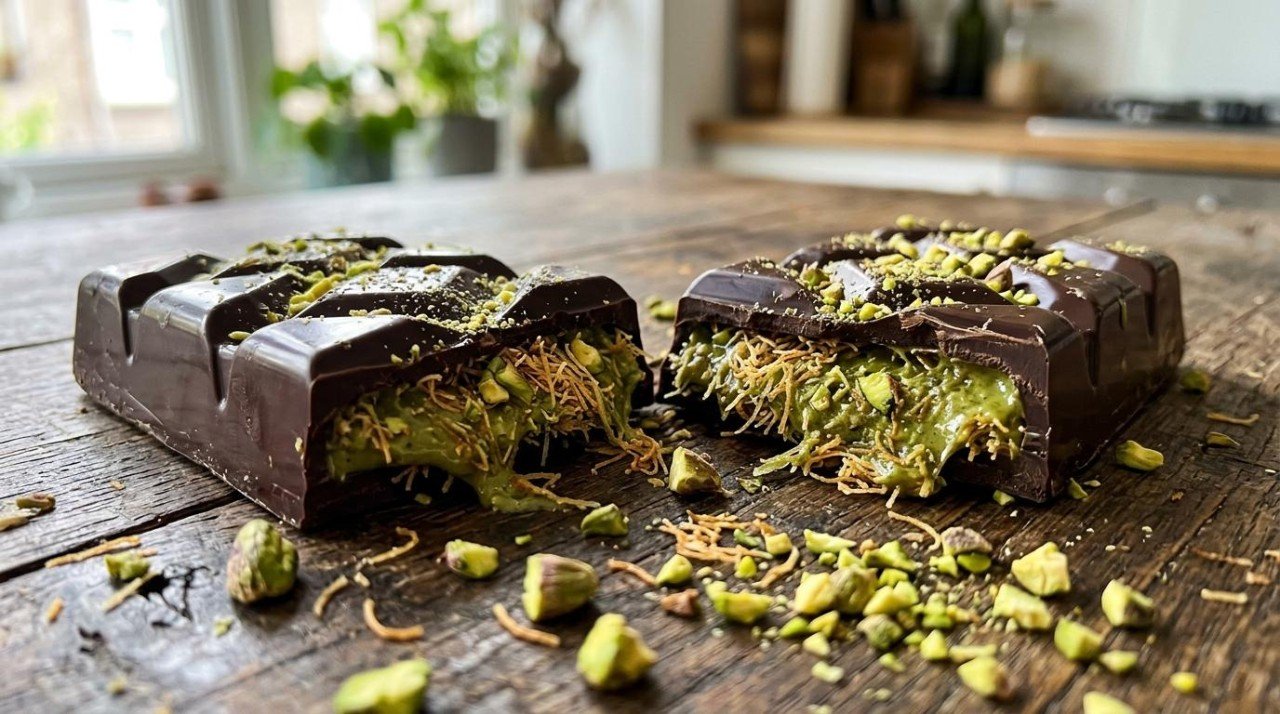
You have seen the video even if you have never seen the bar. Someone snaps a thick slab of chocolate in half, and out spills a green, glossy, crackling middle. That is the Dubai chocolate bar — properly called "Can't Get Knafeh of It," made by FIX Dessert Chocolatier in Dubai. Sarah Hamouda dreamed it up during a pregnancy craving for knafeh, launched it in 2022, and by 2024 TikTok and Instagram had turned an operation that started out making around 25 bars a day by hand into a worldwide phenomenon.
It deserves the hype. Pistachio, tahini, and shredded pastry fried in butter is a genuinely great combination, and the crack-and-crunch is engineered for video. So we built a representative version of the recipe everyone makes at home and ran it through Eat Well Planner's Nutrition Score, the same number you see on any public recipe page. It came back 24 out of 100.
Here is where this post is going to be different from the others in this series. We usually promise you the same dish with much better numbers. This time the honest promise is smaller and, we think, more interesting: we got it to 36, we will show you every point, and then we will show you exactly where the ceiling is and why no amount of cleverness gets a pistachio candy bar past it. This is candy. The goal was never to turn it into a salad. It was to find out how much better candy can get before it stops being the thing you actually wanted.
The original: what's in it and how it scores
Here is the standard home version we scored, the one that shows up in most of the copycat recipes, cut into 12 pieces:
- 14 oz (400 g) milk chocolate, melted, for the shell
- 5 oz (150 g) kataifi pastry
- 3 tablespoons butter, for toasting the kataifi
- About 1 cup (250 g) store-bought sweetened pistachio cream
- 2 tablespoons tahini
Nutrition Score: 24/100. Now the diagnosis, because the why is what lets you read your own recipes.
One number does almost all the damage. A single piece carries 25.5 g of added sugar — 96% of a day's worth. The American Heart Association puts the daily ceiling at 6 teaspoons (25 g) for women and 9 teaspoons (36 g) for men. So one piece of this — one twelfth of the bar, roughly 2.5 oz — is an entire day's added sugar for most women, and that is before you notice that nobody eats one twelfth of a Dubai chocolate bar.
Saturated fat is the second problem, at 8.8 g per piece, or 38% of the AHA's roughly 13 g a day. And fiber is close to absent at 2.2 g.
The sugar comes from two places, and one of them surprises people. The milk chocolate is the obvious source. The other is the pistachio cream. Read the label on a typical supermarket jar and the order runs: sugar, then vegetable oils, then pistachios at around 25%, then milk powder. It is a pistachio-flavored sugar spread, not a pistachio spread — which is why we modeled it by its real composition when we scored it, rather than pretending it was ground nuts.
But here is what is already good, and it matters: the pistachios and the tahini are the genuinely redeeming part of this recipe. Pistachios bring about 6 g of protein and 3 g of fiber per ounce, plus potassium and a big hit of vitamin B6, and they carry more lutein and zeaxanthin than most nuts. A protein-quality analysis presented at the 2019 FENS conference (funded by the pistachio industry, so read it with that in mind) found roasted pistachios contain all nine essential amino acids in adequate amounts for anyone over five, which is unusual for a nut. Tahini is just ground sesame, and it is doing real mineral work.
So the plan writes itself. The good stuff in this bar is present in trace amounts and buried under sugar. We are not adding kale. We are going to make the pistachios the actual filling instead of a flavor note.
The upgrades
Four swaps, scored cumulatively in this order. The first one is worth more than the other three combined, which is the usual shape of these things.
1. Rebuild the filling from real pistachios
- Swap: 250 g store-bought pistachio cream + 2 tbsp tahini → 200 g whole pistachios blended into butter, plus 3 tbsp tahini and 1 tablespoon of honey
- Score impact: +6 points (24 → 30)
- What it changes: Added sugar drops from 25.5 g to 19.9 g per piece, protein climbs from 5.2 g to 7.7 g, fiber goes from 2.2 g to 3.5 g, and the pistachio content of the filling goes from about a quarter to essentially all of it
- What it costs you: Ten minutes with a food processor, and a filling that is less sweet and much more nutty. It tastes more like pistachio, because it is more pistachio
This is the swap that makes the whole post worth writing. You are replacing a jar that is mostly sugar and refined oil with the thing the jar was imitating. Blend shelled pistachios in a food processor for five to eight minutes, scraping down as you go — they will go from crumbs to a stiff paste to a loose, glossy butter as the oils release. Then blend in the tahini, the honey, and a good pinch of salt.
The honey is doing a real job here beyond sweetness: it loosens the paste and keeps the filling spoonable rather than stiff. It is also still added sugar like any other syrup. And if you cannot find tahini, the seed and nut butter guide covers what works in its place — though tahini's slight bitterness is genuinely part of this bar's flavor, so swap it last.
2. Dark chocolate for the milk chocolate shell
- Swap: 400 g milk chocolate → 400 g 70% dark chocolate
- Score impact: +4 points (30 → 34)
- What it changes: Nearly halves the added sugar again, from 19.9 g to 10.8 g per piece, and lifts fiber from 3.5 g to 5.0 g
- What it costs you: Real sweetness, and — honestly — a small amount of saturated fat. It went up, from 9.0 g to 10.2 g per piece
That saturated fat increase is the kind of thing a makeover post is tempted to leave out. Dark chocolate has more cocoa butter than milk chocolate, so trading up on cocoa percentage buys you a lot less sugar and a bit more saturated fat. The score judged that trade worth +4, and we agree, but it is a trade, not a free win.
It is worth saying plainly that the original is a milk chocolate bar, and dark chocolate makes it a different bar. We would argue it makes it a better one: the filling is already sweet and rich, and a sweet shell on top of it is why the original reads as cloying to a lot of people after two bites. Harvard's Nutrition Source recommends 70% or higher to get meaningful flavanols, and 70% is also about as bitter as you can go before the bar stops reading as a treat. Do not go to 85% here.
3. A thinner shell and a thicker middle
- Swap: 400 g dark chocolate → 275 g
- Score impact: +1 point (34 → 35)
- What it changes: Very little on the score, but a lot on the plate — 60 fewer calories and 2.3 g less saturated fat per piece
- What it costs you: The theatrical thickness. Your snap will be a crisp click rather than a heavy crack
We are including this one precisely because it only scored +1, and that gap is instructive. The score cares about composition — what a serving is made of — and thinning the shell removes good things (cocoa fiber, iron, magnesium) alongside the sugar and saturated fat, so it mostly cancels out. The per-serving numbers still moved meaningfully. Both facts are true at once, which is why we publish the full comparison next to the score.
4. Less butter in the kataifi, less honey in the filling
- Swap: 3 tablespoons butter → 2, and 2 tablespoons honey → 1
- Score impact: +1 point (35 → 36)
- What it changes: Trims added sugar to 6.9 g and saturated fat to 7.5 g per piece
- What it costs you: Nothing you will notice, as long as you do not cut the butter further
The butter has a floor, and it is worth knowing where it is. Kataifi gets its crunch from three things — thorough toasting, enough fat, and dryness — and a pastry chef's rule of thumb is about 50 g of butter per 150 g of kataifi, toasted on medium-low for 15 to 20 minutes until it is dark golden and rattles like dry leaves. We went to 30 g and the strands still toast properly. Below that they steam instead of fry, and you lose the crunch that is the entire reason this bar exists. You can use oil or a dairy-free spread instead, which is what you would do for a vegan version, but butter genuinely tastes better here and 2 tablespoons split 12 ways is not the problem.
Take the Guesswork Out of Eating Well
Eat Well Planner helps you organize your favorite recipes, plan balanced meals, and automatically generate shopping lists — all in one place. Whether you're tracking macros, managing dietary restrictions, or just trying to stop asking "what's for dinner?", we've got you covered.
Our AI-powered tools can adapt any recipe to your dietary needs, help you discover new meals you'll love, and even log your nutrition effortlessly. It's meal planning made simple.
Start Organizing Your Meals — FreeWhat we kept, and where we stopped
We kept butter-toasted kataifi, full-fat tahini, real chocolate, and honey. Every one of those is a thing a more aggressive makeover would have come after, and every one of them is load-bearing.
Now the honest part, and the reason this post exists. We could get to 41. We tested it. Drop the kataifi entirely and it scores 41. Thin the shell down to a chocolate coating barely worth the name and it also scores 41 — with no saturated fat caution and no added sugar caution at all. Five more points were available the whole time, and both roads to them end with a thing that is not a Dubai chocolate bar. So we stopped at 36.
Two more things we will not pretend about. Plant points did not move: 2 before, 2 after. A candy bar is not going to help you toward 30 different plants a week, and any post that tells you otherwise is selling something. And the original actually beat our version on one nutrient — it was an excellent source of vitamin E, at 27% of your daily value per piece, almost all of it from the refined sunflower oil in the store-bought pistachio cream. We took the oil out and the vitamin E went with it. We think iron, magnesium, B6, potassium, and fiber were the better trade, but it was a trade.
One swap we deliberately did not make: cutting the serving size. It is the most common move in healthier-recipe posts and it would have flattered our numbers enormously, because the score is calculated per serving. Slicing the same bar into 20 pieces instead of 12 would have "improved" it without changing a single ingredient. That is arithmetic, not cooking, so we held servings at 12 for every run above. Eating a smaller piece is still excellent advice — it is just not a recipe improvement, and we are not going to score it as one.
The healthier version: full recipe
Nutrition Score: 36/100 (up from 24). Makes 12 pieces.
- 9 oz (275 g) 70% dark chocolate, chopped
- 5 oz (150 g) kataifi pastry, thawed
- 2 tablespoons (30 g) butter
- 1 2/3 cups (7 oz / 200 g) shelled unsalted pistachios
- 3 tablespoons (45 g) tahini, well stirred
- 1 tablespoon (20 g) honey
- 1/4 teaspoon salt
- Cut the kataifi into short lengths while it is still cold, then pull the strands apart with your fingers so they are not clumped.
- Melt the butter in a wide skillet over medium-low heat, add the kataifi, and toast for 15 to 20 minutes, stirring often, until every strand is deep golden and the pan sounds dry and crackly. Spread it on a plate and cool completely.
- Blend the pistachios in a food processor for 5 to 8 minutes, scraping down the sides, until they pass through crumbs and stiff paste and become a loose, glossy butter.
- Add the tahini, honey, and salt and blend for another 30 seconds, until smooth and pourable.
- Fold the cooled kataifi into the pistachio mixture by hand. It should hold together when pressed but still feel loose and strandy.
- Melt two thirds of the chocolate in a bowl set over barely simmering water until it reaches about 110 F, then take it off the heat, add the remaining chocolate, and stir until it melts and the whole bowl cools to 88 to 90 F. This is what gives you the snap.
- Brush a thin layer of chocolate into a bar mold or a parchment-lined loaf pan, working it up the sides, and chill for 10 minutes. Add a second thin coat and chill again.
- Spoon in the filling and press it level, leaving a small rim of chocolate clear around the edge.
- Pour over the remaining chocolate, tap the mold on the counter to level it, and chill for 30 minutes until fully set.
- Unmold and cut into 12 pieces. It keeps in an airtight container at cool room temperature for a week, and the kataifi stays crisp.
Per piece, original versus improved:
- Nutrition Score: 24 → 36
- Calories: 367 → 309
- Added sugar: 25.5 g (96% DV) → 6.9 g (26% DV)
- Saturated fat: 8.8 g (38% DV) → 7.5 g (32% DV)
- Fiber: 2.2 g → 4.2 g (14% DV)
- Protein: 5.2 g → 6.6 g
- Now a good or excellent source of: iron (33% DV), phosphorus (25%), magnesium (16%), thiamine (16%), vitamin B6 (16%), fiber (14%), biotin (13%), zinc (11%), potassium (10%)
One caveat on those calories, because it would be easy to oversell them. The improved piece is also a physically smaller piece — about 2.1 oz against 2.6 oz — because we took 125 g of chocolate out of the bar. Gram for gram, the two versions are almost identical in calories, and the new one is actually a hair denser, since pistachios are not a light food. This is not a lighter bar. It is a better-composed one, and that distinction is worth more than the calorie line.
Swaps we tested and skipped
- Dropping the honey entirely. Worth exactly +1 point (36 → 37). The filling goes stiffer and noticeably more austere for one point. Not a trade we would make, and a good example of why we score things instead of assuming.
- Skipping the kataifi to cut the refined carbs. Scores 41, the highest number we found. It also deletes the crunch, which is the single feature that made this bar famous. At that point you have made an expensive pistachio truffle.
- Going to 85% dark chocolate. Not a scoring problem, a flavor one. Against a tahini filling that already carries bitterness, 85% tips the whole bar from rich into harsh.
- Sugar-free chocolate. Maltitol- and erythritol-sweetened bars do not set with the same snap and bring their own digestive baggage in the quantities you would eat here. The dark chocolate swap already removed most of the sugar.
Make it fit other diets
For a vegan version, use dairy-free dark chocolate (most 70% bars already are — check for milk fat), swap the butter for coconut oil or a dairy-free spread, and use maple syrup or date syrup in place of the honey at roughly 1:1. For gluten-free, the kataifi is the blocker and there is no honest substitute — it is shredded wheat pastry. Toasted gluten-free rice vermicelli or crushed nuts will give you crunch, but not that crunch, and we would rather tell you that than pretend. If you want either version written out properly, Eat Well Planner's Recipe Variations will rewrite the whole recipe with the swaps worked in, and you can ask the AI recipe chat about any single ingredient with the full recipe in front of it.
Do this to your own recipes
Everything above came out of the app. We scored the original, then used Make It Healthier — which proposes ingredient swaps and runs each one through a calculator to verify the nutritional gain before showing it to you — and confirmed each delta in the Recipe Playground, where you can edit an ingredient and watch the score move in real time. That is also how we found the ceiling at 41, and how we knew the honey was only worth one point.
You can do the same to anything. Saw the bar on TikTok? Import the video straight into Eat Well Planner, get its score before you buy 400 g of chocolate, and see which changes are worth making. Because the useful move with a bar like this was never to fix it. It was to know exactly what it is, make it worth eating, and then let dessert be dessert.