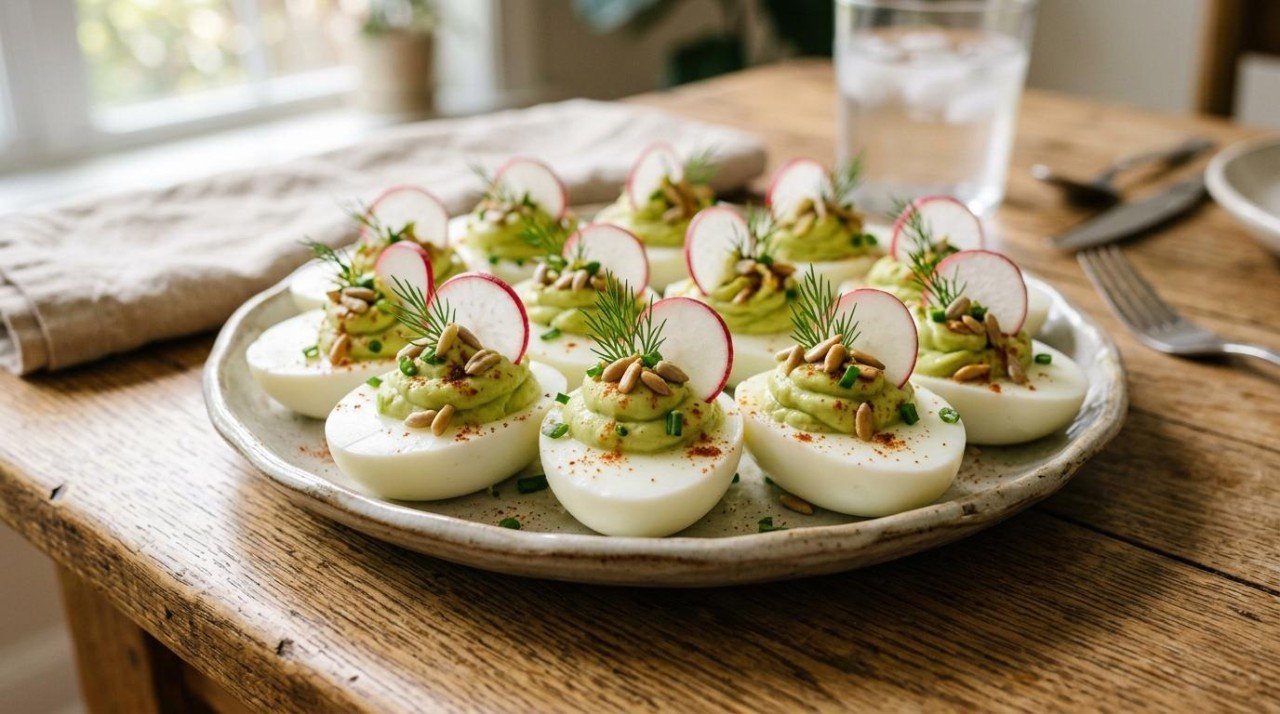
Deviled eggs are the first thing to disappear from the table and the dish nobody plans for. They are also much older than their filling: the earliest known stuffed-egg recipe comes from 13th-century Andalusia, the word "deviled" showed up in print for spicy food in 1786, and mayonnaise was not suggested until the 1896 edition of Fannie Farmer's Boston Cooking School Cook Book. The mayo is barely a century old.
We scored a standard classic version in Eat Well Planner and it came out at 35 out of 100. That number is worth sitting with, because it is not low for the reason you would guess. The score did not flag the yolks. It did not flag the cholesterol. It barely flagged the fat. What it flagged was that a deviled egg is an egg and a spoonful of oil, and that is the whole dish.
So we rebuilt it. Same platter, same piped filling, all six yolks still in there, and a final score of 70 — exactly double. Here is every swap, the head-to-head test of the five filling styles people argue about, and the one popular "healthy deviled egg" trick that turned out to be worth two points.
The classic: what is in it and how it scores
The version we scored is the one on the back of the mayonnaise jar. For six eggs, making twelve halves:
- 6 large eggs, hard-boiled
- 1/3 cup mayonnaise
- 1 teaspoon yellow mustard
- 1 teaspoon vinegar
- 1/2 teaspoon salt
- 1/4 teaspoon black pepper
- Paprika, dusted over the top
Nutrition Score: 35/100. Per serving of two halves, that is 160 calories, 6.4 g protein, 14.4 g total fat, 3.0 g saturated fat, about 350 mg sodium, and 0.1 g of fiber.
Now the diagnosis, which is where this dish gets interesting. The score listed exactly three weaknesses: low vitamin C, high sodium, and low niacin. Saturated fat did not make the list. Cholesterol did not make the list. And the score's strengths were all coming from the egg — omega-3 ALA, vitamin B12, riboflavin, plus choline at 32% of the Daily Value, biotin, phosphorus, and vitamin A.
Two of those three complaints are about what is missing, not what is there. There is no plant in a classic deviled egg — the paprika is a dusting. Plant variety came in at 0.5 against a weekly target of 30, fiber was a rounding error, and the gut health sub-score was 21 out of 100, the lowest of the six dimensions by a wide margin.
The sodium is real, though: 350 mg per two halves, roughly 55% of it from the half teaspoon of salt and most of the rest riding in on the mayonnaise. Americans average about 3,400 mg of sodium a day against a 2,300 mg ceiling, and party food is where a lot of it comes from.
What we are not going to do is take the yolks out. They carry the choline (32% DV a serving — most Americans eat less than the adequate intake of 550 mg a day for men, 425 mg for women), the B12, and the vitamin A. And for most people, cholesterol in food has a smaller effect on blood cholesterol than the mix of fats in the overall diet. We tested the yolk swap anyway. It is not worth what it costs.
Four fillings, scored head-to-head
Before building anything, we settled the argument. Each of these replaces the mayonnaise in the classic recipe above, with everything else left exactly as it was, so the numbers are comparable.
- Avocado (1/2 avocado, about 75 g, mashed, plus 2 teaspoons lime juice): 55 (+20)
- All Greek yogurt (1/3 cup plain nonfat): 42 (+7)
- Light mayonnaise (1/3 cup): 40 (+5)
- Mustard-forward (mayo down to 2 tablespoons, plus 5 teaspoons of Dijon): 40 (+5)
- Half mayo, half Greek yogurt: 39 (+4)
The avocado wins by a mile, and not for the reason people usually give. It is not that avocado fat beats mayonnaise fat — the score barely cared. It is that avocado is the only one of the five that brings fiber and a plant into a dish that had neither, taking the gut health sub-score from 21 to 52 on its own. The lime was worth 1 of those 20 points; without it the version scored 54.
The disappointments are instructive. Greek yogurt halves the calories (160 down to 83 a serving) and adds protein, and still bought only 7 points, because it fixes nothing that was actually wrong. Light mayonnaise — the swap everyone reaches for first — bought 5 while adding sugar (0.08 g to 0.75 g a serving) and slightly more sodium than the full-fat jar. Our mayonnaise substitutes guide covers what each option does to texture.
The upgrades, in the order we would make them
These are cumulative — each score is the recipe with every change above it already applied. We put the additions first and the subtractions last on purpose, because the additions cost you nothing.
1. Avocado for half the mayonnaise
- Swap: 1/3 cup mayonnaise → 1/2 medium avocado + 1 1/2 tablespoons mayonnaise + 2 teaspoons lime juice
- Score impact: +13 points (35 → 48)
- What it changes: Fiber from 0.1 g to 0.8 g a serving, potassium up 70%, and the first real plant in the dish
- What it costs you: A faintly green filling and a mild avocado note. The mayo tang is still there because the mayo is still there
Half is the number that matters. All-avocado scores higher (55 in the head-to-head) but reads as guacamole in an egg white, losing the sharp, salty edge that makes a deviled egg a deviled egg. Keeping 1 1/2 tablespoons of real mayonnaise holds the flavor and still banks 13 of the 20 points. A medium avocado carries about 10 g of fiber and 15 g of monounsaturated fat, and in a 111,000-person cohort, two or more servings a week was associated with a 16% lower risk of cardiovascular disease — mostly when it replaced saturated fat.
The lime juice is not optional. It is acid, it wakes the filling up, and it keeps the avocado from browning on a platter that has to sit out.
2. Put plants in it and on it
- Swap: Add 1 finely diced celery stalk to the filling; top with chopped chives, fresh dill, and thin radish slices
- Score impact: +8 points (48 → 56)
- What it changes: Plant variety from 1.5 to 4, low vitamin C off the weakness list entirely, folate onto the highlights
- What it costs you: Five minutes of chopping. Nothing on the plate
This is the swap that fixes the actual diagnosis, and nobody will look twice at it — deviled eggs are always garnished with something. But herbs are not decoration to the score: they are separate plants, and the American Gut Project found that people eating more than 30 different plant types a week had measurably different gut bacteria than people eating 10 or fewer, with the count of plants predicting more than any diet label did. Two herbs and a radish is three of your thirty, from a garnish — the whole argument behind counting plants instead of calories.
The celery goes in the filling, finely diced. It is the crunch that mayonnaise-only deviled eggs never have.
3. A spoonful of toasted sunflower seeds on top
- Swap: Add 2 1/2 tablespoons toasted sunflower seeds, scattered over the finished eggs
- Score impact: +3 points (56 → 59)
- What it changes: Clears the last of the low-niacin flag, adds vitamin E, magnesium, and another 0.4 g of fiber
- What it costs you: Nothing. It is the best texture on the plate
Low niacin was one of the original's three weaknesses and a genuinely hard one to fix on a deviled egg — there is nowhere to put a food that has much of it. Toasted sunflower seeds solve it and give a soft dish something to crunch. Toast them dry in a skillet for three minutes, until they smell nutty.
4. Halve the salt
- Swap: 1/2 teaspoon salt → 1/4 teaspoon
- Score impact: +8 points (59 → 67)
- What it changes: Sodium from about 310 mg to about 220 mg a serving
- What it costs you: Honestly, something — but less than you think, because of what is already in the bowl
This is the one swap that asks for a real concession, which is why it is fourth — and it works better here than it would have at the start, because the lime, the vinegar, the mustard, and the peppery radish are already doing salt's job.
Here is the receipt on ordering. Applied earlier in the build, before the seeds, this same cut was worth only 3 points — and the seeds were then worth 8. The pair is worth 11 together either way; whichever you do second gets the bigger number. Worth remembering whenever you see one swap advertised with a big number attached.
5. Half the remaining mayonnaise becomes Greek yogurt
- Swap: 1 1/2 tablespoons mayonnaise → 1 tablespoon mayonnaise + 1 1/2 tablespoons plain Greek yogurt
- Score impact: +3 points (67 → 70)
- What it changes: Protein from 7.4 g to 7.7 g a serving, saturated fat from 2.7 g to 2.4 g
- What it costs you: A faint tang. At this ratio, most people will not find it
Small, and the last honest point available. We scored this with plain nonfat Greek yogurt; whole-milk strained yogurt tastes better in a cold filling and will give back a little of the gain. Either way, keep it thick — plain unstrained yogurt loosens the filling and it slumps out of the piping bag. Our Greek yogurt substitutes guide covers the rest.
Take the Guesswork Out of Eating Well
Eat Well Planner helps you organize your favorite recipes, plan balanced meals, and automatically generate shopping lists — all in one place. Whether you're tracking macros, managing dietary restrictions, or just trying to stop asking "what's for dinner?", we've got you covered.
Our AI-powered tools can adapt any recipe to your dietary needs, help you discover new meals you'll love, and even log your nutrition effortlessly. It's meal planning made simple.
Start Organizing Your Meals — FreeWhat we kept, and where we stopped
All six yolks stayed. Every one. So did real mayonnaise, so did salt, and so did the classic mustard-vinegar-paprika backbone. We stopped at 70 because the next moves all break the dish: the score still lists high saturated fat and high sodium as weaknesses on the finished version, and both have obvious fixes we refused. Removing the salt entirely takes it to 77. Pulling three of the six yolks takes the saturated fat down. Neither produces something you would put on a table.
Worth naming what the upgrade cost, too. Cutting most of the mayonnaise dropped omega-3 ALA from 41% of the Daily Value a serving to 13%, because soybean oil was quietly supplying it. The fiber, potassium, and plant variety we gained more than paid for it — but the score does not hide the loss, and neither will we.
The healthier version: full recipe
Nutrition Score: 70/100. Makes 12 halves; 6 servings of 2 halves.
- 6 large eggs
- 1/2 medium ripe avocado (about 60 g)
- 1 tablespoon mayonnaise
- 1 1/2 tablespoons plain Greek yogurt
- 2 teaspoons fresh lime juice
- 1 teaspoon yellow mustard
- 1 teaspoon apple cider vinegar
- 1/4 teaspoon salt
- 1/4 teaspoon black pepper
- 1 celery stalk, very finely diced (about 40 g)
- 1/4 cup finely chopped chives
- 3 tablespoons chopped fresh dill
- 4 radishes, sliced paper thin
- 2 1/2 tablespoons sunflower seeds, toasted
- 1/4 teaspoon paprika, for dusting
- Put the eggs in a saucepan, cover with an inch of water, and bring to a boil. Cover, kill the heat, and leave them for 11 minutes. Move them straight into ice water for 5 minutes, then peel under running water.
- Toast the sunflower seeds in a dry skillet over medium heat for about 3 minutes, shaking the pan, until they smell nutty. Tip them onto a plate so they stop cooking.
- Halve the eggs lengthwise and pop the yolks into a bowl. Set the whites on a platter, hollow side up.
- Mash the yolks with a fork until crumbly. Add the avocado, mayonnaise, Greek yogurt, lime juice, mustard, vinegar, salt, and pepper, and mash smooth — a small food processor is faster and gives you a pipeable filling.
- Fold in the diced celery and half the chives. Taste it now. If it seems flat, add vinegar or lime, not salt.
- Spoon or pipe the filling into the whites; a zip-top bag with a corner cut off is fine.
- Top each half with a radish slice, then scatter the remaining chives, the dill, and the toasted sunflower seeds over the platter. Dust with paprika.
- Serve within a couple of hours, or chill covered for up to a day — the lime juice keeps the filling from going gray.
Per serving of two halves, original versus improved:
- Calories: 160 → 139
- Protein: 6.4 g → 7.7 g
- Total fat: 14.4 g → 10.7 g
- Saturated fat: 3.0 g → 2.4 g
- Sodium: about 350 mg → about 200 mg
- Fiber: 0.1 g → 1.5 g
- Potassium: 70 mg → 210 mg
- Cholesterol: 210 mg → 210 mg (unchanged, on purpose)
- Plant variety: 0.5 → 5 different plants
The finished version is an excellent source of choline (32% DV), biotin, vitamin B12, phosphorus, and riboflavin, and a good source of pantothenic acid, iron, vitamin K, vitamin A, vitamin E, folate, and protein. Tripling the potassium while cutting the sodium is the other half of the salt story, and here it came almost entirely from the avocado.
Swaps we tested and skipped
- Dropping half the yolks. The classic internet fix: six whites, three yolks. Scored like-for-like against the finished recipe, it was worth 2 points — and it cut choline from 26% of the Daily Value to 14%, dropped vitamin B12 off the highlight list entirely, and took the vitamin A with it. Not worth throwing away the most nutritious part of the egg.
- Removing the salt completely. Scores 77, seven points above our version. Also produces unseasoned egg paste. We are not publishing a recipe nobody finishes.
- Dijon instead of yellow mustard. Tested mid-build: +0 points. Use whichever you like; the score genuinely does not care.
- Dropping the last of the mayonnaise. Replacing the final tablespoon with more Greek yogurt scored exactly 70 — identical. Since keeping it cost nothing, we kept it. A free choice, and dairy-free cooks should go the other way.
- Light mayonnaise. Five points in the head-to-head, but it brings added sugar and slightly more sodium than the regular jar. Avocado does the job better.
Make it fit other diets
This version is already gluten-free as written. The two adjustments people actually ask for:
- Dairy-free: skip the Greek yogurt and use 1 1/2 tablespoons of mayonnaise instead. That is the 67-point version, and it tastes closer to the original.
- Seed allergy: leave the sunflower seeds off and use crisp-fried shallots for the crunch. You give back the niacin fix and the vitamin E; everything else holds.
If you want a full rewrite rather than a note — Whole30, keto, egg-free entirely — the AI Recipe Chat in Eat Well Planner will do it with the whole recipe in context, and Recipe Variations will hand back a complete adapted version in one step.
Do this to your own recipes
Nothing here required guessing. We scored the classic, tested five fillings against each other, then applied five changes one at a time and watched the number move — which is exactly what the Eat Well Planner Recipe Playground does when you edit an ingredient, and what Make It Healthier does when it proposes one: a calculator verifies the nutritional gain before the suggestion is ever shown to you.
Import any recipe you love — from a website, a photo of a recipe card, or an Instagram reel — and you get its Nutrition Score, the specific reasons behind it, and a ranked list of swaps with the real gain attached to each. Then you do the part no app can do, which is decide which of those points are worth paying for. We did the same for potato salad, and kept the mayonnaise there too.
The yolks stay. That was never the problem.