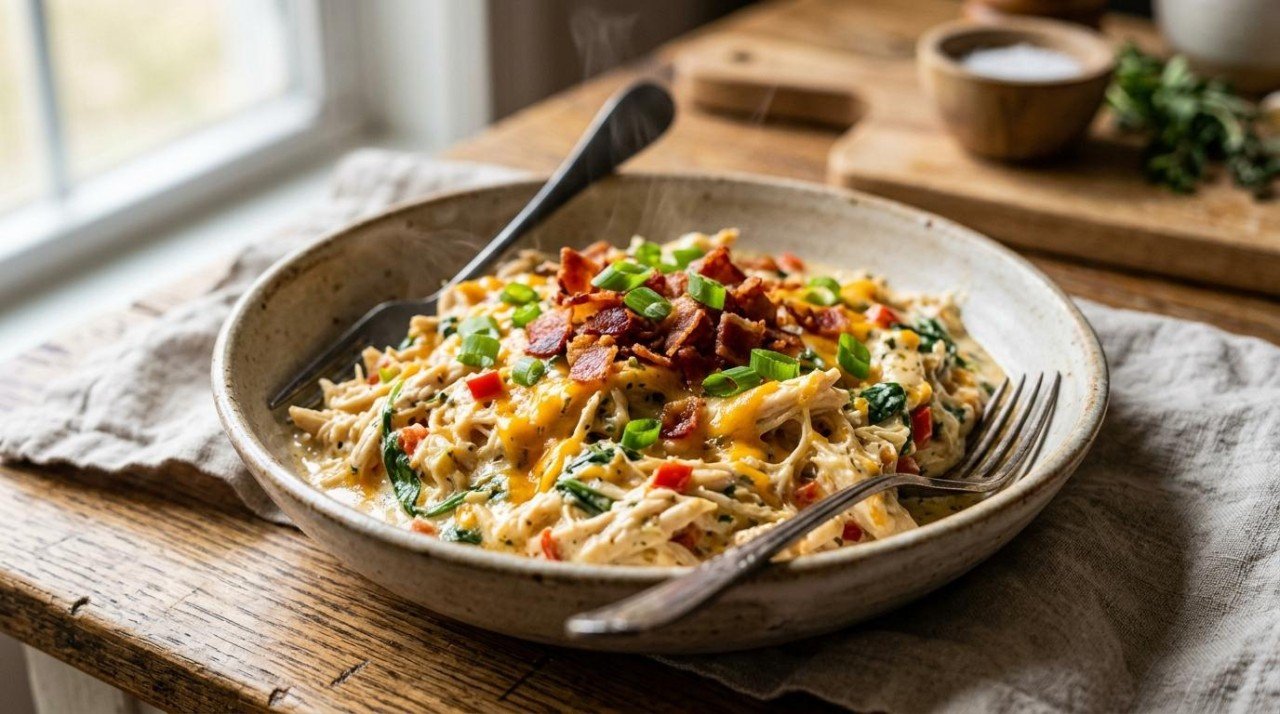
Crack chicken is four things in a slow cooker: chicken breasts, a block of cream cheese, a packet of ranch seasoning, and bacon. You come home, shred it with two forks, stir in cheddar, and pile it on rolls or into tortillas. It has been reposted into every slow cooker roundup on the internet, and the reason is obvious the first time you make it - it is creamy, salty, smoky, and it costs you about four minutes of actual work.
The slow cooker version most people cook is widely credited to the food blog Cookies and Cups, which posted its slow cooker crack chicken in February 2015 and still calls it the original. It shares its DNA with crack dip, the cream-cheese-and-ranch party dip that came before it, and it has been reeled and TikToked ever since. (We are going to keep calling it crack chicken here because that is what you searched for, but ours is really just a very good creamy ranch chicken.)
We ran the standard version through Eat Well Planner's Nutrition Score - the same at-a-glance number that shows on any public recipe page - and it came back 33 out of 100. Then we rebuilt it. Still creamy, still ranch, still has bacon on top, and it now scores 64. That is 31 points, and the single biggest swap was not the bacon or the cream cheese. It was the vegetables, worth 15 points on their own.
The original: what's in it and how it scores
Here is the version we scored, sized for six:
- 2 lb (907 g) boneless skinless chicken breasts
- 8 oz (227 g) block cream cheese
- 1 packet (1 oz / 28 g) dry ranch seasoning
- 8 oz bacon, cooked crisp and crumbled - about 3 oz (85 g) of crumbles once the fat renders out, which is what we actually scored
- 1 cup (113 g) shredded cheddar
Nutrition Score: 33/100. Now the diagnosis, because understanding why a recipe scores the way it does is what lets you fix your own. Per serving, the original runs about 474 calories, 46.7 g protein, 13.4 g saturated fat, roughly 830 mg sodium, and 0.5 g of fiber. Three things hold it down:
- Saturated fat is very high - 13.4 g a serving, 57% of a day's worth on the Nutrition Facts scale. The Dietary Guidelines cap saturated fat at less than 10 percent of calories, with the American Heart Association arguing for 7 percent, and one bowl of this is most of that. It comes from three places at once: the block of cream cheese, the cup of cheddar, and the bacon.
- Sodium is high - about 830 mg, 36% of the day, before you put it on a roll. Americans already average about 3,400 mg a day against a 2,300 mg ceiling, roughly 75% of it from commercially prepared food. Worth knowing: the ranch seasoning we scored carries about 1,290 mg of sodium across the whole batch, or 215 mg a serving. Hidden Valley's own label puts its packet at 60 mg per 1/4 teaspoon across about 36 servings - closer to 2,160 mg a packet. If that is the packet in your cupboard, your version is saltier than the one we scored.
- Nothing green, at all - 0.5 g of fiber, no vitamin C, and zero plant points. The score flags low plant diversity and low vitamin C, and it is right to. There is not a single plant in the recipe unless you count the dried herbs in the packet. Americans average about 15 g of fiber a day against the 25 to 35 g we need, and this dinner contributes half a gram to that.
What is already fine, and worth defending? More than you would guess. Two pounds of chicken breast across six people is 46.7 g of protein a serving, which makes this an excellent source of niacin (95% of the daily value), vitamin B6 (78%), phosphorus (74%), and pantothenic acid (39%). There is essentially no added sugar. Apart from the seasoning packet, nothing in it is ultra-processed - it is real chicken, real cheese, real bacon. The problem is not that crack chicken is junk. The problem is that it is three rich dairy-and-pork fats wrapped around a lean protein, with no plants anywhere near it.
The upgrades
Four swaps, scored cumulatively in the order below. They are ranked by score impact, so if you only make the first one, you have already taken half the total gain.
1. Put vegetables in it
- Swap: Add 1 diced yellow onion, 3 cloves garlic, 1 diced red bell pepper, 5 oz baby spinach, and 1/3 cup sliced green onions
- Score impact: +15 points (33 to 48)
- What it changes: Plant points go from 0 to 4.25, vitamin C from nothing to 42% of the daily value, fiber from 0.5 g to 1.6 g
- What it costs you: Ten minutes of chopping, and the color changes. It is no longer a uniform beige bowl
This is the whole post in one swap, and it is the one nobody makes. The score's two standing complaints about the original were low plant diversity and low vitamin C, and a single bell pepper plus a bag of spinach clears both - bell peppers are among the best vitamin C sources in the produce aisle, against a daily need of 75 mg for women and 90 mg for men. Nothing was taken away here. No fat was cut, no cheese was reduced. We only added, and the score moved 15 points.
Technique matters a little. The onion, garlic, and bell pepper go in at the start and cook down with the chicken until they disappear into the sauce. The spinach goes in at the very end and wilts in the residual heat in about three minutes - added early it turns gray and weepy. The green onions go on last, raw, for the bite. If you are cooking for people who claim not to like vegetables, this is a good dish to be sneaky in: everything except the pepper dissolves into the creaminess.
2. Homemade ranch seasoning instead of the packet
- Swap: 1 oz ranch packet to 1 tablespoon dried parsley, 2 teaspoons dried dill, 2 teaspoons onion powder, 2 teaspoons garlic powder, 1 teaspoon dried chives, 1 teaspoon black pepper, and 1/4 teaspoon salt
- Score impact: +3 points (48 to 51)
- What it changes: Sodium falls from about 860 mg to 750 mg a serving, and plant points rise from 4.25 to 5.75
- What it costs you: Two minutes with a jar, and you have to taste and season at the end rather than trusting a packet
This one surprised us, and the honest version of the finding is that the packet is not the villain everyone assumes it is. Trading it for a homemade blend is worth 3 points, not 15. Most of the sodium in this recipe is in the bacon and the cheese, not the seasoning. What the blend does buy you is control - and six more dried plants, which is not nothing when the score is grading plant diversity.
Mix a double batch and keep it in a jar; it is the same blend that makes a decent ranch dressing whisked into yogurt. Because you are now adding only 1/4 teaspoon of salt to the whole pot, taste the finished chicken before serving. Each extra 1/4 teaspoon you stir in adds roughly 95 mg of sodium a serving, which is a fair trade if the dish needs it - just make it a decision rather than an accident.
3. Greek yogurt for most of the cream cheese
- Swap: 8 oz cream cheese to 12 oz plain Greek yogurt plus 3 oz cream cheese
- Score impact: +4 points (51 to 55)
- What it changes: Saturated fat drops from 13.4 g to 9.2 g a serving, protein rises from 47.9 g to 52.3 g, calories fall from 491 to 448
- What it costs you: A tangier sauce, and one technique step you cannot skip
Greek yogurt gives you a similar creamy body with a fraction of the fat and more protein, and the tang actually suits ranch - buttermilk is the traditional backbone of ranch dressing, and yogurt reads as a cousin of it. Keeping 3 oz of cream cheese is what stops it tasting like a health food: cream cheese brings a dense, faintly sweet richness that yogurt alone does not have. Our cream cheese substitutes guide and Greek yogurt guide go deeper on where this trade works and where it does not.
The technique step: yogurt cannot go into a hot slow cooker. Heat makes its whey proteins denature and bind with the casein into visible clumps, and cultured dairy this lean has little fat coating those proteins to protect them. So: turn the cooker off, stir in the cream cheese and cheddar while it is still hot enough to melt them, wilt the spinach, then let the pot sit until it stops steaming. Stir a few spoonfuls of the hot sauce into the yogurt in a separate bowl first, then stir that back into the pot. Do that and it stays smooth. Dump cold yogurt into a bubbling cooker and it will break.
4. Bacon and cheddar become toppings, not layers
- Swap: 8 oz bacon down to 3 slices crumbled over the top, and 1 cup cheddar down to 3/4 cup sharp cheddar
- Score impact: +9 points (55 to 64)
- What it changes: Calories fall from 448 to 380, saturated fat from 9.2 g to 7.0 g, sodium from about 680 mg to 470 mg
- What it costs you: Less bacon in every bite. You get it in some bites instead of all of them, which is a real change
Here is the receipt that proves these numbers are live rather than decorative: we tested this exact cut on its own, applied to the untouched original, and it was worth 1 point. One. The same swap is worth 9 points here. A recipe carrying two loud caution flags does not reward you for quietly fixing part of one - you have to clear the flag. That is why the vegetables go first and the bacon goes last, and why "just use less bacon" as standalone advice does almost nothing.
Sharp cheddar is the small trick that makes the reduction survivable: it carries more flavor per gram than mild, so 3/4 cup of sharp tastes like more cheese than a full cup of mild does. Scatter both the cheese and the bacon over the top of the finished pot rather than stirring them through, and every serving still gets the smoky, salty hit that the dish is about. Our bacon guide and cheddar guide cover the alternatives, most of which we did not take.
Take the Guesswork Out of Eating Well
Eat Well Planner helps you organize your favorite recipes, plan balanced meals, and automatically generate shopping lists — all in one place. Whether you're tracking macros, managing dietary restrictions, or just trying to stop asking "what's for dinner?", we've got you covered.
Our AI-powered tools can adapt any recipe to your dietary needs, help you discover new meals you'll love, and even log your nutrition effortlessly. It's meal planning made simple.
Start Organizing Your Meals — FreeWhat we kept (on purpose)
The 3 oz of cream cheese stays, and that is the most expensive decision in this post. We scored the finished recipe with the cream cheese taken out entirely and replaced with more Greek yogurt, and it came back at 77 - thirteen points above the version we are publishing, with saturated fat at 4.3 g instead of 7.0 g. We turned it down anyway. Without cream cheese, the sauce goes thin and sour and the dish stops being crack chicken. Thirteen points is a lot, so here is the number in the open: if you want it and do not mind a tangier, lighter sauce, use 14 oz of Greek yogurt and no cream cheese. It is a good dinner. It is a different dinner.
The bacon stays too, even at 3 slices. Putting the whole 8 oz package back into the finished recipe scores 57, which is 7 points down - so the bacon really does cost something, just far less than its reputation suggests. Three slices is our line. The chicken breast stays whole and unmessed with, the cheddar stays real, and nothing here is a substitute pretending to be something it is not.
Where we stopped: at 64, with saturated fat (30% DV) and sodium (20% DV) both still flagged high. That is the honest ceiling for shredded chicken bound in cheese and topped with bacon. Every remaining point lives in the dairy and the pork, and taking those out means cooking something else for dinner.
The healthier version: full recipe
Nutrition Score: 64/100. Serves 6.
- 2 lb (907 g) boneless skinless chicken breasts
- 1 medium yellow onion (about 110 g), diced
- 3 cloves garlic, minced
- 1 red bell pepper (about 120 g), diced
- 1/4 cup water
- 1 tablespoon dried parsley
- 2 teaspoons dried dill
- 2 teaspoons onion powder
- 2 teaspoons garlic powder
- 1 teaspoon dried chives
- 1 teaspoon black pepper
- 1/4 teaspoon salt (about 1.5 g), plus more to taste
- 3 oz (85 g) cream cheese, cubed and at room temperature
- 3/4 cup (85 g) shredded sharp cheddar
- 5 oz (140 g) baby spinach
- 1 1/2 cups (12 oz / 340 g) plain Greek yogurt
- 1/3 cup (40 g) sliced green onions
- 3 slices bacon (about 25 g cooked), cooked crisp and crumbled
- Cook the bacon in a skillet until crisp, drain it on paper towels, and crumble it. Set it aside somewhere you will not eat it before dinner.
- Stir the parsley, dill, onion powder, garlic powder, chives, black pepper, and salt together in a small bowl.
- Put the chicken breasts in the slow cooker in a single layer. Scatter the onion, garlic, and bell pepper over and around them, add the water, and sprinkle the seasoning blend over the top.
- Cook on low for 5 to 6 hours or on high for 3, until the chicken pulls apart easily and reads 165F at the thickest point.
- Shred the chicken right in the pot with two forks and stir it through the vegetables and juices.
- Turn the slow cooker off. Stir in the cream cheese and cheddar while everything is still hot, until they melt into the sauce.
- Add the spinach in handfuls, put the lid back on for 3 to 4 minutes, then stir until it has wilted through.
- Let the pot sit uncovered for 5 to 10 minutes, until it has stopped steaming. This is the step that keeps the yogurt smooth.
- Put the yogurt in a bowl, stir a few spoonfuls of the hot sauce into it, then stir that mixture back into the pot. Taste, and add black pepper, a squeeze of lemon, or another pinch of salt if it needs lifting.
- Scatter the green onions and crumbled bacon over the top and serve - in whole wheat wraps, over brown rice or a baked potato, in lettuce cups, or straight out of the pot with a fork.
Per serving, original versus improved:
- Nutrition Score: 33 to 64
- Calories: 474 to 380
- Saturated fat: 13.4 g (57% DV) to 7.0 g (30% DV)
- Total fat: 27.5 g to 15.0 g
- Sodium: about 830 mg (36% DV) to about 470 mg (20% DV)
- Fiber: 0.5 g to 1.7 g
- Protein: 46.7 g to 47.4 g
- Vitamin C: none to 44% of the daily value
- Plant points: 0 to 5.75
The finished dish is an excellent source of vitamin K (125% DV), niacin (92%), vitamin B6 (90%), phosphorus (77%), protein (59%), vitamin C (44%), riboflavin (39%), potassium (27%), calcium (23%), magnesium (22%), and iron (21%). The gut health sub-score climbs from 22 to 54, and those 5.75 plants count toward the 30 different plant types a week associated with greater gut microbiome diversity in the American Gut Project. If you track plant points, one slow cooker just did a fifth of your week.
One optional stir-in, scored: add a drained 15 oz can of white beans with the spinach and the score goes from 64 to 73, with fiber jumping from 1.7 g to 4.5 g a serving. They melt into the creaminess and thicken the sauce, and you would struggle to identify them in a bite. We left them out of the main recipe because a can of beans is further from the dish you came here for than we were willing to go without telling you first. Nine points says it is worth considering.
Swaps we tested and skipped
- Blended cottage cheese instead of Greek yogurt: 57, seven points lower. This one genuinely surprised us, because blended cottage cheese is the internet's current favorite creamy swap and it carries more protein than yogurt. The problem is salt - cottage cheese is a salted cheese, and swapping it in pushed sodium back up from 470 mg to 630 mg a serving, which was enough to undo the gain. If cottage cheese is what is in your fridge, blend it smooth and use it; just reach for a low-sodium tub. Our cottage cheese guide has more on the swap.
- Turkey bacon instead of real bacon: 66, two points up. Technically a gain, and we still did not take it. Two points is the entire reward for giving up three slices of actual bacon on a dish whose reputation is built on it, and plenty of turkey bacon is just as salty as pork. If you already prefer turkey bacon, use it and take the 2 points. If you do not, you are not missing much.
- Cutting the bacon and cheddar first instead of last: 34, one point up. Worth stating twice, because it is the most useful thing in this post. The exact swap that is worth 9 points in the finished build is worth 1 point applied to the original. Order is not cosmetic - fix the missing plants first, and everything after it pays more.
Make it fit other diets
This dish is naturally gluten-free once the seasoning packet is gone, as long as what you serve it with is too - lettuce cups, a baked potato, or brown rice all work. For lower carb, it already is: the chicken mixture is under 10 g of carbs a serving, so the roll is the only decision to make. Dairy-free is the hard one, since three of the ingredients are dairy - a cashew-based cream cheese plus unsweetened coconut yogurt gets closest, with nutritional yeast for the savory depth the cheddar was providing. In Eat Well Planner, Recipe Variations does that rewrite in one step: ask for "make this dairy-free" on your saved copy and the whole recipe comes back with the substitutions worked in and rescored.
Do this to any recipe you love
Nothing above needed a nutrition degree. Every number came from the app: import the recipe, look at the Nutrition Score, then open Make It Healthier and the AI proposes swaps like these - with a calculator verifying the real nutritional gain before a suggestion is ever shown to you. The per-swap deltas came from the Recipe Playground, where you change one ingredient and watch the score move. Want the full block of cream cheese back? Put it in and see exactly what it costs, then make it up somewhere else.
Saw a version of this on TikTok, Instagram, or YouTube? Paste the link straight into Eat Well Planner and it pulls out the ingredients, instructions, and nutrition, then scores it before you cook it. If creamy, cheesy, slow-cooked comfort food is your genre, the same treatment on buffalo chicken dip is worth a read next. It is free, and it works on whatever is already in your rotation.