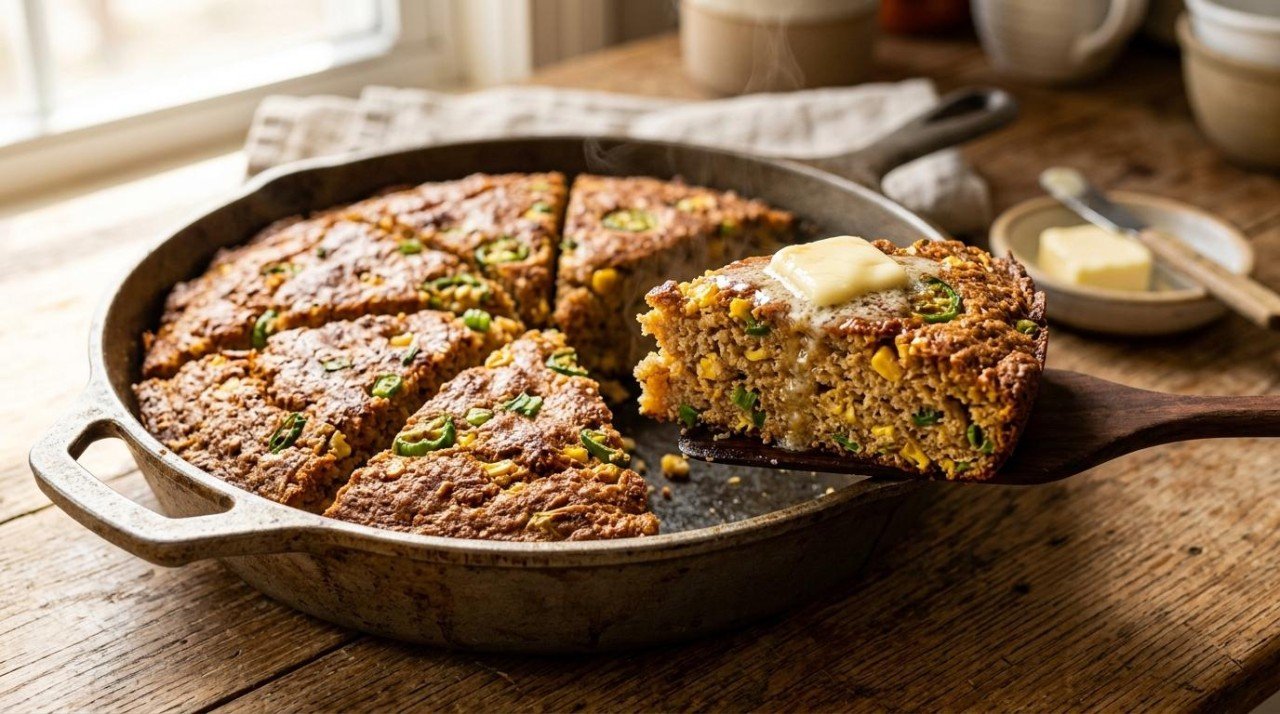
Cornbread is the rare American side dish that starts an argument. Sugar or no sugar. Skillet or pan. Flour or all cornmeal. People have opinions about cornbread that they do not have about, say, dinner rolls.
So we built the version most American home cooks actually bake - a sweet buttermilk cornbread with white flour, degerminated cornmeal, half a cup of sugar and a stick of butter - and ran it through Eat Well Planner's Nutrition Score. It came back at 24 out of 100, with three caution flags and, on the app's plant diversity count, a score of zero.
Then we rebuilt it one verified swap at a time and got to 68. Along the way the sugar argument got settled by the numbers in a way neither camp will love: cutting the sugar early was worth 2 points, and cutting the exact same sugar later was worth 10. Here is the whole build.
The original: what's in it and how it scores
We scored the composite that most popular sweet cornbread recipes converge on, baked in a 9-inch pan and cut into 9 pieces: 1 cup (122 g) degerminated yellow cornmeal, 1 cup (125 g) all-purpose flour, 1/2 cup (100 g) granulated sugar, 1 tablespoon baking powder, 1/2 teaspoon baking soda, 1 teaspoon salt, 1 cup (240 g) buttermilk, 2 large eggs and 1/2 cup (113 g) melted butter. Every number below is one piece.
Nutrition Score: 24/100. Per serving: 266 calories, 4.9 g protein, 33.9 g carbs, 0.9 g fiber, 11.1 g added sugar, 12.2 g total fat, 6.3 g saturated fat and 560 mg sodium. Three cautions fired at once - added sugar at 42% of a day's reference, saturated fat at 27%, and sodium at 25%.
The fiber number is the one worth sitting with. This is a bread made almost entirely of corn and wheat, and it delivers less than a gram of fiber per piece, at a moment when only 5% of American men and 9% of women hit the recommended fiber intake. That is not corn's fault. It is what degerminating does. Standard supermarket cornmeal has had the germ and the bran milled out for shelf life, which is why the Whole Grains Council tells shoppers to avoid labels that say "degerminated" when they are after actual whole grain. White flour has had the same operation done to it. Two grains in the bowl, neither of them whole.
The vitamins the app did surface - folate at 15% of a day's value, iron at 14%, riboflavin at 12% - are not the corn being generous. That is enrichment, put back into white flour by law after milling took it out.
Plenty here is fine, and we are not going to invent problems. The eggs, the butter and the buttermilk are real food. The sodium, at 25%, is high but unremarkable for a bread, and only about half of it is the salt - the baking powder and baking soda together contribute roughly another third. What holds this cornbread at a 24 is the combination the whole dish is built on: two refined grains, half a cup of sugar, and a stick of butter, with nothing in the pan that counts as a plant.
The upgrades
We applied these in order and re-scored after every one, so each number is what that change was worth at that point in the build. If you only make one, make the first.
1. Send both grains whole
- Swap: Degerminated cornmeal → stone-ground whole grain cornmeal, and all-purpose flour → whole wheat flour
- Score impact: +13 points (24 to 37)
- What it changes: Fiber from 0.9 g to 2.5 g per piece, plus the magnesium, thiamine and biotin that milling had removed
- What it costs you: A slightly heartier crumb and a shorter pantry life. The corn flavor gets better.
This is the whole makeover in one move, and it is also the cheapest one flavorwise. Whole grain cornmeal keeps the germ and the bran - Bob's Red Mill's stone-ground line is explicit about leaving them in - and the germ is where the corn oil and most of the corn taste live. Degerminated meal is milder because it has had the flavor removed along with the nutrition. The trade is storage: that same oil goes rancid, so whole grain cornmeal wants a cold cupboard or the freezer rather than a year on the shelf.
The wheat half is the part people flinch at, and in cornbread they should not. Cornmeal is already the coarse, assertive grain in this batter, and whole wheat flour hides behind it in a way it cannot hide in a white sandwich loaf. Rest the batter 15 minutes before it goes in the pan so the bran and the cornmeal both hydrate, and the grittiness people complain about does not show up. It is also the swap with the best evidence behind it: a meta-analysis of more than 786,000 people found 70 g of whole grains a day associated with a 22% lower risk of total mortality. (Our all-purpose flour substitutes guide covers the other options if whole wheat is not in the house.)
2. Put actual corn in the corn bread
- Swap: Add 1 cup (150 g) corn kernels and 2 seeded jalapenos (40 g)
- Score impact: +8 points (37 to 45)
- What it changes: Plant points from 2 to 4, fiber up to 3 g, and vitamin B6, niacin and pantothenic acid all cross into "good source" territory
- What it costs you: Nothing, unless what you wanted was plain cornbread. Then it costs you plain cornbread.
Eight points for adding food rather than removing it, which is the pattern in almost every one of these makeovers. Whole corn kernels bring fiber and moisture; the jalapenos bring vitamin C and a heat that reads as flavor in a batter about to lose most of its sugar. Both are doing double duty - they are the reason the reduced-sugar version below does not taste stripped.
The plant points matter more than they look. Eat Well Planner's Plant Points tracker is built on the microbiome research suggesting that 30 different plants a week beats any single superfood, and a side dish that ends this build with 5 distinct plants in it is doing real work on a number most people never get near. Frozen corn, thawed and patted dry, scores the same as fresh.
3. Most of the butter becomes olive oil
- Swap: 1/2 cup butter → 2 tablespoons butter plus 3 tablespoons olive oil
- Score impact: +3 points (45 to 48)
- What it changes: Saturated fat from 6.4 g to 2.8 g per piece - the saturated fat caution clears entirely - and 28 calories come off
- What it costs you: Less than you would think, because the butter that matters most is the butter you can smell
Only 3 points, and still worth doing, because it is what takes a caution flag off the label. Saturated fat is the one thing a stick of butter contributes at scale here, and the Harvard cohort work on olive oil found that replacing about 10 g a day of butter, margarine or dairy fat with olive oil was associated with lower total and cause-specific mortality across 92,383 people followed for nearly three decades.
Keep 2 tablespoons of real butter. Fat carries aroma, and the two tablespoons you can taste do more for the eating experience than the six you cannot. Use a mild olive oil rather than a peppery finishing one - a grassy Tuscan oil will fight the corn. Avocado oil behaves the same way on the score. (Our butter substitutes guide has the full ratio chart.)
4. Cut the sugar from 1/2 cup to 2 tablespoons
- Swap: 100 g granulated sugar → 25 g
- Score impact: +10 points (48 to 58)
- What it changes: Added sugar from 11.1 g to 2.8 g per piece, and the last big caution flag comes off
- What it costs you: The dessert quality. This is the swap people will argue with, and they should read the next paragraph before they do.
Here is the finding that surprised us. We tested this swap first, before anything else, on the untouched original: cutting the sugar from 1/2 cup to 2 tablespoons moved the score from 24 to 26. Two points. The identical swap, applied at this point in the build, is worth 10. The score is not measuring sugar in isolation - it is measuring what you get for the calories, and on a bread with no fiber and no plants, removing sugar just leaves a smaller pile of nothing. Once the grains are whole and there is a cup of corn in the pan, the sugar is finally the thing standing in the way.
The regional argument is worth acknowledging, because history is on the low-sugar side. Traditional Southern cornbread had no added sugar at all, and the reason was agricultural rather than moral: the dent corn grown across the Southeast was naturally sweeter, and stone milling preserved that sweetness. As breeding and industrial milling flattened it, sugar crept in to replace what the corn used to bring on its own. Which means the whole grain cornmeal back in step one is partly rebuilding the sweetness the sugar was hired to fake.
We kept 2 tablespoons rather than going to zero, on purpose. At zero sugar the same cornbread scores 67 - one point lower than at 2 tablespoons, which is inside the noise, so those two tablespoons are effectively free. Take them; they help the top brown. What is not free is going back up: at 1/4 cup (50 g) the added sugar caution returns and the score falls to 52. (Our white sugar substitutes guide covers swapping rather than cutting, if that is the direction you would rather go.)
5. Half the salt, a third less baking powder
- Swap: 1 teaspoon salt → 1/2 teaspoon, and 1 tablespoon baking powder → 2 teaspoons
- Score impact: +8 points (58 to 66)
- What it changes: Sodium from 520 mg to 350 mg per piece, clearing the final caution
- What it costs you: A noticeably less salty crumb, which the jalapenos and scallions cover
The same positional effect as the sugar, even more starkly. Cutting the salt on the untouched original was worth zero points - the score went 24 to 24, because trimming sodium on a bread carrying three caution flags only changes which flag you are looking at. Applied last, when it is the only flag left, the identical cut is worth 8.
Do not skip the baking powder half of this. Baking powder is sodium bicarbonate packed with dry acids that release carbon dioxide the moment they hit liquid, which is what makes a quick bread rise at all - and a full tablespoon of it puts about 105 mg of sodium into every piece, more than the butter does. Two teaspoons is the standard ratio for this much flour and cornmeal anyway, and the buttermilk and baking soda are already generating lift of their own: lactic acid meeting sodium bicarbonate is the reaction that made buttermilk cornbread a thing in the first place. For context on the total, the FDA puts the Daily Value for sodium at under 2,300 mg, against an American average of about 3,400 mg.
6. Three scallions
- Swap: Add 3 green onions (30 g), thinly sliced
- Score impact: +2 points (66 to 68)
- What it changes: A fifth plant point, and the vitamin K the app had been flagging as low
- What it costs you: Thirty seconds
Small, honest, and in the recipe because it is free. Jalapeno-scallion cornbread is a real Southern thing, not a health-blog invention.
Take the Guesswork Out of Eating Well
Eat Well Planner helps you organize your favorite recipes, plan balanced meals, and automatically generate shopping lists — all in one place. Whether you're tracking macros, managing dietary restrictions, or just trying to stop asking "what's for dinner?", we've got you covered.
Our AI-powered tools can adapt any recipe to your dietary needs, help you discover new meals you'll love, and even log your nutrition effortlessly. It's meal planning made simple.
Start Organizing Your Meals — FreeWhat we kept on purpose, and where we stopped
Two things we could have changed for more points and did not.
The last 2 tablespoons of butter. Dropping them and going to all olive oil scores 74 - six more points, verified. We are not doing it. Cornbread that has never met butter tastes like a corn muffin from a hospital cafeteria, and six points is not worth the thing the dish is famous for. This is the honest edge of the makeover: the score can go higher, and past this line it stops being the recipe you came for.
The buttermilk. Swapping it for plain Greek yogurt also scores 74, and adds nearly 2 g of protein per piece. It is a legitimate move and it works - thinned yogurt is acidic enough to react with the baking soda the same way buttermilk does. We kept the buttermilk because its lactic acid is what gives cornbread the tang people identify as cornbread, and because a cup of it is one pour instead of a mixing step. If you want those 6 points, thin 3/4 cup of Greek yogurt with 1/4 cup of milk and use it cup for cup. (More options in our buttermilk substitutes guide.)
The healthier version: full recipe
Nutrition Score: 68/100, up from 24, with no caution flags. Serves 9.
- 1 cup (122 g) stone-ground whole grain cornmeal, medium grind
- 1 cup (125 g) whole wheat flour
- 2 tablespoons (25 g) granulated sugar
- 2 teaspoons (8 g) baking powder
- 1/2 teaspoon (3 g) baking soda
- 1/2 teaspoon (3 g) fine salt
- 1 cup (240 g) buttermilk
- 2 large eggs
- 3 tablespoons (42 g) mild olive oil, divided
- 2 tablespoons (28 g) butter, melted
- 1 cup (150 g) corn kernels, fresh or frozen and thawed
- 2 medium jalapenos (40 g), seeded and finely chopped
- 3 green onions (30 g), thinly sliced
- Put a 10-inch cast iron skillet in the oven and heat it to 425°F. If you are using a 9-inch square pan instead, grease it and skip the preheating.
- Whisk the cornmeal, whole wheat flour, sugar, baking powder, baking soda and salt together in a large bowl.
- In a second bowl, whisk the buttermilk, eggs, melted butter and all but 1 teaspoon of the olive oil.
- Pour the wet into the dry and stir just until no dry streaks remain. A few lumps are correct; overmixing makes it tough.
- Fold in the corn, jalapenos and green onions. Let the batter rest 15 minutes so the bran and the cornmeal hydrate - this is what keeps a whole grain cornbread from tasting gritty.
- Pull the hot skillet out, brush it with the reserved teaspoon of oil, and pour in the batter. It should sizzle. Level the top.
- Bake 22 to 26 minutes, until the top is golden and a toothpick in the center comes out clean.
- Cool 10 minutes in the pan, then cut into 9 pieces. Best warm.
Per serving, original vs. improved:
- Nutrition Score: 24 → 68
- Calories: 266 → 217
- Protein: 4.9 g → 5.8 g
- Fiber: 0.9 g → 3.1 g
- Added sugar: 11.1 g → 2.8 g
- Saturated fat: 6.3 g → 2.8 g
- Sodium: 560 mg → 350 mg
- Plant points: 0 → 5
- Caution flags: 3 → 0
Swaps we tested and skipped
- Cutting the sugar first. Worth 2 points on the untouched original, 10 points in position. Order is not cosmetic in these builds.
- Cutting the salt first. Worth exactly zero on the original. The same cut, applied last, was worth 8.
- Whole grain cornmeal on its own. Only +4 when nothing else changes. It needs the whole wheat flour beside it to be worth the full 13.
- Going to zero sugar. Scores 67, a point below the 2-tablespoon version. There is no scoreboard reason to take the last two tablespoons out.
- All olive oil, no butter. Scores 74, and we still said no.
Make it fit other diets
Gluten-free: replace the whole wheat flour with an equal weight of a 1:1 gluten-free baking blend, or go all cornmeal (2 cups) for the denser, more traditional Southern crumb. Cornmeal is naturally gluten-free, but buy a bag labeled as such, because cross-contact at the mill is common. Dairy-free: use 1 cup of unsweetened soy or almond milk plus 1 tablespoon of lemon juice in place of the buttermilk, and swap the 2 tablespoons of butter for more olive oil. Vegan: the same dairy swap plus 2 flax eggs (2 tablespoons ground flaxseed stirred into 6 tablespoons water and rested 10 minutes).
Rather than working those out by hand, you can hand any recipe in Eat Well Planner to Recipe Variations and ask for a gluten-free or vegan rewrite. It returns the full adapted recipe with the substitutions already worked in, and you can score the result to see what the adaptation cost.
Do this to your own recipes
Nothing here required guessing. We imported a cornbread recipe, read its score, and let the app's Make It Healthier feature propose swaps - each one run through a calculator that verifies the actual nutritional gain before it is shown to you. Then we tested the order in the Recipe Playground, where you change one ingredient and watch the score move, which is the only reason we know that cutting the sugar first is worth 2 points and cutting it fourth is worth 10.
Your family's cornbread is not this cornbread. Maybe it has cheddar in it, or bacon fat, or a whole cup of sugar because that is how your grandmother made it. Import it, score it, and find out what your version is actually worth - then decide which of these six changes you are willing to make, and which one is the entire point of the recipe.