Coleslaw is the side dish nobody plans and everybody eats. It comes in the bucket with the chicken, it sits next to the pulled pork, it turns up in a deli container at every summer party. It is also, by weight, mostly raw cabbage — which is why the numbers surprise people when they finally look.
So we ran a standard creamy deli coleslaw through our Nutrition Score. It came back at 36 out of 100, with two flags: added sugar and sodium. The cabbage was never the problem. One serving carries about 253 calories, and roughly three quarters of them come from a single ingredient.
We rebuilt it to 74. The mayonnaise is still in there. It is still creamy, still tangy, still the thing you would put on a pulled pork sandwich without a second thought. Here is every swap, what each one was actually worth, the one that scored zero when we made it and three points by the end, and the version that scored 85 that we turned down on purpose.
The classic: what is in it and how it scores
The version we scored is the deli-counter standard, built to serve eight as a side:
- 1 medium head green cabbage, shredded (about 800 g)
- 2 medium carrots, grated (110 g)
- 1 cup mayonnaise (220 g)
- 1/4 cup granulated sugar (50 g)
- 2 tablespoons vinegar and 1 tablespoon lemon juice
- 2 tablespoons whole milk, to loosen it
- 1 teaspoon salt, 1/2 teaspoon black pepper
Per serving that is 253 calories, 1.5 g of protein, 21 g of fat, 3.2 g of saturated fat, about 490 mg of sodium, 6.4 g of added sugar, and 2.9 g of fiber. The score flags two of those: added sugar at 24% of a day's limit and sodium at 21%, both marked high.
Here is the arithmetic that explains the whole post. A cup of mayonnaise is close to 1,500 calories. A quarter cup of sugar is about 190. Together that is 84% of everything in the bowl. The two pounds of cabbage and carrot underneath it contribute about 12%. You are eating a dressing with a vegetable delivery system.
Now the part worth saying before we change anything, because the original is doing more than its reputation suggests. Per serving it is an excellent source of vitamin K (89% DV), omega-3 ALA (88% DV), and vitamin C (47% DV), plus a good source of vitamin A, folate, B6, and fiber. Some of that is the cabbage. Some of it — the vitamin K and essentially all of the ALA — is the mayonnaise, which in the American style is mostly soybean oil. The mayo is not a nutritional void. Keep that in mind for later.
There is one more thing the original has going for it that no cooked cabbage dish does: it is raw. Cabbage stores glucosinolates alongside an enzyme, myrosinase, that converts them into isothiocyanates when the cell walls are broken — which is exactly what shredding does. Heat wrecks the enzyme. In a 2021 study of 18 cabbage varieties, steaming and microwaving destroyed over 90% of myrosinase activity, with stir-frying retaining at most 65%, against raw cabbage as the control. Shredded raw cabbage sitting in acid is close to the best-case scenario for that chemistry.
So what drags it to 36? Three things, in order: 6.4 g of added sugar per serving in a savory side dish, a mayonnaise load so large it crowds everything else out of the calorie budget, and — for a dish built entirely from vegetables — a startling lack of plant variety. The whole bowl scores 2.25 plant points. It is cabbage and carrot, and that is it.
The upgrades: five swaps, 38 points
Each swap below is scored on top of the one before it, in the order we made them. If you only make one change, make the first one. If you make two, make the first and the last — the pepitas turned out to be worth almost as much as the dressing rebuild.
1. Half the mayonnaise becomes Greek yogurt
- Swap: 1 cup mayonnaise and 2 tablespoons milk → 1/2 cup mayonnaise, 1/2 cup plain nonfat Greek yogurt, and 1 tablespoon Dijon mustard
- Score impact: +11 points (36 to 47)
- What it changes: 87 calories off per serving, total fat from 21 g to 10.7 g, saturated fat from 3.2 g to 1.6 g, protein from 1.5 g to 2.7 g, and sodium from 490 mg to 430 mg, which is enough to clear the sodium flag
- What it costs you: A tang that is noticeable on the first forkful and gone by the third
Half, not all. This is the argument of the post in one line, and we tested the alternative — see the skipped swaps below, where dropping the mayonnaise entirely turned out to be worth exactly nothing on the score. Half the mayo keeps the fat that carries flavor across nearly two pounds of raw cabbage, and keeps the vitamin K and ALA that the score was already crediting. The yogurt buys back protein and thickness.
Two practical notes. Use plain Greek yogurt, not regular — Greek yogurt is strained to remove the whey, which is what makes it thick enough to stand in for mayonnaise at all. Nonfat is what we scored and it works here because the mayo is carrying the richness; whole-milk Greek yogurt scored 72 instead of 74, two points down and noticeably creamier, and either is a defensible choice. The Dijon is not decoration either. Mustard is a brassica seed, so it brings its own myrosinase to the bowl, and it emulsifies a dressing that would otherwise want to separate. Our mayonnaise substitutes guide and Greek yogurt substitutes guide cover the ratios for other dishes.
2. Cut the sugar from a quarter cup to a tablespoon
- Swap: 1/4 cup sugar → 1 tablespoon sugar, with the vinegar up from 2 tablespoons to 3
- Score impact: +11 points (47 to 58)
- What it changes: Added sugar from 6.3 g to 1.6 g per serving, clearing the added sugar flag entirely; another 19 calories off
- What it costs you: Less than you think, if you add the acid back. Straight sugar removal makes slaw taste flat.
A quarter cup of sugar in a savory side is a lot of sugar to walk past without noticing. The American Heart Association's limit is about 24 g a day for women and 36 g for men, and one scoop of the original slaw uses a quarter of a woman's daily allowance on a side dish. Cutting to a tablespoon puts it at 1.6 g.
The technique matters more than the number. Sugar in coleslaw is doing two jobs, sweetening and balancing the vinegar, so pulling it out without touching anything else leaves the dressing sour and thin. Raising the vinegar at the same time sounds backwards, but the extra acid gives your palate something bright to land on instead of something sweet, and the mustard fills in the middle. Use cider vinegar, which has a fruitiness white vinegar does not (our cider vinegar guide and sugar guide cover the trade-offs).
A footnote on order: we ran these two swaps the other way round as well, and cutting the sugar first was worth +7 with the dressing rebuild then worth +15. Different split, same destination — both routes land on exactly 58. That is not always true. In our pulled pork makeover the same salt and sugar cuts were worth 1 point in one position and 14 in another.
3. Turn two vegetables into six
- Swap: 800 g green cabbage and 110 g carrot → 400 g green cabbage, 250 g red cabbage, 150 g carrot, 1 large Granny Smith apple, 4 scallions, and 1/4 cup chopped parsley
- Score impact: +0 points at this stage (58 to 58) — but see below
- What it changes: Plant points from 2.25 to 5.5, vitamin A from 14% DV to 23% (good to excellent), vitamin K from 70% to 93%, potassium onto the highlights list
- What it costs you: Ten minutes with a knife. Nothing at the table — this is the swap that makes it taste better, not worse.
Zero points. We kept it anyway, and then we went looking for why.
Take the extra plants back out of the finished slaw and the score drops from 74 to 71. Apply the same swap alone to the untouched original and it is worth +3, from 36 to 39. So the plants really are worth about three points — they just landed at the one moment in the build where other things were moving against them. A swap's headline number is a snapshot of one position in one sequence, not a verdict on the ingredient.
And the score cannot see the part we care about most. Plant variety went from 2.25 to 5.5 different plants in a single side dish. The largest microbiome study to date found people eating more than 30 different plants a week had measurably more diverse gut bacteria than people eating 10 or fewer, and herbs count toward the total. Red cabbage earns its place twice over: USDA researchers identified 36 different anthocyanins in red cabbage, the pigments that make it purple, and green cabbage has essentially none of them. The apple is there for sweetness that arrives with fiber attached, which is a large part of how you get away with a tablespoon of sugar.
4. Halve the salt, and make the salt you keep work harder
- Swap: 1 teaspoon salt → 1/2 teaspoon, used to wilt the cabbage before dressing rather than stirred in at the end
- Score impact: +6 points (58 to 64)
- What it changes: Sodium from about 430 mg to 290 mg per serving, roughly 13% of a day's limit
- What it costs you: Genuinely nothing, because of where the salt goes
Most Americans get about 3,400 mg of sodium a day against a 2,300 mg ceiling, and the TOHP follow-up study found a 32% lower risk of developing cardiovascular disease in people who stayed under 2,300 mg than in those eating 3,600 to 4,800 mg. A side dish is a reasonable place to give some back.
The trick is timing. Toss the shredded cabbage with the half teaspoon of salt and let it sit in a colander for 30 minutes before it meets the dressing. Salt draws water out of the cabbage cells by osmosis, so the liquid that would otherwise leak into your dressing an hour after serving comes out first, and the cabbage ends up less fibrous and easier to chew. You get more seasoning impact and less sogginess from half the salt. If you want maximum crunch, use a full teaspoon, wait an hour, then rinse and pat dry — that method removes even more sodium than we counted, because most of the salt goes down the drain with the water. Our scored 290 mg is a ceiling, not a floor.
5. A handful of toasted pepitas
- Swap: Add 1/3 cup toasted pumpkin seeds (40 g)
- Score impact: +10 points (64 to 74)
- What it changes: Protein from 2.9 g to 4.4 g per serving, fiber from 3.35 g to 3.6 g, and magnesium, phosphorus, iron and riboflavin all onto the highlights list
- What it costs you: 29 calories a serving, and you have to remember to toast them
The biggest surprise of the build. A third of a cup of pepitas across eight servings is barely a tablespoon each, and it moved the score ten points — more than halving the mayonnaise did. Pumpkin seeds are about 30% protein and dense in minerals that a bowl of cabbage has nothing of; Harvard notes that most Americans of all ages eat less magnesium than recommended, and pepitas are one of the better food sources.
They also fix a real textural problem: creamy slaw is uniformly soft, which is why it gets boring halfway through a serving. Sunflower seeds are the more traditional choice and we scored those too — 72 instead of 74, so two points behind and honestly interchangeable. Toast either in a dry pan for three or four minutes, and add them at the table rather than in the bowl, or they soften.
What we kept, and where we stopped
Half a cup of real mayonnaise stayed, and so did a tablespoon of real sugar — worth zero points either way, kept for the reason you would expect. Halving the mayo did cost something, and it is only fair to name it: omega-3 ALA went from 88% DV per serving to 51%. That is a real reduction, still comfortably in excellent-source territory, and it is the price of the 87 calories and half the saturated fat. Vitamin K went the other way and rose from 89% to 93%, because the extra cabbage and parsley more than covered the mayo we took out.
We stopped at 74 because the next move on the board was to remove the mayonnaise completely, and that is where a coleslaw makeover stops being a coleslaw makeover.
Take the Guesswork Out of Eating Well
Eat Well Planner helps you organize your favorite recipes, plan balanced meals, and automatically generate shopping lists — all in one place. Whether you're tracking macros, managing dietary restrictions, or just trying to stop asking "what's for dinner?", we've got you covered.
Our AI-powered tools can adapt any recipe to your dietary needs, help you discover new meals you'll love, and even log your nutrition effortlessly. It's meal planning made simple.
Start Organizing Your Meals — FreeThe healthier version: full recipe
Nutrition Score: 74/100. No caution flags. Serves 8 as a side.
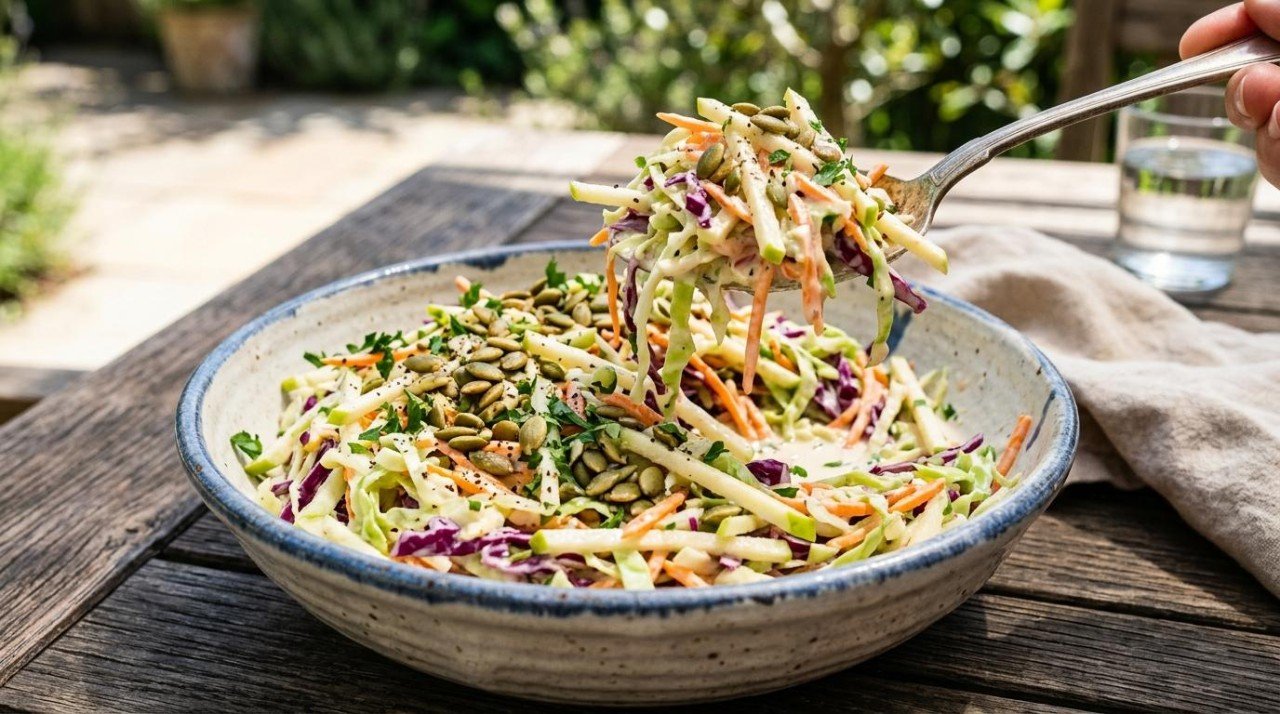
- 5 cups shredded green cabbage (400 g, about half a medium head)
- 3 cups shredded red cabbage (250 g)
- 2 medium carrots, coarsely grated (150 g)
- 1 large Granny Smith apple, cut into matchsticks (180 g)
- 4 scallions, thinly sliced (60 g)
- 1/4 cup chopped flat-leaf parsley (15 g)
- 1/2 teaspoon fine salt (3 g)
- 1/2 cup mayonnaise (110 g)
- 1/2 cup plain nonfat Greek yogurt (110 g)
- 1 tablespoon Dijon mustard
- 3 tablespoons apple cider vinegar
- 1 tablespoon lemon juice
- 1 tablespoon granulated sugar (12 g)
- 1/2 teaspoon black pepper
- 1/3 cup raw pumpkin seeds (40 g)
- Shred both cabbages as thinly as you can manage — a sharp knife beats a food processor here, which tends to bruise the leaves. Toss them in a colander with the 1/2 teaspoon of salt, set the colander in the sink or over a bowl, and leave for 30 minutes.
- While the cabbage drains, toast the pumpkin seeds in a dry skillet over medium heat for 3 to 4 minutes, shaking the pan, until they puff and smell nutty. Tip them onto a plate to cool — they will keep crisping as they sit.
- Whisk the mayonnaise, Greek yogurt, Dijon, cider vinegar, lemon juice, sugar, and black pepper together in a large bowl until smooth. Taste it. It should be sharper than you want the finished slaw to be, because the cabbage will mellow it.
- Squeeze the drained cabbage firmly in handfuls over the sink and add it to the bowl. Do not rinse it — the salt is your seasoning.
- Add the carrot, apple, scallions, and parsley and toss until everything is coated. Cut the apple last so it does not brown, or toss it in a little of the lemon juice first.
- Chill for at least 30 minutes and up to 4 hours. Stir in half the pepitas just before serving and scatter the rest over the top.
Per serving, original to improved:
- Nutrition Score: 36 → 74
- Calories: 253 → 190
- Protein: 1.5 g → 4.4 g
- Total fat: 21.0 g → 12.7 g
- Saturated fat: 3.2 g → 2.0 g
- Sodium: 490 mg → 290 mg (21% DV, flagged high → not flagged)
- Added sugar: 6.4 g → 1.6 g (24% DV, flagged high → not flagged)
- Fiber: 2.9 g → 3.6 g
- Plant points: 2.25 → 6.5
- Gut health sub-score: 44 → 83
The finished slaw is an excellent source of vitamin K, omega-3 ALA, vitamin C, and vitamin A, and a good source of phosphorus, vitamin B6, fiber, magnesium, potassium, folate, iron, and riboflavin — with no caution flags left on the board.
Swaps we tested and skipped
Going vinegar-only. Scored 85 — eleven points higher than the version we published. Same vegetables, same pepitas, 3 tablespoons of olive oil and extra cider vinegar in place of the mayo and yogurt. It is the highest number anything generated in this build, it is a genuinely great dish, and it is not coleslaw as most people mean it. It is also, historically, the original: a 1667 Dutch cookbook records shredded cabbage dressed with melted butter, vinegar and oil, long before mayonnaise existed to be poured over it. Worth making. Not worth pretending it is the same food.
Dropping the mayonnaise entirely for all Greek yogurt. Scored exactly the same. Tested at the same point in the build, half-mayo scored 64 and all-yogurt also scored 64. Giving up the mayonnaise bought precisely zero points, which is the clearest possible answer to whether you need to. It does halve the calories again, to 76 a serving, so if that is your goal it is on the table — but the score will not thank you for it.
Cutting the last tablespoon of sugar. Scored 64, unchanged. Zero points. Kept it.
Whole-milk Greek yogurt instead of nonfat. Scored 72, two points down. Not really a rejection — the two points buy you a noticeably richer dressing, and that is a fair trade if you want it.
And if you want the two-minute version: leave the original recipe exactly as it is and only cut the sugar and the salt. That alone scores 51, up 15 points, for changes that take no extra shopping and no extra chopping.
Make it fit other diets
- Vegan or dairy-free: Use a plant-based mayo and swap the Greek yogurt for unsweetened coconut or soy yogurt, or skip the creamy dressing altogether and make the vinegar version above, which is vegan as written.
- Egg-free: Same fix — vegan mayonnaise, everything else unchanged.
- Gluten-free: Already is, as long as your Dijon is certified (most are).
In the app you can skip the mental arithmetic: open any recipe, ask AI Recipe Chat to make it dairy-free, and Recipe Variations writes the whole thing out with the substitutions worked in — then rescores it so you can see what the swap cost.
Do this to your own recipes
Nothing here required nutrition expertise. It required knowing which number moved when. Import a recipe into Eat Well Planner — from a website, an Instagram reel, a YouTube video, or a photo of a card in your grandmother's handwriting — and it gets a Nutrition Score with the specific things holding it back named out loud. Make It Healthier then proposes swaps like these, and a calculator verifies the actual nutritional gain before a suggestion is ever shown to you, so nothing reaches you that only sounds healthier.
And if you want to argue with it, the Recipe Playground is where we ran every number in this post. Change one ingredient, watch the score move, keep what you can live with. Want the full cup of mayonnaise back? Put it in and see what it costs — then decide whether the pepitas make it up.