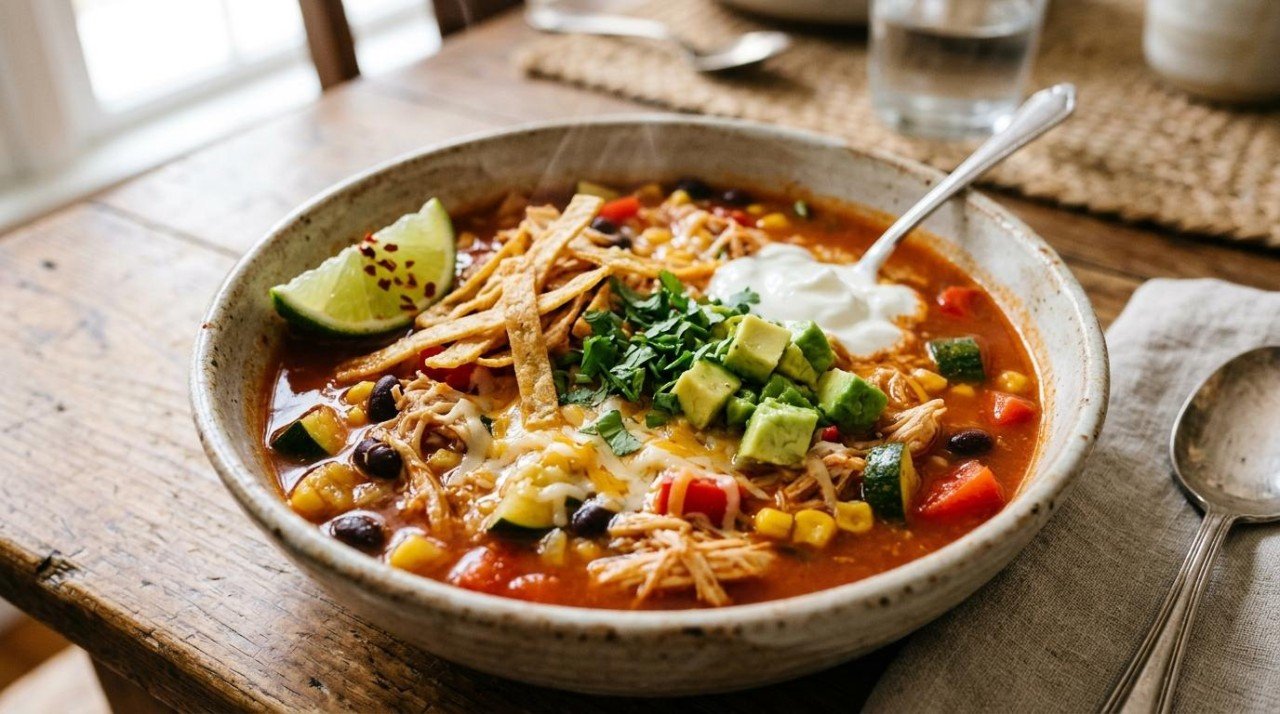
Chicken tortilla soup is one of the best weeknight soups there is. A smoky tomato-chili broth, shredded chicken, black beans and corn, then a pile of crunchy tortilla strips, melted cheese, a spoonful of sour cream and some avocado on top. It is on half the restaurant menus in America and in a lot of slow cookers once the weather cools down.
It is also already a pretty healthy soup, and the score agrees. We ran a standard homemade version through Eat Well Planner's Nutrition Score, the same number a visitor sees on any public recipe page, and it scored 61 out of 100. That is one of the highest starting scores we have seen in this series. It has beans, corn, tomatoes, peppers and lean chicken, and it already delivers about 10 g of fiber and 35 g of protein a bowl.
So we did not rebuild this soup. We changed four things, and it scored 93. Three of those changes are cans you buy differently, and the fourth is the topping. The strips stay crunchy, the cheese stays melty, and every swap below carries the exact score change it earned. Three more tweaks we expected to matter scored zero, and we explain why.
The original: what's in it and how it scores
Our standard version follows the most common pattern among popular recipes like Cooking Classy's and Spend With Pennies', with the toppings most people actually pile on. It serves six:
- 1 tablespoon olive oil, 1 onion, 1 jalapeño and 4 cloves garlic
- 1 tablespoon chili powder and 2 teaspoons ground cumin
- 1 (32 oz) carton regular chicken broth
- 1 (15 oz) can tomato sauce and 1 (14.5 oz) can diced tomatoes
- 1 1/2 cups frozen corn and 1 (15 oz) can black beans, drained
- 1 1/4 lb boneless skinless chicken breast
- Cilantro, lime juice and about 2/3 teaspoon salt
- Toppings: 6 corn tortillas cut into strips and fried, 1 cup shredded Monterey Jack, 3/4 cup sour cream and 1 avocado
Nutrition Score: 61/100. Each bowl, with toppings, has about 532 calories, 35.3 g protein, 10 g fiber, 26.4 g total fat, 9.1 g saturated fat and 1,690 mg sodium. Two flags hold it down:
- Sodium, flagged very high. 1,690 mg is 74% of the daily value in one bowl. The FDA sets the daily value at less than 2,300 mg, says diets higher in sodium are associated with an increased risk of high blood pressure, and notes that over 70% of the sodium Americans eat comes from packaged and prepared foods. This soup is a perfect example. Per bowl, about 590 mg comes from the broth, 330 mg from the tomato sauce, 160 mg from the beans and 90 mg from the diced tomatoes. The salt shaker adds about 260 mg. The cans put in more than four times what the shaker does.
- Saturated fat, flagged high. 9.1 g is 39% of the daily value. Almost all of it comes from two toppings: the sour cream (about 3.2 g a bowl) and the cheese (about 3.6 g).
Everything else is in good shape. The original is already an excellent source of vitamin B6, niacin, iron, protein, potassium and fiber (34% of the daily value), and it has 9 different plants in one bowl. The soup itself is fine. What drags the score down is what comes in the cans and what goes on top.
The upgrades
We applied the swaps cumulatively in this order. The first four are the whole makeover. The last three scored zero and made the cut for other reasons.
1. Greek yogurt instead of sour cream
- Swap: 3/4 cup sour cream → 3/4 cup plain low-fat Greek yogurt
- Score impact: +9 points (61 → 70)
- What it changes: Saturated fat drops from 9.1 g to 5.9 g a bowl, about 40 calories come off, and protein goes up 2 g
- What it costs you: A tangier dollop. On a hot, smoky soup with lime, most people do not notice
If you only make one change, make this one. It is the only swap that scored well on the untouched original, because sour cream is the single biggest source of saturated fat in the bowl. Since it goes on cold as a topping, you do not have to worry about Greek yogurt curdling the way it can when it is boiled into a sauce. For something closer to crema, stir in a squeeze of lime and a splash of water so it drizzles. Putting the sour cream back into the finished soup costs 12 points (93 → 81). Going half sour cream, half yogurt scores 87, a good middle ground if you are not sold yet. Our sour cream substitution guide covers other options.
2. Unsalted chicken stock instead of regular broth
- Swap: 4 cups regular chicken broth → 4 cups unsalted chicken stock
- Score impact: +0 points at this point (70 → 70), but putting the regular broth back at the end costs 15
- What it changes: Sodium drops from 1,690 mg to 1,140 mg a bowl
- What it costs you: Nothing. The chili powder, cumin, jalapeño and lime carry the flavor
This swap cut 550 mg of sodium per bowl and did not move the score at all, and that is not an error. At 1,140 mg, the soup was still well into "very high" sodium territory, so the score had nothing new to reward yet. But in the finished soup, putting the regular broth back drops it from 93 to 78, the biggest put-back penalty in this whole makeover. We see this pattern in almost every recipe in the series: a sodium fix only pays off once the rest of the sodium is fixed too. So do not judge a swap by the first number you see.
Check the label for "unsalted" or "no salt added." The FDA's definition of "reduced sodium" only means at least 25% less than the regular product, so a reduced-sodium broth can still be salty. Our chicken broth substitution guide has more swaps.
3. No-salt-added tomato sauce and diced tomatoes
- Swap: Regular canned tomato sauce and diced tomatoes → the no-salt-added versions of both
- Score impact: +15 points (70 → 85)
- What it changes: Sodium drops from 1,140 mg to 730 mg a bowl
- What it costs you: Nothing you will taste once the soup is seasoned. The cans cost the same and sit right next to the regular ones
This was the biggest single jump, and the tomato sauce was the hidden reason. A 15 oz can of regular tomato sauce has about 2,000 mg of sodium, close to a full day's worth, and it is the second-saltiest ingredient in the pot after the broth. The diced tomatoes add much less. In the finished soup, going back to regular tomato sauce alone costs 7 points, and going back to both regular cans costs 10.
On the original, this swap was worth just +1. Here it is worth +15, because with the broth already fixed, the tomatoes are what finally bring the sodium down out of the "very high" range.
4. No-salt-added black beans
- Swap: Regular canned black beans → no-salt-added black beans
- Score impact: +8 points (85 → 93)
- What it changes: Sodium drops from 730 mg to 570 mg a bowl, and the high-sodium flag clears completely
- What it costs you: Nothing. Drain and rinse them either way
This is the last swap the score really cares about. After this, every remaining sodium source is small. If your store does not carry no-salt beans, see step 5. You can trade this swap for less salt and get the same score. Our black beans guide lists the best stand-ins if you are out.
5. Halve the salt
- Swap: About 2/3 teaspoon salt → 1/4 teaspoon, added at the end and adjusted to taste
- Score impact: +0 points (93 → 93)
- What it changes: Sodium drops from 570 mg to 410 mg a bowl, 18% of the daily value
- What it costs you: Taste before adding more. The cheese is salty too
Once the beans are fixed, the salt does not move the score: no salt at all also scored 93. But the beans and the salt are interchangeable. Keep regular beans or the full salt and the score stays at 93. Put both back and it drops to 86. Think of it as a sodium budget. You can spend it on the beans or on the shaker, but not on both.
6. Bake the tortilla strips
- Swap: Strips fried in about 1/4 cup oil (roughly 2 tablespoons absorbed) → tossed in 1 tablespoon canola oil and baked
- Score impact: +0 points (93 → 93)
- What it changes: About 20 fewer calories and 2 g less fat a bowl
- What it costs you: Baked strips are a little drier and less puffy than fried ones. They are still very crunchy
We expected the frying to matter, and it did not. Frying the strips in the finished soup also scores 93. That matches what we found with fish tacos, fish and chips and other dishes in this series: the fryer is rarely the problem. Corn tortillas are whole grain and low in sodium, and the oil they absorb carries vitamin E and plant omega-3s that the score gives credit for. We bake them anyway because a sheet pan is easier than a pot of hot oil on a weeknight. If you love them fried, fry them. Store-bought tortilla chips, crushed, scored 91, mostly because of the added salt. Our tortilla substitution guide covers the differences between corn and flour.
7. Add a zucchini and a red bell pepper
- Swap: Add 1 diced zucchini and 1 diced red bell pepper with the onion
- Score impact: +0 points (93 → 93)
- What it changes: Vitamin C jumps from 35% to 80% of the daily value, potassium goes up 120 mg, and you add 2 more plants (11 in all)
- What it costs you: Nothing. They melt into the broth and make the pot go further
Another zero we kept on purpose. The original already scored well on vegetables, so the score had little left to reward. The vitamin C and the extra plants are still real. If you are working toward 30 plants a week, this soup now gets you 11 different plants in one bowl.
What we kept (on purpose)
- The full cup of cheese. We tested halving it, and the score went down a point (92), likely because the cheese carries protein and calcium, and the saturated fat flag was already under control. Cotija in place of Jack also scored 92, and no cheese scored 91. A cup of Monterey Jack across six bowls is what makes this soup worth eating, so it stays.
- The avocado. Leaving it off scored 94, one point higher, most likely because avocado is calorie-dense. We kept it anyway. Besides being half the fun, avocado helps your body absorb the carotenoids from the tomatoes and peppers. In a Journal of Nutrition study, adding avocado to salsa raised lycopene absorption 4.4-fold and beta-carotene absorption 2.6-fold. One point is a good trade for that.
- The chili powder. Regular chili powder blends contain a little salt, so we tested a salt-free mix of ancho chile and oregano. It scored 93, the same. Use what is in your cupboard.
- The corn tortillas. They are already the right choice.
Take the Guesswork Out of Eating Well
Eat Well Planner helps you organize your favorite recipes, plan balanced meals, and automatically generate shopping lists — all in one place. Whether you're tracking macros, managing dietary restrictions, or just trying to stop asking "what's for dinner?", we've got you covered.
Our AI-powered tools can adapt any recipe to your dietary needs, help you discover new meals you'll love, and even log your nutrition effortlessly. It's meal planning made simple.
Start Organizing Your Meals — FreeThe healthier version: full recipe
Nutrition Score: 93/100 (up from 61). Serves 6, about 2 cups of soup per bowl plus toppings.
Ingredients
Soup
- 1 tablespoon olive oil
- 1 medium yellow onion, diced (about 1 cup)
- 1 jalapeño, seeded and minced
- 1 medium zucchini, diced (about 1 1/2 cups)
- 1 red bell pepper, diced
- 4 cloves garlic, minced
- 1 tablespoon chili powder
- 2 teaspoons ground cumin
- 4 cups unsalted chicken stock
- 1 (15 oz) can no-salt-added tomato sauce
- 1 (14.5 oz) can no-salt-added diced tomatoes
- 1 1/4 lb boneless skinless chicken breasts
- 1 (15 oz) can no-salt-added black beans, drained and rinsed
- 1 1/2 cups frozen corn
- 1/4 cup chopped fresh cilantro, plus more for serving
- 1 tablespoon fresh lime juice, plus lime wedges for serving
- 1/4 teaspoon salt, plus more to taste
Strips and toppings
- 6 small corn tortillas, cut into 1/4-inch strips
- 1 tablespoon canola oil
- 1 cup (4 oz) shredded Monterey Jack
- 3/4 cup plain low-fat or nonfat Greek yogurt
- 1 ripe avocado, diced
Instructions
- Heat the oven to 400°F. Toss the tortilla strips with the canola oil on a rimmed baking sheet and spread them in a single layer. Bake for 10 to 14 minutes, stirring halfway, until golden and crisp. They crisp up more as they cool.
- Meanwhile, heat the olive oil in a large pot over medium heat. Add the onion, jalapeño, zucchini and bell pepper and cook, stirring now and then, until softened, 6 to 8 minutes. Add the garlic, chili powder and cumin and stir for 1 minute, until fragrant.
- Add the stock, tomato sauce and diced tomatoes and bring to a boil. Add the whole chicken breasts, lower the heat, cover and simmer until the chicken reaches 165°F in the center, 15 to 20 minutes.
- Move the chicken to a cutting board and shred it with two forks. Return it to the pot with the beans and corn and simmer 5 minutes more.
- Turn off the heat and stir in the cilantro, lime juice and 1/4 teaspoon salt. Taste and add more salt only if it needs it.
- Thin the Greek yogurt with a squeeze of lime and a teaspoon or two of water if you want it drizzly. Ladle the soup into bowls and top each with tortilla strips, cheese, a spoonful of yogurt, avocado and extra cilantro. Serve with lime wedges.
Store the strips separately in an airtight container so they stay crunchy. The soup keeps 4 days in the fridge and freezes well without the toppings.
Per bowl: original vs. healthier
- Nutrition Score: 61 → 93
- Calories: 532 → 523
- Sodium: 1,690 mg → 410 mg
- Saturated fat: 9.1 g → 5.6 g
- Total fat: 26.4 g → 19.3 g
- Protein: 35.3 g → 40.4 g
- Fiber: 10.0 g → 10.5 g
- Potassium: 1,250 mg → 1,430 mg
- Plant points: 9 → 11
The finished soup is an excellent source of protein (50% of the daily value), vitamin B6 (86%), vitamin C (80%), potassium (42%), folate (38%), fiber (35%) and magnesium (35%). The only caution left is saturated fat, at 24% of the daily value. That comes mostly from the cheese, and we decided it was worth keeping. Calories stay almost exactly the same. This makeover was never about calories. It cut about 1,280 mg of sodium per bowl, which is more than half a day's limit.
Swaps we tested and skipped
- Halving the cheese, or switching to cotija. Both scored 92, one point lower, as covered above.
- A second can of beans. It pushed fiber to 13.4 g and protein to 43.9 g a bowl, but it scored 92 because it also added about 55 calories a bowl. It is a fine choice if you want a heartier soup, but it is not an upgrade by the numbers.
- Crushed store-bought tortilla chips. They scored 91. They are a fine shortcut, but baking your own strips takes 12 minutes and keeps the salt down.
- Skipping the avocado. It scored 94, but we kept the avocado for the reasons above.
Make it fit other diets
- Vegetarian: Use unsalted vegetable stock and a second can of no-salt-added black or pinto beans instead of the chicken.
- Dairy-free: Skip the cheese and yogurt and add more avocado, or use a plain unsweetened dairy-free yogurt.
- Gluten-free: It already is, as long as your tortillas are 100% corn and your chili powder is labeled gluten-free.
Eat Well Planner's Recipe Variations can rewrite this exact recipe for any of these in one step, or you can ask the AI recipe chat for the swap you need.
Do this to any recipe
This one was a good recipe with a sodium problem hiding in the cans, and you can only see that by checking the numbers. Import any recipe from a website, Instagram reel or YouTube video, see its Nutrition Score, and tap Make It Healthier. The app suggests swaps like these and checks each gain with a calculator before showing it to you. Want to keep the sour cream? Open the recipe in the Recipe Playground to see what it costs, then make up the points somewhere else. It is your soup, and now you know where the points are.