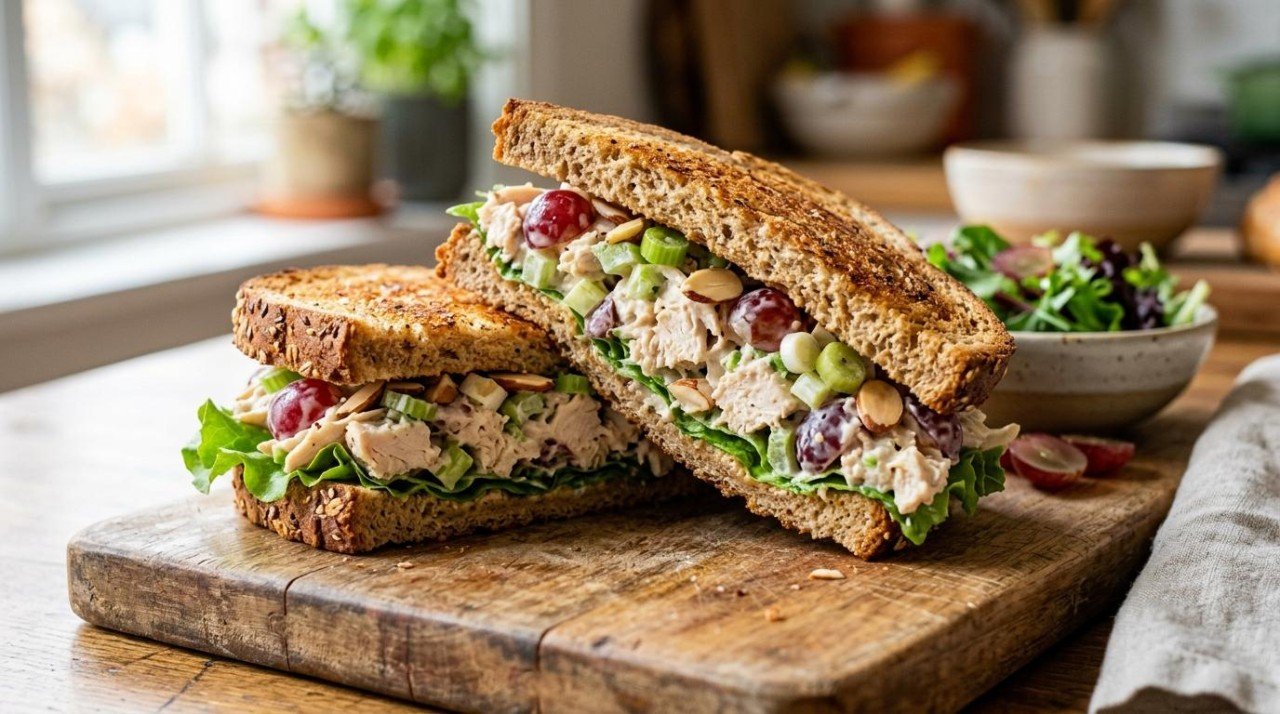
Chicken salad is one of the great uses of leftover chicken. Cold, creamy, a little sharp, ready in the time it takes to shred a breast and open a jar — it is the sandwich you make when you want lunch to be good without wanting lunch to be a project. Every deli counter in America has a version, and most of them are built the same way: shredded chicken, a lot of mayonnaise, a little celery, salt, white bread.
We ran a standard version through Eat Well Planner's Nutrition Score — the same at-a-glance number you see on any public recipe page — and it came back 42 out of 100. Then we rebuilt it to 75 out of 100, and it is still a cold, creamy chicken salad sandwich, still bound with real mayonnaise. That is 33 points, and every swap below carries the real, verified score change it earned.
The surprise is which swap did the most work. It was not cutting the mayonnaise. The biggest single gain in the whole makeover came from a change that added 80 calories per sandwich.
The original: what's in it and how it scores
Here is the version we scored, making four sandwiches:
- 1 lb (450 g) cooked chicken breast, shredded
- 1 cup (220 g) mayonnaise
- 1/2 cup (60 g) diced celery
- 1/4 cup (40 g) minced onion
- 1/2 teaspoon salt, black pepper
- 8 slices white sandwich bread
Nutrition Score: 42/100. Now the diagnosis, because knowing why a recipe scores the way it does is the skill that transfers to your own recipes. Per sandwich, the original runs about 688 calories, 40.2 g protein, 46.4 g total fat, 7.7 g saturated fat, 940 mg sodium, and 1.9 g fiber. Two flags come up, and one big absence:
- Sodium is high — 940 mg per sandwich, 41% of a day's Daily Value in one lunch. About 300 mg of that is the added salt — we measured it later by taking it out. The other two thirds is the bread, which is quietly one of the saltiest things most people eat by volume, and the mayonnaise, which carries more sodium than its reputation suggests.
- Saturated fat is high — 7.7 g, 33% of a day's worth, almost all of it from a quarter cup of mayonnaise per person.
- There is almost no fiber and almost no plant diversity — 1.9 g of fiber and just 2.25 plant points. Half a cup of celery split four ways is a garnish, not a vegetable serving — and a Lancet series of meta-analyses found the greatest reduction in risk across all-cause mortality, heart disease, stroke, type 2 diabetes and colorectal cancer at daily fiber intakes of 25 to 29 g.
What is already fine here, and worth defending? A great deal. Protein is excellent at 40.2 g per sandwich, which is more than most lunches manage and the main reason chicken salad keeps you full. It is an excellent source of vitamin B6 (104% DV) and niacin (98% DV) before we touch anything. And mayonnaise — which gets treated as a villain by default — is mostly soybean or canola oil, so it is largely unsaturated fat, not the artery-clogging brick people assume. The original's problem is quantity and absence, not one evil ingredient.
One structural note that explains the order below. Eat Well Planner flags a nutrient as high at 20% of its daily ceiling. The original is at 41% for sodium and 33% for saturated fat, so it carries two flags. Clearing a flag is worth more to the score than shaving a number that stays flagged, which is why the last two swaps — both small — pay as well as they do.
The upgrades
Five swaps, applied cumulatively in this order. If you only make one, make the second — it is the biggest single jump in the list, and it is an addition, not a subtraction.
1. Swap half the mayonnaise for Greek yogurt
- Swap: 1 cup mayonnaise → 1/2 cup mayonnaise + 1/2 cup plain Greek yogurt
- Score impact: +7 points (42 → 49)
- What it changes: 168 fewer calories per sandwich, total fat from 46.4 g to 26.2 g, saturated fat from 7.7 g to 4.8 g, and protein up from 40.2 g to 42.7 g
- What it costs you: A faint tang. Genuinely close to free at this ratio
A cup of mayonnaise across four sandwiches is roughly 1,500 calories doing one job: making shredded chicken creamy enough to hold together and cling to bread. Thick plain Greek yogurt does most of that job with roughly a tenth of the calories and a useful amount of protein and calcium along the way. Nothing here is heated, so the usual worry about yogurt splitting or breaking never comes up — this is a cold bound salad, the friendliest possible place for a yogurt swap.
Half and half is the ratio we would put in front of anyone without warning them first. We did test pushing it further, and that story is in the skipped-swaps section below, because it is the most interesting number in this post. Our mayonnaise substitutes guide covers the wider range of binders, and the Greek yogurt guide has the ratios for going the other direction.
2. Build in the crunch: more celery, grapes, scallions, toasted almonds
- Swap: 1/2 cup celery + 1/4 cup raw onion → 1 1/4 cups celery + 3/4 cup halved red grapes + 3 scallions + 1/3 cup toasted almonds
- Score impact: +10 points (49 → 59) — the biggest single gain in the makeover
- What it changes: Fiber from 1.9 g to 3.5 g, protein to 45.2 g, plant points from 2.25 to 4.25
- What it costs you: 80 calories per sandwich, and about four minutes of chopping
This is the swap that makes the case for the whole series. It adds calories — 520 to 600 per sandwich — and the score goes up ten points anyway, because the score is not a calorie counter. It is measuring what the food actually delivers: fiber, minerals, plant variety, protein density. Four ingredients that most people would call "the fancy version" of chicken salad turn out to be the single most valuable change on the list.
Each one earns its place. Celery at more than double the original quantity stops being a garnish and becomes the texture of the salad. Grapes bring sweetness and moisture, which matters more than it sounds — sweetness is what makes a yogurt-heavy dressing taste balanced instead of sour, and it is why the classic combination exists. Scallions replace the raw onion with something gentler that you can use more of. And toasted almonds bring crunch that survives refrigeration, plus real fiber and vitamin E; nut intake is one of the better-evidenced dietary patterns going, with meta-analyses associating regular nut consumption with roughly 19-20% lower all-cause mortality and 19% lower cardiovascular disease incidence, and benefits leveling off at about three servings a week — a third of a cup split four ways is right in that range.
Toast the almonds. Raw almonds in a wet salad go soft and taste like nothing; ten minutes in a dry skillet or a 350F oven is the difference between an ingredient and a texture.
3. Add mustard and lemon, then cut the mayonnaise again
- Swap: Add 1 tablespoon Dijon mustard + 1 1/2 tablespoons lemon juice, and drop mayonnaise from 1/2 cup to 1/4 cup
- Score impact: +6 points (59 → 65)
- What it changes: 89 fewer calories, total fat from 31.6 g to 21.4 g, saturated fat from 5.2 g to 3.7 g — which clears the saturated fat flag entirely
- What it costs you: Nothing, if you add the acid. Quite a lot, if you just cut the mayo and stop there
These two changes belong together, and the order matters. Fat carries flavor and coats your tongue; take a chunk of it out and the salad tastes flat and slightly dry no matter how good the chicken is. Mustard and lemon juice fill that gap from the other direction — acid and pungency give you the sensation of a well-seasoned dressing without the fat that was providing it. Dijon does double duty here, since it is also an emulsifier, which helps the thinner dressing cling to the chicken rather than pooling at the bottom of the bowl.
This is the swap where the saturated fat flag finally clears, dropping under the 20% threshold for the first time. If you want to go further with the acid, our lemon juice substitutes guide covers what else brightens a bound salad and what each one does differently.
4. Drop the added salt
- Swap: 1/2 teaspoon salt → none
- Score impact: +5 points (65 → 70)
- What it changes: Sodium from 750 mg to 450 mg per sandwich
- What it costs you: Almost nothing at this point in the build — but taste before you decide
The closest thing to a free swap in this entire post. By the time you have added Dijon mustard, lemon juice, scallions and pepper, the salt was mostly redundant — the mustard is already bringing sodium and the acid is doing the job people think salt is doing. Five points for deleting a line.
It is worth knowing what that 300 mg is buying you. A 2023 crossover trial published in JAMA found that cutting sodium by about a teaspoon of salt a day produced a median 6 mm Hg drop in systolic blood pressure within a week — an effect the authors described as comparable to a commonly used first-line blood pressure medication. This one swap is not a teaspoon a day on its own, but lunch is where a lot of people's sodium quietly lives.
5. Switch to 100% whole wheat bread
- Swap: White sandwich bread → 100% whole wheat
- Score impact: +5 points (70 → 75)
- What it changes: Fiber from 3.6 g to 5.3 g, plant points from 4.25 to 5.25, and it clears the last remaining flag
- What it costs you: A nuttier, denser slice. Chicken salad hides this better than almost any other sandwich
Whole wheat adds 1.7 g of fiber per sandwich and tips the recipe into "good source of fiber" territory at 18% DV. It also, just barely, pushes sodium under the 20% line — the sodium flag was sitting at exactly 20% after the last swap, and this is what clears it. That is a large part of why a bread swap pays as well as it does here, and it is why the final version carries no cautions at all.
Beyond the score, this is the swap with the strongest evidence behind it. A BMJ meta-analysis of whole grain intake found each additional 90 g of whole grains a day associated with 22% lower cardiovascular disease risk and 17% lower all-cause mortality. Worth noting: we also tested this swap on its own against the untouched original and it was worth the same +5 there. Unusually for this series, the bread pays the same whether you do it first or last — so if it is the only change you make, it still counts. Just make sure you are actually buying whole grain, which is harder than it should be; we wrote a guide to reading bread labels for exactly that reason.
Take the Guesswork Out of Eating Well
Eat Well Planner helps you organize your favorite recipes, plan balanced meals, and automatically generate shopping lists — all in one place. Whether you're tracking macros, managing dietary restrictions, or just trying to stop asking "what's for dinner?", we've got you covered.
Our AI-powered tools can adapt any recipe to your dietary needs, help you discover new meals you'll love, and even log your nutrition effortlessly. It's meal planning made simple.
Start Organizing Your Meals — FreeWhat we kept (on purpose)
A quarter cup of real mayonnaise. We could have scored higher without it — considerably higher, as the next section shows — and we kept it anyway. Mayonnaise is an emulsion of oil and egg yolk, and it coats shredded chicken in a way a yogurt-based dressing does not quite manage. Without it the salad reads leaner and more sharply tangy, closer to a yogurt dressing than to chicken salad. One tablespoon per sandwich is what keeps this recognizably the thing you came for.
Chicken breast, poached rather than roasted. The original already used breast meat, so this is technique rather than a scored swap: poaching gently in barely simmering water keeps it tender enough to shred without drying out, which is the failure mode that makes people reach for more mayonnaise. If you are using store rotisserie chicken instead — a completely reasonable shortcut — check the label, since it arrives already seasoned with whatever salt solution that store uses, and you will want to account for it. The chicken breast substitutes guide covers what else works in a cold bound salad.
Where we stopped. 75 is the honest ceiling for this dish as a sandwich. Everything past it involves removing something structural — the mayonnaise, or the bread — and at that point you have made a different lunch. Both of those are in the next section with their real numbers, because they might be the right trade for you.
The healthier version: full recipe
Nutrition Score: 75/100. Serves 4.
- 1 lb (450 g) cooked chicken breast, shredded or diced (about 1 1/4 lb raw, poached)
- 1/2 cup (110 g) plain Greek yogurt
- 1/4 cup (55 g) mayonnaise
- 1 tablespoon (15 g) Dijon mustard
- 1 1/2 tablespoons (20 g) lemon juice, about half a lemon
- 3 medium celery stalks (120 g), diced small
- 3/4 cup (120 g) red grapes, halved
- 3 scallions (25 g), thinly sliced
- 1/3 cup (40 g) almonds, toasted and roughly chopped
- 1/2 teaspoon black pepper
- 8 slices 100% whole wheat bread
- Optional: lettuce leaves, sliced tomato
- If you are cooking the chicken, put the breasts in a saucepan, cover with cold water by an inch, bring to a bare simmer, then turn the heat off, cover, and leave for 15 to 20 minutes until cooked through. Cool, then shred or dice.
- Toast the almonds in a dry skillet over medium heat for 5 to 8 minutes, shaking often, until they smell nutty and have colored. Tip them onto a plate to cool, then chop roughly.
- Whisk the Greek yogurt, mayonnaise, Dijon mustard, lemon juice, and black pepper together in a large bowl until smooth. Do not add salt yet.
- Add the chicken, celery, grapes, and scallions. Fold until everything is coated.
- Taste. It should be bright and sharp. If it needs anything, add more lemon juice or mustard before you reach for salt.
- Fold in the toasted almonds last, right before serving, so they stay crunchy.
- Pile onto whole wheat bread, with lettuce and tomato if you like. If you are making it ahead, keep the almonds separate and add them at the last minute.
Per sandwich, original versus improved:
- Nutrition Score: 42 → 75
- Calories: 688 → 505
- Protein: 40.2 g → 46.5 g
- Total fat: 46.4 g → 21.6 g
- Saturated fat: 7.7 g → 3.7 g
- Fiber: 1.9 g → 5.3 g
- Sodium: 940 mg → 450 mg
- Plant points: 2.25 → 5.25
- Flags: two (high sodium, high saturated fat) → none
The finished sandwich is an excellent source of vitamin B6 (116% DV), niacin (104%), phosphorus (73%), protein (58%), pantothenic acid (53%), vitamin K (44%), iron (32%), thiamine (32%), magnesium (30%), choline (29%), vitamin E (26%), potassium (25%) and zinc (23%), and a good source of fiber (18%), vitamin B12 and calcium.
Swaps we tested and skipped
Dropping the mayonnaise entirely: 82. This is the highest score we found, seven points above the version we are publishing, and we turned it down. Replacing the last quarter cup of mayo with more Greek yogurt takes the sandwich to 421 calories with 47.8 g of protein — genuinely impressive numbers. It also changes what the salad is. Mayonnaise is an oil-and-egg emulsion and yogurt is a strained dairy gel; they feel different in the mouth, and an all-yogurt chicken salad tastes tangy and lean in a way that reads as a healthy substitute rather than as chicken salad. If that trade sounds fine to you, take it — it is a better score and we are not going to pretend otherwise. This is where the flavor breaks for us, not for everybody.
Lettuce wraps instead of bread: 77. Two points better, and it costs you more than it gains. Swapping the whole wheat bread for butter lettuce drops the sandwich to 378 calories, which is the real reason to do it — but fiber falls from 5.3 g to 2.5 g, because the bread was carrying most of it. If you want the calorie cut, it is there. If you are chasing the score, the bread is not what is holding you back.
Walnuts instead of almonds: 72. Three points worse, which surprised us, since walnuts are the nut with the omega-3 reputation. The score does not care about a single nutrient in isolation: almonds carry roughly double the fiber and many times the vitamin E of walnuts, and that combination outweighed the extra ALA. Walnuts still make a good chicken salad. Almonds make a better-scoring one.
Leaving out the grapes: 76. One point higher, if you replace them with more celery. Plenty of people have strong feelings about fruit in chicken salad, and this is the rare case where the version you prefer is not costing you anything measurable — except a plant point, which drops from 5.25 to 4.25. The grapes are in our recipe because they earn their place on flavor and on plant diversity, not because the number demanded it.
Make it fit other diets
Dairy-free: the Greek yogurt is the only dairy here. A thick unsweetened plain coconut or almond yogurt works, though you will want a little extra lemon to compensate for the missing tang. Gluten-free: the salad itself already is — serve it on gluten-free bread, in lettuce cups (77, as above), or over greens. Nut-free: toasted sunflower or pumpkin seeds give you the same crunch-that-survives-refrigeration problem solved, at a similar plant point.
If you would rather not work any of that out yourself, Eat Well Planner's Recipe Variations will rewrite this exact recipe for a given diet in one step, with the substitutions already worked into the ingredients and instructions, and the AI Recipe Chat will answer "what can I use instead of the yogurt?" with the whole recipe in context rather than as a generic swap.
Do this to your own recipes
Nothing in this post required guessing. Every number came from the same tools you have: import the recipe from any URL, Instagram reel, or YouTube video, look at its Nutrition Score and the flags behind it, then run Make It Healthier — the AI proposes concrete swaps for that specific recipe, and a calculator verifies the actual nutritional gain before a suggestion is ever shown to you. Apply them as a new variation and keep the original intact.
The per-swap deltas in this post came from the Recipe Playground, where you can change one ingredient at a time and watch the score move. That is the part worth trying on your own cooking, because the useful discovery here was not "use less mayonnaise" — it was that adding celery, grapes, and a handful of toasted almonds was worth more than every subtraction we made. You would not guess that. You can measure it in about thirty seconds.