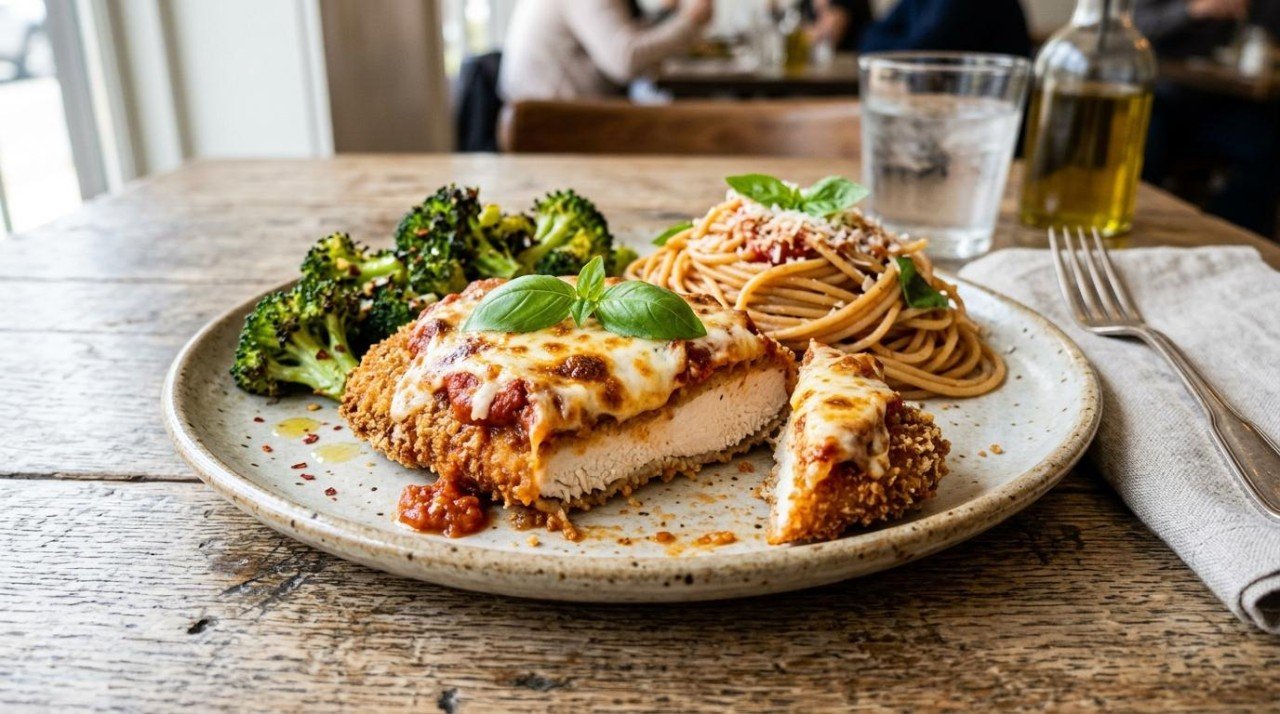
Chicken parmesan is one of those dishes nobody actually orders to be virtuous. A crisp, golden cutlet under a blanket of melted mozzarella, a pool of tomato sauce, a tangle of spaghetti underneath. It is comfort food with an Italian-American accent, and it has been earning its place on red-sauce menus since the 1950s. It deserves the love.
It is also, in its classic restaurant form, a nutritional heavyweight. We built a standard version in Eat Well Planner and ran it through the app's Nutrition Score: a breaded, deep-fried cutlet, an eight-ounce mozzarella blanket, jarred marinara, and a generous bed of refined spaghetti. It scored 49 out of 100. Not a disaster, but held back hard by one number in particular.
So we rebuilt it, one verified swap at a time, and got it to 82 — a 33-point jump — without turning it into something you would not recognize. Still a crunchy cutlet. Still gooey cheese. Still sauce and pasta. Here is every change, exactly what it moved, and the one honest trade-off we decided was worth it.
The original: what's in it and how it scores
The version we scored is the one most people picture — four cutlets' worth, serving four:
- 1 1/2 lb boneless skinless chicken breast, breaded in flour, egg, and Italian seasoned bread crumbs
- Pan-fried in vegetable oil
- 1 1/2 cups jarred marinara
- 8 oz whole-milk mozzarella
- 3/4 cup grated Parmesan
- 10 oz spaghetti
- 1 teaspoon added salt
Nutrition Score: 49/100. Per serving, that works out to about 1,160 calories, 80 g protein, 15 g saturated fat, and — the headline problem — 2,680 mg of sodium.
That sodium number is the whole story. The American Heart Association puts the ideal daily limit at 1,500 mg and a hard ceiling at 2,300 mg — and a single serving of this chicken parm blows past the ceiling on its own. It gets there from three directions at once: the jarred marinara, the Italian seasoned bread crumbs (which are surprisingly salty), and the added teaspoon of salt, all on top of two salty cheeses. The app flagged sodium as "very high" and saturated fat close behind, at 65% of a day's worth in one plate.
What is not wrong with it is worth saying, because a good makeover keeps what already works. The protein is excellent — 80 g per serving. And the fiber is actually fine (about 12 g), because the breading and the big pasta portion carry more than you would guess. So this is not a "add fiber" project. It is a sodium, saturated-fat, and calorie project — plus one quiet weakness: the whole plate counts as a single plant. One. That is the other number we wanted to move.
The upgrades
We led with the swaps that do the most and cost the least at the table. Two things worth knowing before the list: no single change is a magic bullet here, because the sodium is so high you have to attack it from three angles before the needle really moves — and the cheese and Parmesan stay, on purpose, because a chicken parm without real melted cheese is a different, sadder dish.
1. Oven-bake in whole wheat panko instead of deep-frying
- Swap: Deep-fried, refined seasoned bread crumbs → oven-baked in whole wheat panko
- Score impact: +6 points (49 to 55)
- What it changes: Cuts roughly 170 calories a serving, drops sodium about 800 mg, and moves the coating to whole grain
- What it costs you: A little of the deep-fried richness — but panko baked on a rack stays genuinely crunchy
Two problems solved with one technique. Deep-frying loads the cutlet with absorbed oil for no flavor you actually taste under the sauce; baking a well-breaded cutlet on a wire rack at a hot 425°F gets you most of the crunch with a fraction of the fat. And swapping refined Italian seasoned bread crumbs for whole wheat panko does something people rarely expect: it drops a big chunk of sodium, because the "seasoned" in seasoned bread crumbs is mostly salt. Panko's coarse flakes also crisp better than fine crumbs. Season it yourself with oregano, garlic powder, and black pepper and you control the salt. (For the full rundown on coating swaps, see our guide to bread crumb substitutes.)
One technique note that punches above its weight: pound the cutlets to an even half-inch first. Thinner cutlets cook through before the crust burns, and you get more crisp surface per bite — a better crust-to-chicken ratio, which is really what you are after.
2. Measure the mozzarella (and make it part-skim)
- Swap: An 8 oz whole-milk mozzarella blanket → 4 oz part-skim, portioned
- Score impact: +6 points (55 to 61)
- What it changes: Cuts saturated fat by about a third in a single move
- What it costs you: Almost nothing — 4 oz across four cutlets still pulls and melts
The restaurant move is to bury the cutlet, but a full half-pound of whole-milk mozzarella over four servings is more than the dish needs to read as cheesy. Cutting it to four ounces and going part-skim halved the saturated fat contribution here without touching the melt you actually see and taste. Part-skim mozzarella is built for this — it melts and stretches beautifully, which is exactly why it is the standard pizza cheese. We kept the Parmesan, too, because a little sharp, salty Parmesan does more flavor work per gram than a lot of mild mozzarella. If you want to go dairy-light, our mozzarella substitutes guide covers the melters that actually work.
3. Build a 10-minute sauce instead of using the jar
- Swap: Jarred marinara → quick no-salt-added tomato sauce with onion, garlic, and basil
- Score impact: +8 points (61 to 69) — the biggest single jump
- What it changes: Drops sodium another 400 mg a serving, cuts the added sugar to almost nothing, and adds real plants
- What it costs you: Ten minutes and one pan — and it tastes better
Jarred marinara is the sneakiest sodium (and sugar) source in the whole dish, and it is the easiest to fix. Start a can of no-salt-added tomato sauce or crushed tomatoes with a little olive oil, half a chopped onion, a few cloves of garlic, and fresh basil, and simmer it ten minutes while the chicken bakes. You control every gram of salt, the added sugar that jarred sauces lean on disappears, and the onion, garlic, and basil are three more plants on a plate that had almost none. This was the single biggest score move in the whole rebuild — proof that the sodium, not the cheese, was the real ceiling.
4. Back off the added salt
- Swap: 1 teaspoon added salt → about 1/3 teaspoon
- Score impact: +7 points (69 to 76)
- What it changes: Drops sodium roughly another 400 mg a serving
- What it costs you: Nothing you will notice — the Parmesan and sauce carry the seasoning
Here is why we saved this for after the sauce: on the original recipe, cutting salt barely moved the score, because the jarred marinara and seasoned bread crumbs were still flooding the plate with sodium. Once those were handled, backing off the added salt finally counted — a clean 7 points. With sharp Parmesan in the breading and on top, plus a properly seasoned homemade sauce, a full teaspoon of extra salt was never doing much work anyway. Cutting sodium by about 1,000 mg a day is enough to measurably improve blood pressure, and this one dish gets you there on its own.
5. Rebalance the plate: less pasta, more vegetables
- Swap: A big bed of refined spaghetti → a smaller nest of whole wheat spaghetti plus a side of roasted broccoli
- Score impact: +6 points (76 to 82)
- What it changes: Trades refined starch for a whole grain and a real vegetable, taking the plate from 1 plant to more than 6
- What it costs you: A slightly smaller pile of pasta, which the broccoli more than makes up for
The last move is about the shape of the plate, not the cutlet. We shrank the spaghetti portion a little, switched it to whole wheat, and used the space for a big side of roasted broccoli. That single change did more for the plant-diversity score than anything else in the rebuild, and roasted broccoli — tossed with olive oil and blistered at high heat — is the rare vegetable that people actually fight over. (Our take on the roasting method that converts vegetable haters is the technique to steal here.)
One honest note on the pasta: whole wheat spaghetti is the better real-food choice for its extra fiber and minerals, and we used it. In our scoring the two pastas came out close to even on paper, so the real win in this step was the broccoli and the smaller starch load — not the pasta swap by itself. We are telling you that because the whole point of these posts is that the numbers are real, even when they are less dramatic than the internet promises.
Take the Guesswork Out of Eating Well
Eat Well Planner helps you organize your favorite recipes, plan balanced meals, and automatically generate shopping lists — all in one place. Whether you're tracking macros, managing dietary restrictions, or just trying to stop asking "what's for dinner?", we've got you covered.
Our AI-powered tools can adapt any recipe to your dietary needs, help you discover new meals you'll love, and even log your nutrition effortlessly. It's meal planning made simple.
Start Organizing Your Meals — FreeWhat we kept (on purpose)
A makeover that guts the dish is a failed makeover, so we drew a clear line. The real cheese stays — four ounces of part-skim mozzarella and a proper hit of Parmesan, because melted cheese is the point of chicken parm. The crunchy breaded cutlet stays — we changed how it cooks, not what it is. And we did not chase the score past the dish's honest ceiling. The finished version still shows up as "high" on sodium and saturated fat, just no longer "very high," and that is where we stopped: pushing further would mean less cheese or a nearly naked cutlet, and at that point you have made a different dinner. An 82 that is still unmistakably chicken parmesan beats a 90 that nobody is excited to eat.
The healthier version: full recipe
Final Nutrition Score: 82/100. Serves 4.
For the chicken
- 1 1/2 lb boneless skinless chicken breast (4 cutlets, pounded to 1/2 inch)
- 1/3 cup whole wheat flour
- 2 large eggs, beaten
- 1 1/2 cups whole wheat panko
- 3/4 cup grated Parmesan, divided
- 1 teaspoon Italian seasoning, plus black pepper and garlic powder
- 2 tablespoons olive oil, divided
- 4 oz part-skim mozzarella, sliced or shredded
For the sauce
- 1 1/2 cups (about 12 oz) no-salt-added tomato sauce or crushed tomatoes
- 1/2 small onion, finely chopped
- 3 cloves garlic, minced
- 1/4 cup chopped fresh basil (or 1 teaspoon dried oregano)
- 1/3 teaspoon salt, plus a pinch of red pepper flakes
To serve
- 7 oz whole wheat spaghetti
- 1 large head broccoli (about 4 cups florets)
- Heat the oven to 425°F. Set a wire rack on a baking sheet and mist it with a little of the olive oil. Toss the broccoli florets with a teaspoon of oil, salt lightly, and spread on a second sheet.
- Make the sauce: warm 1 tablespoon olive oil in a saucepan over medium heat, cook the onion and garlic until soft, about 4 minutes, then add the tomato sauce, basil, 1/3 teaspoon salt, and red pepper flakes. Simmer gently while everything else comes together, about 10 minutes.
- Set up three shallow bowls: whole wheat flour with black pepper; the beaten eggs; and the panko mixed with 1/2 cup of the Parmesan, the Italian seasoning, and a little garlic powder. Dredge each cutlet in flour, then egg, then press firmly into the panko.
- Place the cutlets on the oiled rack, mist the tops with the remaining oil, and bake 18 to 20 minutes, until golden and cooked through (165°F). Roast the broccoli on its own sheet for the same time, until the edges char.
- Spoon a little sauce over each cutlet, top with the mozzarella and the remaining 1/4 cup Parmesan, and return to the oven (or broil) 3 to 4 minutes, just until the cheese melts.
- Meanwhile, boil the whole wheat spaghetti until al dente. Divide among four plates, top with a cutlet and more sauce, and serve the roasted broccoli alongside.
Per serving, original vs. improved:
- Nutrition Score: 49 → 82
- Calories: about 1,160 → about 870
- Saturated fat: about 15 g → about 10 g
- Sodium: about 2,680 mg → about 1,050 mg
- Added sugar: about 4 g → under 1 g
- Protein: about 80 g → about 70 g (still excellent)
- Fiber: about 12 g → about 10 g (held steady)
- Plant diversity: 1 plant → more than 6
Swaps we tested and skipped
Two changes that sound healthy did not survive the scoring:
- Fat-free mozzarella. It cut the saturated fat further, but the score actually went down a point — and more to the point, fat-free mozzarella turns rubbery and refuses to melt into that glossy pull. All cost, no benefit. Part-skim is the right call.
- Ditching the pasta for zucchini noodles. Swapping the spaghetti entirely for zoodles dropped the score to 75 — seven points lower than keeping a modest nest of whole wheat pasta, because you lose the fiber and some protein that the pasta contributes. It is also, at that point, no longer chicken parm over spaghetti. If you love zoodles, enjoy them, but do it because you want to, not because the numbers demand it.
Make it fit other diets
The two most-asked variations are easy. For gluten-free, swap the whole wheat flour and panko for a gluten-free flour blend and gluten-free panko, and check that your sauce is certified GF. For lower-carb, keep the baked cutlet and sauce and serve it over the roasted broccoli or a big salad instead of pasta (just know, per the test above, that it is a lifestyle choice, not a score win). In Eat Well Planner you can ask the AI to rewrite this exact recipe as gluten-free or dairy-free in one step, and it hands back a full version with the substitutions already worked in.
Do this to any recipe you love
Every number in this post came out of Eat Well Planner's Make It Healthier tool, not out of thin air. Import a recipe from any website, Instagram reel, or YouTube video, and the app scores it, tells you plainly what is dragging the number down — for this dish it was sodium, loud and clear — and proposes swaps like these, with a calculator verifying the real gain before you ever see the suggestion. You can test each change in the Recipe Playground and watch the score move in real time, then save the result as a new healthier version or update the original.
Keep the dish you love. Just find out what it is really made of first, and fix the one number that is actually holding it back.