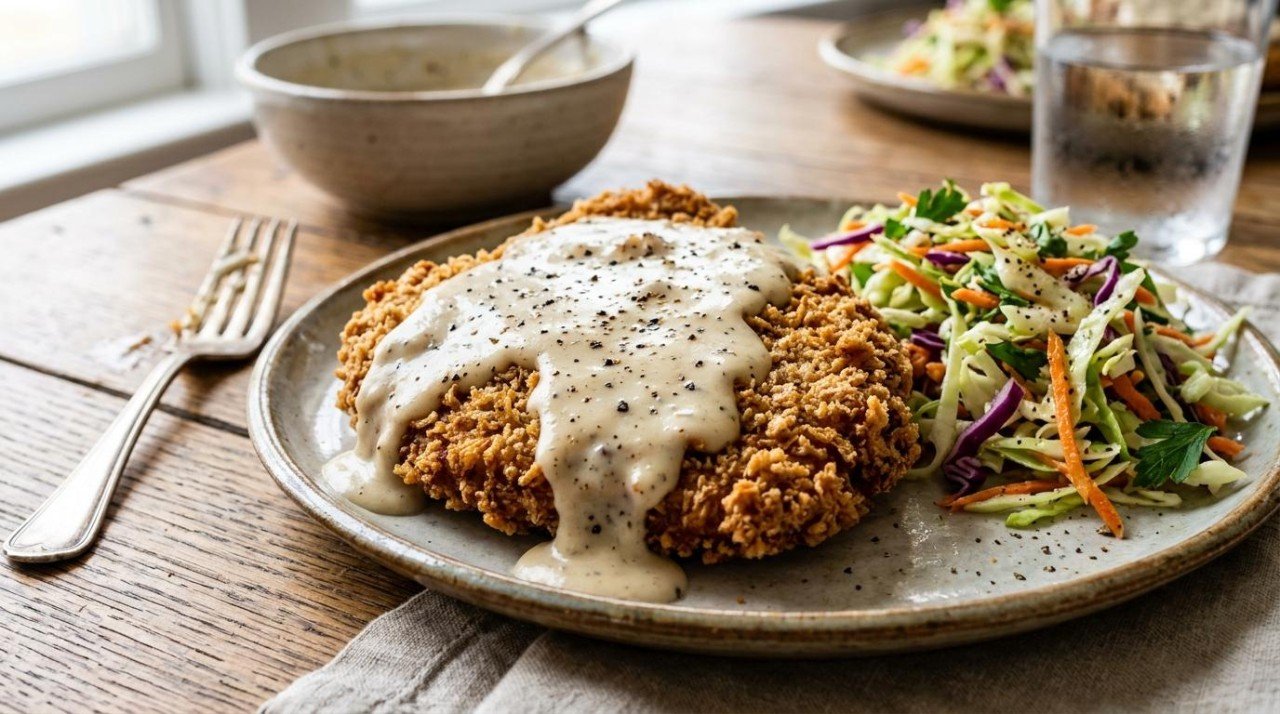
Chicken fried steak is a dish with a chip on its shoulder. It takes the cheapest, toughest steak in the case, beats it flat, dresses it in seasoned flour, fries it hard, and then pours cream gravy over the whole thing. It is a dish invented to make something humble taste like an occasion, and it works.
It also has better manners than its reputation suggests. The Texas State Historical Association traces it to German and Austrian immigrants who swapped the veal in Wiener schnitzel for cheap Texas beef, and notes that the Central Texas version is made with bread crumbs rather than a flour dredge. Hold that thought — it matters later.
We scored a standard version with the app's Nutrition Score: steak, gravy, everything. It came back at 37 out of 100. Then we rebuilt it one swap at a time, scoring after every change, and finished at 71 — with the cream gravy still on the plate. Here is what actually moved the number, and what each change costs you at the table.
The original: what's in it and how it scores
The version we scored serves four and is the one most people cook: about 1 1/2 pounds of cube steak (tenderized top round) soaked in buttermilk and egg, dredged in seasoned white flour (about a cup of it clings once you shake off the excess), and pan-fried in enough oil that roughly 6 tablespoons end up in the crust. The gravy is the classic: 1/4 cup of the frying drippings, 1/4 cup of flour, 2 cups of whole milk, and plenty of black pepper. Across the dish, a bit over 2 teaspoons of salt.
Per serving that lands at 832 calories, 48.8 g protein, 53.7 g total fat, 12.7 g saturated fat, about 1,440 mg sodium, and 1.8 g fiber. Nutrition Score: 37.
Here is what drags it down:
- Sodium, first and loudest. 1,440 mg a serving is 63% of the daily limit in one plate. Harvard's Nutrition Source puts the ceiling at 2,300 mg a day, with 1,500 mg the adequate-intake target, and notes that Americans already average about 3,400 mg.
- The frying oil. It is roughly half the fat on the plate, and the score flags High Omega 6 because of it. A 2021 meta-analysis in Heart pooling 562,445 people found that each extra weekly 114 g serving of fried food raised the risk of major cardiovascular events by 3% and heart failure by 12%.
- Nothing green, anywhere. The score flags Low Plant Diversity and Low Vitamin C, and it is being generous — the plate contains literally 0 mg of vitamin C. Plant points: 0.75, out of a weekly target of 30.
- A refined crust. White flour dredge, 1.8 g of fiber for the entire meal.
And here is what is already fine, because a makeover that manufactures problems is not worth reading. This is 48.8 g of protein — more than half a day's worth — and the score names iron and vitamin B12 as genuine strengths. Cube steak is top round, one of the leanest cuts on the animal. The saturated fat is high at 12.7 g, but it is not the headline, and neither, it turns out, is the gravy. We assumed the gravy was the villain. The score disagreed, repeatedly.
The upgrades
We rebuilt this in the app's Recipe Playground, scoring after each change, in the order below. The deltas are real and they are cumulative — each one is measured on top of the last.
Upgrade 1: Put a vegetable on the plate
- Swap: Nothing green → a lemony cabbage and carrot slaw served alongside
- Score impact: +12 points (37 to 49)
- What it changes: Fiber 1.8 to 4.7 g, plant points 0.75 to 3.75, and vitamin C from zero to a real number
- What it costs you: Ten minutes with a knife. Nothing on the steak changes at all
The single biggest lever in this entire makeover is not the fryer, the flour, or the gravy. It is the empty half of the plate. Raw cabbage carries about 37 mg of vitamin C per 100 g, and Harvard notes that cruciferous vegetables hold onto it best when they are eaten raw or barely cooked — which is exactly what a slaw is. The finished dish is now an excellent source of vitamin C, from a component that touches the steak only on the plate.
It also earns its keep as cooking. Fried steak and cream gravy is rich, soft, and salty from edge to edge; a sharp, crunchy, acidic slaw is what the plate has been missing. This is the one upgrade that makes the meal taste better rather than merely different.
Upgrade 2: Season hard, salt light
- Swap: Salt-forward seasoning → paprika, garlic powder, onion powder, cayenne, and a lot more black pepper, with the salt cut roughly in half
- Score impact: +10 points (49 to 59)
- What it changes: Sodium from about 1,470 to 890 mg a serving, plus more fiber and plant points from the spices
- What it costs you: Nothing. It tastes more like chicken fried steak, not less
Sodium was the score's loudest complaint, so this is the swap that pays for itself. The trick is not to remove salt and hope — that gives you bland steak and pale gravy. It is to make the crust taste seasoned all the way through with something other than salt: smoked paprika, garlic and onion powder, a hit of cayenne, and enough coarse black pepper that the gravy tastes peppery rather than salty. Black pepper is not a garnish in this dish; in a proper cream gravy it is the main flavor, and once you lean on it you can take the salt down by half without anyone at the table noticing.
Upgrade 3: Rebuild the gravy without the drippings
- Swap: 1/4 cup frying drippings + whole milk → toasted flour + 1% milk, no added fat
- Score impact: +8 points (59 to 67)
- What it changes: 151 fewer calories a serving, saturated fat down from 13.3 to 10 g, and the omega-6 load cut by more than a third
- What it costs you: Honestly? Some silkiness. The gravy is lighter and more peppery than the diner version
This one has a twist worth knowing. Our first attempt — tested on its own against the otherwise unchanged original, trading the drippings for a tablespoon of butter and the whole milk for 1% — scored zero points. Zero. The thing everybody assumes is the problem, changed in isolation, did nothing at all. It only paid off, and then paid off big at +8, once the added fat came out of it entirely and the rest of the plate had already improved.
Two practical notes. First, if you are oven-cooking the steak (Upgrade 4), you have no drippings anyway, so the gravy has to be rebuilt regardless. Toast the flour in a dry skillet for two or three minutes until it smells nutty and turns pale tan, whisk it into a little cold milk to make a smooth slurry, then bring it up with the rest of the milk. That toasting step is where the flavor the drippings used to provide comes from. Second, we tested adding just 1 tablespoon of butter back for richness: it cost 4 points. At this calorie level small amounts of fat move the score a lot, so treat that tablespoon as a real decision rather than a rounding error. If you would rather spend it elsewhere, the heavy cream substitutes guide covers what does and does not hold up in a hot sauce.
Upgrade 4: Oven-fry it in a whole wheat panko crust
- Swap: White flour dredge, pan-fried in oil → whole wheat panko crust, oven- or air-fried, with the added crust salt cut to 1/4 teaspoon
- Score impact: +4 points (67 to 71)
- What it changes: 203 fewer calories a serving, total fat 41 to 24.6 g, and sodium down to 750 mg
- What it costs you: The shattering, oil-slicked crust of a true fry. You get crisp; you do not get craggy
Four points looks small next to the calorie drop, and that gap is the most useful thing in this post: cooking method is not where the score lives. It is the same lesson our healthier fried chicken makeover ran into. What the oven does buy you is real all the same — 203 calories and 16 g of fat per serving, and it moves the dish out of the "fried food" category the Heart analysis was measuring.
The crust itself is not a compromise, either. Whole wheat panko toasts into a genuinely crunchy shell in a hot oven where a flour dredge just goes pale and soft, and it is closer to the Central Texas bread-crumb tradition than the flour version is. Refining flour strips out more than half of wheat's B vitamins, 90% of the vitamin E, and virtually all the fiber, so the whole grain version is putting something back. One warning the scoring turned up: packaged crumbs carry their own salt, and brands vary wildly — the whole wheat panko we scored runs around 400 mg of sodium per 100 g, while Kikkoman's plain panko is only 35 mg per half cup. Read the label and cut your added salt accordingly, which is exactly what we did here. The bread crumb substitutes guide has the ratios if you want to use crushed cornflakes or oats instead, and the all-purpose flour guide covers whole grain dredges.
Take the Guesswork Out of Eating Well
Eat Well Planner helps you organize your favorite recipes, plan balanced meals, and automatically generate shopping lists — all in one place. Whether you're tracking macros, managing dietary restrictions, or just trying to stop asking "what's for dinner?", we've got you covered.
Our AI-powered tools can adapt any recipe to your dietary needs, help you discover new meals you'll love, and even log your nutrition effortlessly. It's meal planning made simple.
Start Organizing Your Meals — FreeWhat we kept, on purpose
The cream gravy. We tested the plate with no gravy at all: it scored 3 points higher. Three. That is the entire nutritional case against cream gravy once it is built on low-fat milk instead of frying oil, and 3 points is nowhere near worth eating chicken fried steak naked. Keep the gravy.
The buttermilk soak. Its acidity tenderizes a cheap cut, and it is the glue that makes the crumbs stick without a deep fry. Most of it goes down the drain, so it costs the score almost nothing. Out of buttermilk? The buttermilk substitutes guide covers milk soured with lemon, which works fine here.
Real beef. Cube steak is the dish. See the skipped swaps below for what happens when you replace it.
Where we stopped. The next moves available to us were dropping the gravy and swapping out the beef. Both score higher. Both make it less like chicken fried steak, and a makeover that guts the dish is a failed makeover. 71 with the gravy on it is where we stopped.
The healthier version: full recipe
Final Nutrition Score: 71 out of 100 (up from 37). Serves 4.
Ingredients
- 1 1/2 lb (about 680 g) cube steak, in 4 pieces
- 1 cup buttermilk, for soaking (most is discarded)
- 1 large egg
- 1 1/2 cups (about 90 g) whole wheat panko breadcrumbs
- 1 tablespoon olive oil, plus more for misting
- 1 tablespoon paprika (smoked or sweet)
- 2 teaspoons garlic powder
- 2 teaspoons onion powder
- 1/2 teaspoon cayenne pepper
- 1 tablespoon coarsely ground black pepper
- 1/4 teaspoon salt, for the crust
- For the gravy: 3 tablespoons all-purpose flour, 2 cups 1% low-fat milk, 2 teaspoons coarsely ground black pepper, 1/2 teaspoon salt
- For the slaw: about 4 cups shredded green cabbage (300 g), 2 medium carrots (120 g), 1/4 small red onion, 2 tablespoons lemon juice, 1 tablespoon olive oil
Instructions
- Whisk the egg into the buttermilk in a shallow dish, add the steaks, and refrigerate at least 30 minutes and up to overnight.
- Heat the oven to 425F, or an air fryer to 400F. Set a wire rack over a baking sheet and mist it with oil so the undersides crisp.
- In a shallow dish, toss the panko with 1 tablespoon olive oil, the paprika, garlic powder, onion powder, cayenne, black pepper, and 1/4 teaspoon salt until the crumbs look evenly moistened. That light coating of oil is what browns them without frying.
- Lift each steak from the buttermilk, let the excess drip off, and press it firmly into the crumbs on both sides. Set it on the rack and mist the top with oil.
- Bake 15 to 18 minutes (air-fry 12 to 15), until the crust is deep golden and the steak reaches 145F. On a rack there is no need to flip.
- While it bakes, make the slaw: toss the cabbage, carrots, and red onion with the lemon juice, 1 tablespoon olive oil, and a pinch of the leftover spice mix. Let it sit at least 10 minutes to soften.
- For the gravy, toast the flour in a dry skillet over medium heat, stirring, for 2 to 3 minutes, until it smells nutty and turns pale tan. Take it off the heat and whisk in 1/2 cup of the cold milk until completely smooth, then whisk in the rest.
- Return to medium heat and cook, whisking constantly, until it thickens and coats a spoon, 3 to 5 minutes. Stir in the black pepper and salt. It should be aggressively peppery.
- Rest the steaks 5 minutes so the crust firms up, then serve with the gravy spooned over and the slaw alongside.
Per serving, original vs. this version:
- Nutrition Score: 37 → 71
- Calories: 832 → 565
- Protein: 48.8 g → 49.3 g
- Total fat: 53.7 g → 24.6 g
- Saturated fat: 12.7 g → 7.9 g
- Sodium: about 1,440 mg → 750 mg (63% of the daily limit down to 33%)
- Fiber: 1.8 g → 6.2 g
- Plant points: 0.75 → 5.25
It keeps everything the original was genuinely good for — protein, iron, B12, zinc — and adds what it never had: it is now an excellent source of fiber and of vitamin C, which the original supplied exactly none of.
Swaps we tested and skipped
Mashed potatoes instead of slaw. This is the traditional side, and we wanted to keep it. Swapping the slaw for mashed potatoes on an otherwise identical plate scored 55 — a 17-point swing from the side dish alone. If mashed potatoes are non-negotiable for you, serve a smaller scoop and add the slaw too, and see our healthier mashed potatoes and gravy makeover for the version that costs you less.
Turkey cutlets instead of cube steak. Scored 78, six points above the identical beef build, mostly on saturated fat. But chicken fried steak made without steak is a different dinner, and you lose the iron and B12 the score named as the beef's strengths. If you want it, make it — just call it what it is.
Keeping the fry. If you have no air fryer and no interest in the oven, every other upgrade here still works: fried in oil with the low-fat gravy, the seasoned crust, and the slaw, the plate scores 67. That is 30 points above where it started, at 768 calories instead of 565. Frying is not what was wrong with this dish, and if the crust is the reason you love it, spend your points there.
Butter in the gravy. One tablespoon, split four ways, cost 4 points. Delicious. Priced accordingly.
Make it fit other diets
- Gluten-free: use gluten-free panko or crushed gluten-free cornflakes for the crust, and thicken the gravy with 1 1/2 tablespoons cornstarch whisked into cold milk instead of the toasted flour.
- Dairy-free: soak the steaks in unsweetened soy milk with 1 tablespoon lemon juice, and build the gravy on unsweetened soy milk, which has enough protein to taste like gravy rather than water. See the milk substitutes guide for which alternatives hold up when heated.
- Lower sodium still: use unsalted panko, skip the crust salt entirely, and finish the plate with a squeeze of lemon.
If you would rather not work the swaps out yourself, import the recipe into Eat Well Planner and ask the AI recipe chat to make it gluten-free or dairy-free. It rewrites the whole thing with the substitutions already worked in, in one step.
Do this to any recipe you love
This post is a Make It Healthier session run in the open. That is a real feature: import any recipe — from a website, an Instagram reel, or a YouTube video — get its honest Nutrition Score, and the app proposes swaps like these with the nutritional gain verified by a calculator before the suggestion ever reaches you. Chicken fried steak is a good argument for why that verification matters. Two of the three changes everyone would have predicted — ditch the fryer, fix the gravy — were worth 4 points and 0 points respectively when tested honestly. A bowl of shredded cabbage was worth 12.
So score the whole plate, not just the thing in the middle of it. The dish you love is usually fine. It is the empty space around it, and the salt, that the numbers are complaining about.