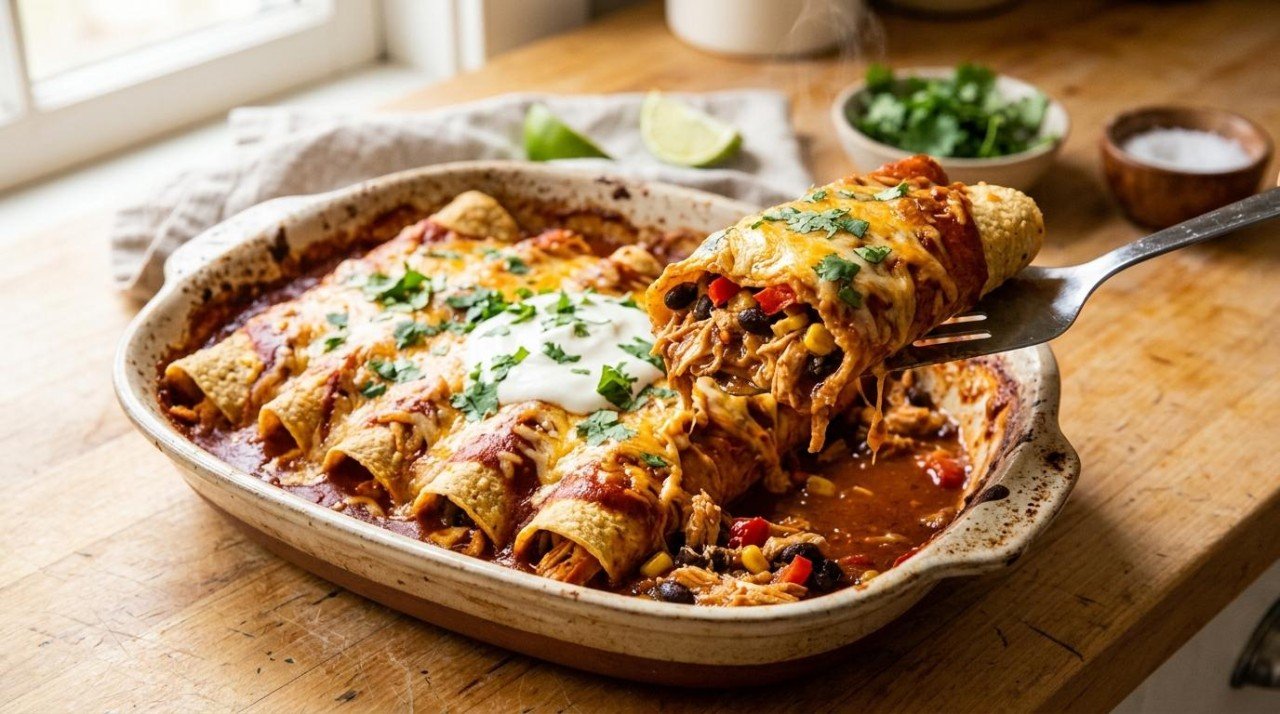
Chicken enchiladas are one of the great American weeknight dinners: a pan of rolled tortillas that comes out of the oven bubbling at the edges, gets cut into with a spoon rather than a knife, and disappears. The standard version is built for speed - shredded chicken, a can of cream of chicken soup, a can of red sauce, a lot of cheese, sour cream on top. It works. That is why everyone makes it.
We ran that version through Eat Well Planner's Nutrition Score - the same number a visitor sees on any public recipe page. It came back 34 out of 100, and what was dragging it down was exactly what you would guess.
Then we rebuilt it to 64 out of 100. It is still a pan of cheesy enchiladas you eat with a spoon. That is 30 points, and every swap below carries the exact score change it earned - including one that was worth a single point, and one that was worth nine points at the end of the build and only one point at the start. That second finding is the most useful thing in this post.
The original: what's in it and how it scores
Here is the version we scored, feeding four people two enchiladas each:
- 8 large flour tortillas (about 12 oz / 360 g total)
- 1 1/2 lb chicken breast, cooked and shredded
- 1 can (10.5 oz) condensed cream of chicken soup
- 1 cup sour cream
- 1 can (10 oz) red enchilada sauce
- 3 cups (12 oz) shredded cheddar
- 1 can (4 oz) diced green chiles
- 1 teaspoon each salt, ground cumin, and garlic powder
Nutrition Score: 34/100. Per serving that is about 1,121 calories, 70.0 g protein, 4.1 g fiber, 55.4 g total fat, 27.4 g saturated fat, and 2,940 mg sodium. Three things are going on:
- Sodium, flagged very high - 2,940 mg per serving, or 128% of the daily value. Federal guidance is no more than 2,300 mg a day for adults, so one plate here is a day and a third. Almost none of it is the teaspoon of salt. It is the canned soup, the canned sauce, the flour tortillas, and the cheese, all of which arrive pre-salted.
- Saturated fat, flagged very high - 27.4 g per serving, 116% of the daily value. Three cups of cheddar plus a cup of sour cream plus a can of cream soup is three separate dairy fat sources stacked in one dish. For scale, Harvard's Nutrition Source puts the Dietary Guidelines ceiling at under 10% of daily calories, roughly 22 grams on a 2,000-calorie diet.
- Fiber, barely present - 4.1 g, only 14% of the daily value, in a dinner carrying 1,121 calories. Refined flour tortillas, no beans, no vegetables. The plant count for the whole plate is 1.5.
Now the part that is already fine, because manufacturing problems is not what we do here. The protein backbone is excellent. Seventy grams per serving, 87% of the daily value. The micronutrients that ride along with chicken and cheese are genuinely strong: niacin at 176% of the daily value, phosphorus 149%, vitamin B6 104%, calcium 84%, riboflavin 78%, iron 76%. Nobody needs to add protein powder to this dish.
So the diagnosis is narrow. The filling's protein is doing its job. What is broken is that almost everything around the chicken came out of a can or a bag with salt and dairy fat already in it, and nothing on the plate is a vegetable.
The upgrades
Five swaps, applied cumulatively in this order - biggest mover and cheapest flavor cost first, hardest trade last. Watch the pacing, because it is the whole lesson: while sodium and saturated fat are both sitting in the very high band, individual fixes to either one barely move the number. The score only breaks loose when a flag actually clears.
1. Bulk the filling with black beans and vegetables
- Swap: 1 1/2 lb chicken → 1 lb chicken + 1 can low-sodium black beans (drained and rinsed) + 1 diced onion + 1 diced red bell pepper
- Score impact: +11 points (34 → 45) - the biggest single move in the makeover
- What it changes: Fiber from 4.1 g to 10.6 g per serving, plant count from 1.5 to 4.5, potassium from 990 mg to 1,180 mg
- What it costs you: Nothing you will taste, and it is cheaper. Ten minutes of dicing
Eleven points, and here is the strange part: this swap does not remove a single calorie. Per serving it actually goes up slightly, from 1,121 to 1,140, and sodium ticks up too, from 2,940 mg to 2,990 mg. It is still the biggest move on the board, because the score is not a calorie counter - it is reading the whole nutrient picture, and a dinner that went from 14% of your daily fiber to 36% has changed category.
The technique matters more than it sounds. Sweat the onion and pepper in the pan first until they have given up their water, then fold in the chicken and beans. Vegetables added raw will steam inside the tortillas and leave you with a watery pan. Rinse the beans in a sieve until the water runs clear - University of Tennessee researchers found that draining canned beans cuts their sodium by 36%, and draining plus rinsing cuts it by 41%. And beans are not just filler: a review of legume trials found intakes above 120 g a day lowered LDL cholesterol and fasting glucose, though that same review is candid that population-level data on legumes and heart disease is null rather than protective.
2. Make the sauce yourself
- Swap: 1 can condensed cream of chicken soup + 1 can red enchilada sauce → 4 dried guajillo chiles, 2 dried anchos, low-sodium chicken broth, tomato paste, olive oil, and oregano
- Score impact: +5 points (45 → 50)
- What it changes: Sodium from 2,990 mg to 2,420 mg per serving, fiber from 10.6 g to 14.4 g, potassium from 1,180 mg to 1,580 mg, plant count from 4.5 to 7
- What it costs you: About 20 minutes and a trip to the Latin aisle for dried chiles
This is the swap that changes what the dish tastes like, and the one we would fight for. The canned combination is doing two jobs - creaminess and red color - and doing neither with much flavor. Toasted guajillos and anchos blended with broth and tomato paste give you an actual sauce: guajillos bring the bright red and the acidity, anchos the raisiny depth. Together they are why enchiladas taste like enchiladas rather than like casserole.
Only five points, though, and that is the flag effect at work: we removed 570 mg of sodium per serving and sodium was still deep enough in the very high band that nothing cleared. Make it anyway. If dried chiles are not happening tonight, 3 tablespoons of chili powder bloomed in the oil with the tomato paste gets you most of the way; our tomato paste substitutes guide and chicken broth substitutes guide cover the rest if your pantry is thin.
3. Corn tortillas instead of flour
- Swap: 8 large flour tortillas → 12 corn tortillas (6-inch)
- Score impact: +4 points (50 → 54)
- What it changes: Sodium from 2,420 mg to 1,820 mg per serving - a 600 mg drop from the tortillas alone - plus 106 fewer calories, saturated fat from 26.7 g to 24.4 g, fiber up to 16.2 g, and added sugar down to zero
- What it costs you: They crack if you roll them cold. Fixable in 30 seconds, see below
The sodium number here surprises people every time. Consumer Reports' comparison puts a corn tortilla at about 5 mg of sodium per ounce against 240 mg for a flour tortilla - not a modest difference, a different category of food. Corn also counts as a whole grain, and the alkali treatment behind masa is what makes that corn nutritionally useful: the Whole Grains Council notes that this treatment liberates the niacin in corn, which is why cultures built on nixtamalized corn avoided pellagra.
The honest cost is structural: cold store-bought corn tortillas split down the middle the moment you roll them. Warm them first - wrap the stack in a damp paper towel and microwave 12 to 30 seconds, or pass each one through a hot skillet for 10 to 20 seconds a side - then roll them while warm and do not overfill. They are also smaller, so you roll 12 instead of 8, which is why the improved recipe serves three a person instead of two. If corn is a hard no in your house, our tortilla substitutes guide has the alternatives, and we priced the flour option in the skipped-swaps section below.
4. Greek yogurt instead of sour cream
- Swap: 1 cup sour cream → 1 cup plain 2% Greek yogurt
- Score impact: +1 point (54 → 55)
- What it changes: 77 fewer calories per serving, saturated fat from 24.4 g to 18.4 g, and protein back up from 62.1 g to 66.4 g
- What it costs you: A sharper, tangier finish - and you cannot bake it hard
One point. We removed 6 grams of saturated fat per serving and added 4 grams of protein, and the Nutrition Score gave us a single point, because saturated fat was still sitting in the very high band with three cups of cheddar in the pan. This is exactly why we run the numbers instead of trusting intuition: the swap everyone recommends first turns out to be worth almost nothing until you deal with the cheese.
Make it anyway - it is free, and it is setting up the next swap. One technique note: spoon the yogurt over the finished pan or serve it at the table, and do not bake it. Yogurt's proteins tighten and go grainy under sustained oven heat in a way sour cream's higher fat content protects against. Full-fat or 2% behaves better than nonfat here for the same reason. Our sour cream substitutes guide has the full list if yogurt is not your thing.
5. Measure the cheese
- Swap: 3 cups (12 oz) shredded cheddar mixed through and piled on → 6 oz sharp cheddar, all of it on top
- Score impact: +9 points (55 → 64) - the biggest jump of the five
- What it changes: 174 fewer calories per serving, saturated fat from 18.4 g to 10.3 g (78% of the daily value down to 44%), sodium from 1,810 mg to 1,530 mg
- What it costs you: Real, and visible. It is half the cheese
Nine points, because this is the swap that finally pulled saturated fat out of the very high band and into merely high. Everything the previous four swaps did to the fat number was waiting on this gate to open.
And here is the finding worth taking away from the whole post. We also tested this exact swap on the original recipe, on its own, with nothing else changed. It was worth 1 point - 34 to 35. Halving the cheese on the untouched recipe removes 8 grams of saturated fat per serving and buys you almost nothing, because the sodium and the refined tortillas and the empty fiber column are all still broken. The same swap, made last, is worth nine. Order is not a detail; the cheese cut is the payoff for the other four, not a substitute for them.
To make 6 oz feel like 12: use sharp cheddar rather than mild, since the flavor per ounce is roughly double, and put every bit of it on top where you can see it and it browns, instead of burying half of it in the filling where it only registers as fat. Shred it off the block - the anti-caking starch on pre-shredded cheese is what makes a thin layer look stingy and melt unevenly. Our cheddar substitutes guide covers which cheeses melt properly if you want to swap.
Take the Guesswork Out of Eating Well
Eat Well Planner helps you organize your favorite recipes, plan balanced meals, and automatically generate shopping lists — all in one place. Whether you're tracking macros, managing dietary restrictions, or just trying to stop asking "what's for dinner?", we've got you covered.
Our AI-powered tools can adapt any recipe to your dietary needs, help you discover new meals you'll love, and even log your nutrition effortlessly. It's meal planning made simple.
Start Organizing Your Meals — FreeWhat we kept (on purpose)
Real cheddar, browned on top. Real chicken. A cup of cultured dairy on the pan. Corn tortillas softened in steam or a hot pan rather than baked dry into crackers. We did not add cauliflower to anything, we did not swap the chicken for anything, and we did not thin the sauce to save calories - the sauce is the dish.
We also stopped deliberately. At 64 this recipe still carries a high sodium flag: 1,530 mg per serving, which is 67% of the daily value in one dinner. That is down 48% from where we started, and it is about as low as three cheese-covered enchiladas go without removing something that makes them enchiladas. If you want it lower, the lever is the cheese, and we tell you exactly what that costs in the next section.
The healthier version: full recipe
Nutrition Score: 64/100. Serves 4 (12 enchiladas, three each). About 30 minutes of prep and 25 minutes in the oven.
For the red chile sauce:
- 4 dried guajillo chiles (about 1 oz / 30 g), stemmed and seeded
- 2 dried ancho chiles (about 1 oz / 30 g), stemmed and seeded
- 2 cups low-sodium chicken broth
- 2 tablespoons tomato paste
- 1 tablespoon olive oil
- 1 teaspoon dried oregano, preferably Mexican
- 1 teaspoon ground cumin
- 1 teaspoon garlic powder
- 1 teaspoon fine salt
For the filling and assembly:
- 1 lb (454 g) boneless skinless chicken breast, cooked and shredded
- 1 can (15 oz) low-sodium black beans, drained and rinsed (about 9 oz / 260 g drained)
- 1 medium onion (about 5 oz / 150 g), diced
- 1 red bell pepper (about 5 oz / 150 g), diced
- 1 can (4 oz) diced green chiles
- 12 corn tortillas (6-inch)
- 6 oz (170 g) sharp cheddar, shredded off the block
- 1 cup (240 g) plain 2% Greek yogurt, to serve
- Toast the guajillos and anchos in a dry skillet over medium heat, 30 to 60 seconds a side, until fragrant but not darkened. Cover with just-boiled water and soak 20 minutes.
- Warm the olive oil in a saucepan over medium heat, add the tomato paste, cumin, garlic powder, and oregano, and cook 1 minute until the paste darkens and smells toasty.
- Drain the chiles and blend them with the tomato paste mixture, the broth, and the salt until completely smooth, then push the sauce through a sieve so no skins remain. Return it to the pan and simmer 5 minutes to thicken slightly.
- Heat a skillet over medium-high and cook the onion and bell pepper until softened and any water has cooked off, 6 to 8 minutes. Stir in the shredded chicken, the rinsed black beans, the green chiles, and about 1/2 cup of the sauce, just enough to make the filling glossy rather than wet.
- Heat the oven to 375F and spread about 1/2 cup of sauce across the bottom of a 9x13 inch baking dish.
- Soften the tortillas so they will roll without cracking: wrap the stack in a damp paper towel and microwave 12 to 30 seconds, or pass each one through a hot dry skillet for 10 to 20 seconds a side. Keep them wrapped in a towel as you work.
- Fill each tortilla with a scant 1/3 cup of filling, roll it snugly, and set it seam side down in the dish. Do not overfill - that is what splits them.
- Pour the remaining sauce evenly over the top, making sure every tortilla is covered so the edges do not dry out, then scatter the cheddar across the whole pan.
- Bake 20 to 25 minutes, until the sauce bubbles at the edges and the cheese is browned in patches. Rest 5 minutes before serving.
- Spoon the Greek yogurt over the top at the table, or serve it alongside. Do not bake it into the pan.
Per serving, before and after:
- Nutrition Score: 34 → 64
- Calories: about 1,121 → about 787 (down 30%)
- Saturated fat: 27.4 g → 10.3 g (down 62%, from 116% of the daily value to 44%)
- Sodium: about 2,940 mg → about 1,530 mg (down 48%)
- Total fat: 55.4 g → 25.3 g
- Fiber: 4.1 g → 16.2 g (14% → 55% of the daily value)
- Potassium: 990 mg → 1,570 mg
- Cholesterol: about 250 mg → about 130 mg
- Protein: 70.0 g → 56.5 g (still 70% of the daily value)
- Plants on the plate: 1.5 → 8
The finished dish is an excellent source of fiber, vitamin C, folate, iron, potassium, magnesium, and B vitamins by FDA thresholds - and eight different plants in one pan is a real chunk of the 30-plants-a-week target from one weeknight dinner.
Swaps we tested and skipped
- Whole wheat tortillas instead of corn (scored 57). Seven points worse, and the most useful rejection here, because whole wheat is the swap everyone assumes is the healthy one. It scored identically to plain white flour tortillas, which also came in at 57. More fiber, yes - but Consumer Reports puts whole wheat tortillas at around 150 mg of sodium per ounce against corn's 5 mg, and in a dish already fighting a sodium flag that wipes out the fiber gain completely.
- Flour tortillas at the end (scored 57). If you have flour tortillas in the fridge and no intention of buying corn, this is what it costs: seven points. The other four swaps still take you from 34 to 57, which is a real makeover. Do that and do not feel bad about it.
- Regular canned black beans instead of low-sodium, rinsed (scored 61). Three points for a can swap and 30 seconds under the tap. Worth it.
- Reduced-fat cheddar, same 6 oz (scored 67). Three points, and not a rejection so much as a priced trade we chose not to take. Pulling fat out of cheese tightens the para-casein protein network, which is why reduced-fat cheese comes out firm, rubbery, and poorly melting - and browned melted cheese is the entire top of this dish. If you want the three points, use it as half a blend with sharp cheddar rather than all of it.
- Cutting the cheese to 3 oz (scored 68). Four more points. Across 12 enchiladas, 3 oz is a dusting rather than a layer, and it will not brown properly. This is where we drew the line.
- No cheese at all (scored 73). Nine points, and an easy no. These are cheese-topped enchiladas.
- Nonfat Greek yogurt instead of 2% (scored 64). Exactly zero points - the same score to the digit. So use whichever you like better, and 2% tastes better and is less likely to go grainy.
Make it fit other diets
Gluten-free: the corn tortilla version already is, as long as your broth and tortillas are certified - both are common places gluten hides. Vegetarian: swap the chicken for a second can of beans plus a diced sweet potato or roasted zucchini; the sauce carries the dish either way. Dairy-free: skip the yogurt and use a smaller amount of a cashew-based shreddable cheese, accepting that it will not brown the same. In Eat Well Planner you do not have to work any of this out yourself - ask the AI recipe chat to adapt this recipe and Recipe Variations rewrites the whole thing with the substitutions already built in.
Do this to any recipe you love
None of these numbers were estimated. Every score and delta came out of Eat Well Planner's Make It Healthier tool, which proposes swaps and runs a calculator to verify the real nutritional gain before it shows you the suggestion, so you never chase a change that does not actually help. We tested each one in the Recipe Playground, watching the score move edit by edit - which is the only reason we found the thing that makes this post worth reading: halving the cheese is worth 1 point first and 9 points last, and the swap everyone recommends first, Greek yogurt for sour cream, is worth 1 point on its own.
Your version of this recipe is not our version. Maybe yours has olives in it, or your grandmother's green sauce, or twice the cheese and no apologies. Import it into Eat Well Planner from any recipe site, look at what the score actually flags, and then decide which trades you are willing to make - with the numbers in front of you instead of a guess.