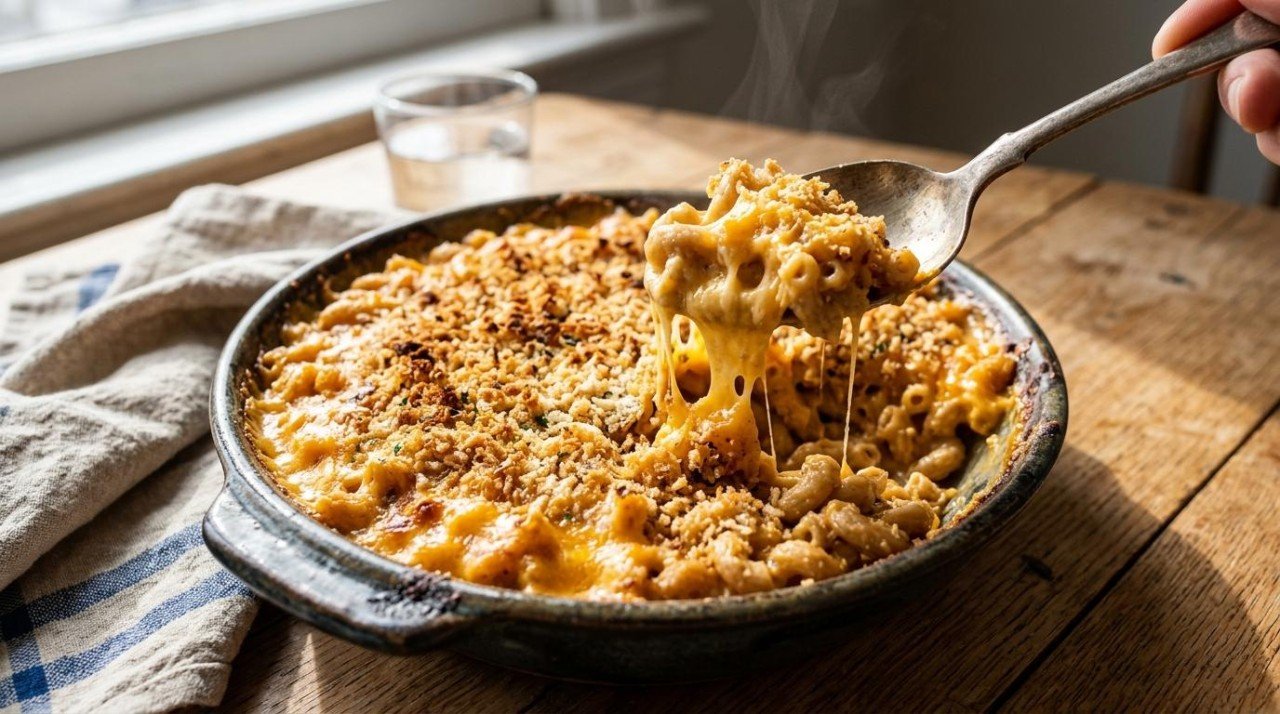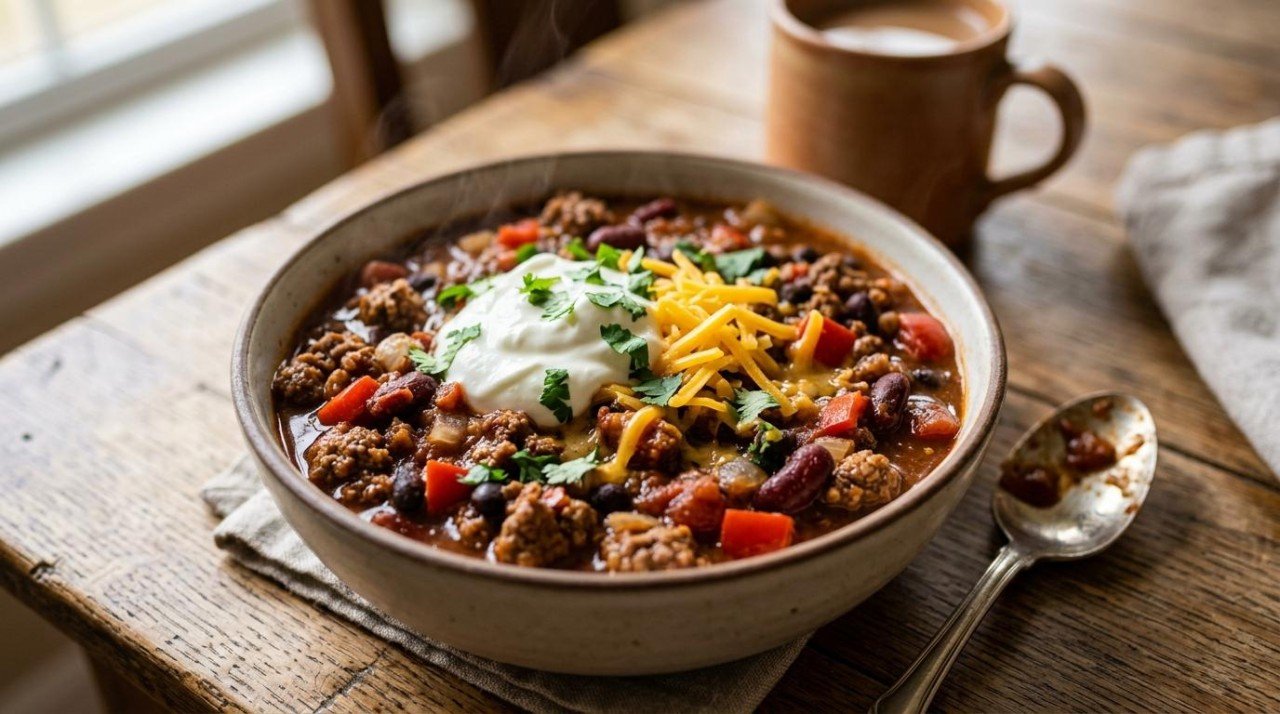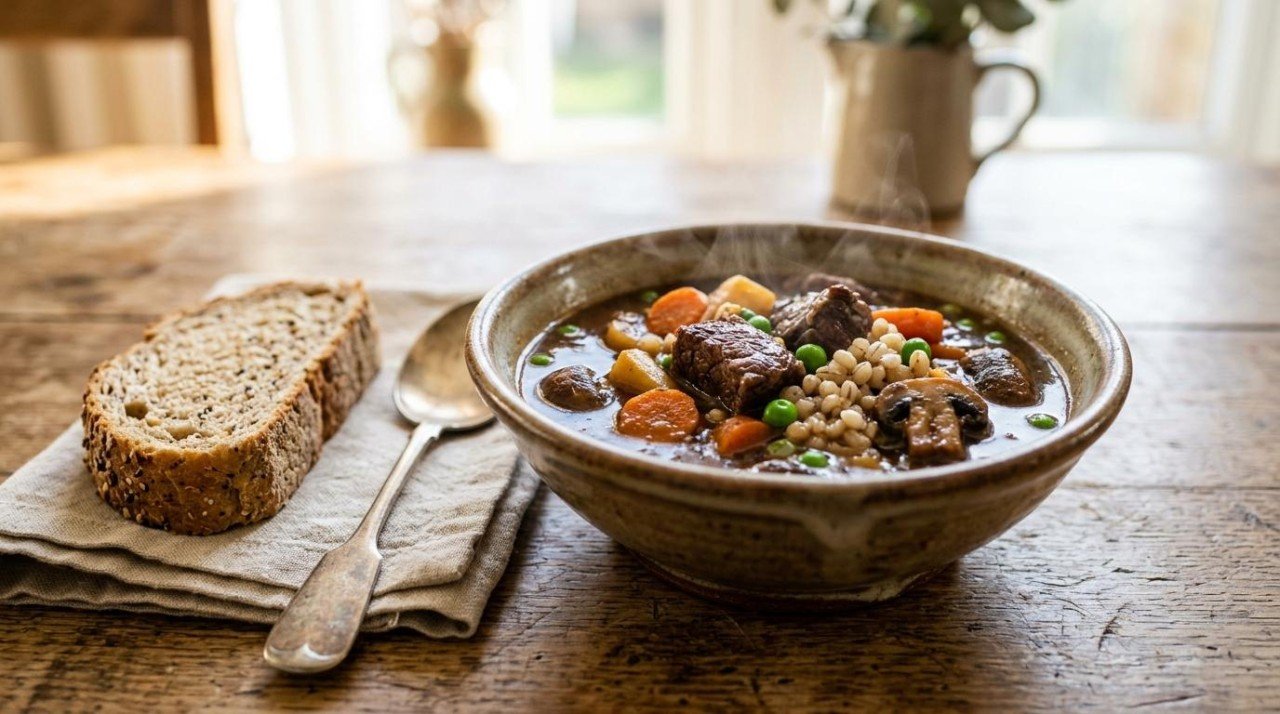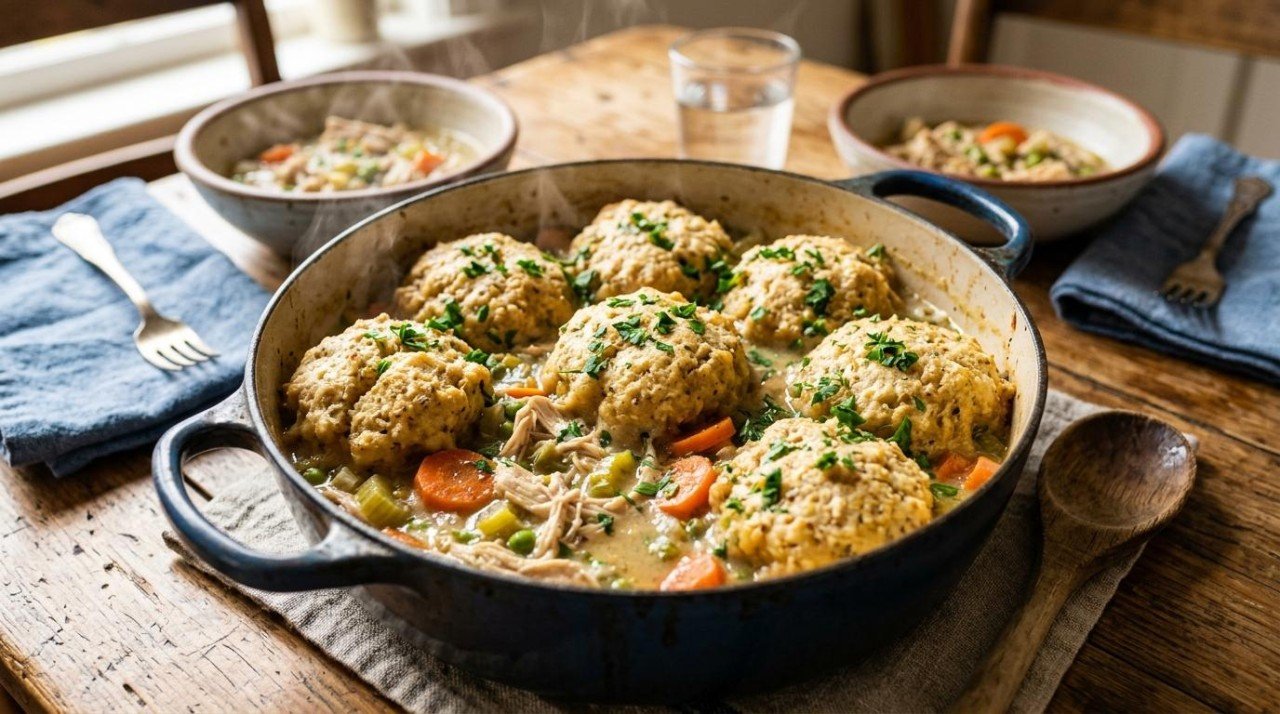
Chicken and dumplings is the one dish that makes a kitchen smell like somebody loves you. A thick, savory stew going cloudy with steam, and sitting on top of it, dumplings that have puffed up soft and pillowy from the simmer underneath. It is Sunday food, sick-day food, cold-Tuesday-and-nothing-in-the-house food.
So this is not a post about swapping the dumplings for cauliflower. It is about one question: a standard homemade version — cream-enriched stew, white flour dumplings loaded with butter — scores 32 out of 100 on our Nutrition Score. How far can we push that number before the dish stops being chicken and dumplings?
Further than we expected. Five swaps took it from 32 to 60, a 28-point jump, and we re-scored the pot after every single one, so we know exactly what each was worth. The dumplings still come out light. The stew is still creamy. And we will tell you exactly where we stopped, what it cost us in points, and why we stopped there anyway.
The original: what is in it and how it scores
The version we scored is the one most recipes land on, serving six: butter, onion, carrot, and celery; a flour roux; four cups of chicken broth; a cup of heavy cream for richness; a pound and a half of boneless, skinless chicken thighs; a cup of frozen peas. On top, drop dumplings made from two cups of all-purpose flour, a tablespoon of baking powder, a quarter cup of butter, and milk.
Scored per serving against our default profile, that is 32/100. The app flags two problems, both of them "very high": saturated fat and sodium. In real numbers, per serving:
- Calories: about 746
- Saturated fat: 19.4 g — on a 2,000-calorie day, that is roughly 88% of the Dietary Guidelines' limit of under 10% of calories, in one bowl
- Sodium: about 1,620 mg — 70% of the 2,300 mg daily ceiling
- Fiber: 3.6 g
- Protein: 31.8 g
- Plant points: 4
Nearly all of the saturated fat traces to two ingredients: the cup of heavy cream, and the half cup of butter split between the roux and the dumplings. The sodium is mostly the broth — four cups of regular chicken broth is a lot of salt before you have added any — plus the teaspoon stirred into the pot and the salt in the dumplings.
The fiber number is the quiet one. At 3.6 g per serving that is about a seventh of a day's target, and most Americans are already running at about 15 g against a 25 to 35 g need. The dish has vegetables in it, but not many, and the dumplings are pure refined flour.
Here is what deserves saying just as plainly: the original is not junk food. That same bowl carries 31.8 g of protein, half a day's iron, 80% of your phosphorus, and strong showings for niacin, thiamine, and vitamin B6. We are not fixing something broken — we are patching two holes and leaving the rest alone.
The upgrades
Five swaps, in the order we would make them. One note before the numbers: each delta is measured at that point in the build, because swaps interact. Where a swap is worth very different amounts alone versus in sequence, we say so.
1. Triple the vegetables
- Swap: 2 carrots, 2 celery stalks, 1 cup peas → 5 carrots, 4 celery stalks, a bigger onion, 1 1/2 cups peas, plus fresh parsley and thyme
- Score impact: +6 points (32 → 38)
- What it changes: Fiber 3.6 g → 5.8 g, plant points 4 → 4.5, and vitamin A jumps to one of the dish's top strengths
- What it costs you: Nothing. It is more food in the same pot
The highest-scoring single change you can make, and the only one with no downside. Chicken and dumplings has always had carrots and celery in it — most recipes just use a token amount. Tripling them turns the stew from a sauce with things in it into an actual stew, and makes six servings genuinely fill six bowls.
The carrots do most of the work: they carry vitamin A to 62% of the daily value in the finished dish, and add sweetness that plays against the salty broth. The parsley and thyme stirred in at the end cost nothing and add another plant to your weekly plant count.
2. Heavy cream to whole milk
- Swap: 1 cup heavy cream → 1 cup whole milk
- Score impact: +6 points (38 → 44)
- What it changes: Saturated fat 19.4 g → 12.0 g and about 113 calories off per serving, plus a little more calcium
- What it costs you: A shade of richness on the tongue — but the roux is doing the creaminess, so it is far less than you would guess
Here is the culinary fact that makes this nearly free: the creamy body of the stew comes from the roux, not the cream. Whisk milk into a cooked flour-and-fat paste and it thickens into a silky sauce that coats everything in the pot. Cream layers extra fat on top of a sauce that is already thick, which is exactly why it can leave without the texture collapsing. Same trick as our chicken pot pie makeover.
One exception worth flagging, because it cuts against advice we have given elsewhere: our heavy cream substitutes guide warns against plain milk as a 1:1 swap for cream, and that is right — in a sauce with no thickener, milk is too thin. Here there is a thickener, which changes the answer.
3. Butter to olive oil in the stew base
- Swap: 4 tablespoons butter for the roux → 3 tablespoons olive oil
- Score impact: +5 points (44 → 49)
- What it changes: Saturated fat 12.0 g → 8.7 g, clearing the "very high" saturated fat flag entirely, and adds vitamin E
- What it costs you: Very little — the butter flavor in a roux is buried under broth, chicken, and thyme anyway
An olive oil roux behaves exactly like a butter one: heat the fat, whisk in the flour, cook it a minute or two, add liquid. Olive oil is about 72% monounsaturated fat, and trading saturated fat for unsaturated is the change with the strongest evidence behind it: a Cochrane review found that replacing saturated fat with polyunsaturated fat cut cardiovascular event risk by about 27%, and swapping just 5% of daily calories was worth roughly a 25% drop in coronary heart disease risk in large cohorts. The same research is clear that what you replace it with decides the benefit — trading saturated fat for refined starch buys you nothing.
Use a regular or light olive oil, not a peppery finishing one, or it will announce itself. Most people skip this swap because butter feels non-negotiable in comfort food — but taste the finished stew blind and almost nobody picks it out. Save the butter for the dumplings, where you actually taste it.
4. Half whole wheat dumplings
- Swap: 2 cups all-purpose flour → 1 cup all-purpose + 1 cup whole wheat, with 2 extra tablespoons of milk
- Score impact: +4 points (49 → 53)
- What it changes: Fiber 5.8 g → 7.4 g, plant points 4.5 → 5.5, plus the B vitamins and minerals refining strips out
- What it costs you: A faintly nuttier flavor and a slightly less snow-white dumpling. Not the fluff — if you do it right
This was the risky one, which is why the ratio matters. Whole wheat carries the bran, and bran's sharp edges cut the gluten network that holds a dumpling's structure. It also absorbs more liquid and makes a stiffer dough, and a stiff dough cannot puff. Push to 100% whole wheat and you get a heavy, damp little brick.
Half and half is the sweet spot — King Arthur puts 50% at about the ceiling for quick breads and cookies before texture noticeably changes. Two things make it work: add the extra milk (2 tablespoons per cup of whole wheat, well above King Arthur's 2-teaspoon minimum, because a drop dumpling wants a wetter dough than a biscuit), and stop mixing the second it comes together. Refining strips out more than half of wheat's B vitamins, 90% of its vitamin E, and virtually all the fiber, so buying half of that back for one nuttier note is a good trade. Our flour substitutes guide covers the rest.
5. Low-sodium broth and less added salt
- Swap: 4 cups regular chicken broth → low-sodium broth, plus the added salt cut back to 1/3 teaspoon in the pot (from 1 teaspoon) and 1/3 teaspoon in the dumplings (from 3/4)
- Score impact: +7 points (53 → 60) — but only about +2 on its own, see below
- What it changes: Sodium 1,610 mg → 1,080 mg per serving, dropping it out of the "very high" band
- What it costs you: Some seasoning, unless you replace it — which you should
Four cups of regular broth is the biggest salt source in the pot before you season anything, and switching to low-sodium plus pulling back the added salt takes about a third of the sodium out. That is worth doing: for every extra 1,000 mg of daily sodium, cardiovascular disease risk rises about 18%, and most of us are already at roughly 3,400 mg against a 2,300 mg ceiling.
This is also the clearest example of why order matters. Made on its own to the original recipe, this swap is worth about +2. Made last, after the fat has come down, it is worth +7 — because it is the change that finally clears the last red flag, and a flag only clears once. Do not read that as "save the sodium for last." Read it as: the points come from the combination, not from a hero swap.
Replace the salt with flavor instead of just removing it: a bay leaf, a real hit of black pepper, the thyme and parsley from swap one, and a squeeze of lemon at the end. Our chicken broth guide covers which broths are worth buying and which are basically salt water.
Take the Guesswork Out of Eating Well
Eat Well Planner helps you organize your favorite recipes, plan balanced meals, and automatically generate shopping lists — all in one place. Whether you're tracking macros, managing dietary restrictions, or just trying to stop asking "what's for dinner?", we've got you covered.
Our AI-powered tools can adapt any recipe to your dietary needs, help you discover new meals you'll love, and even log your nutrition effortlessly. It's meal planning made simple.
Start Organizing Your Meals — FreeWhat we kept (on purpose)
We stopped at 60, and it was not because we ran out of ideas. Three more swaps tested higher, and we turned all three down. Here they are with their real numbers, so you can overrule us.
- Chicken thighs, not breast. Swapping in breast scores 64 — 4 points, 50 fewer calories, and 4.5 g more protein. We kept the thighs because thigh meat carries roughly twice the collagen of breast meat and holds up through a long simmer, where breast turns stringy. If you are careful not to overcook it, breast is a legitimate choice — take the points.
- Butter in the dumplings. Replacing all 4 tablespoons with olive oil scores 67. Replacing half of it scores 66 — nearly the whole gain for half the change, which makes the half-and-half version the better deal if you want it. We kept the butter because the dumpling is the entire point of this dish, and butter is what makes it taste like one.
- Half the dumplings white. All-whole-wheat dumplings score 64 and push fiber to 9.0 g. See swap four for why we would not: dense dumplings are a failed makeover no matter what the number says.
Stack all three and the dish scores 72 — with lean shredded breast and dense whole wheat dumplings bound with olive oil. That is the honest ceiling, and it is also no longer the thing you were craving. Sixty points, eaten twice a winter, beats seventy-two points made once.
The healthier version: full recipe
Nutrition Score: 60/100. Serves 6. Per serving it is now a good source of vitamin K (69% DV), vitamin B6 (69%), niacin (64%), vitamin A (62%), iron (54%), protein (43%), potassium (31%), vitamin C (27%), and fiber (25%).
For the stew
- 3 tablespoons olive oil
- 1 large onion, diced (about 1 1/4 cups)
- 5 medium carrots, diced (about 10 oz)
- 4 large celery stalks, diced (about 6 oz)
- 1/3 cup all-purpose flour
- 4 cups low-sodium chicken broth
- 1 cup whole milk
- 1 1/2 lb boneless, skinless chicken thighs
- 8 oz frozen peas (about 1 1/2 cups)
- 1/4 cup chopped fresh parsley
- 1 tablespoon fresh thyme leaves (or 1 teaspoon dried)
- 1/3 teaspoon salt, plus black pepper to taste
For the dumplings
- 1 cup all-purpose flour
- 1 cup whole wheat flour
- 1 tablespoon baking powder
- 1/3 teaspoon salt
- 4 tablespoons cold butter, cubed
- 3/4 cup plus 2 tablespoons whole milk
- Heat the olive oil in a large pot or Dutch oven over medium heat. Cook the onion, carrots, and celery, stirring now and then, until softened and coloring at the edges, about 8 minutes.
- Sprinkle the 1/3 cup all-purpose flour over the vegetables and stir constantly for 1 to 2 minutes, until the raw flour smell is gone.
- Pour in the broth a splash at a time at first, whisking to keep it smooth, then add the milk. Simmer gently until it thickens to a pourable, gravy-like sauce, about 5 minutes.
- Lower in the chicken thighs, cover, and simmer gently for 18 to 20 minutes, until cooked through. Lift them out, shred with two forks, and return the meat to the pot.
- Stir in the peas, parsley, thyme, salt, and plenty of black pepper. Keep the stew at a bare simmer while you make the dumplings.
- Whisk both flours, the baking powder, and the salt together. Cut in the cold butter until the mixture looks like coarse crumbs, then pour in the milk and stir just until a shaggy dough forms — a few dry streaks are fine, and overmixing is what makes dumplings tough.
- Drop 12 heaping spoonfuls of dough onto the simmering stew, spaced apart so they have room to swell.
- Cover tightly and simmer gently for 15 minutes without lifting the lid — the dumplings cook in trapped steam, so every peek costs you height. They are done when they have roughly doubled and a toothpick comes out clean.
- Finish with a squeeze of lemon and more black pepper, and rest 5 minutes before serving.
Original vs. improved, per serving:
- Nutrition Score: 32 → 60
- Calories: 746 → 656
- Saturated fat: 19.4 g → 9.0 g
- Total fat: 41.0 g → 27.7 g
- Sodium: about 1,620 mg → about 1,080 mg
- Fiber: 3.6 g → 7.4 g
- Protein: 31.8 g → 34.7 g
- Plant points: 4 → 5.5
Sodium is still flagged as high at 1,080 mg, and we want to be straight about that: this is a broth-based stew with baking powder in the dumplings, and there is a floor to how low it goes without the dish tasting flat. If you are watching sodium closely, unsalted homemade stock and cutting the added salt entirely will take it lower still.
Make it fit other diets
Two swaps cover most requests. Dairy-free: unsweetened oat or soy milk in the stew (oat is closest in body), and olive oil instead of butter in the dumplings. Gluten-free: skip the roux and thicken with 3 tablespoons of cornstarch slurried into cold broth, and use a 1:1 gluten-free baking blend for the dumplings, which want a slightly wetter dough and a couple of extra minutes under the lid.
Or let Recipe Variations rewrite the whole recipe dairy-free or gluten-free in one step, then score the result so you can see what the change did.
Do this to any recipe you love
None of these numbers are estimates. We scored the original, applied one change at a time, and re-scored after each — the same Make It Healthier process the app runs on your own recipes, where a calculator verifies the real nutritional gain before a suggestion is ever shown to you. That is how we know the sodium swap is worth +7 in one position and +2 in another, and that the all-whole-wheat dumplings scored higher and still lost.
Import a recipe from any website, Instagram reel, or YouTube video and you get its Nutrition Score in seconds. Make It Healthier proposes the swaps; the Recipe Playground lets you argue with them — keep the cream, see what it costs, make it up in the vegetables. Save the winner as a new variation and the original stays right where it was, for the nights when you want it.
Keep the dish. Move the number.