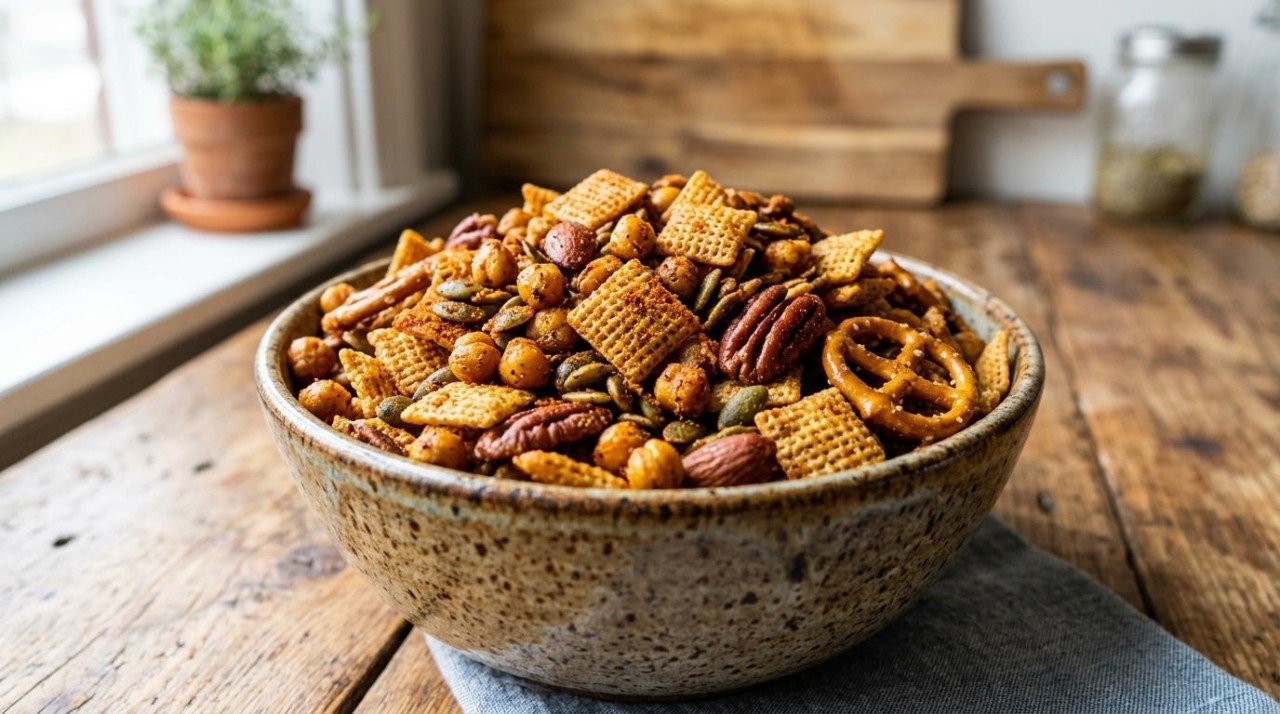
Chex mix has been the bowl on the end of the table since 1952, when a recipe for it turned up in a Life magazine ad and Americans discovered you could turn three boxes of cereal into something you could not stop eating. It stayed a homemade thing for over thirty years before anyone bothered to sell it in a bag. Everybody has a version. Almost nobody has read the label.
So we scored the one on the box. The Original Chex Party Mix - three cereals, mixed nuts, pretzels, bagel chips, six tablespoons of butter, Worcestershire, and seasoned salt - comes out at 48 out of 100 on the Eat Well Planner Nutrition Score. Not a disaster. Not good.
Then we rebuilt it to 78, and the surprise was which swap did the work. Everybody blames the seasoned salt. The seasoned salt was worth 4 points. Trading four of the six tablespoons of butter for olive oil was worth 12 - and it is the change nobody tastes.
The original: what is in it and how it scores
The canonical batch is 3 cups each of Corn, Rice, and Wheat Chex, 1 cup of mixed nuts, 1 cup of mini pretzels, and 1 cup of garlic bagel chips, tossed with 6 tablespoons of melted butter, 2 tablespoons of Worcestershire sauce, 1 1/2 teaspoons of seasoned salt, 3/4 teaspoon of garlic powder, and 1/2 teaspoon of onion powder, then baked at 250 degrees F for an hour. It makes about 12 cups, which the recipe calls 24 servings of half a cup each.
Scored per half-cup serving, that batch lands at 48/100: 126 calories, 2.8 g protein, 2.0 g fiber, 6.5 g total fat of which 2.4 g is saturated, 260 mg sodium, and only 0.5 g of added sugar.
Start with what is genuinely fine, because a lot of it is. The added sugar is almost nothing, which is more than most party snacks can say. And the fortified cereal makes this bowl a legitimate iron delivery system - 57% of the Daily Value per serving, enough for the app to flag it as an excellent source, plus 17% of your B12 and a spread of B vitamins. Chex mix is not empty calories. It is fortified calories.
What holds it at 48 is the shape of the rest:
- 2.4 g saturated fat per half cup from six tablespoons of butter, in a snack with 126 calories. That is the single heaviest drag on the score.
- 2.0 g of fiber, in a bowl made almost entirely of grain. Rice Chex and bagel chips are refined; the wheat is only a third of the cereal.
- 2.8 g of protein, so nothing tells you to stop.
- 2.75 plant points out of a weekly target of 30 - three cereals from three grains and one can of nuts is not variety.
The half-cup problem
Here is the part the label does not want to discuss. Half a cup is a small handful - what fits in a cupped palm, once. Nobody standing next to a bowl of Chex mix eats one cupped palm of it.
So we rescored the identical batch at a realistic portion - 1 1/2 cups, the amount that disappears during one conversation. The score drops to 46, and two caution flags appear that were invisible at half a cup: 780 mg of sodium (34% of the Daily Value) and 7.1 g of saturated fat (30%). The FDA's rule of thumb is that 20% DV or more per serving counts as high, and Americans already average about 3,400 mg of sodium a day against a limit of 2,300.
That is the honest diagnosis. Chex mix is not a sodium problem at half a cup. It is a sodium problem at the portion people actually eat, which is the only portion that matters.
The upgrades
Five swaps, each scored on top of the last, in the order we would make them. The first two are worth 21 of the 30 points.
1. Trade four of the six tablespoons of butter for olive oil
- Swap: 6 tablespoons butter to 2 tablespoons unsalted butter + 3 tablespoons extra-virgin olive oil
- Score impact: +12 points (48 to 60)
- What it changes: Saturated fat per serving falls from 2.4 g to 1.4 g, a 40% cut, with total fat essentially unchanged
- What it costs you: Almost nothing. There is still real butter in the pan, and the smoked paprika and Worcestershire do the rest
This is the whole post in one line. Replacing saturated fat with unsaturated fat is one of the best-established moves in nutrition - Harvard's Nutrition Source summarizes the evidence that unsaturated fats lower LDL and raise HDL, and that a diet rich in monounsaturated fat lowers blood pressure and improves lipids. Note what we did not do here: total fat per serving went from 6.5 g to 6.2 g, which is nothing. We did not take the fat out. We changed what kind it is.
The technique detail that makes it work: Chex mix bakes at 250 degrees F, far below any oil's smoke point, so this is one of the rare baked recipes where you can use a good peppery extra-virgin olive oil and actually taste it. Melt the butter and the oil together in the roasting pan and the coating behaves exactly like all-butter. If you want the full ladder of options here, our butter substitutes guide and olive oil substitutes guide cover which fats survive which jobs.
2. Swap the can of salted mixed nuts for almonds, pecans, and pumpkin seeds
- Swap: 1 cup salted mixed nuts to 1/2 cup raw almonds + 1/2 cup pecan halves + 1/2 cup pumpkin seeds
- Score impact: +9 points (60 to 69)
- What it changes: Sodium drops another 20 mg per serving, plant points go from 2.75 to 4.75, and magnesium, vitamin E, and riboflavin all climb
- What it costs you: A few dollars, and you lose the salt-dusted cashew. The pepitas more than pay it back in crunch
A can of salted mixed nuts is mostly peanuts with salt on the outside. Three distinct unsalted nuts and seeds cost about the same, add half a cup of volume, and each brings a different nutrient - almonds for vitamin E and magnesium, pecans for their fat profile, pumpkin seeds for zinc and iron. Harvard's analysis of over 210,000 health professionals found a 14% lower cardiovascular risk among people eating an ounce of nuts five or more times a week, and noted that eating varied nuts gives you varied nutrients.
One caveat we will not dress up: this swap adds calories - 125 to 139 per half cup on its own, and the finished mix lands at 164 against the original's 126. Nuts are simply denser than the cereal they sit next to. What you get for those calories is fiber, protein, and minerals rather than nothing, but it is a real trade and we are not going to pretend otherwise.
3. Make Wheat Chex the majority and drop the bagel chips
- Swap: Rice Chex and garlic bagel chips out; Wheat Chex up from 3 cups to 6
- Score impact: +1 point (69 to 70)
- What it changes: Fiber per serving rises from 2.1 g to 2.9 g, a 35% jump
- What it costs you: The bagel chips were the most snackable thing in the bowl. This is a real loss
We are keeping this swap and telling you honestly that the score barely noticed it, because the reason is instructive. Rice Chex is refined but heavily fortified, so on the micronutrient side it was already pulling its weight - swapping it out gives back some fortification even as it adds fiber, and the two roughly cancel.
The fiber is still worth having on its own terms. A serving of Wheat Chex carries 8 g of fiber; the slightly larger serving of Rice Chex carries 2 g. And most Americans get about 15 g of fiber a day against a target of 25 to 35. Sometimes a swap is right even when the number shrugs. Being able to see that the number shrugged is the point.
4. Add a can of roasted chickpeas
- Swap: Add one 15 oz can of chickpeas, drained, dried, and roasted crisp
- Score impact: +4 points (70 to 74)
- What it changes: Protein from 3.7 g to 4.6 g per serving, fiber to 3.7 g, folate to 17% DV, plant points to 5.75
- What it costs you: Thirty-five extra minutes and a shorter shelf life - see the honest warning below
Roasted chickpeas are the single best thing you can add to a snack mix, because they are the only ingredient that brings protein and fiber in the same bite while tasting like a crouton. They also take the seasoning better than the cereal does.
The trade-off is storage, and it is real. Roasted chickpeas soften in a sealed container. Food Republic's guidance is to keep them at room temperature in an unsealed jar or under a dish towel so moisture can escape, with best texture for about five days. The original mix keeps in a tin for weeks; this one is a five-day mix. If you are making it for a party, that is fine. If you want the three-week tin, roast the chickpeas separately and stir them into each batch as you serve it.
5. Replace the seasoned salt with a homemade blend
- Swap: 1 1/2 teaspoons seasoned salt to 1/2 teaspoon fine sea salt + smoked paprika, garlic powder, onion powder, celery seed, black pepper, and cayenne
- Score impact: +4 points (74 to 78)
- What it changes: Sodium from 230 mg to 190 mg per serving - the jar's 1 1/2 teaspoons were carrying 2,280 mg on their own, and the half teaspoon of sea salt that replaces them puts back about half of that
- What it costs you: Nothing, if you use enough smoked paprika. This version tastes more of something, not less
Look at what is actually in the jar. Lawry's Seasoned Salt lists salt, sugar, spices including paprika and turmeric, onion, corn starch, and garlic, and packs 380 mg of sodium into a quarter teaspoon. The homemade blend is that ingredient list with the salt turned down and the spices turned up - and the smoked paprika, which the jar does not have, gives you the toasted savory note people are chasing when they reach for the shaker.
Worth noting where this swap sat in the order. Applied on its own to the untouched original it is worth only 3 points. Applied last, after the fat and the nuts and the chickpeas, it is worth 4. Sodium reductions pay better once the rest of the recipe has stopped fighting you - which is exactly why we did not lead with the one everybody expects.
Take the Guesswork Out of Eating Well
Eat Well Planner helps you organize your favorite recipes, plan balanced meals, and automatically generate shopping lists — all in one place. Whether you're tracking macros, managing dietary restrictions, or just trying to stop asking "what's for dinner?", we've got you covered.
Our AI-powered tools can adapt any recipe to your dietary needs, help you discover new meals you'll love, and even log your nutrition effortlessly. It's meal planning made simple.
Start Organizing Your Meals — FreeWhat we kept (on purpose)
Every makeover has a point where the next swap stops being an upgrade and starts being a different recipe. Here is exactly what we left on the table, and what each thing cost:
- The last 2 tablespoons of butter - 7 points. Going to all olive oil scores 85 instead of 78. That is the biggest single number in this post, and we are still not taking it. Chex mix tastes like butter; two tablespoons across twelve cups is what keeps it recognizable. If you would rather have the points, leave the butter out and let olive oil do all of it - whether you hold at 3 tablespoons or push to 5, it scores 85 either way.
- The cup of pretzels - 2 points. Dropping them scores 80. They are the least nutritious thing in the bowl and they are also the thing people fish for. Two points is a fair price.
- The last 1/2 teaspoon of salt - 2 points. Leaving it out entirely scores 80 and takes sodium to 150 mg per serving. Salt-free Chex mix is a snack nobody finishes, and a snack nobody finishes scores zero in real life.
- The 3 cups of Corn Chex - free, and then some. We tested replacing it with more Wheat Chex to make the mix fully whole grain. It scored 77, one point worse. The corn cereal is carrying fortification the wheat does not, so the classic three-cereal look costs nothing at all.
The healthier version: full recipe
Nutrition Score: 78/100, up from 48. Makes about 12 cups - 24 servings of half a cup, scored at the same portion as the original.
- 6 cups Wheat Chex cereal
- 3 cups Corn Chex cereal
- 1 cup mini pretzels
- 1 (15 oz) can chickpeas, drained and rinsed
- 1/2 cup raw almonds
- 1/2 cup pecan halves
- 1/2 cup pumpkin seeds (pepitas)
- 3 tablespoons extra-virgin olive oil, divided
- 2 tablespoons unsalted butter
- 2 tablespoons Worcestershire sauce
- 2 teaspoons smoked paprika
- 2 teaspoons garlic powder
- 1 teaspoon onion powder
- 1/2 teaspoon celery seed
- 1/2 teaspoon coarsely ground black pepper
- 1/2 teaspoon fine sea salt
- 1/4 teaspoon cayenne pepper
- Heat the oven to 400 degrees F. Drain and rinse the chickpeas, then dry them thoroughly on a clean towel, rolling them around until the skins look dull. Wet chickpeas steam instead of crisping, and this step is the whole difference.
- Spread the chickpeas on a rimmed baking sheet, toss with 1 tablespoon of the olive oil, and roast for 30 to 35 minutes, shaking the pan twice, until they rattle and sound hollow. Set aside.
- Turn the oven down to 250 degrees F. Stir the smoked paprika, garlic powder, onion powder, celery seed, black pepper, salt, and cayenne together in a small bowl.
- Melt the butter with the remaining 2 tablespoons of olive oil in a large roasting pan in the oven, about 3 minutes. Stir in the Worcestershire sauce and the spice blend until smooth.
- Add the Wheat Chex, Corn Chex, pretzels, almonds, pecans, and pumpkin seeds. Stir gently but thoroughly, lifting from the bottom rather than mashing, until everything is evenly coated.
- Bake at 250 degrees F for 1 hour, stirring every 15 minutes.
- Stir in the roasted chickpeas for the final 15 minutes of baking.
- Spread the mix on paper towels or a cooling rack and cool completely, about 30 minutes. It crisps as it cools, so do not judge the texture while it is warm.
- Store at room temperature in a jar with the lid slightly ajar, or covered with a dish towel. Best within 5 days, while the chickpeas are still crunchy.
Per half-cup serving: original vs. improved
- Nutrition Score: 48 to 78
- Calories: 126 to 164
- Protein: 2.8 g to 4.7 g
- Fiber: 2.0 g to 3.8 g
- Saturated fat: 2.4 g to 1.4 g
- Sodium: 260 mg to 190 mg
- Plant points: 2.75 to 6.5
- Nutrient highlights, original: excellent source of iron (57% DV); good source of vitamin B12 (17%), folate, niacin, thiamine, and vitamin B6
- Nutrient highlights, improved: excellent source of iron (77% DV); good source of folate (17%), thiamine (14%), fiber (13%), phosphorus (13%), vitamin B6 (13%), riboflavin, and niacin
And at the portion people actually eat - 1 1/2 cups - the difference gets larger, not smaller. The original drops to 46 with two caution flags; the improved mix holds at 78 and delivers 11.2 g of fiber (38% DV) and 14 g of protein for 493 calories. Its sodium is still flagged at 580 mg, which is the honest ceiling for a savory snack mix. It is a snack, not a salad. But it is 200 mg lower than the original at the same portion, and it comes with enough fiber and protein that the third handful is a decision rather than a reflex.
Swaps we tested and skipped
- Cutting the fat instead of changing it. With the butter gone, we tried replacing it gram for gram with more olive oil - 5 tablespoons in total - and then tried cutting back to just the 3 tablespoons the recipe already calls for. Both scored 85. Two tablespoons of fat, added or removed, moved the score by nothing at all. The amount of fat bought us zero points; only the type of fat did. So we stopped trying to use less and just used better.
- Going fully whole grain. Covered above as a keep, but it belongs here too, because it is the one test that came back negative: dropping the Corn Chex for more Wheat Chex scored 77, a point below leaving it alone. More fiber, less fortification, and no reason to change.
- More Worcestershire to make up for less salt. Bumping it from 2 to 3 tablespoons scored 78 - no change at all, and it added 10 mg of sodium back per serving. Worcestershire is worth using for flavor, not for points. If you need a version without anchovies or gluten, our Worcestershire sauce substitutes guide has the ratios.
Make it fit other diets
- Gluten-free: Corn Chex and Rice Chex are both labeled gluten free, so build the base from those instead of Wheat Chex, use gluten-free pretzels, and check your Worcestershire - the US Lea and Perrins uses distilled vinegar and is gluten free, while the UK and Canadian versions use barley malt vinegar and are not. You will lose the fiber the wheat was bringing; extra chickpeas and pepitas cover most of it.
- Vegan: Drop the butter and use all olive oil, which scores 85 anyway, and use a vegan Worcestershire.
- Nut-free: Replace the almonds and pecans with more pumpkin seeds and sunflower kernels, and add a second can of chickpeas.
In Eat Well Planner, Recipe Variations does any of these in one step - ask for the gluten-free version and you get a full rewritten recipe with the swaps already worked in, which you can then score to see what the change actually cost.
Do this to any recipe you love
Nothing here required a nutritionist. We took a recipe off a cereal box, scored it, looked at which factors were dragging it down, tested swaps one at a time, and kept the ones that earned their place - including the ones that earned it on flavor rather than points.
That is exactly what Eat Well Planner does. Import a recipe from any website, video, or photo, and it gets a Nutrition Score with the reasons behind it. Make It Healthier then proposes ingredient swaps like these, with a calculator verifying the real gain before the suggestion ever reaches you - no vibes, no guessing. The Recipe Playground is where the per-swap numbers in this post came from: change one ingredient, watch the score move, decide whether the trade was worth it. Want to keep all six tablespoons of butter? See what it costs, then make it up somewhere else.
And if the plant points caught your eye - this mix went from 2.75 to 6.5 in a single afternoon, which is a fifth of the 30 different plants a week that gut research keeps pointing at. Snacks are an easy place to find them. Our trail mix makeover is the other half of that story, and it has its own surprise: the dark chocolate was not the reason.