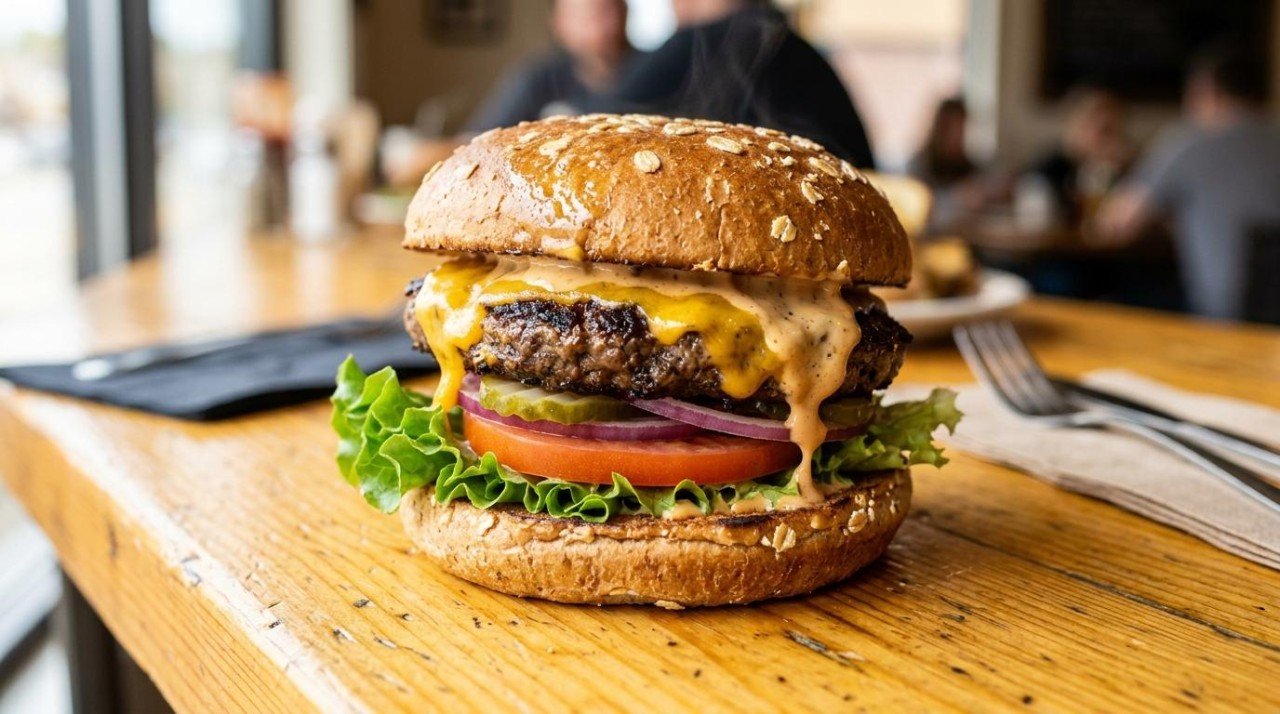
The cheeseburger is about as close to a perfect food as American cooking gets: a seared, juicy beef patty, cheese melting into the craggy edges, a soft bun catching the drips. It is widely credited to a 16-year-old cook named Lionel Sternberger, who in 1924 laid a slice of cheese on a hamburger at his family's diner, The Rite Spot, in Pasadena, California (the menu called it the "Aristocratic Burger"). A hundred years later it is still the thing most of us would order if calories did not count.
They do count, though, and a classic cheeseburger scores 39 out of 100 on our Nutrition Score. That is not a great number — but the interesting part is why it scores that way, and how much of it you can fix without turning the burger into a sad turkey-and-lettuce impostor.
So we rebuilt it, swap by swap, scoring every change against real production nutrition data. The finished burger scores 62 — 23 points higher — with half the saturated fat, more than four times the fiber, and six plants instead of zero. And it still chars, still melts, still drips down your wrist. Here is exactly what we changed, what each swap is worth, and the one healthy-sounding swap we refused to make.
The classic cheeseburger: what's in it and how it scores
The version we scored is the diner standard, built for one burger: a third-pound (about 5 oz) patty of 80/20 ground beef, a white hamburger bun, a slice of American cheese, a tablespoon of mayonnaise, and a tablespoon of ketchup. No lettuce, no tomato — just the core burger most of us picture.
That burger scores 39/100. Here is the diagnosis, per burger:
- Saturated fat: 17.5 g — the single biggest drag, flagged "very high" at 74% of the daily value. To put it in context, the American Heart Association recommends keeping saturated fat under about 13 g a day because it raises LDL cholesterol. This one sandwich blows past a full day's limit.
- Sodium: 890 mg — high (39% of the daily value), and most of it is not even the beef. The American cheese slice and the condiments do the damage.
- Added sugar: 5.5 g — flagged high, almost entirely from the ketchup and the sweetened white bun.
- Fiber: 1.3 g, and zero plant points — a refined bun and a slab of meat give you almost nothing your gut can use.
Now the honest other side, because a good makeover does not pretend the original is worthless: the beef makes this a genuinely strong protein and micronutrient package. One burger delivers about 35 g of protein and is an excellent source of vitamin B12, zinc, and iron — three nutrients a lot of people actually fall short on. We are not here to gut that. We are here to keep the protein and the minerals while dragging down the saturated fat, sodium, sugar, and the total lack of plants.
The upgrades
Five swaps, ordered from the biggest, easiest win to the smaller finishing touches. If you only make one, make the first.
1. Lean the beef with a mushroom blend
- Swap: A 5 oz 80/20 patty → 4 oz of 90/10 beef mixed with finely chopped browned cremini mushrooms
- Score impact: +8 points (39 → 47)
- What it changes: Halves the saturated fat (17.5 g → 8.8 g), cuts trans fat by two-thirds, drops about 177 calories, and adds a plant — while protein actually holds steady
- What it costs you: Almost nothing. Done right, the burger gets juicier, not worse
This is the highest-leverage move in the whole post, and it barely touches the flavor. Swapping to 90/10 beef trims the hard fat, and replacing a quarter to a third of the meat with finely chopped, hard-browned mushrooms does the rest. Mushrooms are mostly water and umami, so they keep the patty moist and deepen that savory, meaty taste rather than diluting it. This is not a fringe hack — it is "The Blend," developed by the Culinary Institute of America, and a randomized trial from Johns Hopkins found that swapping mushrooms for some of the beef cut daily calorie and fat intake while people reported feeling just as full and satisfied.
The technique that matters: chop the mushrooms fine, then cook them in a dry hot pan until the water has driven off and they are browned before you mix them into the beef. Wet mushrooms make a loose patty; browned ones make a better burger. (For the full rundown of lean beef swaps, see our guide to substitutes for ground beef.)
2. Real sharp cheddar instead of a processed slice
- Swap: American cheese → a thin slice (about 0.75 oz) of real sharp cheddar
- Score impact: +2 points (47 → 49)
- What it changes: Cuts about 170 mg of sodium and swaps an ultra-processed slice for real, minimally processed cheese
- What it costs you: Nothing — you get more cheese flavor, not less
This is the most honest swap in the post, so let's be straight about it: the score barely moves, and the saturated fat even ticks up slightly, because real cheddar is a touch fattier per ounce than a processed slice. So why do it? Two reasons. First, cheddar carries noticeably less sodium than American cheese, which is loaded with the emulsifying salts that make it melt so smoothly. Second — and this is the whole philosophy of the app — trading an ultra-processed ingredient for real food is a win the score does not fully capture. The bonus is flavor: sharp cheddar tastes like more cheese, so a thinner slice still satisfies. If you want to match the exact melt, our cheddar substitutes guide covers which cheeses melt like what.
3. Trade the white bun for 100% whole wheat
- Swap: White hamburger bun → 100% whole wheat bun
- Score impact: +4 points (49 → 53)
- What it changes: Nearly doubles the fiber, adds B vitamins and minerals, drops the added sugar, and clears the "high added sugar" flag entirely
- What it costs you: A slightly nuttier, heartier bun — toast it and you will not miss the white one
White hamburger buns are refined flour plus a surprising amount of added sugar. A real 100% whole wheat bun brings fiber, magnesium, and B vitamins, and enough of a sugar drop to knock the added-sugar caution off the scorecard. The catch is that "wheat" and "multigrain" on the label often mean refined flour with coloring — you want 100% whole wheat or whole grain as the first ingredient. Our guide on how to buy bread that's actually whole grain walks through reading the label. Toasting the cut sides on the griddle gives you a sturdier, tastier bun that stands up to the juices.
4. Build a special sauce on Greek yogurt
- Swap: Plain mayo + ketchup → a special sauce of Greek yogurt, a little mayo, mustard, and dill relish
- Score impact: +2 points (53 → 55)
- What it changes: Cuts added sugar to almost nothing, trims another ~120 mg of sodium and a chunk of calories, and adds a little protein
- What it costs you: Nothing — it tastes like a tangy diner sauce, which is an upgrade on plain mayo and ketchup
This is the classic move: plain Greek yogurt does most of the work of the mayo for a fraction of the fat and calories, plus a hit of protein and live cultures. Keep a teaspoon of real mayo for richness, then build flavor with yellow mustard and dill pickle relish. What you are really cutting here is the ketchup, which was quietly a double hit of sugar and salt. The result tastes like a proper burger sauce, not a diet compromise. The mayonnaise and Greek yogurt substitution guides have the full ratios if you want to dial it in.
5. Stack the vegetables
- Swap: A bare burger → lettuce, tomato, red onion, and pickle
- Score impact: +7 points (55 → 62)
- What it changes: Takes plant points from 2 to 6, adds fiber and vitamins A and C, and adds real volume for very few calories
- What it costs you: Nothing but a minute of slicing — and you gain crunch and freshness
This is the second-biggest jump in the whole build, and it is the easiest thing on the list. Piling on crisp lettuce, a thick tomato slice, thin red onion, and a few pickle chips adds four different plants, more fiber, and a good dose of vitamin C — the exact things the bare burger was missing. It also makes the burger eat bigger and more satisfying without adding meaningful calories. The one honest trade-off: the pickle nudges sodium back up by about 170 mg, since pickles are brined in salt. We kept it anyway, because the plant diversity and the classic dill crunch are worth it — and diversity of plants is exactly what your gut microbiome thrives on (it is why the app tracks plant points in the first place).
Take the Guesswork Out of Eating Well
Eat Well Planner helps you organize your favorite recipes, plan balanced meals, and automatically generate shopping lists — all in one place. Whether you're tracking macros, managing dietary restrictions, or just trying to stop asking "what's for dinner?", we've got you covered.
Our AI-powered tools can adapt any recipe to your dietary needs, help you discover new meals you'll love, and even log your nutrition effortlessly. It's meal planning made simple.
Start Organizing Your Meals — FreeWhat we kept (on purpose)
A makeover that guts the dish is a failed makeover. So the improved burger is still, unmistakably, a cheeseburger: real 90/10 beef (not turkey), real melting cheddar (not a fat-free slice), a real bun (not a lettuce wrap), and the hard sear that gives you those crisp, browned edges. We stopped exactly where the next swap would break the burger.
And we are not going to oversell the result. At 62, the burger still carries a "high" flag on both saturated fat and sodium — they are just no longer "very high." A cheeseburger built around beef and cheese is never going to be a salad, and pretending otherwise would be the dishonest kind of health writing. What we did is cut the saturated fat in half, cut the sugar by nearly three-quarters, quadruple the fiber, and go from zero plants to six — while keeping everything that makes you crave it. That is a burger you can eat far more often without a second thought.
The healthier cheeseburger: full recipe
Final score: 62/100. Makes 4 burgers.
- 1 lb 90/10 lean ground beef
- 8 oz cremini mushrooms, very finely chopped (about 3 cups)
- 1 teaspoon garlic powder, 1 teaspoon onion powder, plenty of black pepper
- 4 slices (about 3 oz total) sharp cheddar cheese
- 4 whole wheat hamburger buns (100% whole wheat), toasted
- 1/4 cup plain Greek yogurt
- 4 teaspoons mayonnaise
- 4 teaspoons yellow mustard
- 4 teaspoons dill pickle relish
- Green leaf or romaine lettuce, 1 large tomato (sliced), 1/2 red onion (thinly sliced), dill pickle chips
- 1 teaspoon neutral oil for the pan
- Chop the mushrooms fine and cook them in a dry, hot skillet over medium-high heat until the moisture cooks off and they are browned, about 6 to 8 minutes. Let them cool slightly.
- Mix the browned mushrooms into the beef with the garlic powder, onion powder, and a generous amount of black pepper. Season with only a small pinch of salt (or none) — the cheese, mustard, relish, and pickle bring plenty. Form 4 patties, pressing a shallow dimple into the center of each so they cook flat.
- Stir together the Greek yogurt, mayonnaise, mustard, and relish to make the special sauce.
- Heat the oil in a cast-iron skillet or griddle over medium-high. Cook the patties undisturbed for 3 to 4 minutes to build a deep sear, flip, top each with a slice of cheddar, and cook another 2 to 3 minutes to your liking. Cover the pan for the last minute to melt the cheese.
- Toast the buns cut-side down in the same pan. Spread sauce on both halves, then build: patty, lettuce, tomato, red onion, and pickle chips. Serve right away.
Per burger, here is the before and after:
- Nutrition Score: 39 → 62
- Calories: about 712 → about 511 (down roughly 28%)
- Saturated fat: 17.5 g → 8.7 g (cut in half)
- Total fat: 49 g → 22 g (less than half)
- Trans fat: 1.4 g → 0.4 g
- Sodium: 890 mg → 770 mg
- Added sugar: 5.5 g → 1.5 g
- Fiber: 1.3 g → 5.9 g (more than 4x)
- Protein: 35 g → 43.5 g
- Plant points: 0 → 6
One note on the salt, because it is the honest asterisk on that sodium number: we seasoned the patties with garlic powder, onion powder, and black pepper rather than salt, leaning on the naturally salty cheese, relish, and pickle to carry it. Every 1/4 teaspoon of salt you add to the meat is worth roughly another 145 mg of sodium per burger — so if you want to salt the patties, that is the lever, and you can make it up by dropping the pickle.
Swaps we tested and skipped
We scored several "healthier" moves that did not make the cut, and this is where the numbers get interesting:
- Fat-free cheese (scored 73 — 11 points higher!): This was the hardest one to walk away from. Fat-free cheese slashes the saturated fat and jumps the score to 73. But it does not melt — with no fat and no emulsifiers to let it flow, it stays rubbery and plasticky instead of going gooey. A cheeseburger without the melt is not a cheeseburger. We left 11 points on the table on purpose, and we would make that trade every time.
- A turkey patty (scored 65 — 3 points higher): Swapping to 93/7 ground turkey barely moved the needle, because at the same lean ratio turkey is only a hair leaner than our 90/10-plus-mushroom blend (more on that in the ground beef guide). Three points is not worth the bait-and-switch — it stops being the beef cheeseburger you actually wanted.
- Going bunless in a lettuce wrap (scored 57 — 5 points lower): The low-carb instinct backfires here. Dropping the whole wheat bun throws away the fiber and the plant point it was contributing, so the score falls. The bun is pulling its weight — keep it.
Make it fit other diets
The same burger flexes easily: for gluten-free, use a certified GF bun or a portobello cap; for dairy-free, skip the cheese and lean on extra mushroom and a slice of avocado for richness, or use a plant-based melting cheese; for lower sodium, drop the pickle and relish and lean harder on the fresh vegetables and mustard. You do not have to work these out by hand — in Eat Well Planner you can ask the AI recipe chat to rewrite this exact burger as dairy-free or gluten-free, and it returns a full recipe with the swaps already worked in.
Do this to any recipe you love
Every number in this post came out of the app's own tools, and you can run the same play on any recipe you have. Import it from a website, an Instagram reel, or a YouTube video; the app scores it against real nutrition data; and Make It Healthier proposes swaps like these — with a calculator verifying the actual nutritional gain before it shows you the suggestion, so you are never guessing. Want to see what keeping the extra pickle or the full-fat cheese costs you? Drop the recipe into the Recipe Playground and watch the score move with every edit.
Keep the burger you love. Just build a slightly better one — and let the numbers, not the guilt, tell you it worked.