The Caesar salad was invented on July 4, 1924, in Tijuana, by an Italian restaurateur named Caesar Cardini who had moved across the border to serve alcohol during Prohibition. The story his daughter told is that a holiday rush cleaned out the kitchen, so he wheeled a cart into the dining room and improvised a salad from what was left: romaine, Parmesan, lemon, olive oil, egg, bread, and Worcestershire sauce. There were no anchovies in it — Cardini thought they were too loud.
A hundred years later, the version most of us eat is a bowl of lettuce carrying a mayonnaise-based dressing, a handful of croutons, and a shower of Parmesan. We ran a standard one through Eat Well Planner's Nutrition Score — the same at-a-glance number that shows on any public recipe page — and it came back 45 out of 100.
That is the number people half expect, but the reason for it is not what most "healthy Caesar" articles say. It is not the croutons. We took them out entirely and the score did not move a single point. Here is what actually costs you, what each fix is worth, and the 91-point version that still has anchovies, real Parmesan, and croutons in it.
The original: what is in it and how it scores
The version we scored is the one most home cooks and most restaurants make, built for four:
- About 1 1/4 lb (600 g) romaine, chopped
- Dressing: 1/2 cup mayonnaise, 2 tablespoons olive oil, 2 tablespoons lemon juice, 4 anchovy fillets, 2 cloves garlic, 1 teaspoon Dijon, 1 teaspoon Worcestershire, 1/2 teaspoon salt, black pepper
- 2 1/4 oz (65 g) Parmesan — some in the dressing, the rest shaved over the top
- About 2 cups (80 g) white bread croutons
Score: 45/100. Per serving: 451 calories, 11 g protein, 3.9 g fiber, 35.6 g fat, 7.8 g saturated fat, 1,100 mg sodium. The score flags two cautions — sodium at 48% of the daily value and saturated fat at 33% — and lists high sodium, low vitamin D, and high saturated fat as its weaknesses. On plant diversity it earns 1.5 plant points out of a weekly target of 30.
To find out where that comes from, we scored the parts separately. The romaine on its own scores 98 and contributes 32 calories per serving. The dressing on its own scores 25 and contributes 326 calories — roughly 72% of the whole salad's calories, from about a tenth of its weight. Mayonnaise scored alone comes in at 13/100: 680 calories and 74.8 g of fat per 100 g.
So the diagnosis is unusually clean. The lettuce is close to perfect and nutritionally almost free. The dressing is the entire problem, and it is a problem in two directions at once: it is where the calories live and, together with the Parmesan and anchovy, where the sodium lives. Meanwhile the salad delivers 11 g of protein for 451 calories, which is why a Caesar leaves you hungry at 3pm despite costing as much as a burrito.
What is already fine: the anchovies, the garlic, the lemon, the Worcestershire, and the olive oil. Between them they cost almost nothing and carry most of the flavor. The croutons, as it turns out, are also close to innocent — more on that below.
The upgrades, in order of what they are worth
Each swap below was applied on top of the one before it, and the score re-run each time. The deltas are what that specific change was worth at that point in the build.
1. Rebuild the dressing on Greek yogurt — keep everything else in it
- Swap: 1/2 cup mayonnaise → 1/2 cup plain nonfat Greek yogurt
- Score impact: +15 points (45 → 60)
- What it changes: Cuts 171 calories and 20 g of fat per serving; saturated fat drops from 7.8 g to 4.7 g; protein rises
- What it costs you: A thinner, tangier dressing. Real, but fixable — and the savory backbone is untouched
This is the whole makeover in one move. Scored on their own, mayonnaise is 680 calories per 100 g and Greek yogurt is 59, with 10.3 g of protein. Swapping one for the other and changing nothing else takes the salad from 451 calories a serving to 280 and moves the score 15 points — more than the next two swaps combined.
The critical part is what stays: the anchovies, the garlic, the Dijon, the Worcestershire, the Parmesan, and both tablespoons of olive oil. Those are what make a Caesar taste like a Caesar, and none of them are what the score objects to. Yogurt is thinner than mayo, so mash the anchovy and garlic into a paste first and whisk the oil in last; that gives you back most of the cling. If you want it closer to the original texture, 2% Greek yogurt works and costs you a little of the gain. Our mayonnaise substitutes guide and Greek yogurt guide cover the ratios in more detail.
2. Add roasted chickpeas, and make half the croutons whole wheat
- Swap: 2 cups white croutons → 1 cup whole wheat croutons + 1 cup roasted chickpeas
- Score impact: +8 points (60 → 68)
- What it changes: Fiber 3.9 g → 7.0 g per serving, protein up to 16.8 g, plant points 1.5 → 3.5
- What it costs you: Nothing much. Roasted chickpeas are a different crunch than a crouton, not a worse one
We tested three versions of this. All whole wheat croutons scored 66. All chickpeas and no croutons scored 66. Half and half scored 68 — the best of the three, and the only one that still tastes like a Caesar salad. Chickpeas bring the fiber and the folate; the croutons bring the thing you actually wanted when you ordered a Caesar.
Legumes are worth adding on their own merits: Harvard's Nutrition Source notes that eating them about four times a week is associated with roughly 22% lower risk of heart disease. Roast them dry at 400F for 20 minutes before they go anywhere near the dressing, or they turn soft in the bowl. And drain and rinse them if they come from a can — University of Tennessee researchers found that draining alone removes 36% of the sodium and draining plus rinsing removes 41%.
3. Put actual chicken on it
- Swap: Add 14 oz (400 g) grilled chicken breast
- Score impact: +7 points (68 → 75)
- What it changes: Protein 16.8 g → 39.3 g per serving. It stops being a side and becomes a meal
- What it costs you: Ten minutes and a hot pan
This is the least surprising swap on the list — chicken Caesar is a standard order, not an invention. But the number is worth seeing: the same 400 g of chicken added to the original mayo-based salad only scores 54, because it lands on top of 451 calories instead of 280. Order matters. Fix the dressing first and the chicken is worth more.
4. Add kale and cherry tomatoes to the greens
- Swap: Replace a third of the romaine with lacinato kale, and add 1 1/4 cups halved cherry tomatoes
- Score impact: +6 points (75 → 81)
- What it changes: Plant points 3.5 → 5.5, vitamin K 114% → 213% DV, vitamin C to 58% DV, fiber to 8.5 g
- What it costs you: Kale needs a 30-second massage or it fights you. Tomatoes make it a slightly wetter salad
Tested individually at this point in the build, the tomatoes were worth +3 and the kale +4; together they land at +6. This is also the swap that fixes the thing the original was quietly worst at — a Caesar has exactly one plant in it, and the score notices. Kale holds dressing better than romaine and does not wilt if you dress it ten minutes early, which makes this version far better as a packed lunch than the original ever was.
5. Take out the added salt
- Swap: Remove the 1/2 teaspoon of salt from the dressing
- Score impact: +10 points (81 → 91)
- What it changes: Sodium 910 mg → 650 mg per serving
- What it costs you: Genuinely nothing, if you season with lemon instead
This is the swap nobody puts in a recipe makeover, and it was worth more than the chicken. It is also the clearest example in this series of an order effect: taking the same half teaspoon out of the original salad is worth only +2 points, because at 1,100 mg the sodium is so far over the line that 260 mg does not change the verdict. Once everything else is fixed, that same 260 mg is the difference between 81 and 91.
You can do this because a Caesar dressing already contains three salty ingredients doing the job — anchovy, Parmesan, and Worcestershire. What it needs instead is acid. America's Test Kitchen makes the point that acid competes with bitter compounds much as salt does, so with a small amount of acid you need noticeably less salt. Taste the dressing on a piece of romaine rather than off a spoon, and if it reads flat, add lemon juice a few drops at a time before you reach for salt. (Our lemon juice substitutes guide covers what to use if you are out.) We found the same thing scoring the viral green goddess salad, where half a teaspoon of salt was worth 20 points.
Take the Guesswork Out of Eating Well
Eat Well Planner helps you organize your favorite recipes, plan balanced meals, and automatically generate shopping lists — all in one place. Whether you're tracking macros, managing dietary restrictions, or just trying to stop asking "what's for dinner?", we've got you covered.
Our AI-powered tools can adapt any recipe to your dietary needs, help you discover new meals you'll love, and even log your nutrition effortlessly. It's meal planning made simple.
Start Organizing Your Meals — FreeWhat we kept on purpose, and where we stopped
Two swaps scored higher than the version we are publishing, and we rejected both.
Dropping the anchovies scores 95. That is four points better than our final salad. We are not doing it. Anchovies are the reason a Caesar tastes like a Caesar rather than like a bowl of lettuce with yogurt on it, and four points is not worth losing the dish. Four fillets across four servings is a rounding error in your day; the flavor is not.
Dropping the Parmesan entirely scores 96. Same answer. Cutting it from 65 g to 35 g splits the difference at 94 and clears the saturated fat caution, so if you want the last few points, that is where they are — grate it finely rather than shaving it and the smaller amount goes further. Our Parmesan substitutes guide has options if you need a lower-sodium version. But a Caesar with no Parmesan is a different salad, and this series is about keeping the one you came for.
We also kept both tablespoons of olive oil (see below for why), the Worcestershire, the Dijon, and the garlic. Where we stopped: sodium is still flagged at 28% of the daily value, and saturated fat at 20%. Both are the direct cost of anchovy and Parmesan, and both are prices we decided to pay. The score also still flags low vitamin D, which nothing in a salad bowl fixes — that one wants sunlight, fortified dairy, oily fish, or mushrooms treated the right way.
The healthier version: full recipe
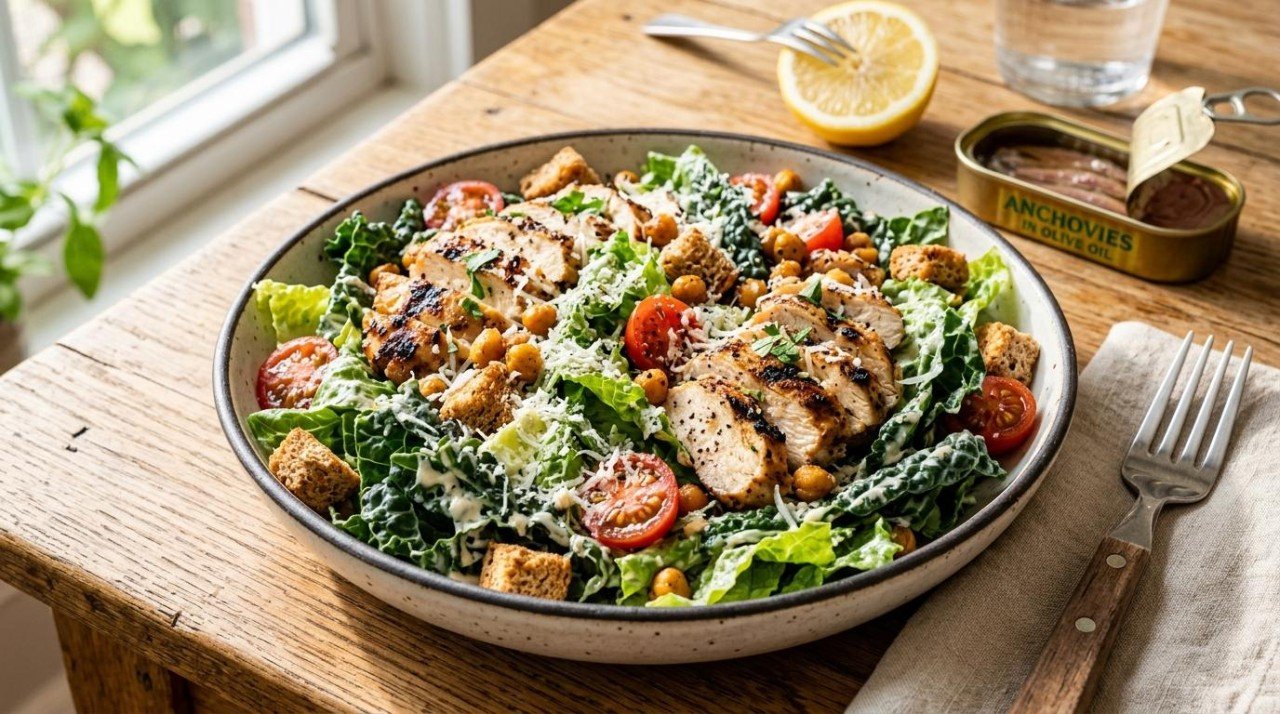
Score: 91/100. Serves 4.
- 1 lb (450 g) romaine hearts, chopped (about 2 hearts)
- 5 oz (150 g) lacinato kale, stems removed, leaves thinly sliced
- 14 oz (400 g) boneless skinless chicken breast
- 1 1/4 cups (200 g) cherry tomatoes, halved
- 1 cup (200 g) cooked chickpeas, drained and rinsed
- 1 1/2 slices (40 g) whole wheat bread, cut into 1/2-inch cubes
- 1/2 cup (110 g) plain nonfat Greek yogurt
- 2/3 cup (65 g) Parmesan, finely grated
- 2 tablespoons lemon juice, plus more to taste
- 4 oil-packed anchovy fillets, drained
- 2 cloves garlic
- 1 teaspoon Dijon mustard
- 1 teaspoon Worcestershire sauce
- 2 tablespoons olive oil, divided
- 1/2 teaspoon black pepper
- No added salt
- Heat the oven to 400F. Pat the chickpeas thoroughly dry, toss with 1 teaspoon of the olive oil and a grind of pepper, spread on a sheet pan, and roast for 20 minutes.
- Toss the bread cubes with 1 teaspoon of the olive oil, add them to the pan alongside the chickpeas, and roast 10 to 12 minutes more, until the croutons are golden and the chickpeas rattle when you shake the pan. Cool on the pan — they crisp as they cool.
- Rub the chicken with 1 teaspoon of the olive oil and season with pepper. Grill or pan-sear over medium-high heat, 5 to 6 minutes per side, until it reaches 165F. Rest 5 minutes, then slice across the grain.
- Mash the anchovies and garlic together into a paste with the flat of a knife. Whisk into the yogurt along with the lemon juice, Dijon, Worcestershire, the remaining 1 tablespoon olive oil, half the Parmesan, and the pepper. Do not add salt.
- Taste the dressing on a piece of romaine rather than off the spoon. If it tastes flat, add lemon juice a few drops at a time.
- Rub the sliced kale between your hands for about 30 seconds until it darkens and softens.
- Toss the romaine, kale, and tomatoes with the dressing until every leaf is coated.
- Add the chickpeas, croutons, sliced chicken, and remaining Parmesan. Toss once and serve.
Per serving, original versus this version:
- Nutrition Score: 45 → 91
- Calories: 451 → 498
- Protein: 11 g → 40 g
- Fiber: 3.9 g → 8.5 g
- Total fat: 35.6 g → 18.9 g
- Saturated fat: 7.8 g → 4.7 g
- Sodium: 1,100 mg → 650 mg
- Potassium: 500 mg → 1,130 mg
- Plant points: 1.5 → 5.5
Note the calories went up. That is the honest headline of this makeover: the original spent 451 calories to deliver 11 g of protein and 3.9 g of fiber, and this one spends 498 to deliver 40 g and 8.5 g. It is a meal now instead of a side dish charging meal prices. It also registers as an excellent source of vitamin K (213% DV), niacin (103%), phosphorus (77%), vitamin B6 (73%), vitamin A (71%), and vitamin C (58%).
On the sodium: 650 mg is still a real number against the 2,300 mg daily ceiling, especially given that most Americans already run around 3,400 mg a day. It is 450 mg less than the original, which is the part we can claim. On fiber, 8.5 g in one meal is meaningful when the average American gets about 15 g in a whole day against a 25 to 35 g target.
Swaps we tested and skipped
- Cutting the croutons entirely: 91. Exactly the same score, with one fewer plant point and less fiber. The croutons are not the problem, have never been the problem, and removing them buys you nothing. This is the single most common "healthy Caesar" advice on the internet and it is worth zero points.
- Halving the olive oil: 89. Two points worse. The score treats olive oil as an asset, not a cost, and the dressing stops coating the leaves. Keep the 2 tablespoons.
- Light mayonnaise instead of Greek yogurt: 85. Six points below the yogurt version, and 547 calories a serving against 498. The obvious swap is the worse swap.
- An all-kale base: 91. Identical score. More fiber (11.1 g), but one fewer plant point, because you traded a plant for more of another plant. Do it if you prefer kale, not because it scores better.
Make it fit other diets
For a vegetarian version, swap the anchovies for 1 teaspoon of white miso and use a vegetarian Worcestershire (the standard kind is made with anchovy) — you lose some of the funk but keep the savory depth, and the chickpeas can carry the protein if you double them. For gluten-free, the croutons are the only thing standing in your way; toast gluten-free bread the same way or go all chickpeas, which scored 66 at that stage of the build. In the app, Recipe Variations will rewrite the whole recipe for either one in a single step, amounts adjusted, rather than leaving you to work out the substitutions yourself.
Do this to any recipe you love
Nothing here required giving up the dish. The anchovies stayed, the Parmesan stayed, the croutons stayed, the olive oil stayed — and it went from 45 to 91 because one ingredient was doing 72% of the damage and half a teaspoon of salt was doing most of the rest.
That is the entire method, and it is what Eat Well Planner is built to do for the recipes you already cook. Import a recipe from any website, Instagram reel, or YouTube video, and it gets a Nutrition Score immediately. Make It Healthier then proposes concrete swaps like these, with a calculator verifying the real nutritional gain before you ever see the suggestion — so you find out that the croutons are innocent and the mayonnaise is not, instead of guessing. Every per-swap number in this post came out of the Recipe Playground, where you can change one ingredient at a time and watch the score move, which is also how you find out what keeping the bacon actually costs you.
It is free to use. Bring the recipe you would defend in an argument.