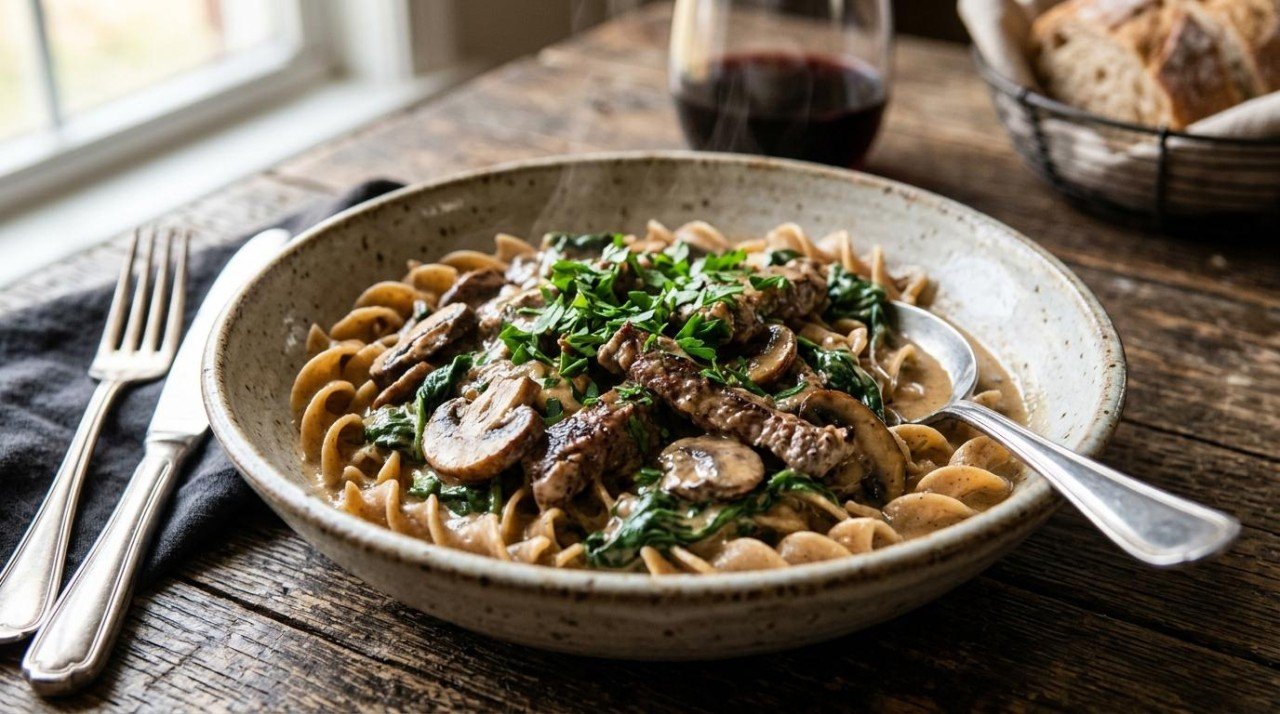
Beef stroganoff is the dinner that makes a Tuesday feel like an occasion. Seared beef, browned mushrooms, a tangy cream sauce clinging to wide egg noodles — rich without being fussy, and on the table in half an hour.
So we ran a standard version through Eat Well Planner's Nutrition Score, the same number a visitor sees on any public recipe page. It came back 48 out of 100, with two red flags: saturated fat and sodium, each at 34% of a day's value in one bowl.
We rebuilt it to 75. It is still stroganoff — still seared beef, still a glossy tangy sauce over noodles — and the biggest single swap was not the one everybody recommends. It was worth 8 points, it takes ninety seconds, and it costs you nothing.
The original: what's in it and how it scores
Here is the standard version we scored, for six people:
- 1 1/2 lb beef sirloin, sliced thin
- 3 tablespoons butter
- 1 medium yellow onion, chopped
- 8 oz white mushrooms, sliced
- 2 cloves garlic, 2 tablespoons all-purpose flour
- 1 1/2 cups beef broth
- 1 tablespoon Worcestershire sauce, 1 teaspoon Dijon mustard
- 1 cup sour cream
- 12 oz egg noodles
- 1 teaspoon salt, 1/2 teaspoon black pepper
Nutrition Score: 48/100. Per serving that is about 538 calories, 36.7 g protein, 7.9 g saturated fat, 770 mg sodium, and 2.9 g fiber. Three things hold it back:
- Saturated fat, flagged high at 34% of a day's value — a cup of sour cream plus three tablespoons of butter is nearly all of it. Harvard's Nutrition Source notes the Dietary Guidelines cap saturated fat at less than 10 percent of daily calories, with the American Heart Association suggesting no more than 7 percent.
- Sodium, also flagged high at 34%, from regular broth, a teaspoon of added salt, and the Worcestershire. Americans already average about 3,400 mg a day against a 2,300 mg ceiling.
- Barely any fiber, and nothing green. 2.9 g per serving, and one of the score's three listed weaknesses was low vitamin K — the plate is beef, dairy, refined noodles, and two beige vegetables.
What is already fine, though, is a lot. Per serving the original is an excellent source of niacin (92% DV), vitamin B12 (75%), iron (69%), thiamine (69%), phosphorus (65%), folate (59%), vitamin B6 (57%), riboflavin (53%), and zinc (50%), with 36.7 g of protein. That is the beef doing nearly all of it, and it is why the original starts at 48 rather than in the 20s. We are not here to take the beef out.
One variable to check first: we scored sirloin, because that is what most published stroganoff recipes call for. If yours uses chuck or generic stew meat, the identical recipe scores 40 — saturated fat climbs to 10.6 g per serving. The cut alone is worth 8 points, and sirloin sliced thin against the grain cooks in two minutes.
The upgrades
Six changes, ordered by what each is worth on its own, biggest first. The scores are cumulative — each swap built on the last, in this order. If you only make one change, make the first.
1. Throw in spinach and a handful of parsley
- Swap: Nothing removed — add 5 oz baby spinach and 1/4 cup chopped fresh parsley
- Score impact: +8 points (48 → 56)
- What it changes: Vitamin K goes from a flagged deficiency to 137% of the daily value — clearing the one listed weakness this dish can actually fix
- What it costs you: Ninety seconds — spinach wilts into the sauce and disappears
This was the surprise of the whole test: the most valuable change to beef stroganoff is not a swap at all, it is five ounces of spinach stirred into the pan at the end. Harvard's Nutrition Source explains that vitamin K "helps to make various proteins that are needed for blood clotting and the building of bones," with an adequate intake of 120 mcg a day for men and 90 mcg for women.
Add it in handfuls after the beef goes back into the sauce and stir until it collapses; nobody at the table will identify it as the healthy addition. The parsley is not decoration either — it carries a startling amount of vitamin K for its weight.
2. Greek yogurt instead of sour cream
- Swap: 1 cup sour cream → 1 cup plain 2% Greek yogurt
- Score impact: +5 points (56 → 61)
- What it changes: Saturated fat from 7.9 g to 4.1 g per serving — clearing the saturated-fat flag entirely — plus more protein and about 50 fewer calories
- What it costs you: A sharper tang, and a sauce that will split if you rush it
This is the swap everyone expects, and the one that takes saturated fat off the warning list. It is also the only place this makeover can genuinely go wrong, so here is the honest version: yogurt will curdle if you boil it. Food scientist Jessica Gavin explains the mechanism — "There are natural acids in sour cream due to the fermentation process. The presence of these acids makes a specific protein in milk called casein very unstable when heated." Greek yogurt is more acidic and more protein-dense, so it is more prone to breaking, not less. Three things prevent it, and you want all three:
- Take the pan off the heat and let it stop bubbling — a full two minutes — before the yogurt goes near it. Gavin's rule applies double here: add it "over low heat, or take the pan off the stove."
- Temper it. Stir two or three spoonfuls of the hot sauce into the yogurt in a separate bowl first, then stir that back into the pan. Cold yogurt hitting a hot pan is what makes grainy sauce.
- Keep the roux. The flour already in the sauce doubles as a stabilizer, holding the proteins apart. Do not skip it and thicken at the end instead.
Fat also protects against splitting, which is why we scored 2% rather than nonfat: nonfat is likeliest to go grainy, whole-milk the most forgiving but it hands back saturated fat you just saved. Be honest about the tang, too — most people read it as brighter and stop noticing by the second forkful, but if your family will revolt, we scored the compromise further down. Our sour cream substitutes guide covers which stand-ins survive heat.
3. Olive oil for most of the butter
- Swap: 3 tablespoons butter → 2 tablespoons olive oil + 1 tablespoon butter
- Score impact: +2 points (61 → 63)
- What it changes: Saturated fat down again, 4.1 g to 2.8 g per serving
- What it costs you: Almost nothing — the last tablespoon of butter carries the flavor
You need fat in the pan to sear beef and brown mushrooms, so this is not about using less; it is about which fat. Harvard notes that replacing saturated fat with unsaturated fat "lower[s] the 'bad' LDL cholesterol, and it improves the ratio of total cholesterol to 'good' HDL cholesterol." Sear the beef and start the mushrooms in olive oil, then drop the butter in with the onions — browning from the oil, buttery aroma from the butter, which is the part you actually taste. Our butter substitutes guide has the ratios.
4. Low-sodium broth and half the salt
- Swap: Regular beef broth → low-sodium, and 1 teaspoon salt → 1/2 teaspoon
- Score impact: +6 points (63 → 69)
- What it changes: Sodium from 770 mg to 510 mg per serving — 34% of the daily limit down to 22%
- What it costs you: Nothing, if you keep the Worcestershire and Dijon
A genuinely interesting quirk turned up here. Tested on its own against the original, this swap was worth only 3 points. Applied at this stage, after saturated fat had been dealt with, it was worth 6. Once one caution clears, the next starts to dominate — a good argument for fixing the biggest problem first rather than nibbling at several.
Broth is the lever because it is mostly salty water by design. Keep the Worcestershire and Dijon; between them they carry most of the savory depth for very little sodium, and halving the added salt is undetectable once the mushrooms are properly browned. Our broth substitutes guide works through the sodium math, including the rule that matters most here: dishes that reduce their liquid concentrate every milligram added at the start.
Take the Guesswork Out of Eating Well
Eat Well Planner helps you organize your favorite recipes, plan balanced meals, and automatically generate shopping lists — all in one place. Whether you're tracking macros, managing dietary restrictions, or just trying to stop asking "what's for dinner?", we've got you covered.
Our AI-powered tools can adapt any recipe to your dietary needs, help you discover new meals you'll love, and even log your nutrition effortlessly. It's meal planning made simple.
Start Organizing Your Meals — Free5. Whole wheat egg noodles
- Swap: 12 oz white egg noodles → 12 oz whole wheat egg noodles
- Score impact: +4 points (69 → 73)
- What it changes: Fiber from 3.4 g to 4.9 g per serving, plus B vitamins and minerals refining removes
- What it costs you: A nuttier, sturdier noodle — largely hidden under a heavy cream sauce
Refining strips out the bran and germ, and with them, per Harvard's Nutrition Source, "more than half of wheat's B vitamins, 90 percent of the vitamin E, and virtually all of the fiber." Keeping them costs little here, because stroganoff sauce is assertive enough to carry a heartier noodle. Cook them a minute shy of the package time so they stay springy.
6. Double the mushrooms, and a bigger onion
- Swap: 8 oz mushrooms → 1 lb; medium onion → large
- Score impact: +2 points (73 → 75)
- What it changes: Fiber to 5.6 g and protein to 41.3 g per serving, and more food for almost no extra calories
- What it costs you: Five more minutes of browning — and the dish tastes better for it
This is the smallest scoring swap in the list and the one we would fight hardest to keep. Doubling the mushrooms bought only 2 points because the score already counted mushrooms as a plant — more of the same plant is worth far less than one new one. That is why five ounces of spinach outscored a doubled pound of mushrooms four to one, and it is the most useful lesson in this post. Variety beats volume, the same principle behind the 30 different plants a week target for gut health.
We doubled them anyway, because a pound of properly browned mushrooms is what makes stroganoff taste like stroganoff. Give them room and leave them alone until they release their water and start to color — crowded, steamed mushrooms are the most common reason a homemade stroganoff tastes flat.
What we kept (on purpose)
All 1 1/2 lb of beef stayed; it is the reason this dish is an excellent source of B12, iron, zinc, and niacin. The last tablespoon of butter stayed too, and we checked the price: scoring the finished recipe with the butter gone and 3 tablespoons of olive oil in its place came back at 75 — identical. The butter is free. Keep it.
We stopped at 75 because the surviving weaknesses are structural. Sodium is still flagged at 22% of a day's value, and the only way further down is to lose the Worcestershire and Dijon that make it stroganoff. The other two — low omega-3 EPA+DHA and low vitamin D — are not fixable in a beef-and-noodles dish. The one honest half-measure is mushrooms, the only plant-style food that makes vitamin D, and only if they have seen UV light, which the ones in most stores have not; our guide to getting vitamin D from mushrooms covers that, though it is not reflected in the score above.
A footnote we enjoyed: the first published stroganoff, in Elena Molokhovets's 1871 A Gift to Young Housewives, was beef in a simple roux with prepared mustard and broth, finished with "a small amount of sour cream: no onions, no mushrooms and no alcohol." The cup-of-sour-cream version is a 1960s American invention — so a broth-forward sauce with a modest tangy finish is closer to the original dish than the one most of us grew up with.
The healthier version: full recipe
Nutrition Score: 75/100. Serves 6.
- 1 1/2 lb beef sirloin, sliced thin against the grain
- 2 tablespoons olive oil
- 1 tablespoon butter
- 1 large yellow onion, thinly sliced
- 1 lb white or cremini mushrooms, sliced
- 2 cloves garlic, minced
- 2 tablespoons all-purpose flour
- 1 1/2 cups low-sodium beef broth
- 1 tablespoon Worcestershire sauce
- 1 teaspoon Dijon mustard
- 1/2 teaspoon salt
- 1/2 teaspoon black pepper
- 5 oz baby spinach
- 1 cup (8 oz) plain 2% Greek yogurt
- 1/4 cup chopped fresh parsley
- 12 oz whole wheat egg noodles
- Cook the noodles a minute short of the package directions, then drain and set aside.
- Pat the beef dry and season with half the pepper. Heat 1 tablespoon of the olive oil in a large skillet over high heat and sear the beef in two batches, about 1 minute per side, until browned but not cooked through. Transfer to a plate.
- Lower the heat to medium-high. Add the remaining olive oil and the mushrooms, spread them out, and leave them alone until they release their water and start to brown, 8 to 10 minutes.
- Add the butter and the onion and cook until soft and golden, about 5 minutes. Stir in the garlic for 30 seconds, then the flour, and cook 1 minute more.
- Whisk in the broth a little at a time, then the Worcestershire, Dijon, salt, and remaining pepper. Simmer, stirring, until the sauce coats a spoon, 3 to 5 minutes.
- Return the beef and any juices to the pan. Add the spinach in handfuls, stirring until it wilts into the sauce, 1 to 2 minutes.
- Take the pan off the heat and let it stop bubbling, about 2 minutes. Stir 2 to 3 spoonfuls of the hot sauce into the yogurt to temper it, then stir the tempered yogurt back into the pan. Do not return it to a boil.
- Stir in the parsley and serve over the noodles.
Per serving, before and after:
- Nutrition Score: 48 → 75
- Calories: about 538 → about 508
- Saturated fat: 7.9 g → 2.5 g (the high-saturated-fat flag cleared completely)
- Sodium: 770 mg → 510 mg (34% → 22% of the daily limit)
- Fiber: 2.9 g → 5.6 g (10% → 19% of the daily value)
- Protein: 36.7 g → 41.3 g (46% → 51% of the daily value)
- Vitamin K: flagged as a deficiency → 137% of the daily value
- Warning flags: 2 (saturated fat and sodium) → 1 (sodium)
Swaps we tested and skipped
- Zucchini noodles instead of pasta (scored 73). The counterintuitive one. Spiralized zucchini in place of the whole wheat noodles lowered the score by 2 points and dropped the meal to 320 calories a serving — light enough that it stops being dinner. The noodles are not the problem in stroganoff; they carry fiber, B vitamins, and enough substance to make it a meal.
- Light sour cream instead of Greek yogurt (scored 73). Less a rejection than a priced option. If your household will not accept the tang, reduced-fat sour cream in the same quantity lands at 73 — saturated fat goes back up to 6.3 g per serving, but you keep 25 of the 27 points. If that is what gets this on your table, take it.
Make it fit other diets
Gluten-free: gluten-free wide noodles, 1 tablespoon cornstarch slurried in cold broth instead of the flour roux, and check the Worcestershire label. Dairy-free: cashew cream or unsweetened plain coconut yogurt in place of the Greek yogurt will not split, though you lose the tang — add a squeeze of lemon. Meatless: a full 2 lb of mixed mushrooms instead of the beef makes a genuinely good stroganoff, but you will need to find the B12 and iron elsewhere in the day. In Eat Well Planner you do not have to work this out by hand — ask the AI recipe chat to "make this gluten-free" and Recipe Variations rewrites the whole recipe with the swaps built in.
Do this to any recipe you love
None of this was guesswork. Every score and delta came out of Eat Well Planner's Make It Healthier feature, which proposes swaps like these and runs each through a calculator to verify the real nutritional gain before showing you the suggestion. Each swap was then tested in the Recipe Playground, where the score moves with every edit — which is how we caught the two findings that made this post: that a handful of spinach beats the sour cream swap, and that the sodium fix doubles in value once saturated fat is dealt with first.
Run the same process on your own family's stroganoff. Import it from a website, a photo, or even an Instagram reel, see where it scores, and let Make It Healthier show you where the cheap points are hiding. Keep the dinner you love. Just make the numbers better.