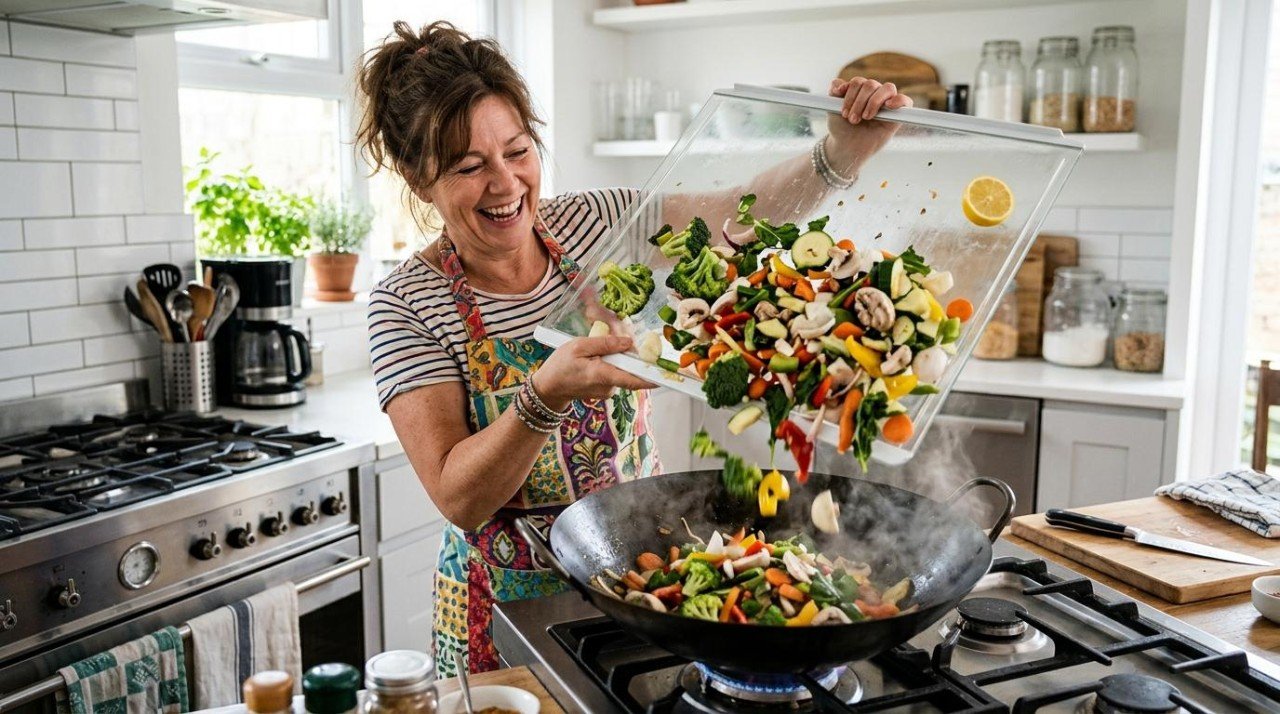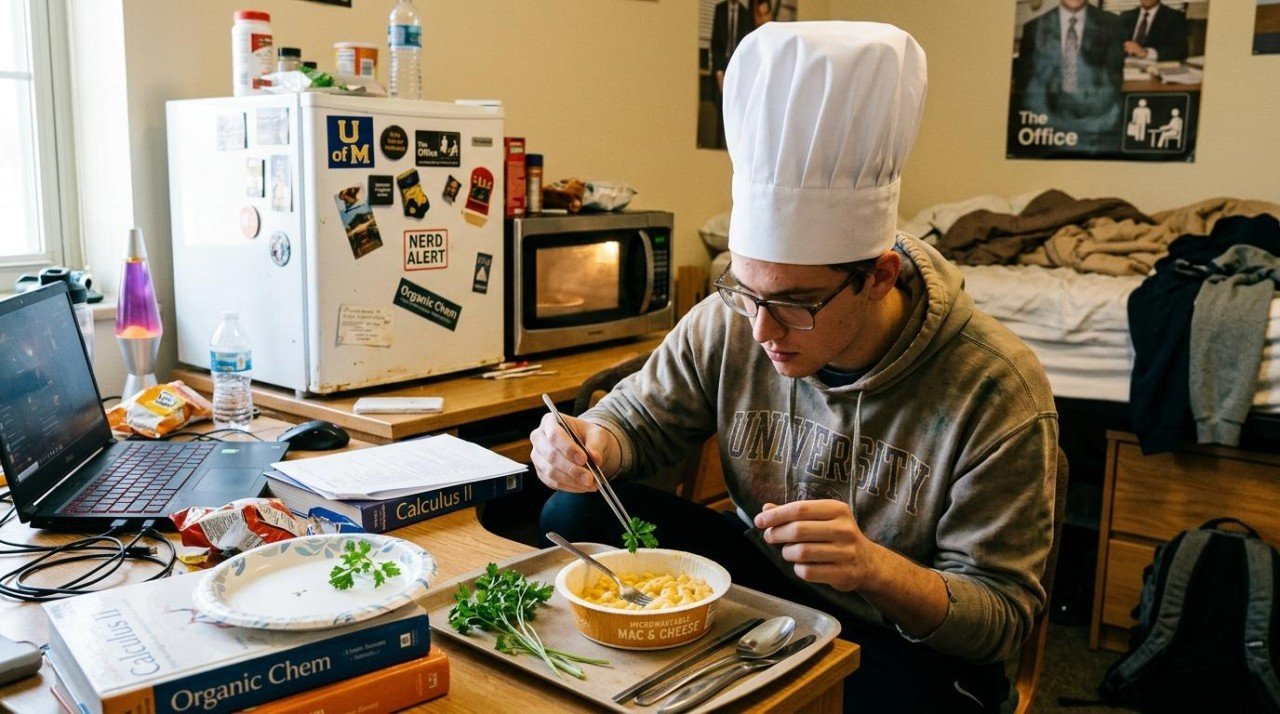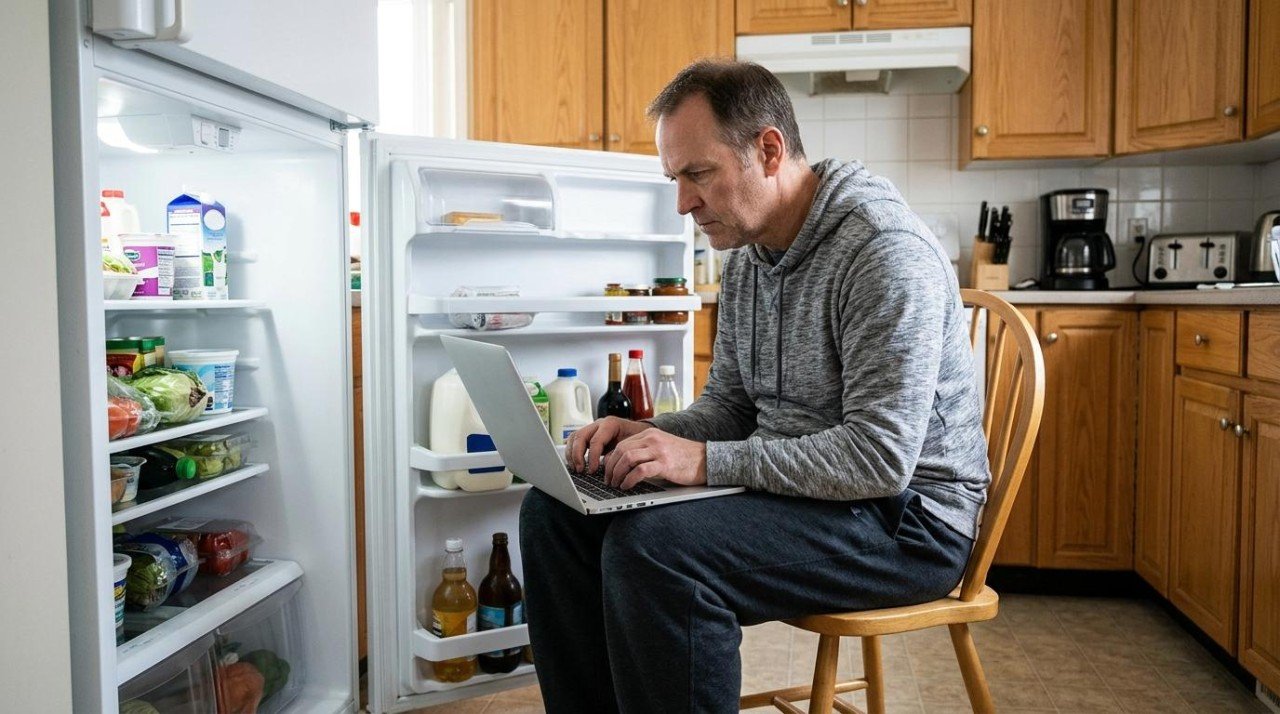
You sit down at your desk with the best intentions. Then, somewhere between the 9 a.m. email pile and the mid-morning meeting, you drift into the kitchen. A handful of crackers. A square of chocolate. A spoonful of peanut butter straight from the jar because why dirty a plate. By 3 p.m. you genuinely cannot tell whether you have eaten a real meal all day or grazed your way through the equivalent of two — and you feel oddly unsatisfied either way.
If that sounds familiar, welcome to one of the quietest occupational hazards of remote work. When your office is ten steps from your refrigerator, the kitchen stops being a place you visit at mealtimes and becomes a permanent background presence — open all day, fully stocked, staffed by exactly one person who knows where everything is.
Here is the most important thing to understand before we go any further: this is not a character flaw, and it is not fixed by trying harder. Constant grazing at home is the predictable output of an environment that makes snacking the easiest possible thing to do. The good news is that environments can be redesigned. This post is about doing exactly that — building structure into your work-from-home day so that eating well becomes the path of least resistance, instead of a battle you have to win a dozen times before lunch.
Why Working From Home Turns Into All-Day Grazing
Start with the reassuring part: you are not imagining this, and you are far from alone. A 2022 study published in Frontiers in Sustainable Food Systems looked at how remote work reshaped people's eating during the pandemic and found a striking paradox. Fully remote workers were about 1.5 times more likely than office workers to say they were eating healthier — yet 29.2% of them reported gaining weight, compared with 18.9% of people who stayed in the office. Believing you eat better at home and actually eating less are, it turns out, two very different things. Increased snacking was one of the behaviors people flagged most often.
So what is actually driving it? A few forces stack up at once.
The food is simply too close
Physical distance to food is one of the most reliable levers on how much of it we eat. A systematic review in the British Journal of Nutrition examined 18 studies that repositioned food — moving it nearer or farther, higher or lower, earlier or later in a line — and found that 16 of them shifted what people chose to eat. The clearest driver was effort: the more convenient a food is to reach, the more of it we take. The two studies that found no effect were the ones where the items barely moved and stayed within easy reach the whole time.
In an office, the snack drawer is a shared candy dish and a vending machine down the hall. At home, the entire pantry is within a thirty-second walk, and there is no coworker to witness your fourth trip. Convenience is the whole game, and home is engineered for it.
Boredom and stress do the rest
Not all grazing is about hunger. A lot of it is about what your brain is doing while your hands look for something to do. In a set of studies published in Frontiers in Psychology, researchers tracked people's boredom and eating in a week-long diary and found that on days when boredom rose by one standard deviation, participants ate roughly 100 additional calories — an effect that held even after accounting for stress and mood. Their explanation is that eating becomes a way to escape the flat, restless feeling of boredom. A repetitive spreadsheet is an excellent boredom generator, and the snack that interrupts it feels like relief.
Stress pulls in the same direction through a different door. As Harvard Health explains, ongoing stress raises cortisol, which increases appetite and specifically nudges us toward foods high in fat and sugar. Worse, those foods appear to blunt the stress response for a moment, which quietly teaches the brain to reach for them again next time. People who mount a bigger cortisol response to stress are also more likely to snack in reaction to the ordinary hassles of a day — and a workday at home has plenty of those, from a frozen video call to a looming deadline, all experienced within arm's reach of the cupboard.
Eating at your desk barely registers
There is one more culprit that is easy to miss: eating while you work. When your attention is on a screen, your brain does a poor job of recording the meal, and that has downstream consequences. A meta-analysis in the American Journal of Clinical Nutrition pooled two dozen studies and found that eating while distracted increased how much people ate in the moment — and, more strikingly, increased how much they ate later in the day by an even larger margin. Enhancing people's memory of what they had eaten did the opposite, reducing later intake. A sandwich inhaled over your inbox is a meal your body half-forgets, which primes you to graze again an hour after you technically ate.
Put these together — food within reach, a boredom-heavy task, background stress, and meals eaten on autopilot — and all-day grazing is not a mystery. It is your environment working exactly as designed. Which means the fix is to redesign it.
Take the Guesswork Out of Eating Well
Eat Well Planner helps you organize your favorite recipes, plan balanced meals, and automatically generate shopping lists — all in one place. Whether you're tracking macros, managing dietary restrictions, or just trying to stop asking "what's for dinner?", we've got you covered.
Our AI-powered tools can adapt any recipe to your dietary needs, help you discover new meals you'll love, and even log your nutrition effortlessly. It's meal planning made simple.
Start Organizing Your Meals — FreeThe Reset: Design the Day, Not Your Willpower
The reset is not a diet and it is not a rule about what you are allowed to eat. It is a set of small structural changes that make grazing a little less automatic and real meals a little more so. None of these is a magic switch on its own; together they change the shape of the day.
Anchor the day with real meals
Grazing thrives in the vacuum left by skipped or half-hearted meals. If breakfast is coffee and lunch is whatever you find standing at the counter, your body will go looking for the calories it missed — one handful at a time, all afternoon. The antidote is to eat meals substantial enough to actually register as meals, ideally built around protein and fiber-rich plants.
Protein earns its reputation here, with an honest caveat. In a study led by researchers at the University of Missouri and published in the American Journal of Clinical Nutrition, young women who habitually skipped breakfast ate either a normal-protein (13 g) or high-protein (35 g) breakfast. The high-protein breakfast increased fullness through the day, shifted appetite hormones toward satiety, and — notably — reduced evening snacking on high-fat foods compared with skipping breakfast entirely. The honest caveat: it did not lower their total daily calorie intake, and other research on more modest protein and fiber increases has found smaller effects on appetite than you might hope. So think of a protein-forward breakfast and lunch not as a trick that shrinks your appetite, but as a way to feel genuinely fed and steady — which makes the pull toward mindless afternoon grazing weaker and easier to notice.
Give snacks a time and a shape
Structure does not mean banning snacks. A planned snack at 10:30 and 3:00 is a completely different thing from open-ended grazing, because it has a beginning and an end. The problem with the peanut-butter-spoon approach is not the peanut butter — it is that it has no boundaries, no plate, and no off switch.
So decide in advance roughly when you will snack and what it will be, and give it a physical form: portioned into a bowl, plated, sitting on a napkin. A snack with edges is a snack you will remember eating, which — per the attentive-eating research above — is exactly what keeps you from drifting back for more an hour later. Prepping a couple of satisfying options ahead of time (Greek yogurt with fruit, hummus and cut vegetables, a handful of nuts and an apple) means the easy choice and the good choice are the same choice.
Put distance between you and the food
Remember that the single biggest lever in the food-placement research was effort. You can use that in your favor at home the same way an office accidentally uses it against you. Keep the tempting, grab-and-go foods out of arm's reach — off the counter, out of the clear jar on the desk, on a high shelf or at the back of the pantry rather than at eye level. Keep the foods you actually want to reach for first — fruit, cut vegetables, water — visible and convenient.
The goal is not to make snacks impossible; it is to add just enough friction that a graze becomes a decision rather than a reflex. A candy dish two rooms away gets visited a fraction as often as one on the desk, and that gap is not about willpower — it is about steps.
Eat your food, not your keyboard
Because distracted meals barely register and set you up to eat more later, one of the highest-leverage changes you can make is also one of the simplest: step away from the screen to eat. Close the laptop, sit somewhere that is not your work chair, and actually taste the meal. Even ten unhurried minutes gives your brain the chance to record that you ate, which the research suggests quietly reduces how much you go looking for later. It also cleanly separates work from food, so the desk stops doubling as a dining table where snacking is always in bounds.
Drink first
Mild dehydration is easy to misread as hunger, and it creeps up fast when you are focused and the water glass is empty. Hydrating regularly removes one of the false alarms that sends you to the kitchen. Water can also take the edge off appetite directly: in a study in Clinical Nutrition Research, young adults who drank about 300 mL (roughly 10 ounces) of water immediately before a meal ate noticeably less — around 123 grams of food versus 162 grams without the pre-meal water, a reduction of about a quarter. The effect is not universal or enormous, but the habit is free and harmless: when the urge to snack hits, drink a glass of water first and give it a few minutes before deciding whether you are actually hungry.
Take a break that is not a fridge break
Since boredom and stress are doing a lot of the grazing on your behalf, the real fix is to meet those feelings with something other than food. The trouble with a fridge break is that it answers restlessness with chewing and then sends you back to the same screen. A short walk, a few minutes of stretching, stepping outside, or a genuine change of scene addresses the boredom and stress directly — and, conveniently, moves you away from the kitchen while it does. Build one or two real breaks into the day on purpose, so that when the restless urge arrives, there is already a better default waiting.
A Sample Work-From-Home Rhythm
None of this has to be rigid. A loose rhythm beats strict rules, because it survives a chaotic Tuesday. Here is what a structured day might look like in practice:
- Morning: A protein-forward breakfast eaten away from the desk — eggs and vegetables, or Greek yogurt with fruit and nuts. Fill a large water bottle for the day.
- Mid-morning: A planned snack around 10:30 if you want one, portioned into a bowl. Otherwise, a glass of water and a short walk around the block.
- Lunch: A real meal, plated, eaten somewhere that is not your work chair — ideally with the laptop closed for ten minutes.
- Mid-afternoon: The predictable danger zone. A pre-planned snack with edges, a glass of water first, and a five-minute movement break to break the boredom loop.
- End of day: Close the kitchen, so to speak. Deciding the kitchen is done for the workday removes the endless open-buffet feeling that stretches grazing into the evening.
Notice what this rhythm is really doing. It is not asking you to resist temptation all day; it is arranging the day so temptation shows up less often and structure shows up more. That is the whole philosophy of the reset: change the environment, and the behavior follows.
Make the Structure Automatic
The catch with structure is that it takes a little planning, and planning is exactly what tends to collapse on a busy workday. This is where a bit of upfront organization pays for itself. When your meals and snacks for the week are decided in advance — with real recipes attached and the ingredients already in the house — the structured choice is not something you have to summon willpower for at 3 p.m. It is simply what is ready.
This is where Eat Well Planner fits naturally into a work-from-home routine. You can plan set meals and a couple of deliberate snacks for your working days, let the app build the shopping list so those satisfying options are actually stocked, and lean on a library of quick, protein-and-plant-forward recipes so that eating a real lunch is easier than grazing through one. Just as useful for breaking the grazing habit, the food diary lets you log what you eat — including the handfuls you would otherwise forget — so the patterns become visible. Once you can see that the snacking clusters at 3 p.m. on stressful afternoons, you can put a walk or a planned snack exactly where the pattern is, instead of guessing.
The point is not to track obsessively or to eat perfectly. It is to give your work-from-home days a shape, so that the kitchen ten steps away stops running your afternoon.
The Takeaway
Grazing all day at home is not a sign that you lack discipline. It is what happens when highly available food meets a boring, stressful, screen-bound day — a setup that would nudge almost anyone toward the pantry. The way out is not more self-control; it is a better-designed day. Anchor it with real meals, give snacks a time and a shape, add a little distance between you and the food, eat away from the screen, hydrate before you graze, and take breaks that move you rather than feed you.
Do that, and you are not fighting your environment anymore. You have quietly rebuilt it so that eating well is simply the easiest thing to do — which, on a random Wednesday at your kitchen-adjacent desk, is worth far more than willpower.