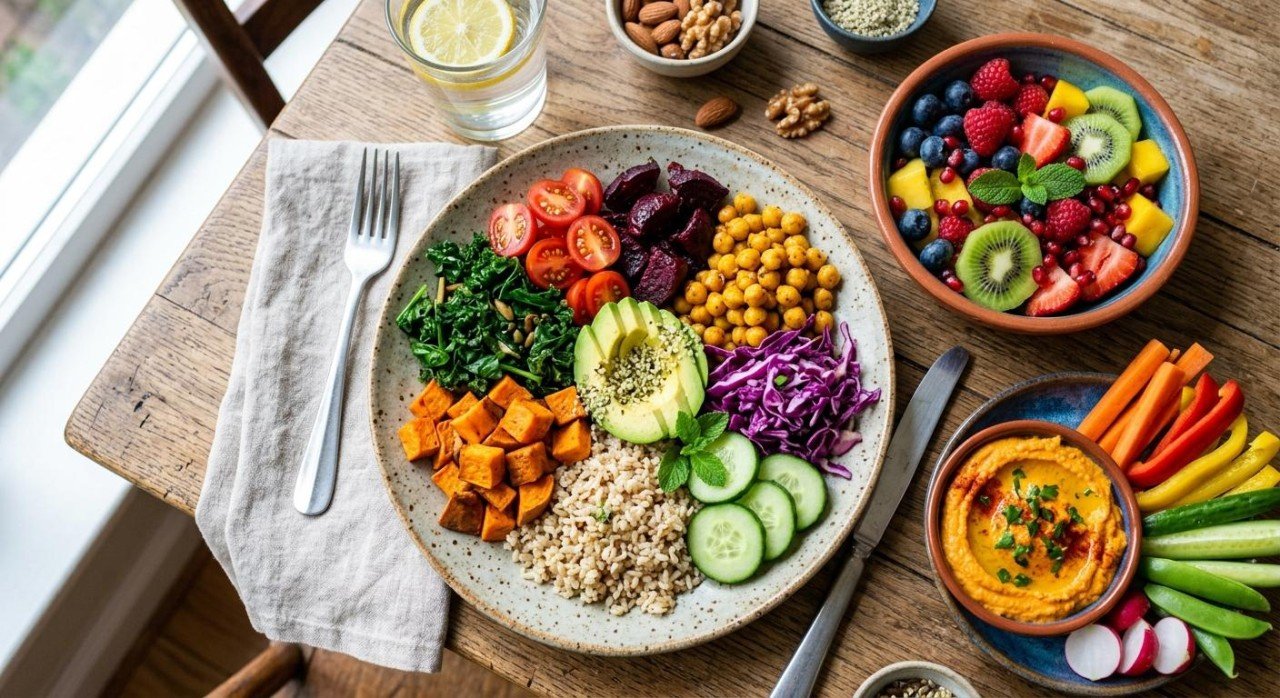
The whole "eat the rainbow" idea sounds like preschool nutrition advice — but there's real biochemistry behind it. The pigments that make a tomato red, a blueberry purple, and broccoli green aren't decorative. They're actual molecules with measurable effects on your blood vessels, your brain, your eyes, and your DNA. And because each color group does different jobs, eating from only one or two corners of the produce aisle leaves real protective compounds on the table.
Here's the problem: most of us are doing exactly that. According to the CDC, only about 12.3% of American adults meet the recommended fruit intake, and 10% meet the vegetable recommendation. Even among people who do eat produce, intake clusters around a narrow set of usual suspects — potatoes, lettuce, bananas, tomatoes. Color diversity loses out to habit and convenience.
This post is about why that narrow palette costs you something specific, and what to actually do about it.
The science behind food colors
Plants make colorful compounds called phytonutrients (or phytochemicals) — things like carotenoids, flavonoids, betalains, and chlorophylls. These aren't vitamins, but they have measurable biological activity in the human body: they neutralize free radicals, modulate inflammation, support cell signaling, and in some cases switch on the body's own detoxification systems.
A 2022 umbrella review published in Molecules pulled together 449 meta-analyses covering more than 37 million participants and concluded that color-associated pigments in fruits and vegetables were tied to improvements in roughly 42% of measured health outcomes — including body weight, lipid profile, inflammation, cardiovascular disease, mortality, type 2 diabetes, and cancer. Importantly, the review noted that color-based variety appeared to confer benefits beyond simply eating more produce overall.
In other words, an extra serving of spinach and an extra serving of beets are not interchangeable. They do different jobs. Let's go color by color.
Red — lycopene and friends
Red foods like tomatoes, watermelon, pink grapefruit, and guava are rich in lycopene, a carotenoid pigment. According to Harvard Health, lycopene is a potent free-radical scavenger that has been studied for its possible protective effects against prostate cancer and cardiovascular disease.
Two practical things to know about lycopene:
- Cooking helps. Heat breaks down plant cell walls and rearranges lycopene molecules into a shape your body absorbs more easily. Tomato paste and cooked tomato products deliver more bioavailable lycopene than raw tomato.
- Fat helps even more. Lycopene is fat-soluble. One study found that consuming tomatoes cooked in olive oil led to an 82% increase in plasma trans-lycopene compared with tomatoes cooked without oil. Pasta sauce with olive oil isn't a guilty pleasure — it's pharmacology.
Strawberries and raspberries get their red from a different family — anthocyanins — which we'll come back to. The point is that even within "red," the active compounds aren't all the same.
Orange and yellow — the carotenoid family
Carrots, sweet potatoes, butternut squash, mangoes, cantaloupe, papaya, and orange peppers get their color from beta-carotene, alpha-carotene, and beta-cryptoxanthin — all carotenoids. Beta-carotene is converted in the body to vitamin A, which supports immune function, skin, and vision.
The Molecules umbrella review linked orange and yellow pigments to reduced risk of several cancers, lower all-cause mortality, and improved cataract and fracture risk.
An important nuance: beta-carotene from whole foods is consistently associated with better health outcomes, but isolated high-dose beta-carotene supplements are a different story. Long-term follow-up of major trials has shown that beta-carotene supplementation actually increased lung cancer risk in smokers. The takeaway isn't that beta-carotene is bad — it's that the food matrix matters. Eat the carrot. Skip the megadose pill.
Green — chlorophyll, sulforaphane, and lutein
"Eat your greens" is one of those slogans that turns out to be more specific than it sounds. Green vegetables actually span at least two interesting biochemical categories.
Cruciferous vegetables — broccoli, kale, Brussels sprouts, cabbage, cauliflower, arugula, watercress — contain glucosinolates. When you chop or chew them, an enzyme called myrosinase converts those glucosinolates into sulforaphane and related isothiocyanates. Sulforaphane activates a cellular pathway (Nrf2) that switches on dozens of the body's own detoxification and antioxidant defenses. Harvard Health describes this class of compounds as among the most studied for their potential cancer-blocking activity.
A practical tip: lightly steaming broccoli (about 3 to 4 minutes) preserves more sulforaphane-forming capacity than boiling it to mush, which deactivates the enzyme.
Dark leafy greens — spinach, kale, collards — are particularly rich in lutein and zeaxanthin, two carotenoids that accumulate specifically in the macula of the eye, where they filter blue light and protect against oxidative damage. The landmark AREDS2 trial, with long-term results published in JAMA Ophthalmology in 2022, ultimately replaced beta-carotene with lutein and zeaxanthin in its official supplement formula for age-related macular degeneration — finding that lutein/zeaxanthin had a beneficial association with slowing late AMD progression, without the elevated lung cancer risk seen with beta-carotene.
Greens also deliver folate, vitamin K, magnesium, and fiber. There is very little nutritional downside to adding more of them to your week.
Blue and purple — anthocyanins
Blueberries, blackberries, blackcurrants, eggplant, purple cabbage, purple sweet potato, purple carrots, plums, and red onions get their color from anthocyanins — water-soluble flavonoids that act as antioxidants and appear to support cardiovascular and brain health.
The umbrella review linked anthocyanin-rich foods with improvements in inflammatory markers, blood glucose control, blood pressure, and vascular function.
On the brain side, a recent systematic review and meta-analysis of nine randomized controlled trials, involving 513 older adults, found that chronic blueberry consumption produced a statistically significant improvement in episodic memory in elderly individuals with mild cognitive impairment or subjective cognitive decline. The effect wasn't uniform across every cognitive domain — working memory and processing speed didn't show clear changes — but the memory finding is one of the more consistent signals in this area.
Worth noting: "purple" doesn't have to mean fruit. Purple cabbage in a slaw, red onion on a salad, a few roasted purple carrots — these are easy ways to slot anthocyanins into savory meals without leaning entirely on berries.
White and brown — don't write them off
White and pale produce is the easiest to dismiss visually, but onions, garlic, leeks, shallots, mushrooms, cauliflower, parsnips, and pears are nutritionally interesting.
The onion and garlic family contains allicin and other organosulfur compounds, formed when you chop or crush the cloves. These have been studied for cardiovascular benefits. Onions, apples, and pears are also among the richest dietary sources of quercetin, a flavonoid with anti-inflammatory activity. The umbrella review tied flavone-rich white pigments to reduced liver cancer risk and lower all-cause and cardiovascular mortality.
Mushrooms deserve a specific shout — they're technically fungi rather than plants, but they bring their own set of compounds (beta-glucans, ergothioneine) plus a meaty texture that makes plant-forward meals more satisfying.
Why variety beats volume
If there's one through-line in the research, it's that diversity matters as much as quantity.
The American Gut Project — a citizen-science microbiome study run out of UC San Diego — found that participants who ate more than 30 different plant types per week had measurably more diverse gut microbiomes than those who ate 10 or fewer. Notably, plant diversity mattered more than whether the person identified as "vegan" or "omnivore." Variety beat the label.
A more diverse gut microbiome is associated with better immune regulation, lower inflammation, and improved metabolic health. And each color group tends to feed different microbial communities through its specific mix of fibers and polyphenols. The microbes have specialists.
So the goal isn't to choke down kale every meal. It's to rotate.
Take the Guesswork Out of Eating Well
Eat Well Planner helps you organize your favorite recipes, plan balanced meals, and automatically generate shopping lists — all in one place. Whether you're tracking macros, managing dietary restrictions, or just trying to stop asking "what's for dinner?", we've got you covered.
Our AI-powered tools can adapt any recipe to your dietary needs, help you discover new meals you'll love, and even log your nutrition effortlessly. It's meal planning made simple.
Start Organizing Your Meals — FreeA simple weekly color framework
Here's a practical, low-effort approach. Aim to hit every color group at least twice in a week:
- Red: tomatoes (cooked, with olive oil), red bell pepper, strawberries, watermelon, pink grapefruit, radishes
- Orange and yellow: sweet potato, carrot, butternut squash, mango, cantaloupe, yellow pepper, apricot
- Green: broccoli, spinach, kale, Brussels sprouts, zucchini, peas, avocado, green apple, asparagus
- Blue and purple: blueberries, blackberries, eggplant, purple cabbage, red onion, plums, black grapes, purple carrots
- White and brown: garlic, onion, leek, mushroom, cauliflower, pear, parsnip, jicama
Think of it less as a checklist and more as a guardrail. If you notice your last three days have been all greens and reds, your next grocery trip should include something purple and something orange.
Where most people get stuck
The science of phytonutrients is well-established. The hard part is operational. People fail at "eat the rainbow" for very specific reasons:
- Habit ruts. You buy the same five vegetables every week because you know how to cook them.
- Variety waste. You buy a new vegetable, don't have a plan for it, and watch it wilt.
- Recipe fatigue. Twenty saved recipes that all lean on broccoli and chicken.
- No visibility. You can't tell at a glance whether your week skewed beige.
This is where having a system genuinely helps. If you import recipes from anywhere on the web — and a weekly meal plan automatically pulls from your personal library, surfaces dishes you've forgotten about, and builds the shopping list around real ingredients you'll actually use — color diversity stops being a willpower problem and becomes a default. Eat Well Planner is built around exactly that workflow: import recipes from any website, Instagram reel, or YouTube video; generate a personalized weekly plan; auto-build the shopping list. The friction that usually keeps people stuck in beige-and-green territory mostly disappears once the planning is done for you.
A few small habits also go a long way:
- Pick one new color or one new produce item per grocery trip, not five. Five is how things rot.
- Keep frozen versions of the harder-to-rotate colors on hand. Frozen blueberries and frozen spinach are nutritionally excellent and don't wilt.
- Cook tomatoes with fat. Roasted, sautéed, blended into sauces. You'll absorb several times more lycopene.
- Chop garlic and let it sit for about 10 minutes before cooking. This lets the allicin form before heat shuts the enzyme down.
The bottom line
Different colors of produce really do different things in the body. Red brings lycopene that supports cardiovascular tissue and may help shield against certain cancers. Orange and yellow deliver carotenoids that feed vision and immunity. Green covers two distinct jobs — sulforaphane for detoxification pathways, lutein for eye protection. Blue and purple bring anthocyanins for vascular and likely cognitive health. White brings organosulfur compounds and quercetin for heart health and inflammation.
You don't need to memorize the biochemistry. You just need a way to make sure your week doesn't quietly collapse into the same three colors. Rotate intentionally, plan ahead, and let the rainbow take care of itself.