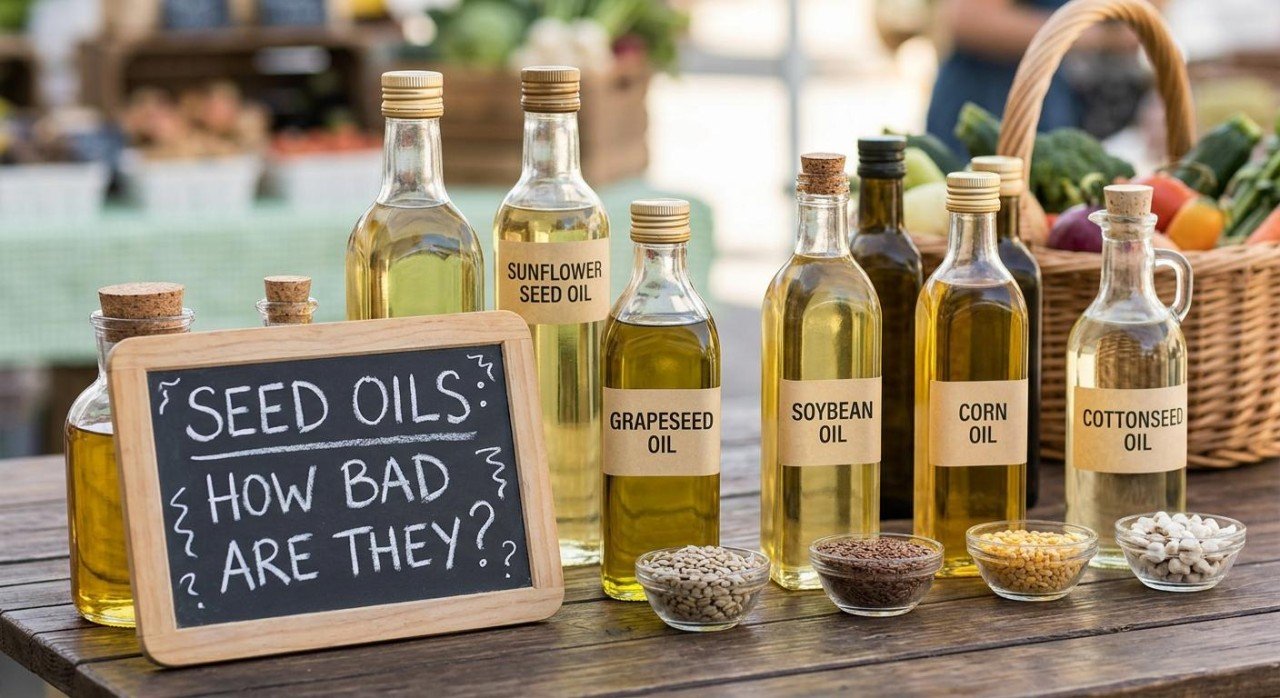
Scroll through health content for more than a few minutes and you will run into someone warning you that seed oils are quietly poisoning you. Canola, soybean, corn, sunflower, safflower, grapeseed — the so-called "hateful eight" — get blamed for inflammation, heart disease, obesity, and just about everything in between. The advice is usually some version of: throw out your vegetable oil, cook everything in butter or beef tallow, and never look back.
It is a compelling story. It is also a lot more complicated than a 30-second video can capture. So let us do something the panic rarely does: look calmly at what the controlled research actually shows, separate the real concerns from the overblown ones, and land on a takeaway you can actually use in your kitchen.
What Are Seed Oils, Exactly?
Seed oils are vegetable oils extracted from the seeds of plants rather than from fruits (like olive oil) or nuts. The most common ones in the American diet are soybean, canola, corn, sunflower, safflower, cottonseed, grapeseed, and rice bran oil. What unites them — and what most of the controversy centers on — is that they are relatively high in omega-6 polyunsaturated fatty acids, particularly one called linoleic acid.
The core accusation goes like this: omega-6 fats are "pro-inflammatory," our intake of them has skyrocketed, and that surge tracks neatly with rising rates of chronic disease. Each piece of that argument deserves a closer look, because the reality turns out to be more reassuring than the headlines suggest.
The Inflammation Claim, Tested
The theory behind the omega-6 inflammation worry is that linoleic acid is converted in the body into arachidonic acid, which in turn can be made into inflammatory signaling molecules. On paper, more linoleic acid should mean more arachidonic acid, which should mean more inflammation. That chain of logic is repeated constantly online. The problem is that when researchers actually measure it in people, the dominoes do not fall.
A 2012 systematic review of randomized controlled trials set out to test exactly this. Across 15 trials in healthy adults, the authors examined a wide panel of inflammatory markers — C-reactive protein, fibrinogen, cytokines, tumor necrosis factor-alpha, and more. Their conclusion was blunt: "virtually no evidence is available from randomized, controlled intervention studies among healthy, noninfant human beings to show that addition of [linoleic acid] to the diet increases the concentration of inflammatory markers."
Why doesn't the theoretical pathway play out? Because the first domino barely moves. A systematic review of 36 studies found that changing how much linoleic acid people ate — anywhere from cutting it by 90% to increasing it more than fivefold — did not meaningfully change the amount of arachidonic acid in their tissues. As the authors put it, the intervention studies "bring no evidence to suggest that changes in dietary [linoleic acid] will modify tissue [arachidonic acid] content in an adult population consuming a Western-type diet." The conversion that the whole inflammation theory depends on is, in practice, tightly regulated and minimal in humans.
This is why mainstream cardiology has landed where it has. As Harvard Health summarizes an American Heart Association science advisory, eating more omega-6 fats "either reduced markers of inflammation or left them unchanged" — and the fats are "not only safe but they are also beneficial for the heart and circulation."
But What About the Omega-6 to Omega-3 Ratio?
A more sophisticated version of the argument focuses not on omega-6 alone but on the balance between omega-6 and omega-3 fats. There is a real kernel of truth here. As Cleveland Clinic notes, a healthier ratio is thought to be somewhere around 1:1 to 2:1, while many Americans sit closer to 10:1 or even 20:1.
But here is the key move that gets lost: the fix for a lopsided ratio is not necessarily to slash omega-6. It is usually easier and more beneficial to raise your omega-3 intake — the fats found in salmon, sardines, walnuts, flax, and chia. Harvard's guidance lands in the same place: rather than cutting back on omega-6 fats, "add some extra omega-3s." You improve the ratio by eating more of the fat most people are short on, not by fearing a fat that, on its own, looks neutral to beneficial in the data.
What the Heart-Disease Data Actually Shows
If seed oils were silently driving cardiovascular disease, you would expect people with more linoleic acid in their bodies to fare worse. The opposite shows up. A 2019 pooled analysis published in Circulation combined 30 prospective cohort studies across 13 countries — nearly 68,700 participants — and measured fatty acids directly in people's blood and tissue rather than relying on food questionnaires. Higher levels of linoleic acid were associated with a lower risk of total cardiovascular disease and a notably lower risk of cardiovascular death. The authors concluded the results "support a favorable role for [linoleic acid] in CVD prevention."
This fits with decades of work on what happens when people swap one fat for another. A 2020 Cochrane review of 15 randomized trials with more than 56,000 participants found that reducing saturated fat cut the risk of combined cardiovascular events by about 17%, and that "replacing the energy from saturated fat with polyunsaturated fat or carbohydrate appear to be useful strategies." In other words, the controlled evidence points toward polyunsaturated fats like those in seed oils being part of the solution for heart health, not the cause of the problem.
Where the Critics Have a Point: Heat and Oxidation
None of this means seed oils get a blanket pass in every situation. There is one genuine, evidence-backed concern, and it is worth taking seriously: what happens when polyunsaturated oils are heated to high temperatures, repeatedly.
Polyunsaturated fats are chemically fragile. The same double bonds that make them "polyunsaturated" also make them prone to oxidation. When these oils are heated to frying temperatures (around 350°F / 180°C) and especially when the same oil is reused over and over, they generate compounds called lipid oxidation products, including reactive aldehydes. A 2018 review describes how these toxic aldehydes form during high-temperature frying and "repetitively escalate with the unfortunately common reuse of such frying media." The review notes these compounds are both cytotoxic and genotoxic, and links them to a range of chronic disease processes. Notably, it also points out that saturated fats are "extremely resistant to peroxidation" — which is the legitimate chemical reason some traditional fats hold up better under prolonged high heat.
So if there is a steel-man case against seed oils, this is it — but notice how specific it is. The concern is not a drizzle of canola oil in a salad dressing or a quick saute at home. It is industrial-scale deep frying, vats of oil reused for days, the kind of cooking that happens far more in commercial fast-food fryers than in your kitchen. Which brings us to the single most important point in this entire debate.
The Confounder Hiding in Plain Sight
The seed-oil graphs that go viral usually show two lines climbing together: seed oil consumption on one axis, rates of obesity or heart disease or diabetes on the other. It looks damning. But two things rising at the same time does not mean one caused the other — and an enormous amount changed in the American diet over the same century.
The rise in seed oil intake is real and dramatic. According to a 2011 analysis in the American Journal of Clinical Nutrition, per-capita soybean oil consumption in the US increased more than a thousandfold between 1909 and 1999, and the availability of linoleic acid rose from about 2.8% to 7.2% of total calories. But here is what else happened in that window: portion sizes ballooned, physical activity plummeted, added sugar climbed, and ultra-processed foods went from a novelty to the majority of what many Americans eat.
And that last point is the crux. Seed oils are everywhere in ultra-processed food — the packaged snacks, fried fast food, cookies, chips, and convenience meals that we already have strong reasons to eat less of. As Cleveland Clinic puts it, "the real reason they're considered so bad for you is related to how they're most often used: in processed foods and ultra-processed foods." Tellingly, the experts add that when people cut seed oils from their diet, "what they really end up doing is cutting out many processed foods" — and then feel better, and credit the oil.
This is the classic confounder. If you stop eating chips, fried takeout, and packaged baked goods, your health may well improve. But it is hard to pin that on the linoleic acid rather than on the salt, refined starch, added sugar, sheer calorie density, and reheated frying oil that came bundled with it. The oil is riding along in the foods that are the actual problem.
Take the Guesswork Out of Eating Well
Eat Well Planner helps you organize your favorite recipes, plan balanced meals, and automatically generate shopping lists — all in one place. Whether you're tracking macros, managing dietary restrictions, or just trying to stop asking "what's for dinner?", we've got you covered.
Our AI-powered tools can adapt any recipe to your dietary needs, help you discover new meals you'll love, and even log your nutrition effortlessly. It's meal planning made simple.
Start Organizing Your Meals — FreeSo What Should You Actually Do?
Here is a calm, evidence-based way to think about cooking oils — no fear required:
- Don't panic about seed oils in moderate, home-cooking amounts. A little canola or sunflower oil in a stir-fry or dressing is not the thing standing between you and good health. The controlled evidence on linoleic acid is neutral to favorable.
- Do go easy on deep-fried and heavily fried foods — especially restaurant and fast-food frying, where oil is reused at high heat. This is where the legitimate oxidation concern actually lives.
- Use the right oil for the job. For higher-heat cooking, more stable choices like extra-virgin olive oil, avocado oil, or even modest amounts of butter hold up well. For dressings and finishing, the flavor and fat profile of olive oil is hard to beat.
- Raise your omega-3s. If the ratio worries you, the easiest lever is eating more fatty fish, walnuts, flax, and chia — not waging war on omega-6.
- Aim your energy at the real target: ultra-processed food. Cooking more meals from whole ingredients at home naturally cuts both the questionable frying oils and the refined carbs, added sugar, and additives that ride along with them.
Notice that almost every practical recommendation circles back to the same habit: cooking more of your own food from fresh, recognizable ingredients. That is the move that quietly resolves the seed-oil debate — not because the oil is uniquely toxic, but because home cooking displaces the ultra-processed foods where the real issues cluster.
Making "Cook More at Home" Actually Happen
The catch, of course, is that "just cook from scratch" is easy to say and hard to sustain when you are busy, tired, and staring into the fridge at 6pm. That is exactly the gap Eat Well Planner is built to close. It is a free tool designed to make whole-food cooking the path of least resistance instead of the heroic exception.
You can save recipes from anywhere — a website, an Instagram reel, a YouTube cooking video — into one organized recipe book, then let the app build a balanced weekly meal plan around the foods you actually want to eat. From that plan it generates an automatic shopping list, so you walk into the store with a purpose instead of drifting toward the processed-snack aisle. And because the built-in nutrition tracking and food diary focus on the things that genuinely move the needle — more plants, more whole ingredients, less ultra-processed food — you spend your attention on what the evidence says matters, not on chasing the villain of the week.
The seed oil panic is, in the end, a useful case study in how nutrition fear works: take a real concern (high-heat oxidation, ultra-processed food), strip away the context, and turn it into a single scary ingredient to eliminate. The more durable approach is less dramatic but far more effective — build a week of fresh, mostly home-cooked meals, lean into plants and omega-3s, and let the ultra-processed stuff fade into the background on its own.
Try organizing your meals with Eat Well Planner and make eating well the easy default — no fad, no fear, just real food you actually want to cook.