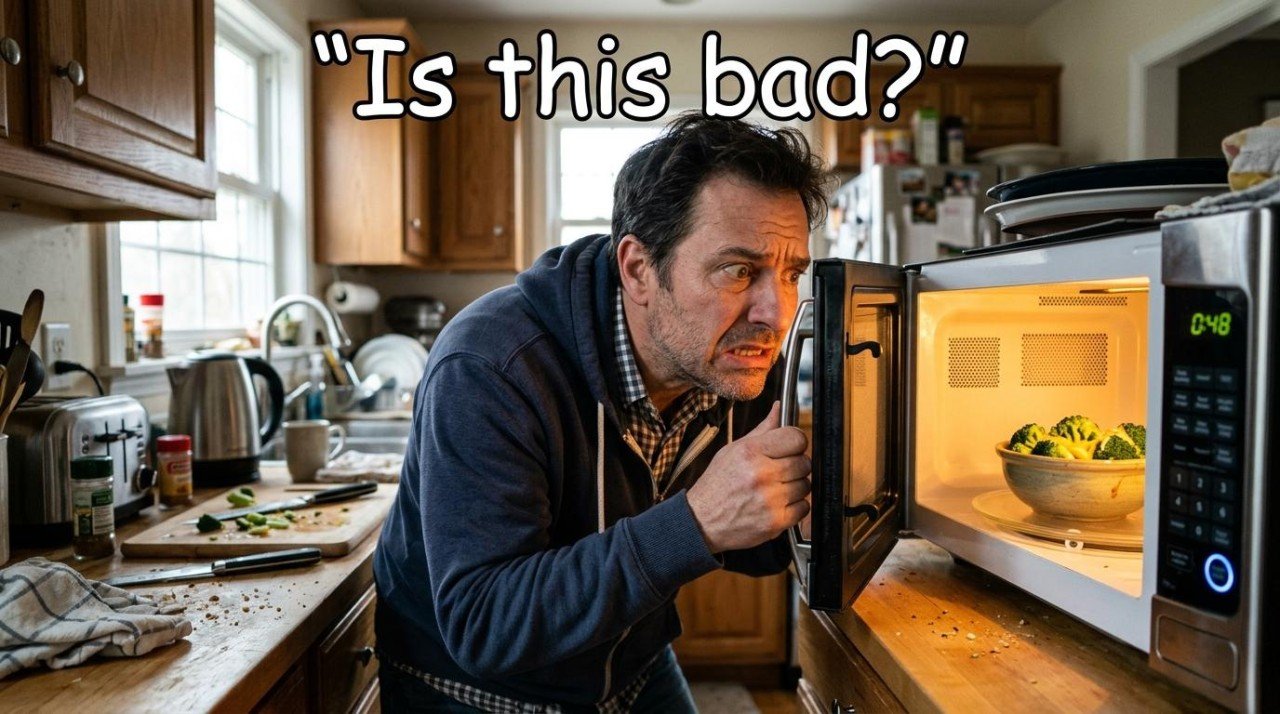
The microwave might be the most quietly distrusted appliance in the American kitchen. We use it constantly — to reheat last night's dinner, steam a bag of vegetables, warm a mug of soup — and yet a nagging voice insists we're doing something slightly wrong. That the convenience comes at a cost. That those two minutes are zapping the goodness right out of our food, or worse, doing something vaguely dangerous to it.
It's a remarkably sticky belief, and it deserves a real answer rather than a shrug. So let's take it seriously and look at what the science actually shows. The short version: microwaving is not only safe, it's often better at preserving nutrients than the stovetop methods we think of as more wholesome. The longer version is worth understanding, because once you know why, you can use your microwave to eat better, not worse.
First, the radiation question
Let's clear the scariest myth out of the way, because it underpins most of the others. The word "radiation" does a lot of heavy lifting here, and it conjures images of X-rays and nuclear fallout. But not all radiation is the same.
Microwaves are a form of non-ionizing radiation — the same broad family as radio waves and visible light. According to the U.S. Environmental Protection Agency, "the non-ionizing radiation used by a microwave does not make the food radioactive." Non-ionizing radiation simply doesn't carry enough energy to knock electrons out of atoms, which is the specific thing that makes ionizing radiation (like X-rays) capable of damaging cells and DNA. The two are not interchangeable, despite sharing a word.
So what actually happens inside the box? A component called a magnetron produces microwaves, which bounce off the metal interior and are absorbed by the water molecules in your food. Those molecules vibrate, the friction produces heat, and the heat cooks the food. The U.S. Food and Drug Administration puts it plainly: "The microwave energy is changed to heat as it is absorbed by food, and does not make food 'radioactive' or 'contaminated.'" When the oven switches off, the microwaves stop — there's nothing lingering in your leftovers.
What about the radiation leaking out and harming you? The FDA has regulated microwave ovens since 1971, and the federal standard (21 CFR 1030.10) limits any leakage to 5 milliwatts per square centimeter at roughly 2 inches from the oven surface, "far below the level known to harm people." It gets even more reassuring with distance: a measurement taken 20 inches away is about one-hundredth of the value at 2 inches. Every oven is also required to have two independent interlock systems that shut off microwave production the instant the door is opened, plus a monitor that stops the oven if those interlocks fail. The practical takeaway is simply this: don't use a microwave with a damaged, bent, or improperly closing door, and you have essentially nothing to worry about.
Does cooking destroy nutrients? Yes — but it's not the microwave's fault
Here's the crucial reframe. All cooking changes the nutrient content of food to some degree. Heat breaks down certain vitamins, especially the delicate, heat-sensitive ones like vitamin C and some B vitamins. This is true whether the heat comes from a microwave, a stovetop, an oven, or a grill. The microwave isn't doing anything uniquely destructive — it's doing the same thing every cooking method does.
What actually determines how much nutrition survives comes down to three factors:
- Heat — higher temperatures break down more of the fragile compounds.
- Time — the longer food sits exposed to heat, the more nutrients degrade.
- Water — water-soluble vitamins (vitamin C, folate, the B vitamins) and many beneficial plant compounds leach out of food and into the cooking liquid, which most of us then pour down the drain.
Once you understand those three levers, the microwave's reputation flips on its head. As Harvard Health explains, "the cooking method that best retains nutrients is one that cooks quickly, heats food for the shortest amount of time, and uses as little liquid as possible. Microwaving meets those criteria." Microwaving with just a splash of water "essentially steams food from the inside out," keeping in more vitamins and minerals than almost any other method.
The FDA agrees, and says so directly: "Microwave cooking does not reduce the nutritional value of foods any more than conventional cooking. In fact, foods cooked in a microwave oven may keep more of their vitamins and minerals, because microwave ovens can cook more quickly and without adding water."
Microwaving vs. boiling: what the studies actually found
This isn't just theory — researchers have measured it directly, and boiling is consistently the loser.
A 2018 study published in Food Chemistry compared cooking methods across a range of vegetables and found that vitamin C retention ranged from 0 to 91 percent depending on the method, with the highest retention seen after microwaving and the lowest after boiling. Vitamin C is one of the most fragile nutrients we eat, and it's also highly water-soluble — which is exactly why dunking vegetables in a pot of boiling water is one of the most effective ways to lose it. You're not destroying the vitamin so much as dissolving it out into water you'll never drink.
Broccoli — that beloved poster vegetable for healthy eating — makes the point vividly. A study on the effects of domestic cooking on broccoli's flavonoids (the beneficial plant compounds linked to its health reputation) found true retention in the order of microwaving > steaming > boiling. Boiling retained as little as 30 percent of some flavonoids, while microwaved samples often held onto well over 100 percent of the measured baseline — likely because gentle, dry heat softens the plant's cell walls and makes those compounds easier to extract and absorb. Harvard's experts note the same pattern with glucosinolates, the precursors to broccoli's famous cancer-research compound sulforaphane: "steamed broccoli holds on to more glucosinolate than boiled or fried broccoli," and boiling lets those nutrients leach straight into the water.
There's an important nuance buried in all this, and it's the key to using your microwave well: if you microwave vegetables in a large amount of water, you essentially recreate boiling, and the nutrient losses follow. The microwave was never the villain. Water is. Use little to no water, and the microwave becomes one of the most nutrient-friendly tools you own.
None of this means microwaving is magic — no cooking method preserves 100 percent of everything, and a few compounds are simply heat-sensitive no matter what you do. But the persistent idea that the microwave is somehow worse than boiling, frying, or roasting has the science exactly backward.
How to microwave vegetables for the most nutrition
If you want to get the best out of your microwave, the rules follow directly from the heat-time-water principle:
- Use as little water as possible — a tablespoon or two is plenty. The goal is to steam, not to boil. Many vegetables release enough of their own moisture to cook with none added.
- Cover loosely — a lid or a microwave-safe plate traps steam so the food cooks faster and more evenly. Leave a small gap for steam to escape.
- Cook in shorter bursts — check at intervals rather than blasting everything for one long stretch. The less total time, the better.
- Don't drain away the liquid — if a little water collects at the bottom, it holds dissolved nutrients. Use it in the dish where you can.
- Cut pieces evenly — uniform sizes cook at the same rate and help avoid the overcooked-and-undercooked problem.
Done this way, a bowl of broccoli, green beans, or spinach goes from raw to perfectly tender in a couple of minutes, with more of its vitamins intact than the stovetop would have left behind — and almost no cleanup.
Take the Guesswork Out of Eating Well
Eat Well Planner helps you organize your favorite recipes, plan balanced meals, and automatically generate shopping lists — all in one place. Whether you're tracking macros, managing dietary restrictions, or just trying to stop asking "what's for dinner?", we've got you covered.
Our AI-powered tools can adapt any recipe to your dietary needs, help you discover new meals you'll love, and even log your nutrition effortlessly. It's meal planning made simple.
Start Organizing Your Meals — FreeThe real things worth paying attention to
So microwaving is safe and nutrient-friendly. But there are a few legitimate considerations — they just have nothing to do with radiation or destroyed vitamins. They're about what you put your food in, and how evenly it heats.
Plastic is the actual concern
The genuine question with microwaving isn't the food — it's the container. Heat encourages chemicals and tiny plastic particles to migrate out of plastic and into whatever you're eating. A 2026 Greenpeace International analysis of two dozen peer-reviewed studies, reported by Food Safety Magazine, found that polypropylene and polystyrene containers released between 100,000 and 260,000 microplastic particles when microwaved, and that microwave heating drove far more particle release than refrigeration or room-temperature storage. The report also argued that "microwave safe" labeling can give false reassurance — it generally means the container won't melt or warp, not that nothing migrates into your food.
The FDA's own guidance notes that "some plastic containers should not be used in a microwave oven because they can be melted by the heat of the food inside," and that metal pans and aluminum foil should be kept out entirely. The simple, low-effort fix: heat your food in glass or ceramic instead of plastic. Transfer that takeout or those leftovers to a glass bowl before it goes in. It costs you nothing and sidesteps the one part of microwaving that's genuinely worth avoiding.
Cold spots and even heating
Microwaves don't cook food "from the inside out," despite the popular phrase. The FDA explains that with thicker foods, the outer layers are heated by the microwaves while the center cooks more slowly by heat conducting inward. That uneven heating can leave cold spots — which matters mainly for food safety, since bacteria survive in the parts that didn't get hot enough. Stirring partway through, letting food rest for a minute so the heat evens out, and covering it all help. For reheating leftovers or cooking meat, make sure the whole thing is steaming hot throughout, not just at the edges.
The exploding-water trap
One last oddity worth knowing: the FDA has received reports of people being burned by "super-heated" water — water heated past boiling in a clean cup that doesn't appear to be bubbling, then erupts violently when disturbed or when something like instant coffee is added. It's rare, but real. Don't overheat plain water beyond the times your oven's manual recommends, and you'll never meet it.
The microwave as a healthy-eating ally
Step back and the picture is clear. The microwave is fast, it uses little or no water, and it cooks at lower effective temperatures for shorter times than most stovetop or oven methods. Every one of those traits is good news for the nutrients in your food. For busy people, it's not a compromise you make when you're too rushed to cook properly — it can be one of the smartest tools in the kitchen.
And that matters far more than nutrient percentages alone, because the biggest driver of how well any of us eats isn't the cooking method — it's whether a wholesome option is actually within reach when we're tired and hungry. When the easy choice is a microwaved bowl of real vegetables and last night's home-cooked dinner, you eat that. When there's no plan and nothing prepped, the easy choice becomes the drive-through or the ultra-processed snack. The microwave, used well, tilts the odds toward real food on a hectic Tuesday night.
That's exactly the gap Eat Well Planner is built to close. It helps you keep a personal library of quick, real-food recipes — many of which steam beautifully in the microwave — and uses AI to turn them into a balanced weekly meal plan around your preferences and goals. From that plan it generates an organized shopping list automatically, so the fresh ingredients are already in your fridge when you need them. If a recipe needs adapting — fewer dishes, a stovetop step swapped for the microwave, a dairy-free version — the built-in recipe chat will help you tweak it on the spot. The point is to make the nutritious option the path of least resistance, so reaching for whole food becomes the default instead of the effortful exception.
So the next time you reach for the microwave, you can drop the guilt. You're not sacrificing nutrition — done thoughtfully, you may be protecting more of it than you would have any other way. Skip the plastic, go easy on the water, heat things evenly, and let the convenience work in your favor.
Ready to make fast, healthy meals your everyday normal? Try organizing your meals with Eat Well Planner — and let the planning take care of itself.