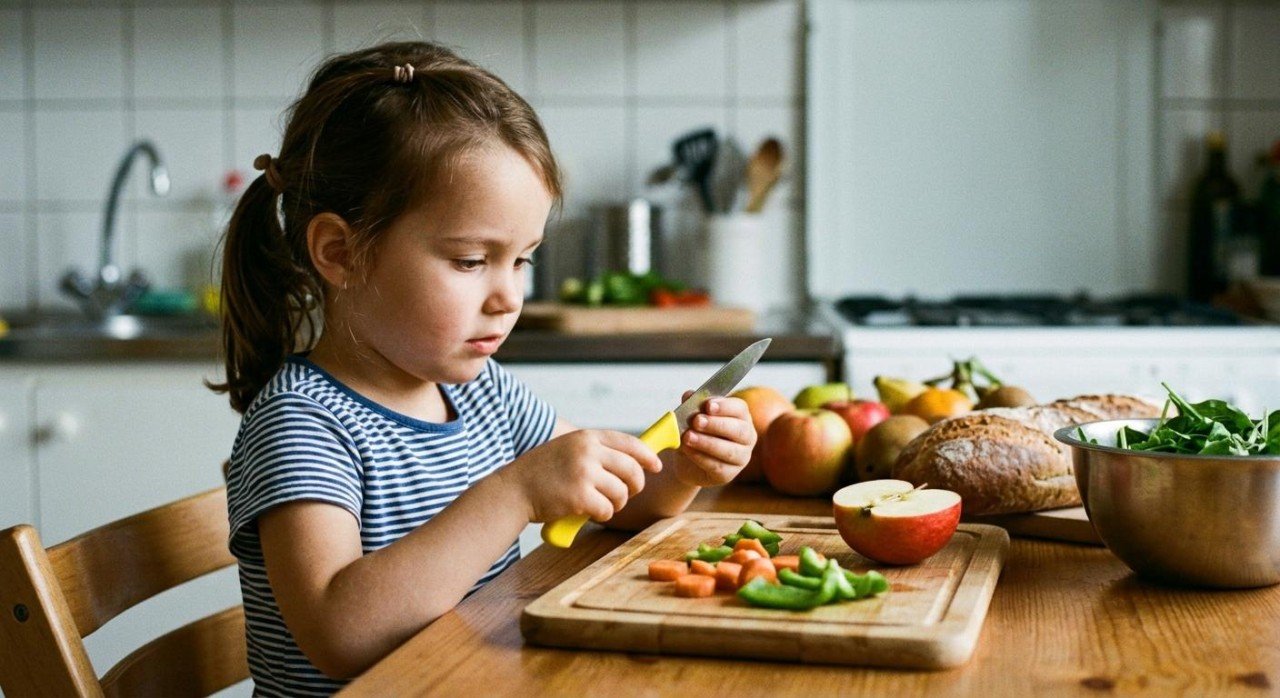
Your toddler wants to help in the kitchen. Every instinct says "not yet" — they're too small, too clumsy, too likely to make a mess. But developmental research says the opposite: the kitchen is one of the best classrooms in your house, and children can start learning there far earlier than most parents assume.
The benefits go well beyond an extra pair of hands at dinner time. Children who cook eat more vegetables, develop better relationships with food, build maths and science skills without realizing it, and carry those habits into adulthood. The trick is matching the right tasks to the right age — so they stay safe, feel successful, and actually want to come back and do it again.
Here's what the research says kids can handle at every stage, from toddlerhood to the teenage years, along with safety guidance, starter recipes, and the science behind why it all matters.
Why It Matters: The Research on Kids Who Cook
Let's start with the evidence, because it's more compelling than most parents realize.
A study published in the journal Appetite tested what happened when children aged 6 to 10 helped prepare their own lunch versus having a parent cook the same meal without them. The results were striking: children who helped cook ate 76% more salad and 27% more chicken, and consumed 25% more calories overall. They also reported feeling more positive and more in control after cooking — a sense of pride and ownership that translated directly into willingness to eat.
That finding isn't isolated. Research from the University of Illinois found that among fourth graders, cooking self-efficacy — simply believing they could cook — predicted higher overall diet quality, greater whole fruit consumption, and increased vegetable intake. It wasn't culinary talent that mattered. It was confidence.
And the effects last. A 10-year longitudinal study tracking over 1,100 young adults found that those who reported adequate cooking skills by their early twenties were 3.5 times more likely to prepare meals with vegetables most days a decade later. They also ate less fast food and had more frequent family meals. The cooking skills children build now shape how they feed themselves — and eventually their own families — for years to come.
Beyond nutrition, cooking teaches children maths (measuring, fractions, doubling recipes), science (what happens when you heat an egg? why does bread rise?), reading comprehension (following a recipe), and sequencing (doing steps in the right order). The Utah State University Extension notes that cooking naturally builds skills in "counting, fractions, measuring, science, vocabulary, and how to follow directions" — all while children think they're just making lunch.
Ages 2-3: The Sensory Explorers
At this age, children are driven by curiosity and the desire to do things themselves. Their fine motor skills are developing rapidly, but coordination is still rough — they can grip, tear, and push, but precise movements are beyond them. The goal here isn't producing a dish. It's building familiarity with ingredients and creating positive associations with the kitchen.
What They Can Do
- Wash fruits and vegetables — standing on a sturdy step stool at the sink, rinsing produce under running water. This is a sensory experience as much as a practical task.
- Tear lettuce and herbs — ripping leaves into a salad bowl is satisfying and requires no tools.
- Stir room-temperature ingredients — give them a big bowl and a wooden spoon. Expect mess; that's fine.
- Knead dough — bread dough, pizza dough, or even play dough as practice. Builds hand strength and coordination.
- Snap green beans — a gratifying task with a built-in sound effect.
- Use cookie cutters — pressing shapes into rolled dough or soft foods like cheese or melon slices.
Safety at This Age
Keep children away from heat, sharp objects, and electrical appliances entirely. Use a stable step stool or a learning tower so they can reach the worktop safely. Wash hands before and after. As the Academy of Nutrition and Dietetics recommends, establish the ground rules early: wash hands, tie back long hair, and no tasting raw dough or batter.
Starter Recipes
- Fruit salad — wash, tear, and arrange pre-cut fruit in a bowl. They choose the combination.
- Simple flatbread — knead and flatten dough (you handle the oven). They love watching it puff up.
- Ants on a log — spread peanut butter on celery (you spread, they place raisins on top).
Ages 4-5: The Measurers and Mixers
Fine motor skills are becoming more refined now. Children at this stage can follow simple two-step instructions, pour with moderate accuracy, and are starting to understand cause and effect — "if I add this, the color changes." They're also deeply invested in doing things "by myself," which you can channel productively.
What They Can Do
- Measure dry ingredients — scooping flour, oats, or sugar into measuring cups (expect some spillage).
- Pour pre-measured liquids — from a small jug into a bowl.
- Mix batters and doughs — with a spoon or their hands.
- Mash soft foods — bananas, avocados, or cooked potatoes with a fork or masher.
- Spread with a butter knife — jam on toast, cream cheese on crackers, hummus on pitta.
- Brush oil or egg wash — using a pastry brush on bread or pastries before baking.
- Cut soft foods with a child-safe knife — bananas, strawberries, cooked vegetables. Research from a multidisciplinary study published in Appetite found that children aged 3 to 5 can safely handle supervised cutting tasks with appropriate child-safe knives.
Safety at This Age
Introduce the concept of "hot" and "cold" zones in the kitchen. The hob, oven, and kettle are adult-only zones. Their workspace is at the counter, away from heat. If you introduce a child-safe knife (rounded tip, serrated edge designed for small hands), demonstrate the "claw grip" — curling fingers inward to hold food while cutting — and supervise every cut.
Starter Recipes
- Guacamole — mash avocado, squeeze lime (you cut it), stir in pre-measured seasonings. Serve with vegetable sticks.
- Banana-oat energy bites — mash bananas, mix with oats and a drizzle of honey, roll into balls. No cooking required.
- Mini pizzas on pitta bread — spread tomato sauce, sprinkle cheese, add toppings. You handle the oven.
Ages 6-7: The Egg Crackers
This is often the age when children start to feel like real kitchen contributors rather than helpers. Their hand-eye coordination is significantly better, they can follow multi-step instructions, and they're developing the patience to wait for things to cook. It's also when many children can start using a real (small) knife under close supervision.
What They Can Do
- Crack eggs — expect some shell in the bowl at first. Teach them to crack on a flat surface rather than the bowl edge for cleaner breaks.
- Cut soft foods with a small knife — mushrooms, cooked carrots, cucumber, cheese. Children's Health recommends starting with dull knives and soft foods at this age, always with direct adult supervision.
- Peel with fingers — oranges, bananas, hard-boiled eggs, garlic cloves.
- Use scissors to cut herbs — kitchen scissors are often safer than knives for this task.
- Set the table — counting plates, placing cutlery, folding napkins.
- Read simple recipes — following along with a printed or displayed recipe builds reading skills and independence.
- Assemble ingredients — gathering everything needed before cooking begins (the "mise en place" habit).
Safety at This Age
If introducing a real knife, start small — a paring knife or a short serrated knife works well. Always supervise directly (not from across the kitchen). Reinforce the claw grip every time. Teach them to walk with a knife pointing downward. This is also a good age to introduce the concept of checking that pot handles face inward on the hob so they can't be knocked off.
Starter Recipes
- Scrambled eggs — they crack and whisk the eggs, you manage the hob. They can stir gently with your guidance.
- Vegetable wraps — cut cucumber and pepper, shred lettuce, spread hummus on a wrap, and roll it up.
- Fruit smoothies — measure ingredients, add to the blender (you operate it), pour into glasses.
Take the Guesswork Out of Eating Well
Eat Well Planner helps you organize your favorite recipes, plan balanced meals, and automatically generate shopping lists — all in one place. Whether you're tracking macros, managing dietary restrictions, or just trying to stop asking "what's for dinner?", we've got you covered.
Our AI-powered tools can adapt any recipe to your dietary needs, help you discover new meals you'll love, and even log your nutrition effortlessly. It's meal planning made simple.
Start Organizing Your Meals — FreeAges 8-10: The Recipe Followers
Now things get interesting. Children at this age can follow a full recipe from start to finish with supervision, understand timing (set a timer for 10 minutes), and are developing the coordination and judgement to use more kitchen equipment safely. The Academy of Nutrition and Dietetics notes that children aged 7 to 9 can handle tasks like operating a can opener, storing leftovers properly, and using a food thermometer.
What They Can Do
- Follow a simple recipe independently — reading ingredients, measuring, and assembling with you nearby.
- Use a peeler — for carrots, potatoes, cucumbers. Demonstrate peeling away from the body.
- Operate a can opener — manual or electric, with initial supervision.
- Use the microwave — Children's Health suggests children can start using the microwave around age 7 to 8, provided they can reach it safely without standing on tiptoes and understand that food inside can be hot even when it doesn't look it.
- Grate cheese and vegetables — using a box grater with supervision, keeping knuckles clear.
- Drain pasta or vegetables — with a colander, using oven mitts (you carry the hot pan).
- Make a salad from scratch — washing, tearing, chopping, and dressing.
Safety at This Age
You can begin introducing the hob with direct supervision — stirring a pan of sauce, flipping a pancake with your hand guiding theirs. Teach them to use oven mitts and to turn pot handles inward. The general guidance is that children can start using the stove around age 10 to 11, so at 8 to 9 they should only use it with you standing right beside them. Always reinforce: if something goes wrong (a spill, a small burn, a dropped pan), tell an adult immediately.
Starter Recipes
- Pasta with homemade tomato sauce — they chop onion and garlic (with supervision), you manage the hob together. They stir the sauce and time the pasta.
- Quesadillas — grate cheese, add fillings like beans and sweetcorn, fold the tortilla. You supervise the pan.
- Overnight oats — measure oats, milk, yogurt, and toppings into a jar. No cooking at all, and breakfast is ready in the morning.
Ages 11-13: The Independent Cooks
This is the stage where children can realistically cook a simple meal from start to finish with minimal help. Their fine motor skills are essentially adult-level, they can manage multiple steps simultaneously (stirring the sauce while the pasta cooks), and they're developing the judgement to make decisions — "this looks done" or "I think it needs more seasoning."
What They Can Do
- Use the hob and oven with supervision — frying, boiling, baking, and roasting. By 11 to 12, most children can use the oven safely with an adult in the house, though not necessarily in the room.
- Use sharp knives properly — with the claw grip now habitual, they can handle most cutting tasks. Continue supervising until their technique is consistent.
- Follow complex recipes — multi-step dishes, recipes with precise timing, baking that requires accuracy.
- Cook a complete meal — protein, vegetable, and carbohydrate, timed to finish together.
- Handle raw meat safely — understanding cross-contamination, separate chopping boards, hand washing, and cooking to safe temperatures.
- Clean as they go — washing up between steps, wiping surfaces, putting ingredients away.
Safety at This Age
The biggest shift here is from direct supervision to nearby supervision. You don't need to watch every stir, but you should be in the house and available. Reinforce food safety rules: raw meat goes on a separate board, hands get washed after touching raw chicken or eggs, and cooked food needs to reach the right internal temperature. A food thermometer is a practical gift for this age group.
Starter Recipes
- Stir-fry with rice — chop vegetables, slice chicken or tofu, cook rice, make a simple sauce. A complete meal that teaches timing and heat management.
- Homemade soup — chop vegetables, sauté onion and garlic, add stock, simmer. Teaches patience and seasoning to taste.
- Baked frittata — whisk eggs, add whatever vegetables and cheese are in the fridge, bake. A great introduction to improvising with available ingredients.
Ages 14+: The Meal Planners
Teenagers are capable of everything an adult cook can do — and this is the critical window for developing the habits they'll carry into independent life. The longitudinal research is clear: young adults who feel confident cooking by their early twenties eat significantly better for the next decade. The foundations laid now have a measurable payoff.
What They Can Do
- Plan meals for the week — choosing recipes, balancing nutrition, considering what's already in the fridge.
- Write a shopping list — from a meal plan, calculating quantities for the number of servings needed.
- Cook for the family — taking responsibility for an entire meal, from planning through cooking to serving.
- Adapt recipes — substituting ingredients based on what's available, adjusting for dietary preferences, scaling portions up or down.
- Use all kitchen equipment independently — oven, hob, blender, food processor, grill.
- Batch cook and store food safely — understanding fridge and freezer storage times, labelling leftovers, reheating safely.
- Budget for groceries — comparing prices, choosing seasonal produce, avoiding waste.
Safety at This Age
By now, safety should be habitual rather than supervised. If they've been building skills through the earlier stages, the rules around knife handling, heat, raw meat, and hygiene should be second nature. The main risk at this age is overconfidence — attempting deep-frying, flambeing, or other advanced techniques without understanding the risks. Keep the conversation open rather than the supervision constant.
Starter Recipes
- A full roast dinner — timing multiple components to finish together is the ultimate cooking skill. Start with a simple roast chicken, roasted vegetables, and a grain or potato.
- Homemade curry from scratch — building a spice base, simmering a sauce, cooking rice. A lesson in layering flavor.
- Batch chilli or bolognese — cook a large pot, portion into containers, freeze for the week. An introduction to meal prep and forward planning.
Making the Kitchen a Welcoming Place
The research consistently shows that the biggest predictor of whether children develop cooking skills isn't their age, their coordination, or their natural talent — it's whether they have regular, positive experiences in the kitchen. Here are a few principles that make that more likely.
Let them choose. Children are more invested in cooking when they've had a say in what's being made. Let them pick the recipe, choose between two vegetables, or decide on tonight's flavor. Even small choices build ownership.
Expect mess and build in time for it. If you're rushing to get dinner on the table in 15 minutes, it's not the moment to involve a 4-year-old. Choose low-pressure times — weekend mornings, school holidays, or a lazy Sunday afternoon — when mess and slowness are acceptable.
Praise the effort, not the result. "You measured that really carefully" matters more than "that looks perfect." Children who feel judged on outcomes will avoid trying new things. Children who feel valued for their effort will keep showing up.
Don't re-do their work. If the carrots are uneven, the flour is slightly off, or the egg has a bit of shell in it, resist the urge to fix it. Correcting their work sends the message that their contribution wasn't good enough. Fish out the shell quietly if you must, but let their effort stand.
Cook together regularly. One-off cooking sessions are fun, but the real benefits come from consistency. Even once a week — a Saturday morning breakfast, a Sunday batch-cooking session — builds skills and habits that stick. The Utah State University Extension notes that children regularly involved in meal preparation eat significantly more vegetables than their peers and are more willing to try unfamiliar foods.
Turning Kitchen Skills into a Family Habit
One of the biggest obstacles to cooking with kids isn't safety or skill — it's planning. Finding age-appropriate recipes, figuring out what to buy, and deciding what everyone will eat this week takes energy that's already in short supply for most families.
This is where a tool like Eat Well Planner can genuinely help. Families can browse and save recipes together — children can even pick meals they want to try for the week. The app generates a shopping list automatically, so there's no last-minute scramble for missing ingredients when your 8-year-old is ready to cook pasta from scratch. And because every recipe comes with a full nutrition breakdown, you can see exactly what your family is eating without having to calculate anything yourself.
For teenagers learning to meal plan, it's a practical way to start: pick a few recipes, see the shopping list come together, and understand how a week of meals fits together before they're doing it on their own at university.
A Skill for Life
Teaching children to cook isn't about raising the next celebrity chef. It's about giving them a practical, everyday skill that directly shapes their health, their confidence, and their independence for decades to come.
Start where your child is right now. If they're two, hand them a lettuce leaf to tear. If they're eight, let them follow a recipe. If they're fourteen, challenge them to cook dinner for the family once a week. Every age has a starting point, and every starting point leads somewhere good.
The mess is temporary. The skills last a lifetime.