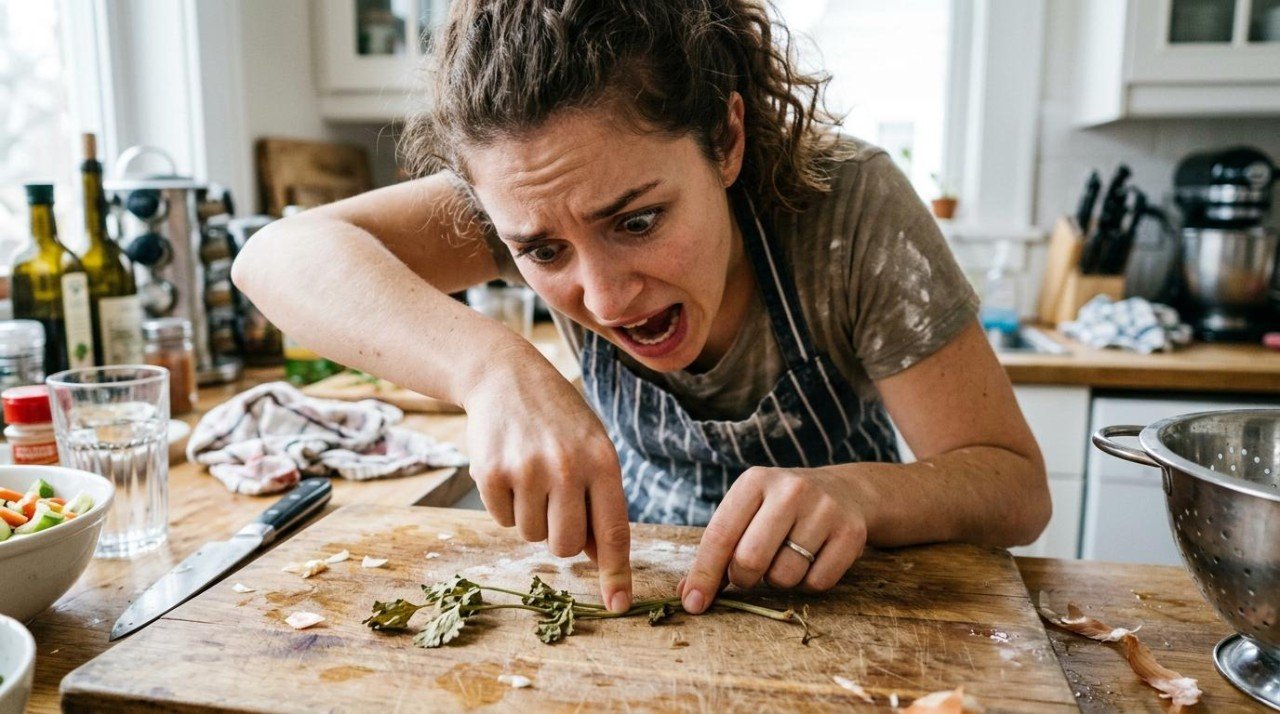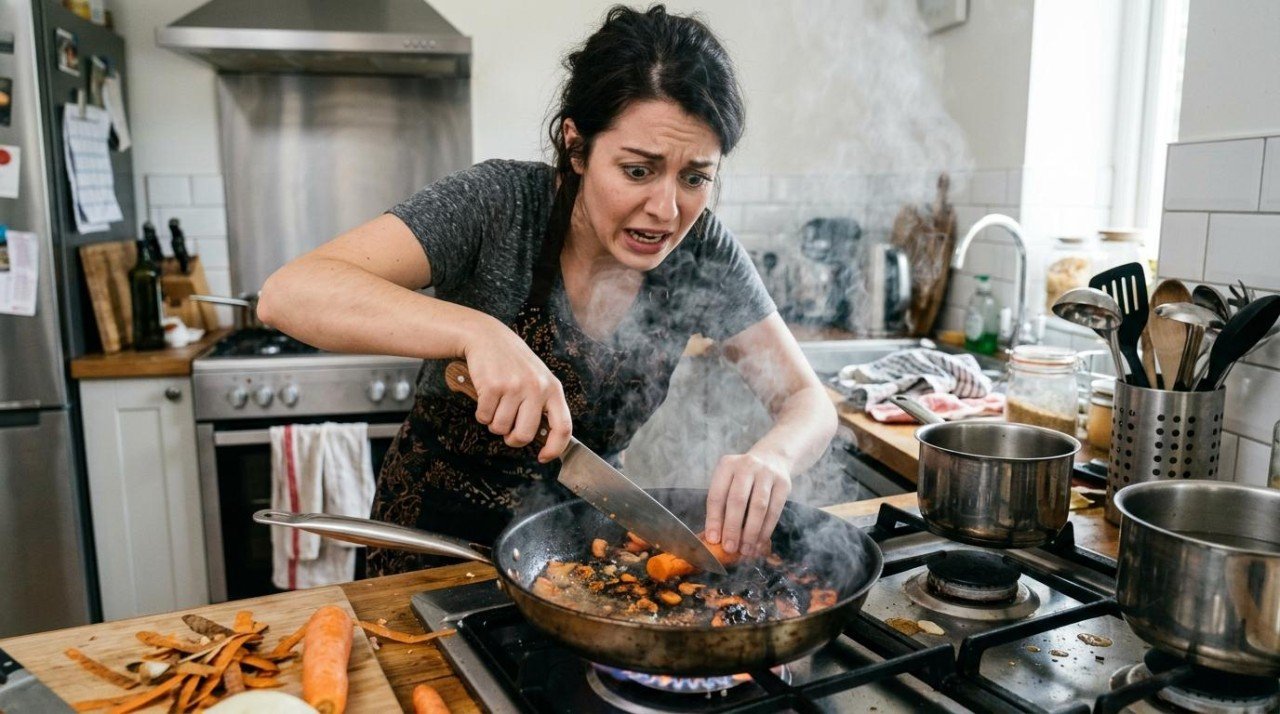
Picture the moment cooking goes sideways. The garlic is sizzling in the pan and smelling incredible — and then you realize the onion still isn't chopped, you can't remember where you put the soy sauce, and the recipe suddenly wants a tablespoon of cornstarch "slurry" you've never heard of. By the time you look back at the stove, the garlic has gone from golden to bitter and black. Dinner isn't ruined, exactly, but your shoulders are up around your ears and the whole thing feels like a small emergency.
If that scene is familiar, the fix isn't cooking faster or buying better knives. It's a habit borrowed straight from professional kitchens, and it takes about ten minutes: mise en place. Restaurants run on it, culinary students learn it before they learn to cook anything, and it happens to be the single biggest upgrade available to a stressed home cook. Here's what it is, why it works on your brain and your dinner alike, and how to do a realistic home-kitchen version without turning your counter into a stack of dirty bowls.
What Mise en Place Actually Means
Mise en place is a French culinary phrase that literally means "putting into place." In a restaurant it refers to all the setup a cook does before service: gathering, measuring, chopping, and arranging every ingredient and tool so that when the tickets start printing, everything needed is already within arm's reach. As the culinary reference puts it, the phrase works as a noun (the array of prepped ingredients), a verb (the act of prepping), and even a state of mind.
The concept is usually traced to French kitchens of the late 1800s and the legendary chef Auguste Escoffier, who organized restaurant cooking into an orderly system of stations and prep. According to Johnson & Wales University, that structure exists to do one thing above all: replace chaos with calm, so cooks make fewer mistakes and can focus on the food itself even when demands pile up.
The idea has spread well beyond stoves. In his book Work Clean, journalist Dan Charnas interviewed more than 100 culinary professionals — including chefs Thomas Keller and Marcus Samuelsson — and argues that mise en place is really a personal-organization system disguised as a cooking technique. The habits that keep a kitchen calm under pressure (plan first, prep before you act, clean as you go, finish what you start) turn out to work just as well for offices, students, and home cooks. But you don't need a productivity philosophy to benefit. You just need to stop trying to chop and cook at the same time.
Why It Works: Your Brain Can't Chop and Watch the Pan at Once
The reason mid-cook multitasking goes wrong isn't that you're a bad cook. It's that human brains are genuinely terrible at doing two focused things at once. What feels like "multitasking" is actually rapid switching back and forth, and every switch has a hidden cost. According to the American Psychological Association, the brief mental blocks created by shifting between tasks can eat up as much as 40 percent of someone's productive time — a figure from psychologist David Meyer's research on task switching. Each switch is small, but they stack up fast, and they raise your error rate along the way.
Now map that onto a hot pan. When you're mincing garlic with one eye on a simmering pot, reading the next recipe line while stirring, and hunting for the salt mid-sauté, you're paying that switching tax at the worst possible moment — when food is actively cooking and seconds matter. Garlic is the classic casualty: it has very little moisture and a fair amount of natural sugar, so over high heat it races from fragrant to acrid in well under a minute. It doesn't wait for you to finish chopping the onion. Neither does browning butter, toasting spices, or a hot skillet you meant to add oil to ten seconds ago.
Mise en place removes the switching entirely. When every ingredient is already measured and every tool is already out, cooking stops being a frantic relay of half-finished jobs and becomes a calm sequence: add this, stir, add that. You're doing one thing at a time because there's only one thing left to do.
The Home-Kitchen Version (You Don't Need Forty Little Bowls)
Restaurant mise en place can look intimidating — rows of tiny stainless bowls, everything labeled and portioned to the gram. Your kitchen doesn't need that. The home version is looser and takes about ten minutes. Here's what it actually looks like.
1. Read the whole recipe first — twice
Before you touch a knife, read the recipe start to finish. Not skim — read. You're looking for the traps: the ingredient that needs to marinate for 20 minutes, the "meanwhile" steps that assume two things are happening at once, the tool you don't own, the oven you were supposed to preheat. Cooks who get ambushed mid-recipe almost always skipped this step. Reading it through turns a series of surprises into a plan you already know.
2. Gather everything before you prep
Pull every ingredient out of the fridge and pantry and set it on the counter — including the salt, oil, and spices you'll reach for on autopilot. This is the moment you discover you're out of cumin or down to half an onion, while there's still time to adjust instead of during a crisis. Same with tools: get out the cutting board, the knife, the measuring spoons, the colander, the pan you'll actually cook in.
3. Prep and portion into bowls
Now do all the chopping, measuring, mincing, and mixing — and put each prepped item in its own bowl, cup, or corner of the board. You don't need a bowl per ingredient; group things that go into the pan at the same time. All the aromatics that hit the oil together can share one bowl. The sauce ingredients can be pre-whisked in a measuring cup. The goal is that when you start cooking, your hands are free and your eyes stay on the food.
4. Keep a scrap bowl
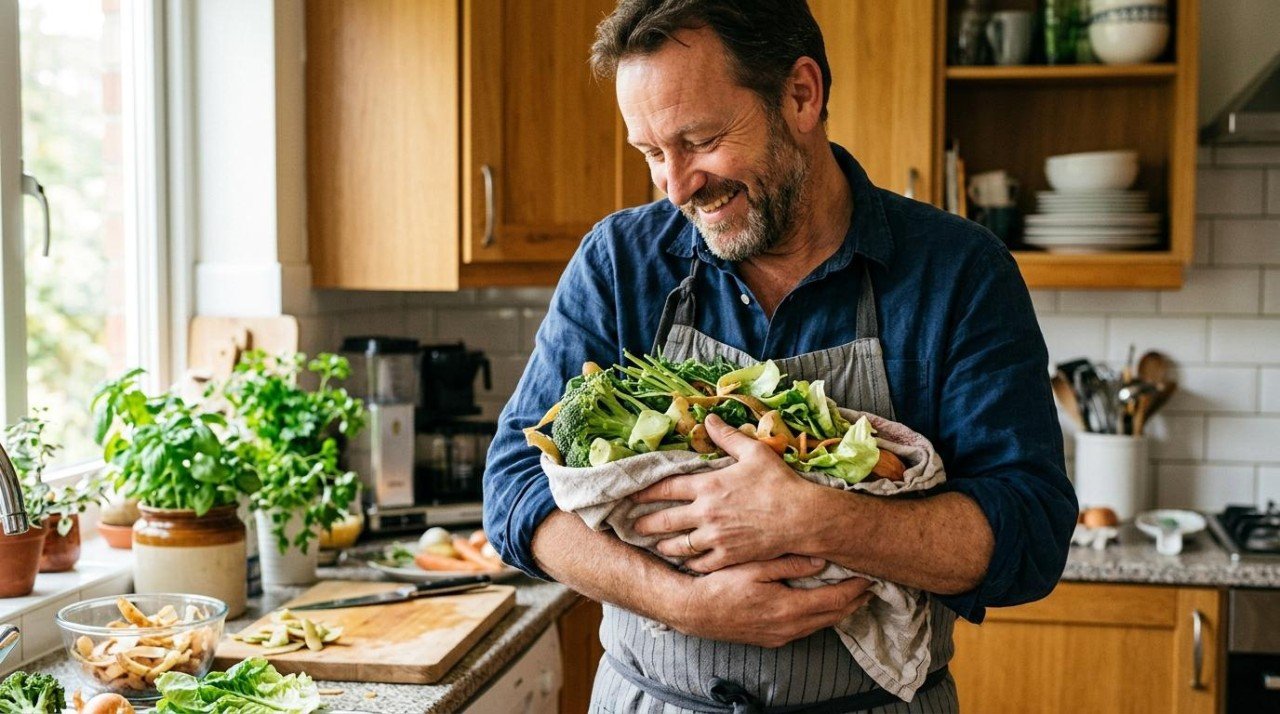
Set one big bowl on the counter for all your trimmings — onion skins, garlic peels, carrot ends, packaging. Instead of walking to the trash a dozen times or letting scraps creep across your workspace, everything goes in one place and gets dumped once. It sounds trivial. It's the difference between a clear board and a cluttered one, and a clear board is a calm board. (Bonus: a collected pile of vegetable scraps is exactly what you'd freeze for homemade stock later.)
5. Clean as you go
Wipe the board, rinse the knife, and wash or stack bowls in the lulls while something simmers. This is one of the core mise en place habits, and it does more than keep you tidy — it's a food-safety practice. The CDC's four steps to food safety (clean, separate, cook, chill) call for washing utensils, cutting boards, and countertops with hot, soapy water after preparing each food item, and using one board for raw meat, poultry, or seafood and a separate one for produce and ready-to-eat foods. Cleaning as you go is how you actually pull that off in real time instead of facing a contaminated jumble at the end.
6. Group like tasks
If three vegetables all need dicing, dice them in one go rather than switching to the stove and back. Batching similar movements keeps you in one mode instead of paying that switching cost over and over. Prep is the time for prep; cooking is the time for cooking. Keeping them separate is the whole point.
The Real Advantage: Everything's Already in the Kitchen
Here's the honest catch with mise en place: it only helps if the ingredients are actually in your house. The most beautifully organized prep session in the world falls apart the moment you open the fridge and discover you're missing half the recipe. For a lot of home cooks, the real chaos starts long before the stove — it starts at 6 p.m. with no plan, no clear idea of what's for dinner, and a fridge full of odds and ends that don't add up to a meal.
That's exactly the gap a little planning closes. When your week is mapped out and your shopping is done, mise en place becomes the only step left between you and dinner — a calm ten minutes of setup, not a scramble that starts with "what do we even have?"
This is where Eat Well Planner earns its keep. You build a weekly meal plan from recipes you actually want to cook — import them from any website, an Instagram reel, or a YouTube video, and the app pulls out the ingredients and instructions for you. From that plan it generates an organized shopping list automatically, so everything a recipe calls for is on hand before the week even starts. By the time you're standing at the counter, there are no surprises left to derail you: the plan is made, the food is bought, and all that's left is the satisfying part — laying out your mise en place and cooking.
Take the Guesswork Out of Eating Well
Eat Well Planner helps you organize your favorite recipes, plan balanced meals, and automatically generate shopping lists — all in one place. Whether you're tracking macros, managing dietary restrictions, or just trying to stop asking "what's for dinner?", we've got you covered.
Our AI-powered tools can adapt any recipe to your dietary needs, help you discover new meals you'll love, and even log your nutrition effortlessly. It's meal planning made simple.
Start Organizing Your Meals — Free"But Doesn't It Dirty More Dishes?"
This is the number-one objection, and it's fair: yes, prepping into separate bowls creates a few more things to wash. But look at what you're comparing it to. Without mise en place, you're not avoiding the mess — you're just spreading it across the whole cooking process, dirtying the same knives and boards repeatedly, wiping up spills you made in a hurry, and often scrubbing a scorched pan because something burned while you weren't looking.
The extra bowls are small, they're easy to rinse, and clean-as-you-go handles most of them before you even sit down. What you get in exchange is real: fewer burned ingredients, fewer forgotten steps, fewer trips to the trash, and a dramatically calmer twenty minutes at the stove. Plenty of cooks find they actually wash less overall, because they're not re-doing work or rescuing disasters. Even if the dish count ticks up slightly, trading a few rinsed prep bowls for a meal that doesn't stress you out is a bargain.
Putting It Together: A Weeknight Stir-Fry
Let's walk through a typical fast weeknight recipe — a vegetable and chicken stir-fry — the mise en place way, because stir-fries are exactly the kind of dish that punishes you for being unprepared. Once the pan is hot, everything happens in about five minutes, with no time to chop.
- Read it through. You notice the recipe wants the chicken sliced thin, a quick sauce whisked together, and the vegetables added in a specific order. Good to know before the wok is smoking.
- Gather. Chicken, broccoli, bell pepper, garlic, ginger, scallions, soy sauce, cornstarch, sesame oil, rice, and your neutral cooking oil all come out to the counter. You confirm you have everything now, calmly.
- Prep into bowls. Slice the chicken (its own plate — raw meat stays separate). Cut the broccoli and pepper into one bowl since they go in together. Mince the garlic and ginger into a small dish with the scallions. Whisk the soy sauce, a little water, and the cornstarch into a measuring cup so the sauce is ready to pour.
- Scrap bowl. All the trimmings go in one bowl as you work. The board stays clear.
- Cook — finally the easy part. Now the pan gets hot. Oil in, chicken in, then the aromatics, then the vegetables, then the sauce, each one already waiting in its bowl. You add, you stir, you watch. Nothing burns because you're never turning away to chop. Dinner comes together in the five focused minutes it's supposed to take.
The cooking itself didn't change. What changed is that all the frantic parts got moved to the front, into a stretch of time when nothing is on fire and you can think.
It's Not Just Faster — It Feels Better
There's a reason chefs describe mise en place almost reverently, and it's not only about efficiency. Working from an organized setup changes the emotional experience of cooking. Instead of reacting to one small crisis after another, you're moving through a sequence you're in control of. That's the difference between cooking as a stressor and cooking as something that can actually settle you.
Research backs up how much the feeling matters. In a controlled trial of 657 adults published in the journal Frontiers in Nutrition, a seven-week cooking program significantly boosted participants' cooking confidence and, alongside it, measures of mental wellbeing, self-esteem, and vitality — benefits that were still present six months later. Notably, the program didn't magically overhaul what people ate; what it reliably changed was how capable and at ease they felt in the kitchen. Confidence, it turns out, is a learnable skill, and structure is how you build it. Mise en place is that structure in its simplest, most repeatable form.
If cooking currently feels chaotic and stressful, you don't need more talent or more time. You need ten quiet minutes at the start, a few bowls, and the discipline to prep before you turn on the heat. Do it a handful of times and it stops feeling like an extra chore and starts feeling like the moment the meal becomes doable. The garlic stops burning. The panic stops coming. And dinner, quietly, becomes calm.
Want the setup to be the only thing standing between you and dinner? Plan your week with Eat Well Planner — save the recipes you love, build a meal plan, and let it generate your shopping list so everything's already on hand when it's time to cook.